The 2026-27 NBA season is only a few games old, which is exactly the point at which rookie-card markets become most entertaining and most dangerous. A single 30-point night can produce a wave of attention. A player receiving 30-plus minutes after barely seeing the floor can change the conversation just as quickly. And an injury absence can leave a highly regarded prospect’s cards trading on expectation rather than NBA evidence.
The first week has supplied all of those storylines. Golden State’s Yaxel Lendeborg has captured the loudest early spotlight, Cameron Boozer has posted the class’s most rounded production, Caleb Wilson has supplied the scoring fireworks, and several less expensive names have created intriguing—if highly uncertain—paths for collectors.
For a practical rookie-card approach, the key is not treating an opening-week box score as a final verdict. Prospecting, in card-collecting terms, means buying early in the belief that a player’s reputation, role or performance will improve. It carries real risk: the evidence here generally spans only two or three NBA games. The more useful question is whether a player has shown a repeatable opportunity, whether the card already reflects the hype, and whether the collector actually wants to own the card if the market cools.
Yaxel Lendeborg has the attention advantage
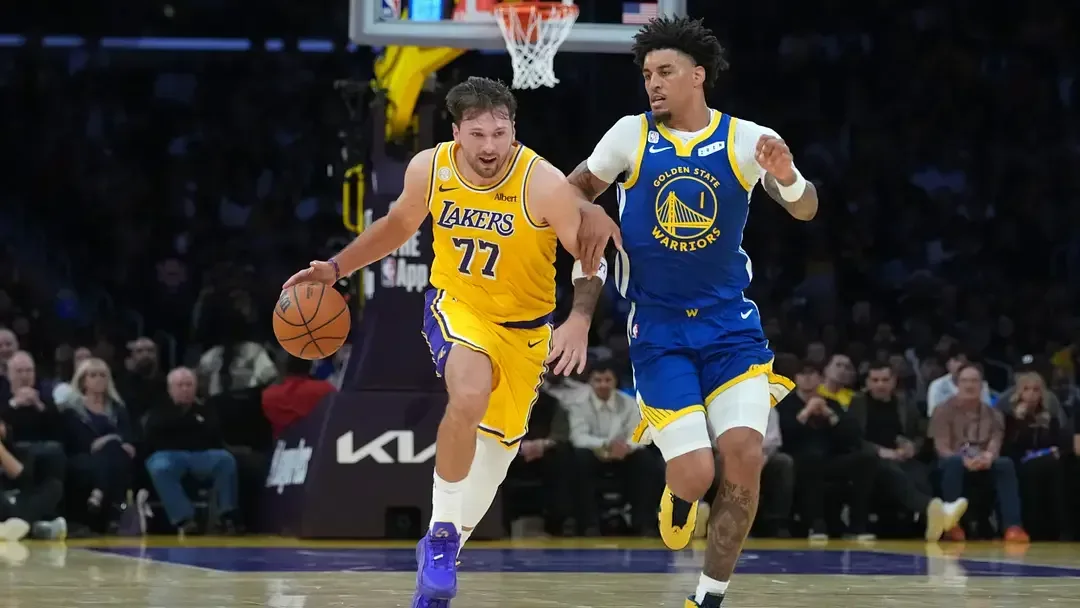
Lendeborg stands apart as the rookie with the strongest opening-week momentum. His NBA debut against the Lakers included a testy exchange with Luka Dončić, an episode that gave social media an immediate narrative beyond the stat sheet. The important follow-up is that his next two outings offered production to go with the visibility.
Against Memphis, Lendeborg recorded 18 points and 13 rebounds for a double-double. He followed that with 26 points and nine rebounds against Phoenix, coming within one rebound of another double-double. Those are substantial early returns for a player attempting to establish himself in Golden State’s rotation, and they explain why attention has moved in his direction.
For collectors, attention is not the same thing as long-term value—but it can matter enormously in the short term. A memorable debut confrontation, two strong games and a clear role in the public conversation can create demand before a full body of work exists. Lendeborg’s appeal right now is the convergence of performance and personality: he has been noticed, then given people a reason to keep watching.
The caution is equally straightforward. Two productive games cannot establish a season-long level. The reasonable collectible thesis is not that his early line guarantees stardom; it is that Lendeborg has become one of the class’s most closely watched early stories.
Cameron Boozer’s all-around case has a major-card benchmark
Boozer, the No. 3 pick, has delivered the most complete statistical opening among the highlighted rookies: 16.0 points, 12.0 rebounds and 5.5 assists per game. His rebound and assist averages lead the rookie group, while his scoring remains inside the class’s top five. That blend matters because it provides more than one route to relevance. A rookie who scores, rebounds and creates for teammates does not need one narrow stat category to carry his case.
Related coverage includes 2026-27 NBA Rookie Card Report: Early Risers, Buy-Low Names and Week 1 Market Movers.
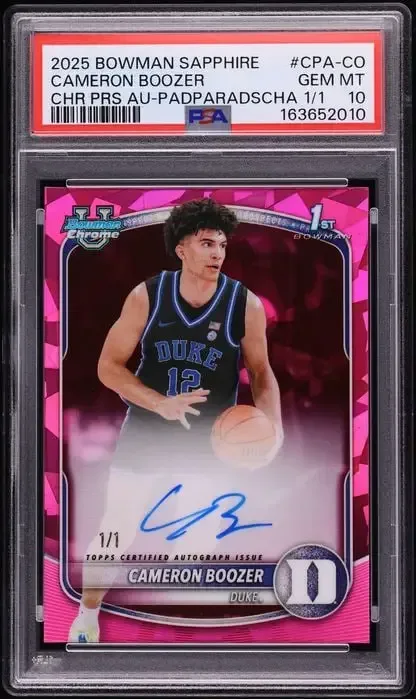
His high-end market has also produced a concrete early marker. A 2025 Bowman Chrome University Sapphire Padparadscha rookie autograph numbered 1/1 and graded PSA 10 sold for $18,300, described as his most valuable card sale to date. A 1/1 is a card with a stated print run of one, making it unique within that parallel. A parallel is a variation of a base design, usually distinguished by a color, finish, numbering or rarity. Add an autograph and a top PSA grade, and this particular card sits in a dramatically different market from a standard rookie issue.
That sale should not be used to price every Boozer card. It is a high-end result for a unique, autographed, PSA 10 example—not a universal comp for unnumbered cards, other parallels or raw copies. Still, it illustrates the difference between a player’s broad collecting market and the premium paid for a flagship rarity. Collectors seeking a Boozer position should identify which market they are actually entering: affordable base and lower-tier parallels, numbered cards, autographs, or elite one-of-one material.
For more perspective on how a one-of-one, player-linked card can create an entirely separate auction narrative, see this look at a Jackson Chourio 1/1 MLB Debut Patch Auto. The sports differ, but the basic collecting lesson is similar: rarity and card construction can matter as much as the name on the front.
Caleb Wilson and Darius Acuff Jr. bring the scoring headlines
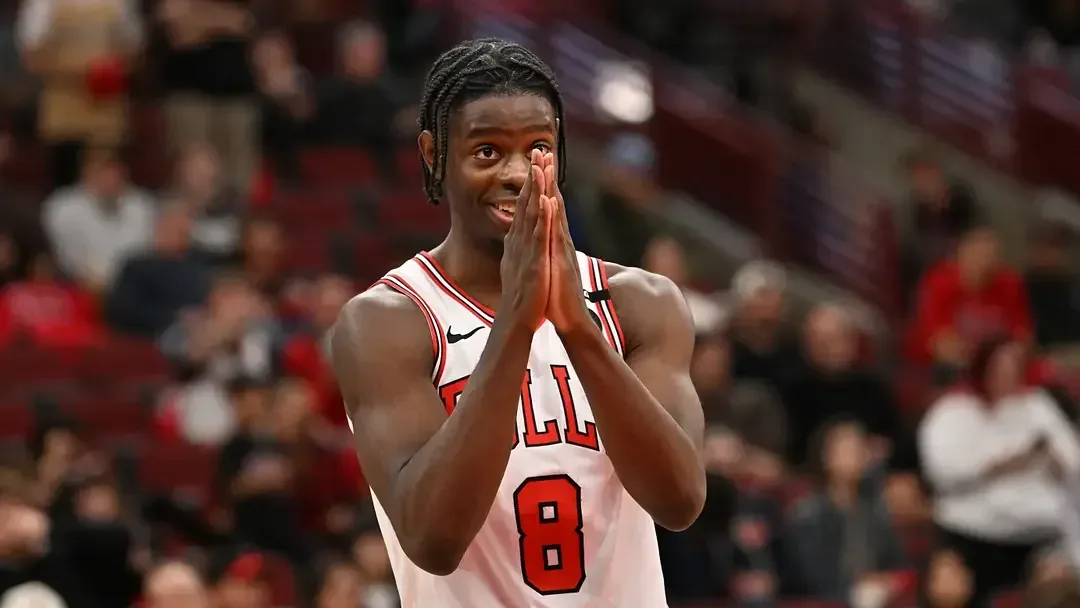
Chicago’s Caleb Wilson has supplied the most forceful pure-scoring argument among the prominent early risers. He is averaging 22.3 points per game and has already crossed the 30-point threshold against Washington. In that same contest, he added 14 rebounds for his first double-double. The opening numbers put Wilson just behind Darius Acuff Jr.’s 22.5-point rookie-leading average.
Wilson’s early appeal is easy to understand. Scoring translates quickly to highlight clips, fantasy conversation and casual collector interest. The 30-point game also gives buyers an identifiable early milestone. But collectors should separate a great night from the type of role that sustains a market over months. The supplied results show Wilson’s scoring power; they do not yet establish how often he will reach that volume or how his broader production will develop.
Acuff has been even more explosive in a single-game sense, scoring 33 points in his second NBA game—the highest one-game rookie total mentioned from the opening week. His efficiency has been a stated concern, yet the ability to put points on the board is not in doubt. That creates a familiar prospecting split: collectors can see the top-line output while also acknowledging that shot selection and conversion rate may determine whether that output remains durable.
Notably, Acuff’s most expensive cards had not sold after the season opener or during October, suggesting a calmer market than the one surrounding Boozer or Wilson. His larger cards were generally in the low-$1,000 range. Relative affordability does not make any card a safe buy, but it changes the equation. A collector who values early scoring upside may find Acuff’s market more approachable than the highest-end Boozer material, while accepting that the performance profile is less polished.
Trevon Brazile is the rebounding value case—on a very small sample
Denver’s Trevon Brazile is second among the rookies cited in rebounds at 10.5 per game, behind Boozer. The major qualification is unavoidable: the Nuggets had played only two games. Still, a second-round pick producing at that level is exactly the kind of development that can put a lower-profile player on collectors’ radar.
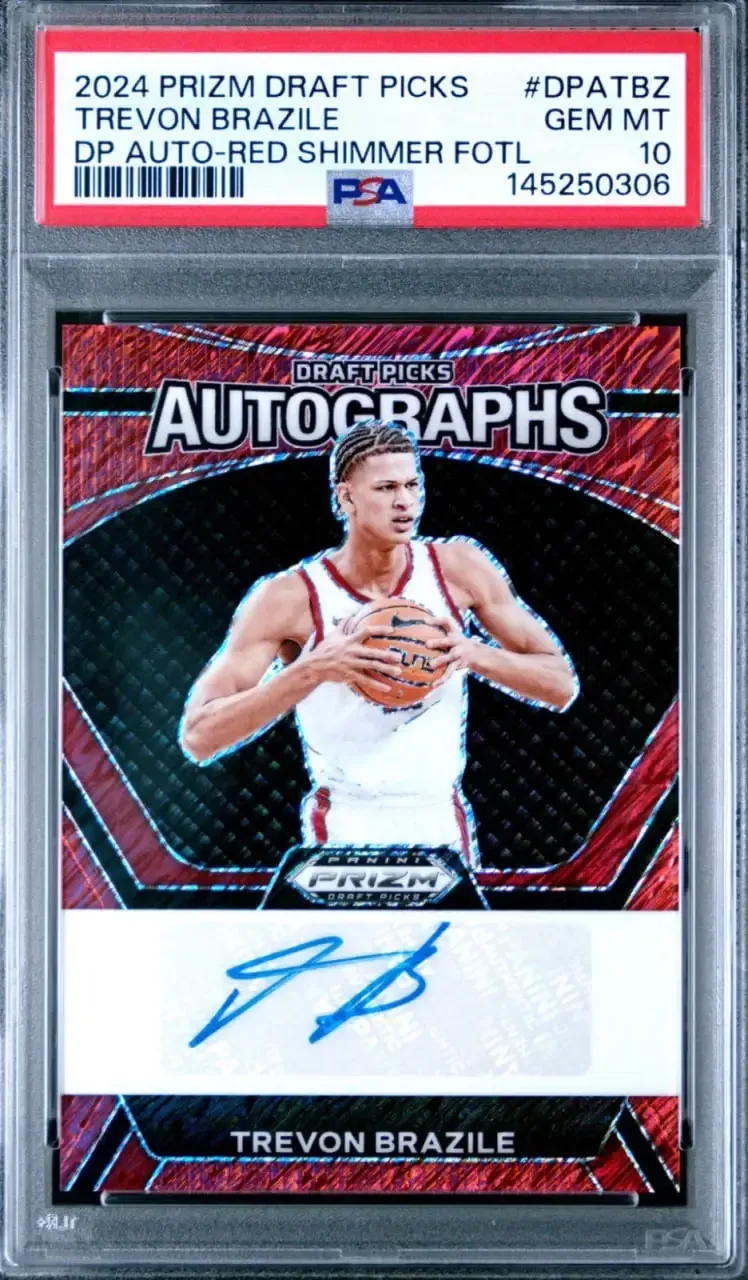
Brazile’s market is framed as comparatively affordable, a notable contrast with the attention surrounding the most celebrated draft picks. A 2024 Prizm Draft Picks Red Shimmer First Off The Line card numbered to 11 and graded PSA 10 sold for $600. FOTL, or First Off The Line, identifies product released through an early format that can contain exclusive parallels. Numbering the card to 11 limits the stated supply, while the PSA 10 grade designates it as gem mint on PSA’s scale.
The appeal is not a promise that Brazile will remain a double-digit rebounder. It is the combination of an early statistical specialty, a lower draft profile and a price point that is far removed from a five-figure unique Boozer sale. For collectors, this is the distinction between buying a well-established premium and buying a less expensive possibility.
Peterson and Wagler illustrate why draft position is not an instant card-market guarantee
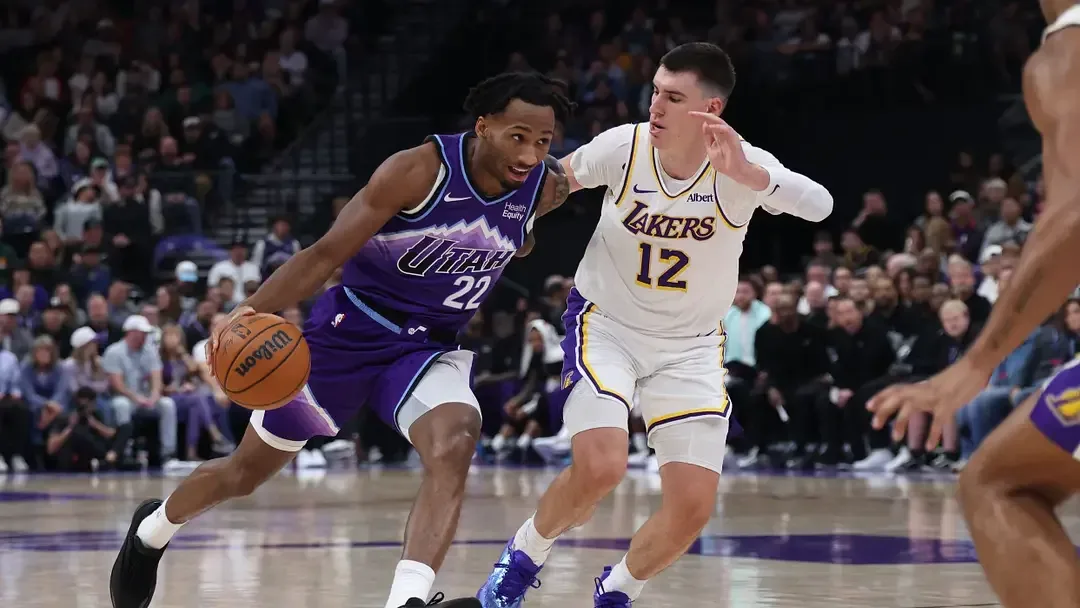
Utah’s Darryn Peterson entered the league as the No. 2 overall pick, but his first three games have not matched that billing. He is averaging 12.0 points, 3.5 rebounds and 2.0 assists. His lone double-figure scoring effort came in a win over New Orleans, while he struggled to move beyond single digits in losses to Memphis and the Lakers.
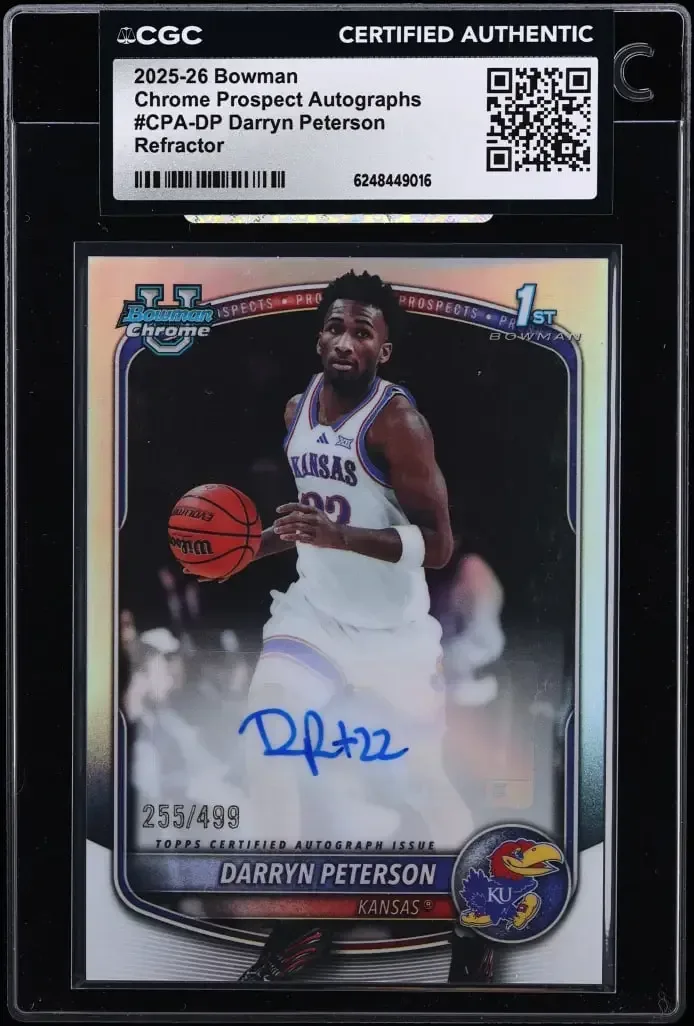
His early market has been described as stagnant. One 2025-26 Bowman Chrome University Refractor on-card autograph numbered to 499 sold for $126. An on-card autograph is signed directly on the card rather than on a separate sticker later applied to it. The /499 serial number means the edition is limited to 499 copies. It is not scarce in the way a 1/1 is scarce, but it is meaningfully more limited than a base card.
The gap between Peterson’s draft position and that sale result is a reminder that card prices react to immediate performance, expectations and available supply—not draft order alone. It may create a lower entry point, but lower price and undervalued price are not synonyms. Peterson needs more on-court evidence before either conclusion is secure.
Clippers rookie Keaton Wagler occupies a more neutral early space. A top-five pick, Wagler has been good without a signature statistic or performance dominating the conversation. His market has been quiet apart from his first autographed card, a 2026 Topps Now Draft Day 1st Auto 1/1 that sold for $7,750 two months earlier. That is another example of how unique debut-related cards can sit apart from a player’s normal market.
Minutes are the central variable for Sergio de Larrea and Brayden Burries
Dallas rookie Sergio de Larrea may offer the clearest proof that playing time can overwhelm an early stat average. He scored no points in seven minutes against Houston and in fewer than 60 seconds against Indiana. Against San Antonio, however, he received 33 minutes and responded with 21 points on 60% field-goal shooting.
That does not settle de Larrea’s outlook. It does show why raw averages from uneven minutes require context. A player cannot accumulate counting stats without court time, and a single larger role can reveal a capability that sparse appearances conceal. The relevant monitoring point is whether the 33-minute opportunity becomes a pattern rather than an outlier.
Brayden Burries has a similar minutes-driven case. He posted 12 points and five rebounds in 16 minutes against Washington, then 10 points and five rebounds in 17 minutes against Philadelphia. Those lines are promising because they arrived in limited action, but they still require restraint. Limited minutes can make per-minute production look tantalizing; they do not guarantee a larger rotation role will follow.
Both players are characterized as affordable relative to the bigger rookie names. That makes them sensible candidates for collectors who enjoy following role growth rather than paying a premium for established early hype. It also makes checking the exact card essential. “Affordable” can mean very different things for a base rookie, a numbered parallel, an autograph, or a graded low-print card.
AJ Dybantsa remains a market built on expectation
AJ Dybantsa has not played in the regular season because of an ankle sprain, making him a distinct case from every rookie above. The early injury is not described as something expected to keep him out for an extended period, and his card market has remained strong despite the absence of professional-game results.
That resilience is both the attraction and the risk. Dybantsa’s supporters are buying into his prospect status before there is a first-week NBA sample to analyze. Collectors concerned about health will see the missed games as an immediate reminder that injuries can change the timing and tone of a rookie market.
His 2025 Bowman Chrome Superfractor rookie 1/1, graded PSA 8, highlights how even a unique card can command attention without NBA production. A Superfractor is a highly scarce parallel designation, and in this case the card is a one-of-one. Yet the core decision remains bigger than rarity: buyers must decide whether they are comfortable paying for future belief while the player is sidelined.
The opening week has not crowned a definitive best rookie-card buy. It has, however, divided the class into useful collector stories: Lendeborg has momentum, Boozer has broad production and a major high-end comp, Wilson and Acuff have scoring-driven cases, Brazile offers a lower-profile rebounding angle, Peterson and Wagler need stronger catalysts, de Larrea and Burries need sustained minutes, and Dybantsa remains a bet on potential. That is plenty of information for a first week—just not enough to confuse excitement with certainty.