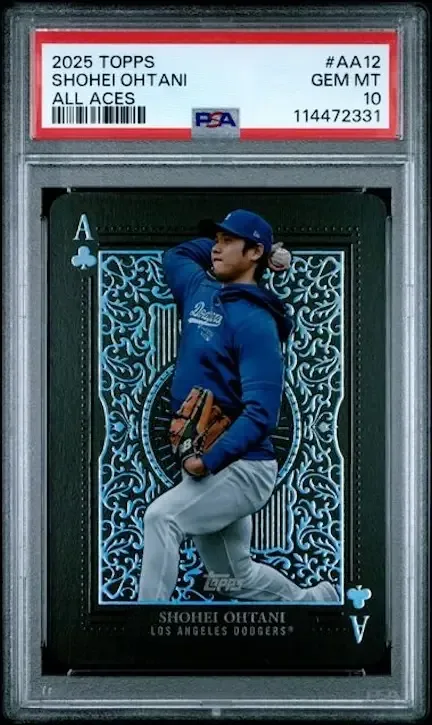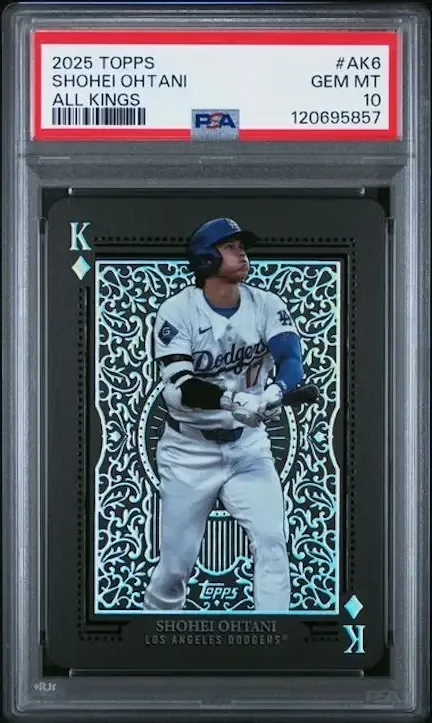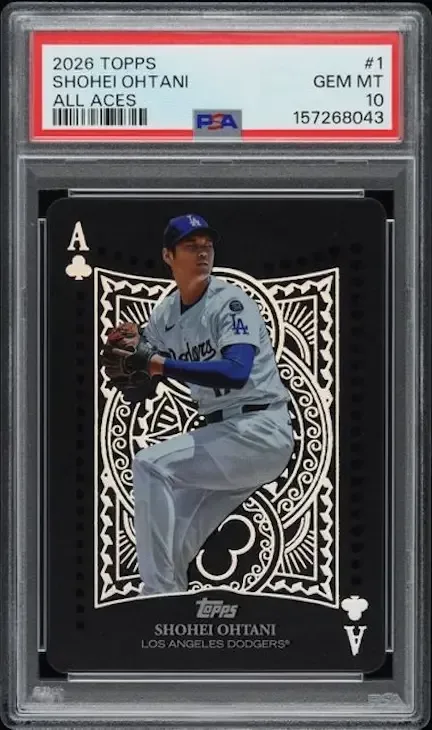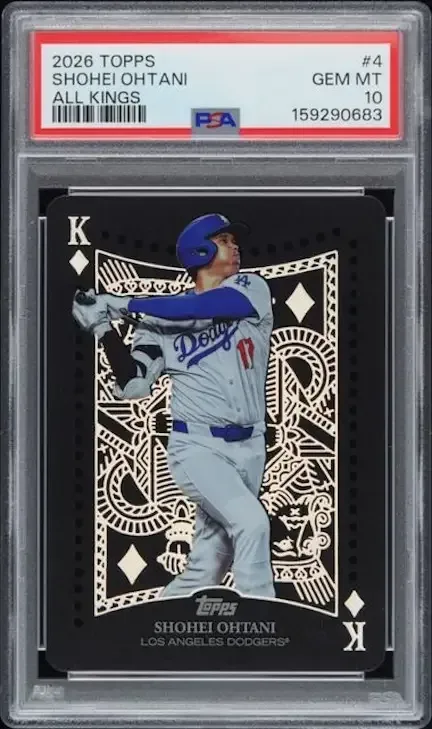
Shohei Ohtani has a rare built-in advantage in the trading-card market: one player can credibly anchor both a pitching-themed insert and a hitting-themed insert. That makes his Topps All Aces and All Kings cards an unusually clean way to examine how scarcity, player identity and condition influence high-end modern baseball-card prices.
The recent headline sales are striking. A PSA 10 copy of Ohtani’s 2025 Topps All Aces Super Short Print, or SSP, reached $10,036 on April 2, 2026. A PSA 10 2025 Topps All Kings SSP then recorded a high sale of $43,200 on August 30. For the following year’s cards, the reported PSA 10 highs were $33,000 for 2026 All Aces on May 14 and $48,000 for 2026 All Kings on August 8.
Those figures do not establish a fixed value for every copy, nor do they guarantee what the next card will sell for. They are individual high-sale results, and high-grade modern SSPs are a thin market by nature. Still, the four sales offer a revealing snapshot: the visual theme matters, the card’s stated pull rate matters, and the answer is not as simple as “the rarer card always sells for more.”
From accessible insert to ultra-rare chase
Topps introduced All Aces in 2023 Topps Series 2. At that stage, it was an insert with stated odds of one per 32 packs. That is still a chase, but it is fundamentally different from a card designed as an SSP. Early in 2025, cards from the insert were reportedly selling in roughly the $10 to $20 range raw, before climbing to about $300 raw and approximately $1,000 in PSA 10.
For more context, explore RuneScape: Dragonwilds Says Its Switch 2 Looks Need a Spellbook of Fixes.
In 2025 Topps Series 1, All Aces became an SSP and was joined by All Kings, a companion insert focused on hitters. The change created a much more useful collector comparison around Ohtani because he appears in both concepts. He is not merely a famous pitcher included in a pitching set or a great hitter slotted into a hitting set; his career is defined by performing both jobs.
SSP means Super Short Print, a label collectors use for cards intentionally produced in extremely limited quantities relative to a set’s regular cards. The provided pull odds quantify the difficulty at the pack level, although pack odds are not a confirmed total print run. An odds line tells collectors how often a card is expected to appear in the specified kind of pack; it does not, by itself, reveal how many packs were made or how many copies ultimately exist.
That distinction is practical. A stated rate of one in 1,167 hobby packs for the 2025 Ohtani All Aces SSP is very scarce. One in 9,235 hobby packs for the 2025 All Kings SSP is scarcer still. But neither number alone proves a precise population or a permanent price hierarchy. Demand, the number of surviving copies submitted for grading, and the number of collectors pursuing the card all remain consequential.
Related coverage includes Shohei Ohtani Topps All Aces and All Kings Values Surge.
Ohtani makes the Aces-versus-Kings comparison unusually compelling
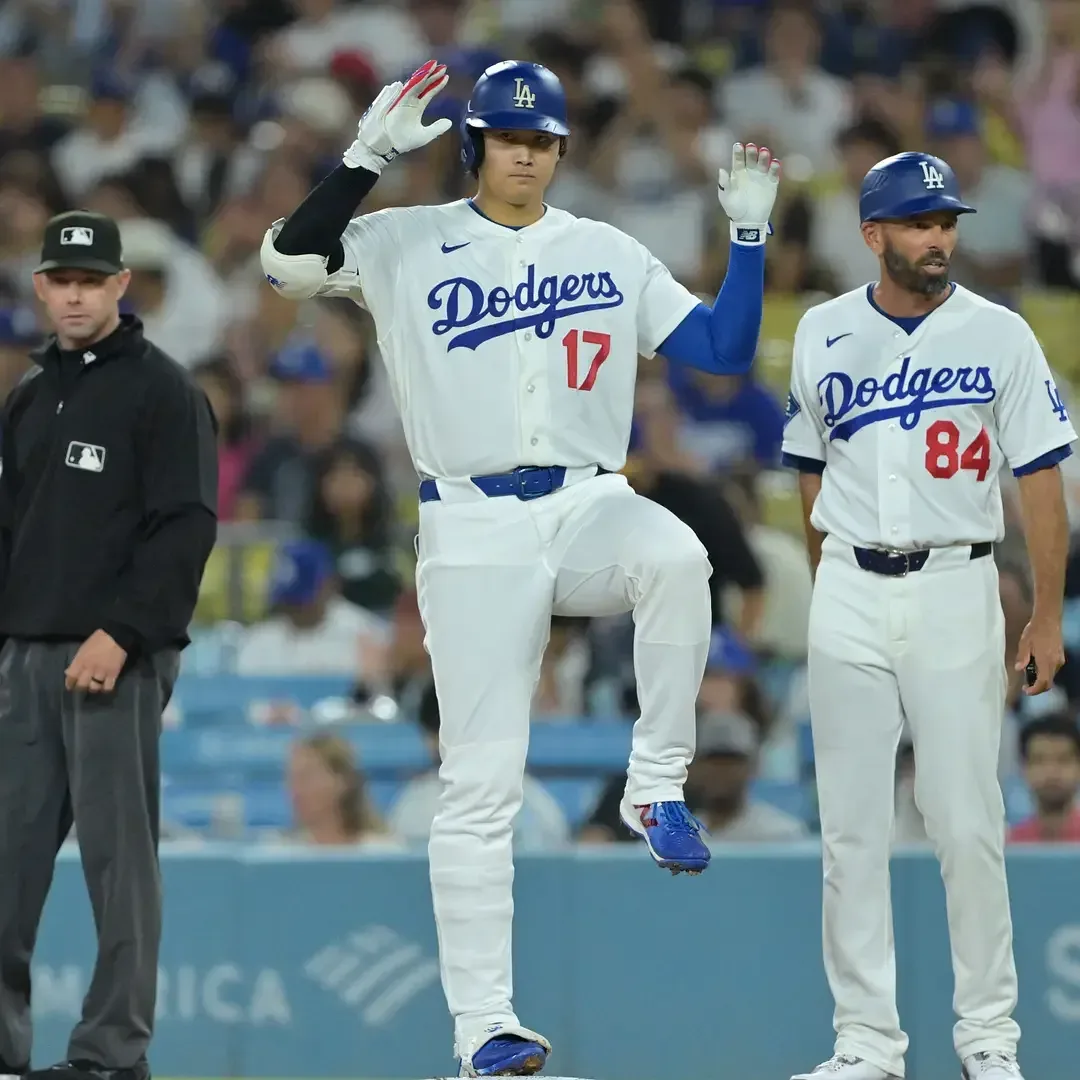
Ohtani entered Major League Baseball from Nippon Professional Baseball in 2018 and immediately established himself as a two-way player with the Angels. His rookie season included 22 home runs and a 4-2 record over 10 pitching starts, and he won Rookie of the Year. He later joined the Dodgers after free agency.
For collectors, the important point is not just that Ohtani has been excellent. It is that both insert identities can be tied to real accomplishments. His pitching résumé includes a 15-9 record in 2022 and a fourth-place finish in Cy Young voting. His hitting résumé includes four MVP awards—two with the Angels and two with the Dodgers—and a 50-home-run, 50-stolen-base season, a feat described here as unique.
That two-way context makes neither insert feel like an arbitrary alternate version. All Aces speaks to the pitching side of Ohtani’s appeal, while All Kings channels the offensive side. The designs and imagery can matter, too. The 2025 All Aces card shows Ohtani warming up in a Dodgers hoodie, giving the card a distinctly pitcher-centered presentation even though it is not an in-game action image.
It also helps explain why collectors should resist reducing the comparison to a battle of generic insert brands. With another player, a hitters-versus-pitchers split could be driven mostly by set construction. With Ohtani, it reflects two genuinely marketable parts of the same athlete’s legacy.
The 2025 results: All Kings carried the larger premium
The 2025 cards provide the sharpest scarcity contrast. Ohtani’s All Aces SSP had reported hobby-pack odds of one in 1,167. Its PSA 10 high sale of $10,036 is substantial, particularly for a modern insert rather than a conventional rookie-card format.
The 2025 All Kings SSP was stated at one in 9,235 hobby packs—nearly eight times less frequent by the listed odds. Its PSA 10 high sale of $43,200 was more than four times the reported high for the 2025 All Aces PSA 10.
That relationship is directionally unsurprising. A much more difficult pull can command a larger premium when the player and grade are comparable. Yet it is not a mechanical equation. The sale-price gap is smaller than the gap suggested by the raw odds. That is a reminder that rarity has to meet demand rather than replacing it. Ohtani’s All Aces identity remains compelling enough that a 1-in-1,167 hobby-pack card still achieved a five-figure top sale in PSA 10.
There is another limitation worth keeping in mind: comparisons between high sales are not controlled experiments. The buyers may have had different budgets and goals, cards may have presented differently in their listings, and the sales occurred on separate dates. The numbers are evidence of what specific PSA 10 copies achieved, not a formula guaranteeing that every All Kings copy will outperform every All Aces copy.
2026 complicates the simple rarity argument
The following year’s odds reverse the scarcity order. The 2026 Ohtani All Aces SSP was listed at one in 13,836 hobby packs, while the 2026 All Kings SSP retained stated odds of one in 9,235 hobby packs. On pack odds alone, 2026 All Aces is the more difficult pull.
Its PSA 10 high sale was $33,000. That is more than three times the reported high for the 2025 All Aces PSA 10, consistent with the considerable increase in stated difficulty from one in 1,167 to one in 13,836 hobby packs. It is a meaningful data point for collectors who believe the shift to a substantially tougher chase elevated the 2026 Aces card.
But the 2026 All Kings PSA 10 still posted the larger reported high sale, at $48,000. In other words, All Kings held the higher high-sale mark even in the year when All Aces had the lower stated pull frequency.
This does not prove that the All Kings brand is categorically more valuable than All Aces in every scenario. It does show that stated odds do not tell the complete story. Ohtani’s offensive accomplishments may carry exceptional appeal, and collectors may simply favor the All Kings concept or that particular card’s presentation. The available results cannot isolate which factor mattered most. What they can show is that the 2026 comparison refuses to behave like a pure scarcity spreadsheet.
Why PSA 10 is central to these numbers
Every headline sale in this comparison is for a PSA 10. PSA is a grading service, and a 10 is its top numerical grade. Grading assesses a card’s condition, including elements such as centering, corners, edges and surface. For modern cards, where collectors can see many copies of the same player and design, the difference between an ungraded card and a top-graded example can be especially important.
That means these sales should not be used to price raw copies or lower-graded copies as though they are interchangeable. A raw card has not received an authenticated condition grade, while a PSA 10 has crossed a key threshold for collectors who prioritize the best available presentation. A card can be rare and desirable yet still trade far below a PSA 10 if its condition is not comparable.
Collectors evaluating a purchase should therefore separate three questions:
- Which card is being compared? Year, insert name and SSP designation all need to match.
- What condition is being compared? PSA 10 highs are not raw-card benchmarks.
- What does the sale actually represent? A top result is evidence of demand at one moment, not an assured floor or future resale figure.
What the four sales say—and what they do not
The clearest takeaway is that Ohtani’s two-way profile gives both lines a powerful narrative foundation. The All Aces cards are not an afterthought in a market that prefers hitters: the 2025 and 2026 PSA 10 high sales, $10,036 and $33,000, respectively, show serious demand. At the same time, All Kings produced the highest reported PSA 10 result in both years: $43,200 in 2025 and $48,000 in 2026.
The other clear takeaway is that Topps’ changing odds reshaped the chase. Moving All Aces from its earlier 1-in-32-pack format to an SSP format transformed the card’s scarcity proposition. Within the SSP era, the 2026 All Aces odds became dramatically tougher than the 2025 version, and the top PSA 10 sale climbed accordingly.
What remains uncertain is how durable any price relationship will be. The supplied figures identify high sales, not average prices, population counts, or a full sequence of transactions. They cannot establish whether demand is increasing across every grade or whether the next sale will match these levels. Serious collectors should treat the results as notable market signals rather than a guarantee.
Still, the Ohtani Aces-and-Kings chase has something many modern insert debates lack: a player whose on-field identity genuinely fits both sides of the comparison. That makes the cards more than parallel rarities. They are competing high-end expressions of the same extraordinary baseball résumé, with scarcity helping set the stakes and collector preference deciding how far each version can run.