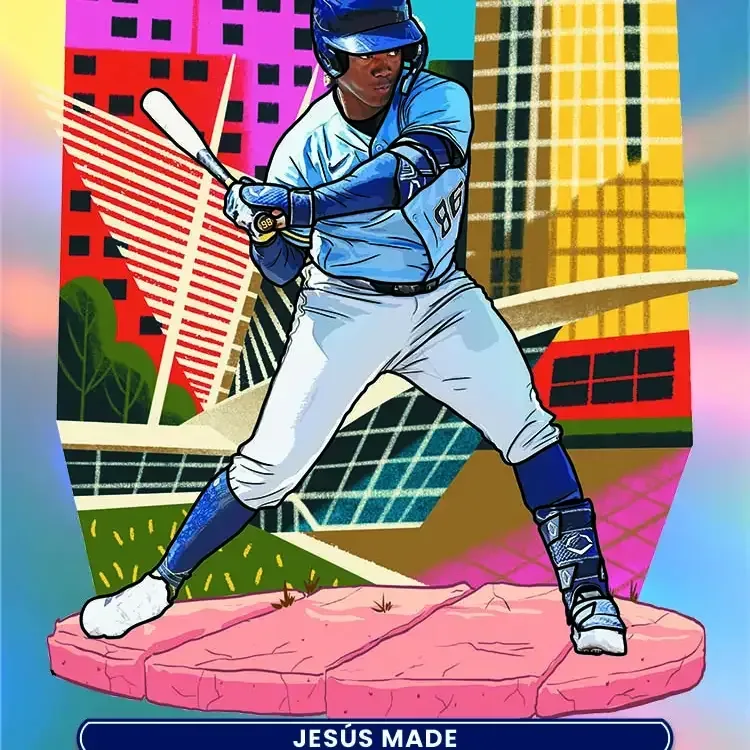
Panini is expanding its baseball-card lineup through a new non-exclusive, multiyear agreement with MLB Players, Inc., the business arm of the Major League Baseball Players Association. The deal covers active Minor League Baseball players and gives Panini a clearer route to build products around prospects and baseball players still on the path to the majors.
The company plans to include eligible MiLB players in up to 12 products a year, alongside collegiate and retired players. Its first named release under the expanded arrangement is Panini Three and Two Baseball, scheduled to begin in November. Donruss Elite Extra Edition and Prizm Baseball are among the brands identified as potential homes for Minor League cards.
What the agreement actually covers
This is a player-rights agreement, not an official MLB trading-card license. That distinction matters in a hobby where collectors routinely encounter several kinds of licensing on the same card aisle.
Player rights generally concern the ability to use an athlete’s name and likeness. In this case, Panini’s agreement with MLB Players, Inc. permits it to produce cards focused on active Minor League players. League licensing, by contrast, is associated with official MLB branding and is held by Topps in the baseball-card market described here.
In practical terms, Panini can now pursue more complete prospect-centered checklists—lists of the players included in a card release—across its established baseball brands. But collectors should not read the deal as a change in Topps’ official MLB license status. The two arrangements address different rights, and Panini’s new partnership is explicitly non-exclusive.
“Having Minor League players within the scope of this agreement creates significant depth across Panini’s baseball portfolio,” Panini America CEO Mark Warsop said. He added that Panini intends to distinguish releases across its annual lineup while giving fans more ways to connect with future stars.
Why prospect cards are central to the plan
Prospect cards occupy a distinct part of baseball collecting. Rather than documenting an established major-league career, they let collectors follow a player before that player reaches the sport’s highest level. The appeal is straightforward: a Minor Leaguer may become an important big-league name, or may not. That uncertainty is part of both the excitement and the risk.
The agreement provides Panini with a deeper pool of active players for this kind of release. Instead of leaning only on collegiate athletes and retired names, the company can place active Minor Leaguers into prospect-oriented sets. That should give individual products different identities within the same annual slate: one release can lean more heavily into prospects, while another can combine prospects with collegiate and retired-player content.
Related coverage includes Panini Lands New Minor League Baseball Card Deal Focused on Prospects.
That is especially relevant for collectors who organize purchases around player development rather than solely around current MLB rosters. A prospect-focused checklist allows a collector to search for an athlete earlier in their professional story, track appearances across brands, and decide whether a particular product’s player selection fits their collection.
It does not, however, guarantee that every highly regarded prospect will appear in every product. The announcement establishes the rights framework and identifies products that can use Minor League players; exact checklists, card designs, insert programs, autograph content and parallel details remain matters for individual product information.
What collectors should watch for
The headline number—up to 12 products per year—signals volume, but it is not a promise of 12 identical prospect releases. Collectors will need to assess each product on its own terms when checklist information is available.
- Checklist composition: Look at how many active Minor Leaguers appear and whether a release is primarily prospect-driven or mixes prospects with collegiate and retired players.
- Brand role: Donruss Elite Extra Edition, Prizm Baseball and Three and Two Baseball may approach the same player pool differently. A familiar brand name does not automatically mean the same kind of checklist.
- Rights and branding: The player-rights deal broadens Panini’s access to MiLB talent, while Topps remains the holder of the official MLB trading-card license. Collectors who prioritize league branding should keep that distinction in mind.
- Individual player availability: The deal concerns active MiLB players broadly, but a collector seeking one prospect should wait for the relevant set checklist rather than assume inclusion.
Those points are useful whether someone collects singles or sealed products. For singles collectors, a published checklist can clarify which brand and release offers a desired player. For sealed-product buyers, the checklist is the clearest starting point for judging whether the prospect mix matches their goals. The presence of active Minor Leaguers adds depth; it does not eliminate the need to evaluate each product’s contents separately.
More competition around the road to the majors
Panini’s expanded access arrives while prospects remain a major point of interest in sports cards. A player’s first appearances in prominent products can attract attention well before a major-league debut, making the minor-league and collegiate pipeline important territory for manufacturers.
The arrangement also gives Panini a way to add continuity to its baseball offerings. A collector may encounter a player in a prospect release, then continue following that player’s career elsewhere in the hobby. Panini’s stated objective is to offer collectors a connection to “the future stars of the sport,” and the active-MiLB access is the mechanism intended to make that possible across more of its lineup.
For hobbyists accustomed to rookie-card discussions, it is worth keeping the categories separate. A prospect card is a card of a player before an established MLB career; a rookie card is a different designation that collectors often use for early major-league-era cards. The announcement is about Minor League player rights and prospect depth, not a redefinition of rookie-card status. For a different view of how early-career cards shape current hobby attention, see Joking Joystick’s NFL rookie card watch.
November is the first scheduled checkpoint
Panini Three and Two Baseball is the first product specifically identified to launch under the new plan, with a November start. Beyond that, the company has named Donruss Elite Extra Edition and Prizm Baseball as brands that can feature Minor League talent, and has said it may produce up to 12 products annually with MiLB players alongside collegiate and retired athletes.
The most meaningful next details for collectors will be product-specific: which prospects are included, how prominently active Minor Leaguers feature, and how Panini differentiates each release. Until those checklists arrive, the agreement is best understood as a meaningful expansion of Panini’s prospect-card toolset rather than a full preview of every card it will make.
MLB Players, Inc. president Evan Kaplan said the partnership builds on the longstanding relationship between baseball fans and player cards, now with greater attention on favorite Minor Leaguers, top prospects and players who may become the sport’s next generation of stars. For Panini, that creates more room to build baseball products around the players collectors are watching before the major-league spotlight arrives.