A raw 1983 Topps baseball rookie can be a relatively inexpensive piece of cardboard. A PSA 10 example can be an entirely different kind of collectible.
That contrast is the central lesson in four notable 1983 Topps rookie cards: Tony Gwynn #482, Ryne Sandberg #83, Wade Boggs #498 and John Stuper #363. Three are immediately recognizable baseball names; the fourth is far less familiar. Yet each has an instructive place in the set because the available grade populations and recorded high sales show that collector attention is not determined by player stature alone. It is shaped by the intersection of player demand, condition, supply at each grade and the willingness of buyers to compete for exceptionally preserved copies.
For collectors, this is not a promise that every old card will become expensive after grading. It is a much more specific point: the label matters most when the card, the grade and the population combine to create a version that buyers see as difficult to replace.
What PSA 10 means — and why it changes the discussion
PSA is a third-party card grading company. Its numerical grade is intended to communicate a card’s physical condition, with PSA 10 serving as its top regular grade. In practical collecting terms, a card in a PSA holder at a 10 is no longer evaluated only as a player collectible or set card. It is also evaluated as a high-grade specimen.
That distinction is particularly important for mass-produced-era cards. A raw card may be easy to find, affordable and perfectly suitable for a binder, team collection or set build. But an old card surviving in condition good enough to receive a 10 is a narrower target. Centering, corner quality, edges and surface condition can all matter to the final grade. The supplied population figures make that narrowing visible.
Population, often shortened to “pop,” refers to the number of copies a grading company has assigned a given grade. It is useful evidence, but it needs careful interpretation. A low PSA 10 population does not automatically mean a card is valuable, because buyers still have to want it. Conversely, an iconic player can create strong demand even when hundreds of PSA 10s exist. Pop data is best read beside player interest and actual sales rather than used as a standalone price forecast.
The four cards below offer four different versions of that equation.
Tony Gwynn #482: the headline rookie
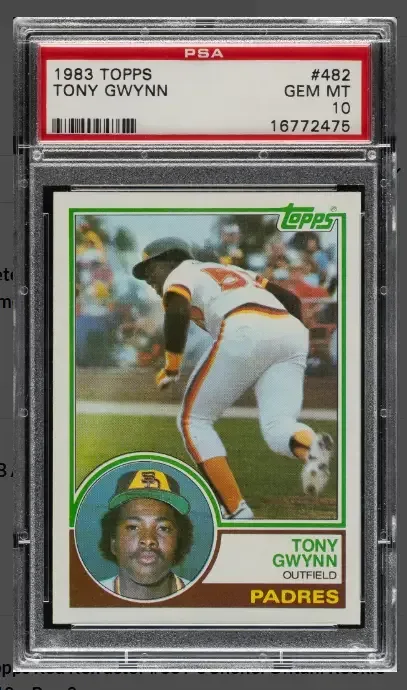
Tony Gwynn’s 1983 Topps rookie, card #482, is the clearest example of a prominent player card where a raw copy and a top-graded copy operate in different value tiers. Raw examples generally sell for about $15 to $25. That is an approachable entry point for a collector who wants the card itself without making condition perfection the goal.
Related coverage includes Four 1983 Topps PSA 10 Rookie Cards That Define the Set.
At PSA, the reported population is 753 copies graded 10, 6,657 graded 9 and 17,963 graded 8. Those figures show a broad graded supply overall, but a much smaller pool at the highest grade. Put another way, PSA 10s are not the only version of the card collectors can pursue, and that is exactly why the 10 occupies a separate premium lane.
The highest public sale cited for a PSA 10 is $9,225, recorded on April 19, 2016 through REA. A single high sale should never be mistaken for a current price guide or a guaranteed floor. It does, however, demonstrate the size of the premium that can emerge when a key rookie card meets the highest stated grade.
Gwynn is also a useful reminder that collectors should separate two questions: “Do I want this rookie card?” and “Do I want the best graded version of this rookie card?” The first can be answered with a raw card or a more attainable graded copy. The second requires accepting that the premium reflects condition scarcity as much as the card’s identity.
Ryne Sandberg #83: a different price ceiling, a similar grade story
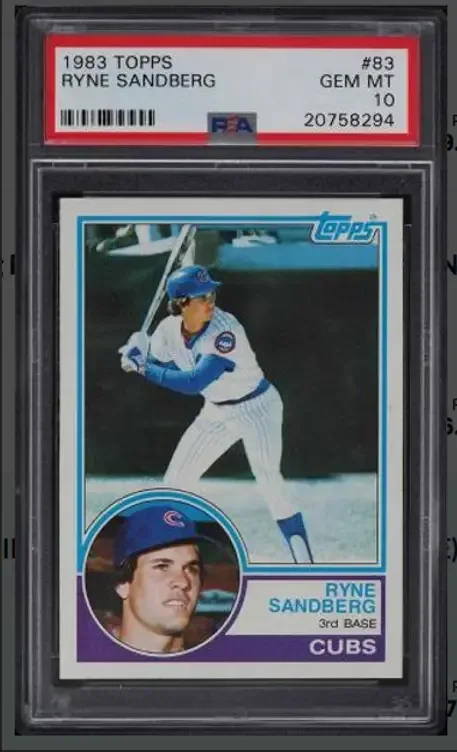
Ryne Sandberg’s rookie is card #83 in the 1983 Topps set. Reported raw pricing sits around $10 to $20, placing it below Gwynn’s raw range. The grading data tells a familiar but distinct story: 826 PSA 10s, 7,845 PSA 9s and 10,596 PSA 8s.
Sandberg’s PSA 10 count is slightly higher than Gwynn’s, while the reported number of PSA 9s is also higher. That does not make one card categorically easier or harder to find in the real world; it simply describes the certified population provided here. What it does reinforce is that a card can have a substantial number of graded examples and still command considerably more attention at the top grade than at 8 or 9.
The cited highest public PSA 10 sale was $3,807 on February 15, 2021 via Fanatics. That total is lower than Gwynn’s cited record, but it remains a dramatic departure from the raw-card range. For a collector comparing the two, the sensible conclusion is not that one card is “better” based only on a single record. Rather, both cards illustrate how demand for recognized rookie cards can become highly grade-sensitive.
This is where a collecting plan helps. A set builder might decide that a PSA 8 or PSA 9 is the right balance of presentation and budget. A player-focused collector may prefer a raw copy with strong eye appeal. A registry-minded collector — someone assembling sets around third-party grades — may pursue the PSA 10 specifically. None of those approaches is inherently wrong; they are different collecting objectives.
Wade Boggs #498: fewer PSA 10s, a major recorded sale
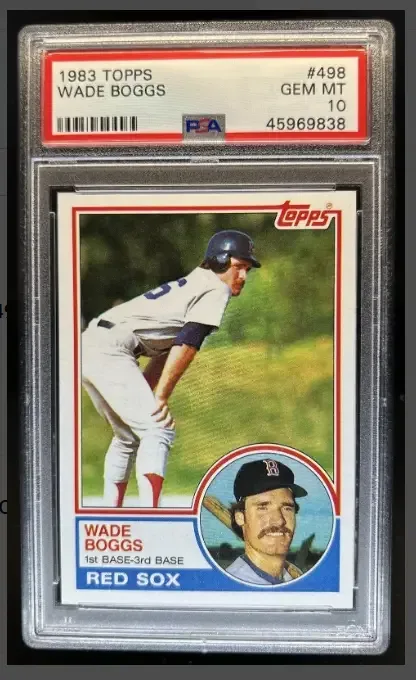
Wade Boggs’ 1983 Topps rookie, #498, has the highest stated raw range among these four cards: roughly $20 to $35. Its PSA population figures are 417 copies at PSA 10, 4,210 at PSA 9 and 9,260 at PSA 8.
Among the four cards discussed, Boggs has the second-smallest PSA 10 total, behind only Stuper. That alone does not fully explain its market position, but it is an important part of the context. The card combines an established rookie-card profile with a reported top-grade population that is materially smaller than the Gwynn and Sandberg totals.
The highest public sale cited for a PSA 10 is $5,822, dated September 27, 2026 and recorded through Fanatics. As with every individual sale, it is a historical data point rather than a universal valuation. Auction or marketplace outcomes can vary with timing, buyer participation, the individual card’s visual qualities and the available alternatives at the time. Still, the sale demonstrates why collectors often look beyond a card’s raw price when judging the significance of vintage or older modern-era rookies.
It also shows why “low population” needs qualification. Boggs is low-pop relative to Gwynn and Sandberg at PSA 10 based on these figures, not low-pop in an absolute vacuum. A collector should ask: low compared with what grade, what player and what comparable card? Specificity prevents population data from becoming a catchy but incomplete sales pitch.
John Stuper #363: rarity alone is not the whole appeal
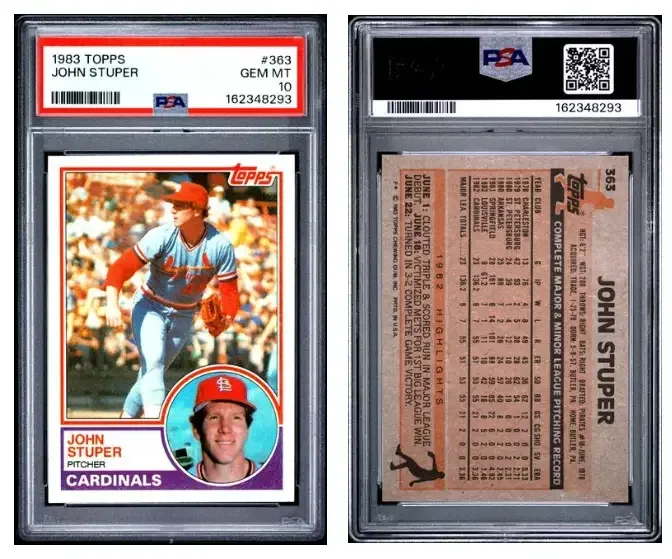
John Stuper’s #363 rookie is the outlier in name recognition and certified counts. Raw copies generally sell for about $3 to $7. The cited PSA population, however, is exceptionally small: 22 PSA 10s, 13 PSA 9s and six PSA 8s.
The small totals call for a little extra caution. They describe the cards PSA has graded in these categories, not necessarily every copy that exists. A tiny population may reflect that fewer collectors have submitted the card, that the card is difficult to find in submission-worthy condition, or a combination of factors. It should not be presented as proof of total surviving supply.
Even so, the reported high sale of $330 for a PSA 10 on March 1, 2026 via Fanatics is notable beside the $3-to-$7 raw range. The gap offers a clean example of how a top grade can generate interest for a lesser-known player card from a collectible set. At the same time, the result remains well below the record levels cited for the three more prominent rookies. That is the important balance: scarcity can create a premium, but player demand still influences how large that premium becomes.
For anyone considering Stuper as a condition-scarcity play, the practical lesson is to avoid treating population alone as a shortcut to value. Check the number of actual public transactions, distinguish between a high recorded result and a regular sale pattern, and recognize that a small buyer pool can make selling more uncertain as well as owning more distinctive.
How to read the four cards together
These rookies show four separate layers of collecting value:
- Raw-card accessibility: all four have reported raw price ranges far below their best PSA 10 results.
- Player significance: Gwynn, Sandberg and Boggs carry stronger name recognition in this group, which helps explain why their top-grade cards have reached four-figure recorded highs.
- Condition scarcity: PSA 10 populations are far smaller than the PSA 8 and PSA 9 populations for the three star rookies, while Stuper’s reported certified counts are small across every listed grade.
- Transaction context: a record sale establishes that a buyer paid that amount for a particular card at a particular time; it does not establish a permanent value for every copy.
That final distinction matters in a hobby where screenshots of notable sales often travel faster than the context behind them. A card’s condition grade, date of sale and sales venue should travel with the price. So should the realization that the market for a PSA 10 and the market for a raw example can be almost unrelated.
A practical checklist before chasing a PSA 10
Collectors interested in 1983 Topps or similarly condition-sensitive sports cards can make better decisions by defining the goal before shopping.
- Choose the version you actually want. Decide whether the aim is a raw rookie, a visually appealing graded copy, a specific grade or a PSA 10. Do not let a headline price decide the goal for you.
- Compare grades, not just players. A PSA 8, 9 and 10 are different markets. The population data above makes that especially clear for Gwynn, Sandberg and Boggs.
- Use record sales carefully. High public results provide useful reference points, but they are not the same thing as a complete market history or a current quote.
- Read population figures as context. Population reports measure graded copies, not every card in existence. They also change as more cards are submitted.
- Keep the raw alternative in view. The raw ranges reported for these cards show that collecting the same rookie need not require pursuing the most expensive condition tier.
The broader sports-card market supplies plenty of examples where key rookie status and scarce high-grade supply meet, including the historical-sale framing around Gale Sayers’ most valuable cards. The specifics differ from card to card, but the principle is consistent: a buyer should identify whether they are paying for the player, the issue, the grade, or all three.
For 1983 Topps, Gwynn, Sandberg, Boggs and Stuper make that principle easy to see. The stars show how a top grade can elevate already desirable rookies into a different financial category. Stuper shows that an extremely limited reported PSA 10 population can produce meaningful interest even without the same player-profile advantage. Taken together, they make a compelling case for looking beyond the front of the card and paying close attention to the number on the slab.