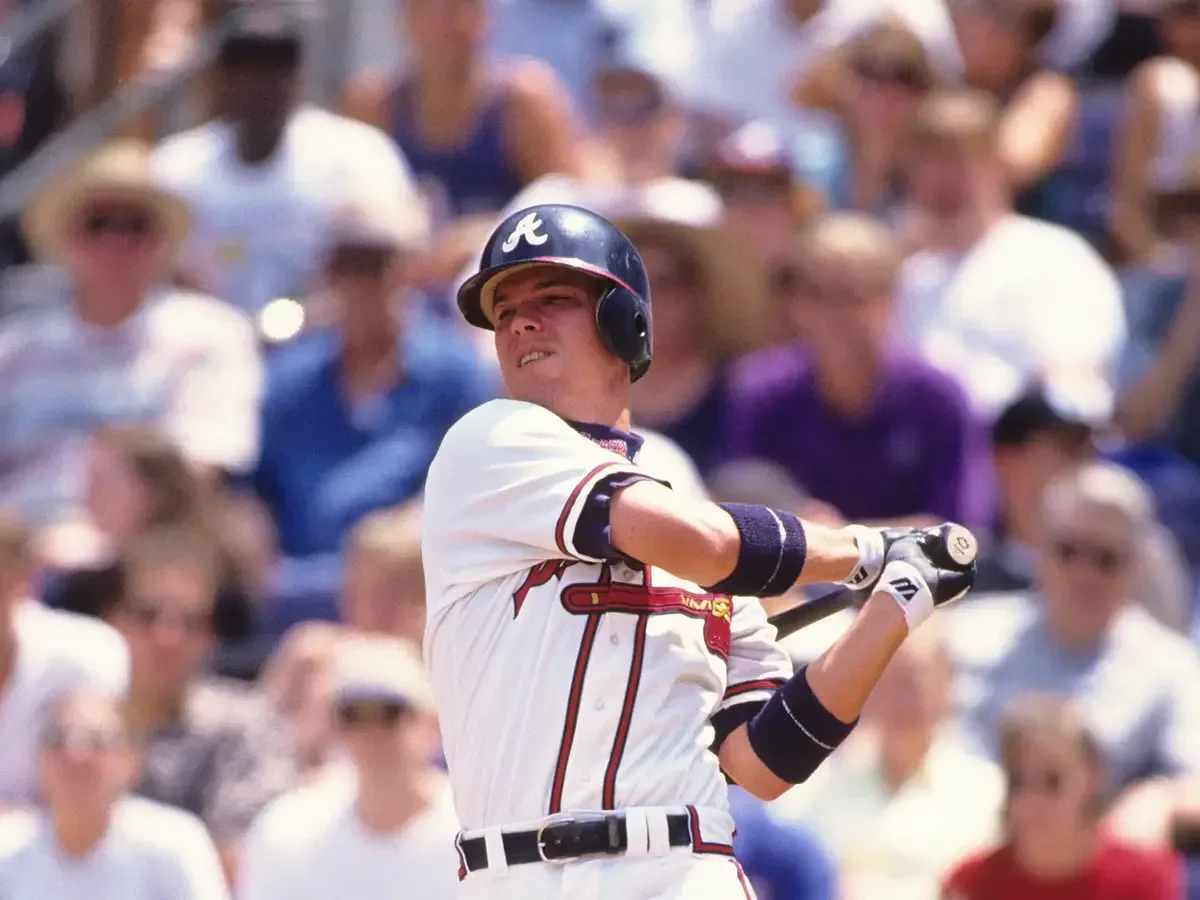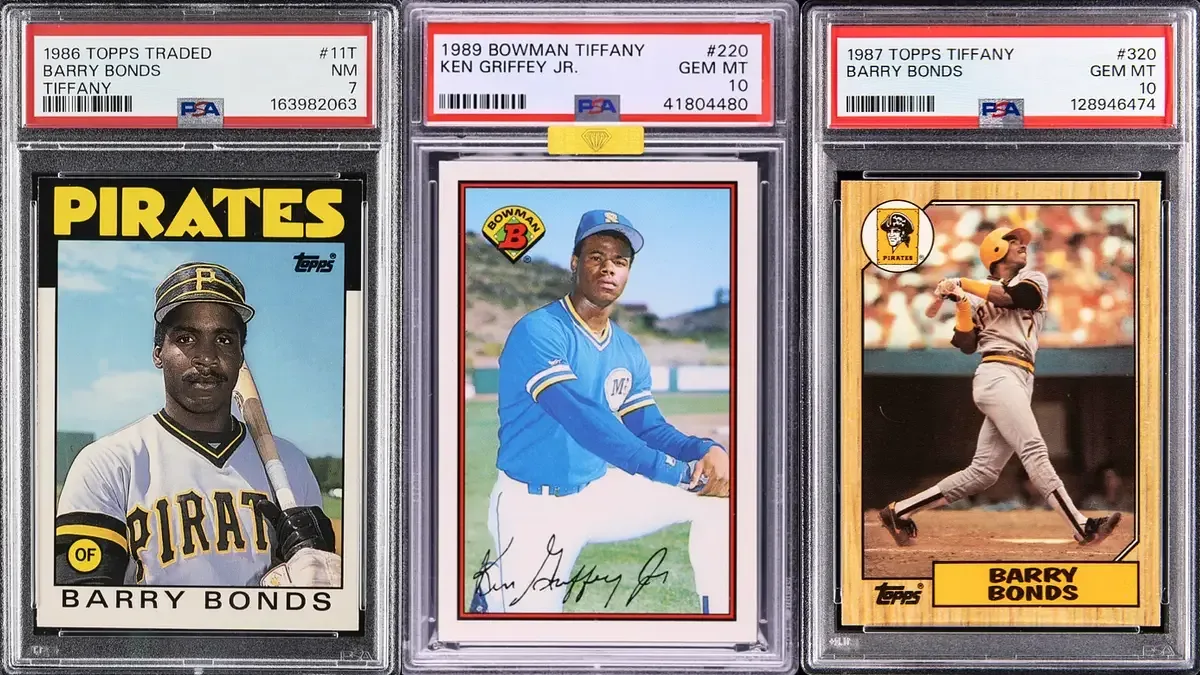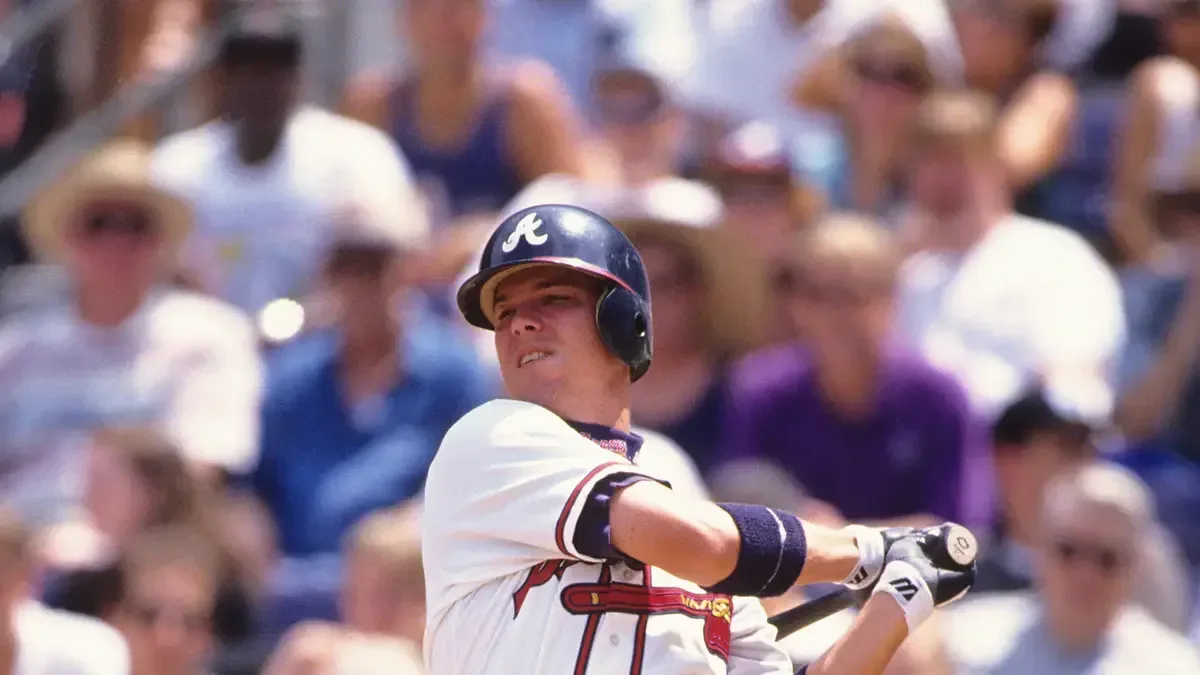
Chipper Jones’ earliest cards offer a particularly clear lesson in how the sports-card market sorts one player’s cardboard legacy into very different collecting lanes. The Hall of Famer and MVP winner has multiple prominent cards from 1991, yet the most familiar rookie is not automatically the most difficult to find, the rarest edition is not always the best entry point, and one of the most coveted early Jones cards is not technically a rookie at all.
That makes this group useful for more than Braves fans or collectors building a Jones-focused binder. It is a compact case study in scarcity, condition sensitivity, premium factory editions and the gap between a raw card’s appeal and the price of a professionally graded copy at the top of the scale.
The essential names are the 1991 Topps Desert Shield, 1991 Bowman, 1991 Upper Deck Top Prospect and 1991 Topps Tiffany, plus the 1993 SP Foil. Their recent reported sales and asking-level benchmarks span from roughly $80 for a gem-mint Upper Deck to nearly $5,000 for a PSA 9 Desert Shield. Those figures are snapshots rather than fixed values, but they illustrate why set name, grade and physical condition need to be considered before a collector decides which Jones card belongs on their want list.
Why Chipper Jones has more than one defining early card
Jones’ first baseball cards arrived in 1991, and the hobby has never reduced his rookie-card conversation to a single universal choice. That is partly because several manufacturers issued meaningful cards in the same year, each with its own production context and collector appeal. Some present a classic rookie-card proposition. Others stand out for a premium finish, a lower-availability version of a mainstream release or a distinctive image.
Jones’ subsequent career explains why the cards retained attention beyond a single team’s fan base. He became a Hall of Famer, won an MVP award and is widely regarded among the game’s leading third basemen. There is also an interesting visual wrinkle in the 1991 Upper Deck card: it reflects a younger Jones fielding as a shortstop, before his move to third base in the majors.
For a collector, the practical takeaway is simple: “best” should be defined before shopping. Does it mean the card with the strongest scarcity story? The one with a premium presentation? The most historically representative rookie? Or a high-grade copy that stays within a more modest budget? These five cards answer those questions in very different ways.
1991 Topps Desert Shield: the major scarcity chase
The 1991 Topps Desert Shield Chipper Jones sits at the top of this group in both lore and reported price. Desert Shield cards were distributed to soldiers serving in the Middle East during the Gulf War. That distribution history gives the set significance beyond ordinary release mechanics: each card is connected to a specific moment, as well as to Jones’ early career and the service of veterans.
Its supply is difficult to define precisely. There is no certainty around how many cards returned to the United States, and it is even harder to know how many survived in strong condition. That uncertainty is a major part of its market identity. Collectors are not simply assessing a 1991 Jones rookie; they are assessing a card with an unusual distribution path and an unknowable surviving population.
A PSA 9 recently sold for close to $5,000. PSA, or Professional Sports Authenticator, is a third-party grading company; its numerical scale is widely used in the hobby when buyers compare condition. A 9 is commonly described as mint, while a 10 is gem mint. The distinction matters enormously on difficult cards, although it should not be mistaken for a guarantee that every card with the same grade will command the same price at every sale.
This is the premium, history-heavy target of the group. Anyone considering it should understand that its appeal is tied to rarity and condition uncertainty, not merely to the fact that it shares a design lineage with 1991 Topps. It is a different collecting proposition from the flagship card.
1991 Bowman: a rookie with a comparatively accessible top grade
The 1991 Bowman Chipper Jones offers another core rookie-card route. Bowman expanded its set size from the previous year, producing a strong rookie class in which Jones became the most expensive name. The set was also scarcer than 1991 Topps, a difference that immediately gives the Bowman version a different market footing from its flagship-era counterpart.
Scarcity, in this context, means fewer examples were available relative to another comparable issue. It does not make a card automatically unaffordable, nor does it remove the need to inspect condition. But it helps explain why two rookie cards of the same player and year can carry noticeably different collector interest.
A PSA 10 copy has been available around $150. That reported level makes 1991 Bowman a notable middle ground: it is a significant Jones rookie that can offer the appeal of a gem-mint graded example without requiring Desert Shield money. Of course, price will vary with sale timing, venue and the individual card’s presentation, but the contrast in recent market levels is stark.
For collectors who want a Jones rookie that feels more distinctive than the baseline flagship choice while remaining far below the elite chase tier, Bowman is the straightforward candidate. Its strength is not an exotic parallel treatment or a historical distribution story. It is the combination of a key rookie identity and a scarcer set context.
1993 SP Foil: not a rookie, still an early-career cornerstone
The 1993 SP Foil Chipper Jones is the reminder that technical rookie status is not the only way a card can become essential. It is not a rookie card, but it has long been regarded as one of the most important cards from Jones’ early period.
The crucial factor is foil. Foil cards use a reflective surface treatment that can look striking, but that surface can also make handling and preservation more demanding. The card is described as condition sensitive, meaning flaws that may be less apparent or less consequential on other paper-stock cards can become a serious hurdle here. As a result, finding a high-grade example is difficult.
A PSA 10 recently sold for close to $3,000. That figure shows how much collectors can value a condition challenge. In broad terms, a difficult surface can create a steeper divide between an ordinary surviving copy and one that has earned a top professional grade. The premium is not just about age: it is about the difficulty of locating the card in an exceptionally clean state.
This card is best understood as an early-career grail rather than a rookie-card substitute. A collector trying to build a concise Jones run could reasonably begin with one 1991 rookie and later treat the 1993 SP Foil as a high-end expansion. The card’s role is different, but its importance is not diminished by that distinction.
1991 Upper Deck Top Prospect: the action-image alternative
The 1991 Upper Deck Top Prospect Chipper Jones has an advantage that does not depend primarily on rarity: its image. Rather than the posed presentation common to many Jones rookies, this card shows him preparing to field a ground ball. It captures a baseball moment and nods to his initial major-league position at shortstop before his transition to third base.
That makes Upper Deck a particularly appealing option for collectors who value the image and player narrative as much as production variation. Card collecting can become overly focused on labels and grade numbers; this is a good counterpoint. The photograph itself tells a small but meaningful part of Jones’ development.
A gem-mint copy can be found for around $80, positioning it as the most approachable high-grade option among the cards discussed here. “Gem mint” refers to the highest end of a card’s physical condition, with sharp presentation and very limited visible defects under the grading standard used. It is still important to distinguish a reported market range from a permanent value floor, but the available benchmark gives collectors a clear sense of the card’s relative accessibility.
The Upper Deck is therefore the practical pick for a collector who wants a graded Jones rookie with an active on-field image and a lower barrier to entry. It may not carry the Desert Shield’s scarcity aura or the SP Foil’s condition-driven prestige, but it offers a compelling visual identity at a dramatically different price level.
1991 Topps Tiffany: the glossy premium edition
The 1991 Topps Tiffany Chipper Jones takes the familiar Topps flagship concept and moves it into a more premium factory-set format. Topps Tiffany continued a practice of releasing a rarer factory version after the standard flagship issue. The cards used heavier stock and a glossy finish, creating a presentation distinct from the ordinary release.
Several thousand sets were reportedly released, though no specific total is established. That lack of a firm print number is worth keeping in mind. Collectors often use production totals as shorthand for rarity, but uncertainty is not the same as a verified low number. The key confirmed distinction here is that Tiffany was much rarer than the regular flagship version and built as a premium variation.
A PSA 9 copy recently sold for $700. That places Tiffany in a compelling upper-middle position within Jones’ early-card hierarchy: substantially more expensive than a gem-mint 1991 Upper Deck, but far below the reported level of a PSA 9 Desert Shield or PSA 10 1993 SP Foil.
It is also a useful example of why collectors should learn edition differences rather than treating a card’s year and player name as the full identification. A 1991 Topps Jones and a 1991 Topps Tiffany Jones are related, but the stock, finish, release format and scarcity picture create materially different collecting targets.
How to choose the right Jones card for a collection
There is no universal ranking that eliminates personal preference, but the choices become clearer when grouped by collecting goal.
- For the historic high-end chase: 1991 Topps Desert Shield combines Jones’ rookie-year status with an unusual Gulf War distribution story and hard-to-measure surviving supply.
- For a significant rookie in a scarcer set: 1991 Bowman is the logical choice, with a reported PSA 10 benchmark around $150.
- For condition-driven prestige beyond rookie status: 1993 SP Foil is the standout, because the foil surface makes high-grade copies difficult.
- For a graded rookie with a more reachable price: 1991 Upper Deck Top Prospect pairs an on-field photograph with a reported gem-mint level around $80.
- For a premium version of a flagship-era card: 1991 Topps Tiffany adds glossy, heavier-stock factory-set appeal and substantially greater scarcity than regular Topps.
When evaluating any of them, grade should be read as one piece of information, not the entire story. A grade communicates an assessment of condition by a third party. The card’s set, edition, physical characteristics and collector demand explain why that same number can mean radically different things from one Jones issue to the next.
Collectors interested in how the hobby stretches across properties can also see a very different type of card conversation in Flash Gordon: Two Worlds. The shared principle is that identifying the precise release matters; the context surrounding an item often matters almost as much as the character or player pictured on it.
For Chipper Jones specifically, the five cards create a clean ladder rather than a single mandatory purchase. The Upper Deck can deliver a satisfying first graded rookie, Bowman brings a scarcer 1991 alternative, Tiffany supplies premium production traits, SP Foil rewards a focus on early-career condition rarity, and Desert Shield occupies the historic top shelf. Knowing which attribute matters most is the best way to avoid confusing a famous card with the right card for your collection.