The sports-card hobby has spent the last decade becoming more centralized, more digital and, at the premium end, far more focused on rarity. That does not mean the local shop, card show or casual trade has vanished. Those remain meaningful parts of collecting. But licensing deals, large marketplace integrations and the growing importance of third-party grading have altered how collectors find cards, decide what to submit and assess a card’s resale potential.
The result is a hobby with two realities operating at once. A collector can still browse inexpensive singles, talk trades face to face and buy boxes through familiar local channels. At the same time, major corporate ownership changes now affect which brands hold key league licenses, online platforms can combine selling with authentication and vaulting, and grading companies can affect access through prices, submission tiers and pauses. For people building a personal collection, the most useful response is not panic or hype. It is understanding which parts of the process serve their own goals.
Licenses moved to the center of the conversation
One of the biggest structural changes has been manufacturer consolidation. Fanatics acquired Topps in 2022 for $500 million. Upper Deck and Leaf remain standalone card manufacturers, but Topps’ position became a major collector concern because licenses strongly influence a brand’s ability to produce cards tied directly to teams and leagues.
At the time of the deal, Topps held Major League Baseball and MLB Players Association licenses among the three major sports. The outlook changed as Topps secured NBA and NFL licenses across the 2024-to-2026 period, leading to robust sales. For collectors, a license is the permission that allows a card maker to use league, team and player identities in specified ways. It is not merely a logo issue: licensing can shape which products become the most visible places to find rookie cards, autographs and premium chase cards.
This makes collecting less simple than choosing a favorite visual design. A collector who values officially branded uniforms or team marks may follow licensing changes closely. Someone who only wants an autograph or a particular player image may have more flexibility. Either approach is valid, but they can produce different buying choices and different expectations for liquidity if the card is eventually resold.
Why “huge hits” matter to a modern product
The market’s appetite for ultra-scarce pulls is illustrated by Rookie Debut Patch Autographs in baseball and football products. These cards pair an autograph with a patch element, creating a high-end chase inside sealed product. Their introduction has been associated with an estimated $4 million increase in revenue.
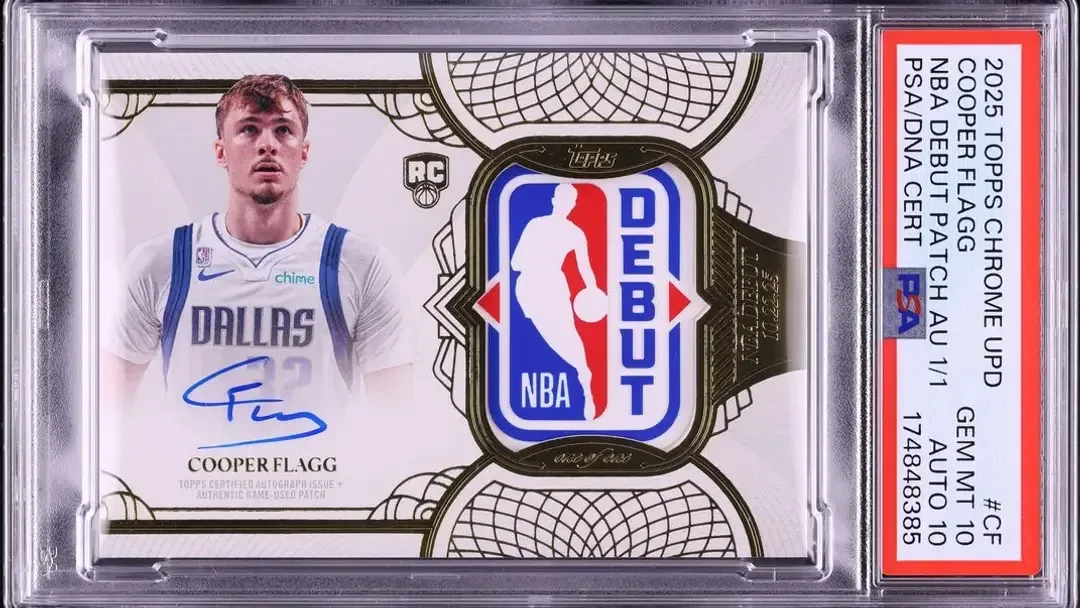
That revenue concentration helps explain why individual cards can command attention well beyond the usual collector audience. In September 2026, Cooper Flagg’s 2025 Topps Chrome Update Rookie Debut Patch autograph, graded PSA GEM MT 10 with a 10 autograph grade, sold for $8.04 million through Fanatics Collect.
The technical language in that description matters. GEM MT 10 is PSA’s top numeric grade for the card’s condition, while the separate autograph grade evaluates the signature. A patch autograph combines a signed card with a piece of material described as a patch. Those attributes do not make every patch autograph a multimillion-dollar card. The player, scarcity, product context and condition all matter. But the Flagg sale shows why modern premium releases place so much emphasis on difficult-to-pull centerpiece cards.
Related coverage includes How the Sports Card Market Changed From 2016 to 2026.
For buyers of sealed boxes, that dynamic is a reminder to distinguish the fun of opening packs from the economics of chasing an exceptional card. A product can be exciting because it contains a possible monster pull, yet the odds of finding that specific card are inherently limited. Collectors focused on one player or card type may prefer buying a single rather than treating a box as a predictable path to the chase.
Online selling is no longer just a listing page
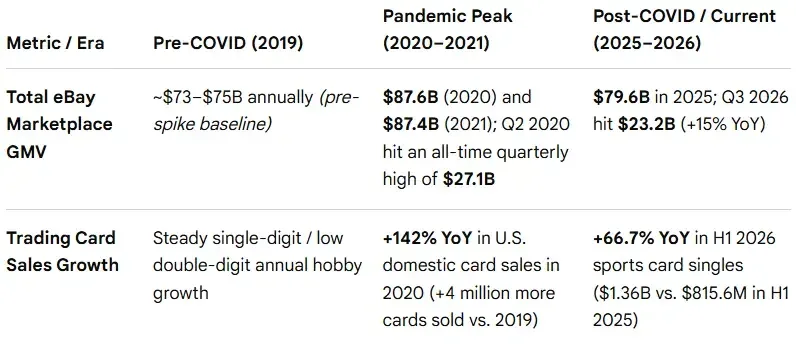
eBay was already available to card collectors in 2016, but the hobby still relied heavily on personal networks. Local stores stocked boxes at approachable prices, shows gave people a chance to meet dealers and search dollar boxes, and transactions often developed through repeat relationships. Social platforms expanded the social layer as Instagram, X, Reddit, YouTube and Facebook groups became venues for showing cards, discussing prices and arranging sales or trades.
That person-to-person component remains valuable because a listing cannot replace every form of collector knowledge. A seller at a show may explain a card’s history or condition in conversation; a local store can provide a place to learn product lines; a collector group can help someone identify an unfamiliar parallel. Online markets add reach and convenience, but they do not automatically remove the need for careful evaluation.
Over the past four years, eBay has pushed further into the collectibles ecosystem. It bought TCGplayer in 2022 and acquired Goldin from Collectors, the parent company of PSA, in 2024 for an undisclosed amount. In the following year, PSA integrated with eBay to offer grading and consignment or vaulting through the platform when collectors buy raw singles.
Raw means a card has not been encapsulated and assigned a grade by a third-party grader. Consignment means a service sells an item on the owner’s behalf. Vaulting refers to secure storage administered through a platform or service. Put together, these services can reduce friction for someone who finds an ungraded card online and wants it graded, sold or stored without managing every transfer themselves.
That convenience also changes the practical questions a collector should ask. Platform integration can make the transaction flow easier, but ease is not a substitute for understanding fees, the specific service tier, the card’s condition before submission and whether grading is useful for that card. The best decision depends on the collector’s purpose: long-term protection, authentication confidence, display preference, resale, or simply owning a favorite card.
The company has also concentrated on integrating Goldin and improving authentication processes after declining an estimated $55.5 billion offer from GameStop in May. Authentication is particularly consequential in a market where expensive cards can be bought from sellers a collector has never met. Still, collectors should treat authentication, grading and market visibility as related but separate services: one addresses legitimacy, another assesses condition and a marketplace creates a route to transact.
Sports cards are only one branch of a broader collectible-card culture. For a contrast with entertainment-focused card coverage on the site, see The Rocketfellers #15.
Grading demand has become a bottleneck
No recent change has been more immediately frustrating for submitters than grading backlogs and service pauses. Collectors Holdings purchased PSA in March 2021. Within weeks, customers were told that economy and value submissions would be suspended after a post-pandemic surge created a backlog of 10 million cards.
In June 2026, PSA again paused lower-tier Value Bulk, Value Plus and Value Max services while addressing an estimated 12 million-card backlog. The demand was also evident at the National Sports Collectors Convention: on the first day, PSA received a record number of cards for on-site grading at its $229.99 service level, exceeding the number submitted over the entirety of the 2025 NSCC.
A submission tier is the service level selected for grading, generally tied to cost and the expected handling or turnaround structure. When lower-cost tiers pause, the effect is felt most sharply by collectors with many modest-value cards. A premium on-site service may fit a high-value card or a collector with a specific event-driven need, but it is plainly not an interchangeable option for every submission.
That is the practical lesson of the backlog: grading should be intentional, not automatic. Before submitting, collectors can consider whether a card is likely to benefit from being slabbed, whether the condition supports the cost, and whether they are comfortable waiting through possible service changes. A slab can offer protection and a recognized condition assessment, but it does not create player demand or turn every card into a strong financial proposition.
Consolidation reaches more graders
Collectors Holdings’ expansion did not stop with PSA. It purchased SGC in 2024 and Beckett in December 2025. SGC experienced growth through early 2025, but submissions fell after it ended bulk-submitter discounts in mid-2025. Its year-over-year submissions declined further after per-card pricing rose from $15 to $50.
The details are important because submission volume is sensitive to cost. Bulk discounts can make grading feasible for dealers or collectors sending many cards at once; removing those discounts changes the equation immediately. A jump from $15 to $50 per card can force a collector to reserve grading for cards with stronger personal or market value.
Beckett saw an increase in submissions following its acquisition, although whether it can return to a leading position remains uncertain. The uncertainty is worth preserving. Corporate ownership alone does not determine a grader’s long-term collector standing. Trust in grading standards, price, turnaround experience, label preferences and resale-market behavior can all influence where collectors submit.
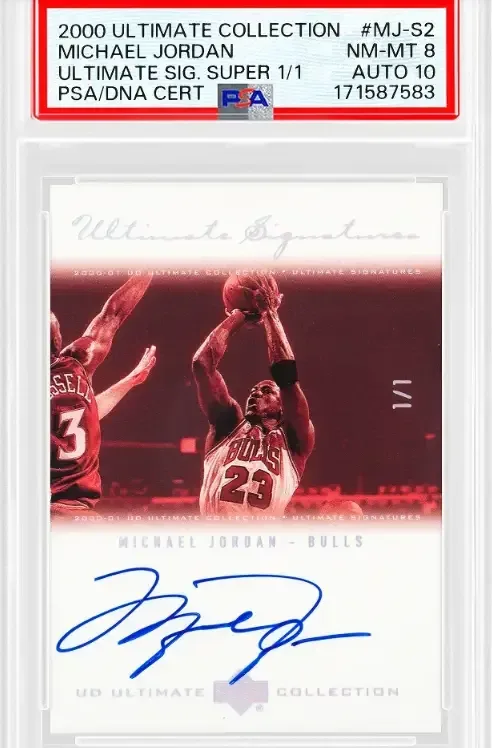
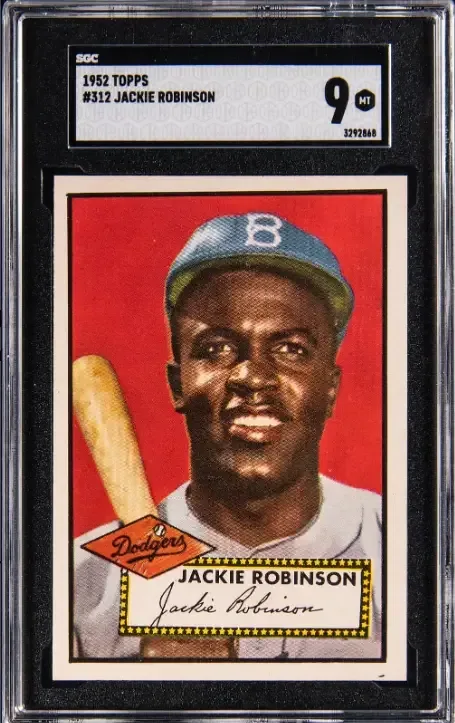
Examples from 2026 show that condition and grading labels continue to matter to major sales. A 2000 Ultimate Collection Michael Jordan Ultimate Signatures Super 1/1 received a PSA 8 card grade and PSA/DNA Auto 10 designation at the National Sports Collectors Convention. Meanwhile, a 1952 Topps #312 Jackie Robinson graded SGC MINT 9, population one, sold for $427,000 on October 10, 2026. Population one, often shortened to “Pop 1,” indicates that a grading company has recorded one card at that stated grade in its population report. It signals scarcity at that grade, not necessarily that only one copy of the card exists.
What collectors can take from the market’s new shape
The decade’s shifts do not require collectors to follow every acquisition, license or high-dollar auction. They do, however, reward clarity. A personal collector may value the player, team, design or memory attached to a card more than a top grade. A buyer who expects to resell may care more about license status, grader preference, scarcity and transaction costs. Neither mindset is inherently superior, but confusing one for the other can lead to poor decisions.
- Define the goal before buying or grading. Is the card for a display, a player collection, preservation or resale?
- Learn the vocabulary on the listing. Raw, graded, autograph grade, patch autograph, population and submission tier describe different things.
- Account for service limits. A low-tier grading pause can change both the timing and the cost of a plan.
- Use online tools without abandoning judgment. Integrated grading, consignment and authentication can be convenient, but collectors still need to inspect details and understand the service selected.
- Keep the hobby personal. The most durable collection is usually built around cards the owner is happy to keep.
That final point matters most in a market defined by million-dollar rookie cards, corporate consolidation and millions of cards waiting in grading queues. The infrastructure of collecting has changed quickly. The fundamental reason people collect does not have to: pursue the cards that hold genuine interest, then use the new tools with open eyes.