Mudkip’s trading-card market has experienced an extraordinary run of record sales, capped by a 2015 Japanese Art Academy Daisuke Ochiai Mudkip promo graded PSA 10 that realized $3,720,000 at the Fanatics September Premier Auction. The result makes it the most valuable Mudkip collectible reported to date—and it does so by an enormous margin.
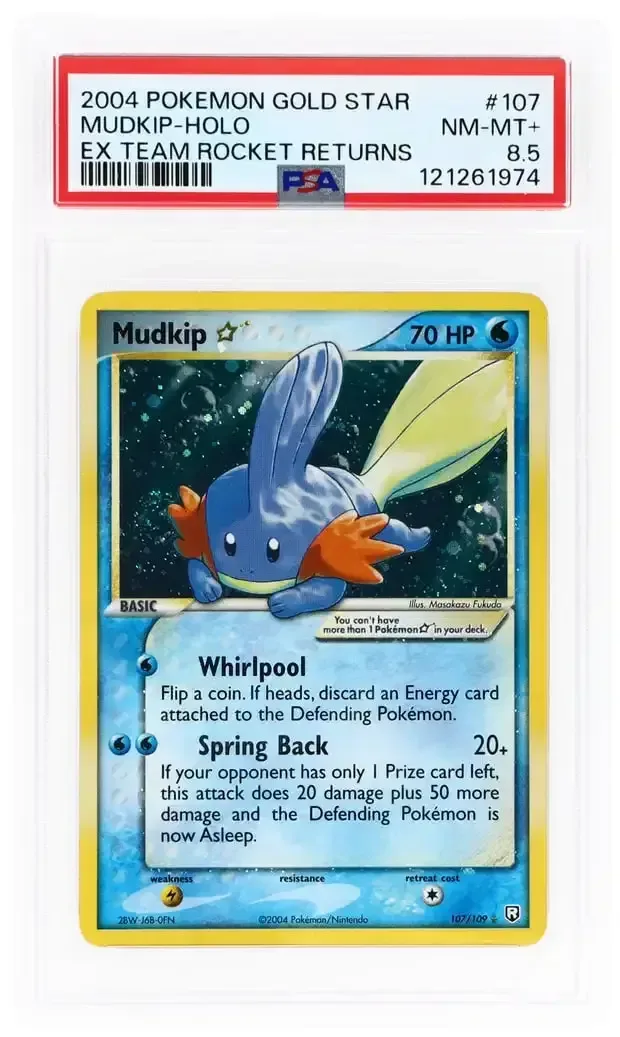
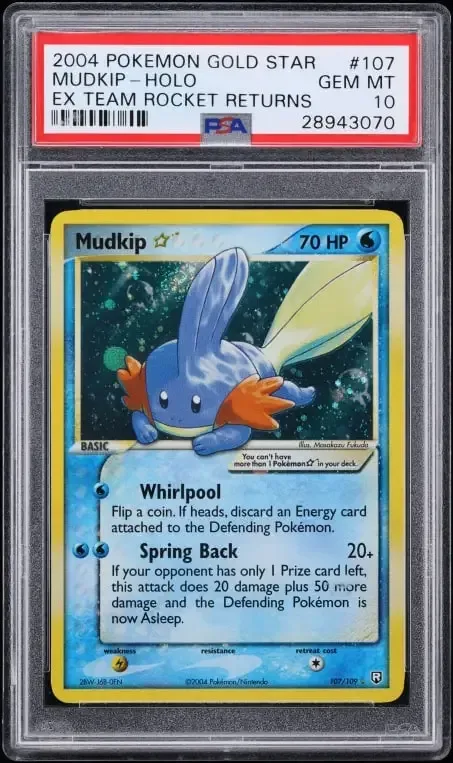
The sale arrived only days after a 2004 EX Team Rocket Returns Mudkip Gold Star, also in PSA 10, reached $1,020,000. That Gold Star result had already made history as Mudkip’s first known million-dollar card. The Art Academy promo then moved the benchmark from one seven-figure sale to a price more than three times as high.
For collectors, the pair of results is a reminder that a character’s market is not defined solely by the oldest card, the best-known set, or even a card’s broad player demand. Scarcity, condition, the exact version of a card, and the circumstances of an auction can combine to produce very different outcomes between cards featuring the same Pokémon.
The $3.72 Million Art Academy Mudkip
The record holder is a 2015 Pokémon Japanese XY Promo Art Academy Daisuke Ochiai Mudkip. It is one of 100 Mudkip cards produced through the Art Academy promotion, with the card attributed to Daisuke Ochiai. Of those 100 copies, only three have received a PSA 10, the Gem Mint grade referenced for this sale.
That “three” is the key number behind the card’s reported POP 3 status. In card-collecting shorthand, population, often shortened to “pop,” refers to the number of copies recorded at a particular grade by a grading company. Here, POP 3 means PSA has graded three copies as PSA 10. It does not mean that only three copies of the card exist: the reported production total is 100. Instead, it describes the exceptionally small pool that has achieved the top stated PSA grade.
That distinction matters. A limited production run establishes that an item is scarce overall. A tiny high-grade population adds another layer, because collectors seeking the highest graded example are competing over an even narrower subset. In this case, the reported figures point to 100 total Art Academy Mudkips and just three PSA 10 examples.
The card appeared in a sale that also included major sports-card lots, including a Cooper Flagg 1/1 Debut RPA. Despite that competition for attention, the Mudkip finished as the auction’s second-most expensive card. Its final $3.72 million price now stands as the defining sale in Mudkip collecting.
The result is especially striking because Mudkip is not usually discussed alongside the Pokémon Trading Card Game’s most routinely headline-grabbing characters. But a market record is not a popularity contest in the simple sense. A very particular card can become a centerpiece when its supply, grade, and collector appeal intersect at the same auction.
Related coverage includes Daisuke Ochiai Mudkip PSA 10 Sells for $3.72 Million, Setting New Record.
Why the Art Academy version is different from a standard set card
Promotional cards can occupy a very different place in the hobby from cards pulled from ordinary booster packs. The Daisuke Ochiai Mudkip is identified as an Art Academy promo from the Japanese XY era, and its limited production of 100 copies separates it from a conventional widely distributed release.
That does not automatically make every promo more valuable than every set card. Collectors generally need to consider the individual card, its total supply, the grade of the specific example, and actual sale evidence. Still, the Art Academy Mudkip’s reported sale shows how a narrowly distributed promo can become a focal point for collectors when few top-condition copies have been certified.
It is also useful to separate a card’s production quantity from its graded population. The first refers to how many copies were made. The second refers to copies submitted to, and recorded by, a particular grading company at specific grades. A card may have a low PSA 10 count because few copies are in top condition, because few have been submitted, or both. The supplied sale information establishes the reported total issue and PSA 10 count here, but does not identify why the PSA 10 population is so limited.
That uncertainty is worth preserving whenever collectors interpret population figures. A population report is valuable evidence about graded copies; it is not a complete census of every ungraded card or every copy held privately.
The Gold Star Mudkip set a million-dollar milestone first
Before the Art Academy promo reset the record, the most dramatic Mudkip result belonged to a 2004 EX Team Rocket Returns Mudkip Gold Star PSA 10. It sold for $1,020,000 in a Fanatics Weekly auction, four days before the $3.72 million Art Academy sale concluded.
That price was a watershed in its own right. It was described as Mudkip’s first seven-figure card sale, and it far surpassed the earlier ceiling for Gold Star Mudkip sales. No Gold Star Mudkip had previously sold for more than $70,000 before that exact PSA 10 copy reached $1.02 million.
Gold Star cards are a specific Pokémon TCG card type, and collectors often distinguish them from promos even when the same Pokémon appears on both. The two record-setting Mudkips are therefore not simply different grades of the same card. They come from different releases, years, and collecting niches: a 2004 EX Team Rocket Returns Gold Star and a 2015 Japanese Art Academy promo.
The $1.02 million Mudkip remains an exceptional result even after losing the overall Mudkip record. It is reported to be tied for the second-most valuable Pokémon Gold Star card, alongside a CGC 10 Rayquaza Gold Star from EX Deoxys. The only Gold Star card stated to rank above them is a PSA 10 Torchic Gold Star from EX Team Rocket Returns.
For anyone following Pokémon grading, the comparison also demonstrates why the company and grade should be read carefully. The Mudkip that crossed $1 million was graded PSA 10. The Rayquaza comparison is a CGC 10. Both are top grades in the cited examples, but they are designations from different grading companies and should be described accurately rather than treated as interchangeable labels.
A fast-moving sequence of Mudkip records
The recent sales did not move in a smooth, gradual climb. Instead, the record changed hands rapidly, with multiple major transactions occurring within a short period.
- September 17: A 2004 EX Team Rocket Returns Mudkip Gold Star Holo graded PSA 8.5 sold for $69,562.80. At that moment, it was reported as the best Gold Star Mudkip in the world and briefly held the Mudkip price record.
- Four days later: A PSA 10 copy of the 2004 Gold Star Mudkip sold for $1,020,000, becoming Mudkip’s first reported million-dollar card.
- Later that week: The 2015 Art Academy Daisuke Ochiai Mudkip PSA 10 sold for $3,720,000, establishing the current reported high-water mark.
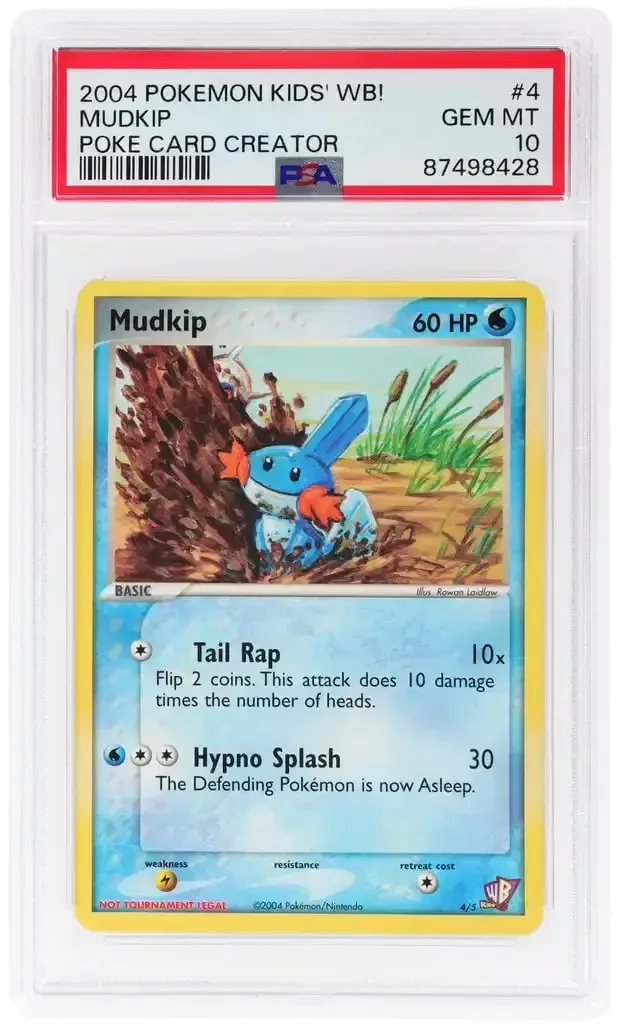
Another important sale sits within that wider picture. A 2004 Kids’ WB Poké Card Creator Pack Mudkip PSA 10 sold for $111,931 on Alt. It was the first Mudkip card reported to surpass $100,000, and at the time became the most expensive Mudkip card, ahead of the Gold Star examples then on record.
That progression illustrates how record-price discussions can change quickly. The $111,931 Kids’ WB promo was a major threshold. The PSA 8.5 Gold Star’s $69,562.80 price showed substantial demand for a lower-graded example. Then the PSA 10 Gold Star expanded the ceiling dramatically, before the Art Academy PSA 10 pushed it further still.
What collectors can responsibly take from the sales
The clear lesson is not that every Mudkip card has suddenly become a seven-figure asset. The record-setting cards are highly specific examples with exceptional characteristics: a PSA 10 Gold Star from a 2004 set, and a 2015 limited Art Academy promo with only three PSA 10 copies reported. Their prices should not be used as a shortcut for valuing an ungraded card, a lower-grade example, or another Mudkip release.
Instead, collectors evaluating a Mudkip card should first identify the exact version. “Mudkip” is not enough information. The release, year, promo or set designation, language, grade, and grading company can all materially affect comparability. A 2004 Gold Star is not directly comparable to a 2004 Kids’ WB promo, and neither is directly comparable to the 2015 Art Academy Daisuke Ochiai card.
Second, distinguish between a single headline auction result and a broader market pattern. A public sale provides a concrete price for that exact item at that particular time. It does not, by itself, prove that every comparable copy would command the same number. This is especially important when the highest-grade population is only three cards, since there are very few directly comparable PSA 10 examples.
Third, keep grading language precise. PSA 10 is identified here as Gem Mint, while PSA 8.5 is a different grade and therefore should not be treated as evidence of the PSA 10 value. The gulf between the $69,562.80 PSA 8.5 Gold Star sale and the $1.02 million PSA 10 sale is a vivid example of how condition and grade can reshape a collectible’s market position.
Finally, collectors interested in Pokémon across both physical and digital spaces may also want to follow developments such as PKForge 3.0’s cross-game Pokémon bank and save-editor tools. It is a separate part of the franchise ecosystem, but it underscores the breadth of Pokémon fandom beyond cards alone.
Mudkip now has two landmark sales, not just one
The immediate headline is the $3.72 million Daisuke Ochiai Mudkip PSA 10, a result that has made a limited 2015 Art Academy promo the most valuable Mudkip collectible reported so far. Yet the $1.02 million PSA 10 Gold Star deserves equal recognition as the sale that first pushed Mudkip into seven-figure territory.
Together with the $111,931 Kids’ WB promo and the $69,562.80 PSA 8.5 Gold Star, these transactions provide a compact snapshot of a character market changing at remarkable speed. They also reinforce a central collecting principle: precise card identification and condition matter. In Mudkip’s case, the difference between releases—and between PSA 8.5 and PSA 10—has become impossible to ignore.