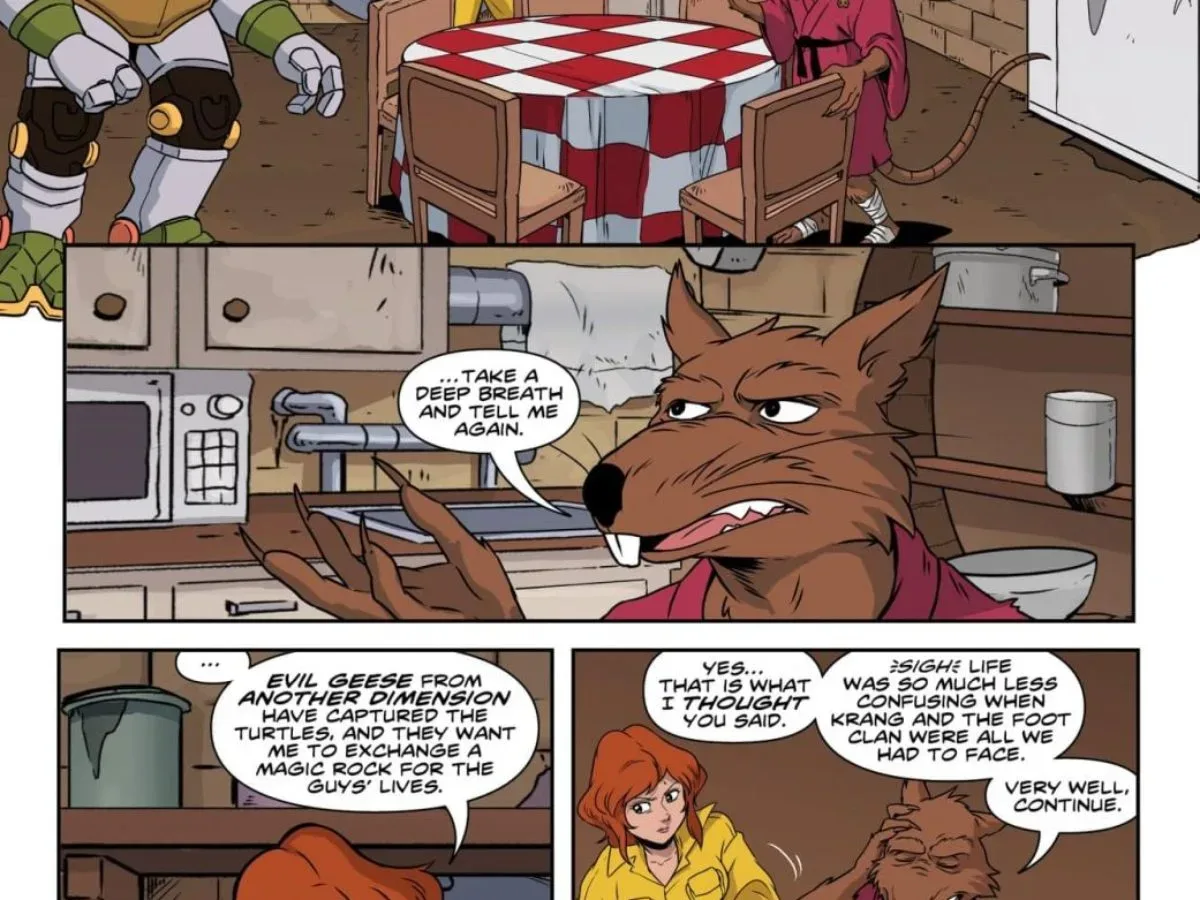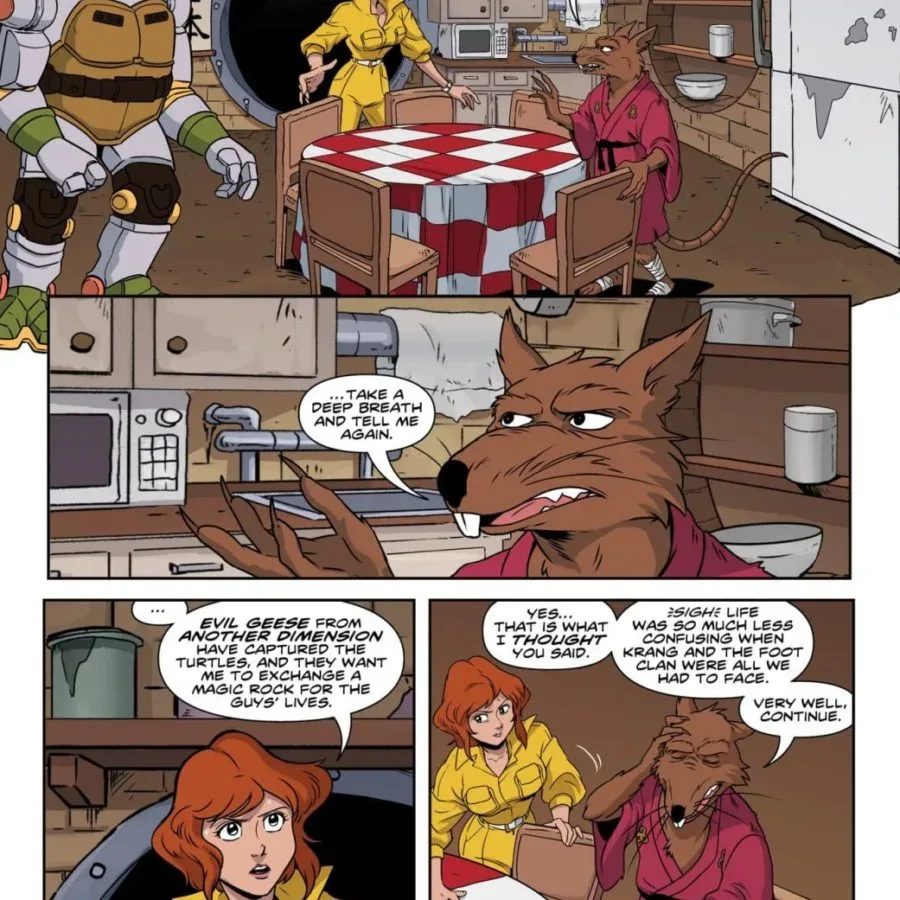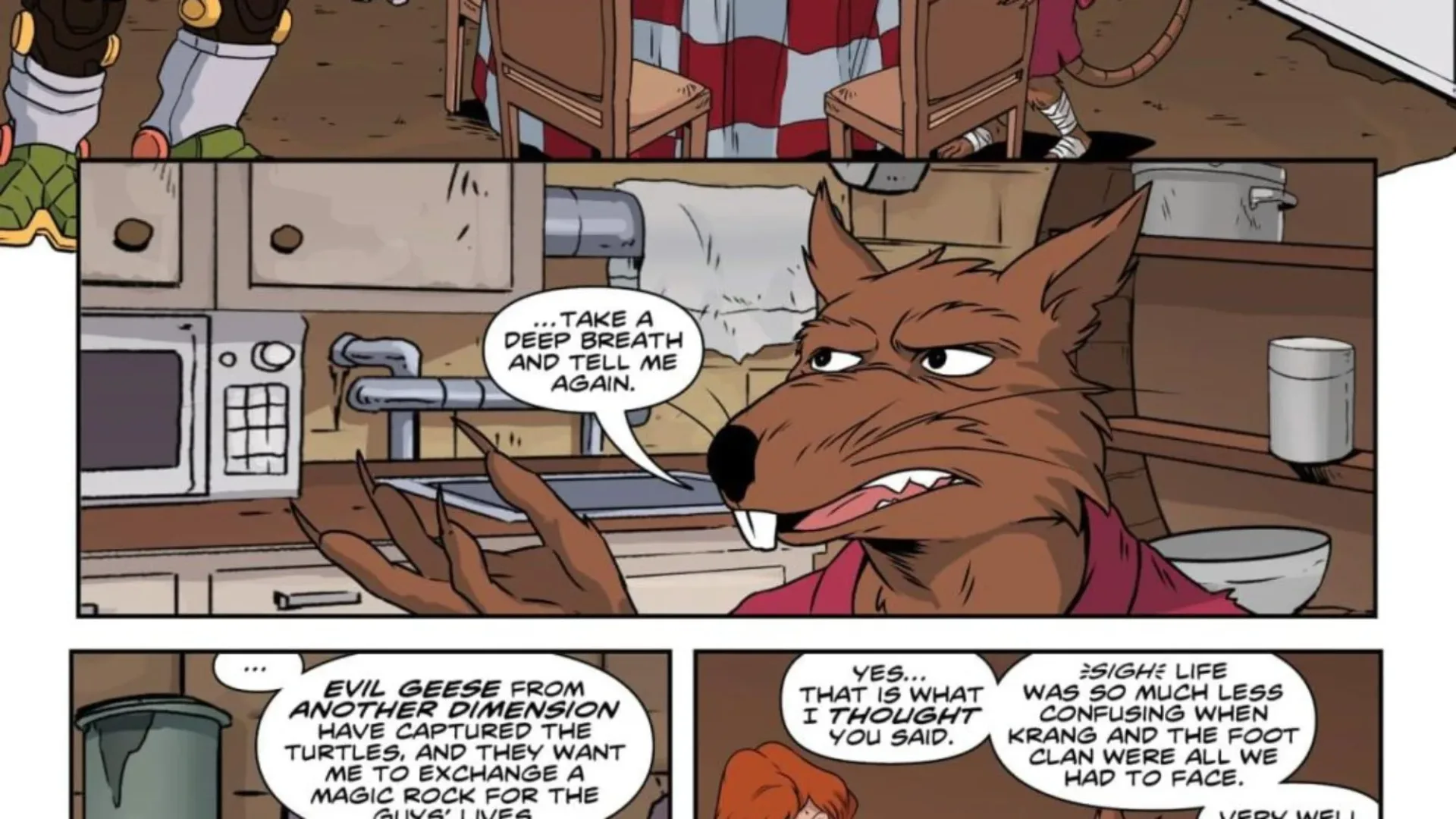
Teenage Mutant Ninja Turtles: Saturday Morning Adventures #41 is set to close out the comic series with an intentionally maximal piece of Saturday-cartoon weirdness: evil geese from another dimension, a heroic Ace Duck appearance, a magical artifact, and a glimpse at what lies ahead for Old Man Mikey. IDW Publishing lists the extra-sized issue for sale on September 23, 2026.
Erik Burnham and Sarah Myer are credited on the issue, with Myer also providing the cover. At 48 pages, it is a larger installment than a standard single comic issue, and its premise is not pretending to be anything other than proudly feather-brained. The Turtles’ final problem in this series is an invasion by hostile geese, with the team apparently captured in a dimensional dungeon while April O’Neil confronts a threat involving her Turtlecom communication device.
That is a lot to put on a finale’s plate, but it matches the stated goal: this is a farewell that leans into the playful, all-ages cartoon tone implied by the Saturday Morning Adventures title rather than shrinking away from it. A hardboiled duck hero arriving to help fight geese is not a tonal accident. It is the point.
A final mission built around cartoon-scale absurdity
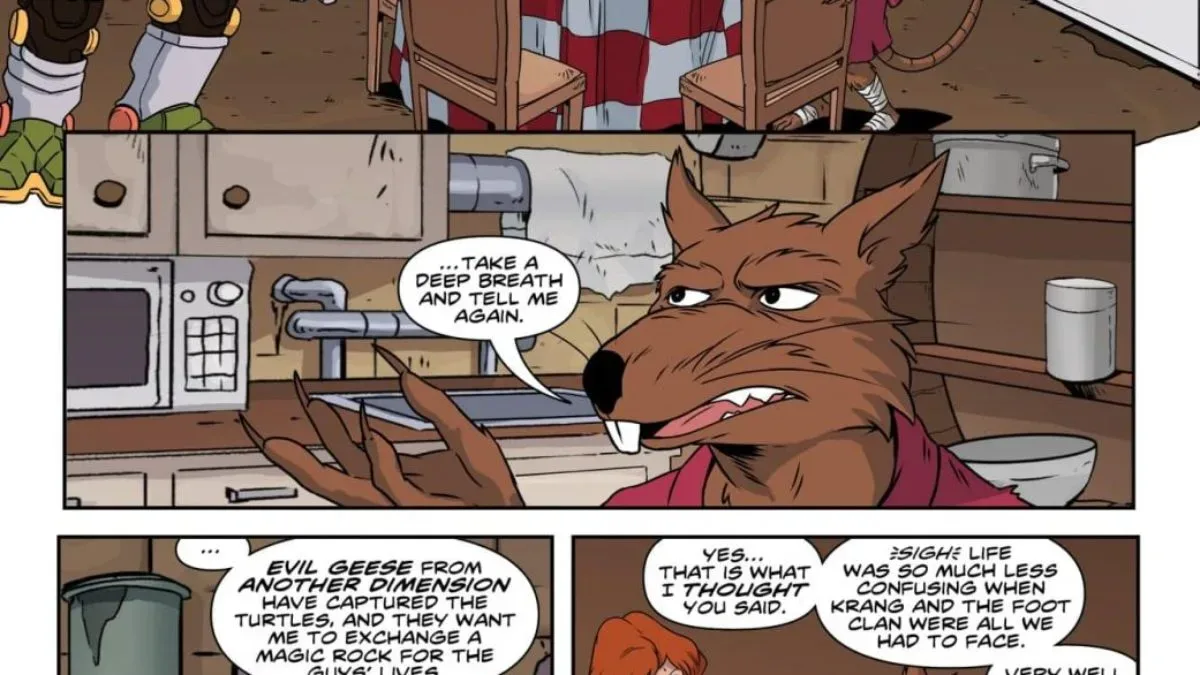
The issue’s solicitation frames #41 as the ending of the Saturday Morning Adventures era. Its central conflict involves evil geese from another dimension, and the available preview details place the Turtles in immediate trouble. Michelangelo reportedly insists that they are the heroes of the story while the team is held captive, a fittingly self-aware bit of dialogue for a story whose villains are weaponized waterfowl.
On paper, “evil geese” sounds like a gag. In a cartoon-inspired Ninja Turtles story, though, a premise like that gives the creative team a very clear lane. It allows for a big, strange antagonist force without losing the series’ buoyant energy. The Turtles can face real peril, but the setup remains built to support expressive art, broad character humor, fast-moving action, and the kind of left-field guest star that a Saturday-morning adventure can accommodate without needing an elaborate grimdark explanation.
The dimensional element matters, too. It makes the geese more than ordinary sewer intruders and gives the finale permission to go beyond a simple city-level confrontation. Dimensional travel is a storytelling device that connects separate worlds or realities, letting a comic bring together characters and threats that would not normally share the same setting. Here, it is also the delivery system for the issue’s bird-versus-bird escalation.
Ace Duck joins the anti-goose coalition
The incoming reinforcement is Ace Duck, described in the issue material as a heroic, hardboiled duck. He is said to arrive through a pink portal, which suggests the book has no interest in playing the cameo as a muted footnote. If the geese are the invading force, Ace Duck is the obvious avian counterweight—and a useful way for the finale to turn a ridiculous premise into an ensemble event.
“Hardboiled” traditionally describes a tough, unsentimental detective-fiction style. In the context of Ace Duck, it signals a noir-flavored heroic attitude rather than any need for readers to expect a realistic detective procedural in the sewers. That contrast is part of the fun: a character with the manner of a private eye is arriving in a colorful portal to aid mutant ninja turtles against interdimensional geese.
For readers who want a finale to feel like a genuine occasion, the guest appearance should help. A concluding issue can be satisfying because it resolves a plot, but it can also work as a celebration of a series’ ingredients. The announced combination of the four Turtles, April, Splinter, Ace Duck, dimensional villains and a future-facing Mikey moment gives #41 a deliberately crowded final-act roster.
The Heart of K’avila and Splinter’s personal stakes
Alongside the goose invasion, the preview material identifies the Heart of K’avila as a magical object of importance. Splinter expresses an interest in using it to become human again. That detail supplies a more personal thread amid the big visual comedy of a bird army and a portal-hopping duck hero.
A magical artifact in adventure fiction is an object whose exceptional power drives character choices and conflict. The Heart of K’avila appears to fill that role here: it is not just scenery, because it represents something Splinter wants. The available material does not establish whether he will obtain it, what limits the Heart may have, or how that wish will affect the wider finale. Those are story details the issue itself will need to answer.
What is clear is that the device gives the finale two different scales of stakes. The Turtles must deal with the immediate external crisis posed by the geese and their leader, Ganz, while Splinter’s interest in becoming human again introduces a quieter, character-specific desire. That is an effective way for a cartoon-sized climactic fight to retain some emotional focus without requiring the solicitation to reveal its resolution.
Ganz is also connected to April’s Turtlecom in the preview information. A Turtlecom is, simply put, a communications device associated with the group. Having it co-opted by the antagonist creates a basic but useful tactical problem: a tool intended to connect allies can instead become compromised by an enemy. Whether that is used for surveillance, deception, a trap, or some other scheme has not been specified, so readers should not assume more than the disclosed interference.
Old Man Mikey opens a window beyond the ending
Although #41 is described as a finale, it is not framed as an absolute full stop for every idea connected to this version of the Turtles. The issue promises a look at the future of Old Man Mikey, a character last seen during the Battle Nexus crossover.
A crossover is a story that brings together material from separate narrative strands, characters, or titles. In this case, the mention of Battle Nexus is useful continuity context for readers who recognize Old Man Mikey, while the phrase “peek at the future” carefully avoids promising exactly how large that role will be. It could be a brief epilogue, a framing beat, or a substantial tease. The information available only supports the fact that the future version of Michelangelo will be revisited in some capacity.
That uncertainty is part of the hook. Finales frequently look backward at what has defined a series; a future glimpse instead asks readers to consider what remains possible after the final page. It can make an ending feel more expansive without undoing its status as an ending. For a TMNT title so willing to put portals, birds and magical hearts in the same story, an Old Man Mikey tease is a fitting reminder that this corner of the franchise can stretch across different eras as easily as it crosses dimensions.
What readers are getting in #41
- Format: An extra-sized 48-page comic.
- Release date: September 23, 2026.
- Publisher: IDW Publishing.
- Creative credits: Erik Burnham and Sarah Myer, with a cover by Sarah Myer.
- Main conflict: The Turtles’ final battle against evil geese from another dimension.
- Guest hero: Ace Duck.
- Continuity hook: A future glimpse involving Old Man Mikey, previously seen in the Battle Nexus crossover.
- Listed U.S. price: $5.99.
Two additional editions are listed: Variant B by Lavigne and Variant C by Mitchroney. Both variants carry the same listed price of $5.99 in the U.S. and $7.99 in Canada. The regular issue is also listed at $5.99 in the U.S.; Canadian pricing for that edition is not supplied in the provided listing.
For comic readers keeping an eye on other September science-fiction launches, Joking Joystick has also covered Star Trek #1’s three-planet mystery with Seven of Nine. The stories are unrelated, but both demonstrate how a first issue or final issue can use a large-scale genre hook to set reader expectations quickly.
Why this finale’s tone is the real selling point
The key practical takeaway is simple: readers looking for a somber, continuity-dense TMNT ending should calibrate expectations to the material actually announced. #41 is explicitly marketed around a goofy conflict, cereal-bowl energy, dimensional spectacle and a duck-versus-goose dynamic. Its all-ages listing reinforces that broad-access approach.
That does not mean the book cannot have genuine character stakes. Splinter’s connection to the Heart of K’avila and the Old Man Mikey tease give the issue a path toward more reflective material. But the central promise remains exuberance. The final chapter appears designed to reward readers who enjoy TMNT at its most elastic: heroes trapped in strange locations, villains with absurdly specific themes, sudden portal arrivals, and a confident refusal to treat its own most outlandish ingredients as embarrassing.
There is also a useful distinction between a series finale and a franchise finale. #41 concludes Teenage Mutant Ninja Turtles: Saturday Morning Adventures, not Teenage Mutant Ninja Turtles as a whole. The future look at Old Man Mikey underscores that distinction. A comic run can deliver an ending while still leaving its characters, concepts, and wider franchise possibilities alive elsewhere.
Teenage Mutant Ninja Turtles: Saturday Morning Adventures #41 goes on sale September 23, 2026. Readers can expect an oversized farewell in which the Turtles take on a cross-dimensional goose threat, Ace Duck joins the action, Splinter weighs a transformative magical possibility, and Old Man Mikey offers a look beyond the series’ closing adventure.