Star Trek #1 is preparing to launch a new Enterprise-G mission with a premise that swaps easy frontier optimism for a far more suspicious version of the final frontier. The new series begins with Captain Seven of Nine and her crew attempting to find a home for the dying Avuran people beyond the known Galaxy. What should be a rescue mission turns into a mystery when the crew locates three pristine Class-M planets in a largely unknown region called the Epsilon Corridor.
Those worlds, collectively known as the Trinity, appear to offer everything the Avuran refugees might need. There are no visible civilizations and no detectable threats. For a mission centered on relocation, that initial reading looks almost too perfect—and the series is clearly built around the possibility that it is.
IDW Publishing lists Star Trek #1 for sale on September 23, 2026. Christopher Cantwell writes the issue, Dennis Menheere provides the art and main cover, and the standard edition is priced at $4.99 US. It is rated T.
The Enterprise-G has a home to find, and a mystery to survive
The core dramatic problem is direct: the Avuran people are dying, and Seven’s Enterprise-G has a pressing reason to seek a viable new world. That urgency matters because it leaves little room for the crew to simply turn away when the Trinity begins producing impossible evidence.
For more context, explore Beats 360 Cushion Kits Get a $9.99 Intro Deal, Giving Headphone Loadouts a Very Cheap Respec.
The three planets reportedly have distinct ecosystems, separate physics-related problems and their own secrets. The crew encounters vanished structures, unexplained artifacts and time skips, along with signs of a presence that earlier Starfleet probes did not detect. Those details position the opening arc as a psychological, high-stakes mystery rather than a straightforward colonization story.
“Time skips” is especially loaded language in this setup. The description does not establish exactly how time is behaving, who experiences its effects or whether the phenomenon is technological, environmental or something else. But it immediately tells readers that ordinary surveying equipment and ordinary cause-and-effect may not be enough to understand the Trinity.
Likewise, the phrase “curated…or quarantined” gives the planets a more unsettling implication. Curated suggests design and deliberate arrangement; quarantined suggests isolation, containment and a danger that may not be obvious from the surface. The question at the heart of the issue is not merely whether the worlds are safe for the Avurans. It is whether their apparent suitability is itself evidence of an unknown agenda.
Seven of Nine leads a crew carrying a lot of legacy
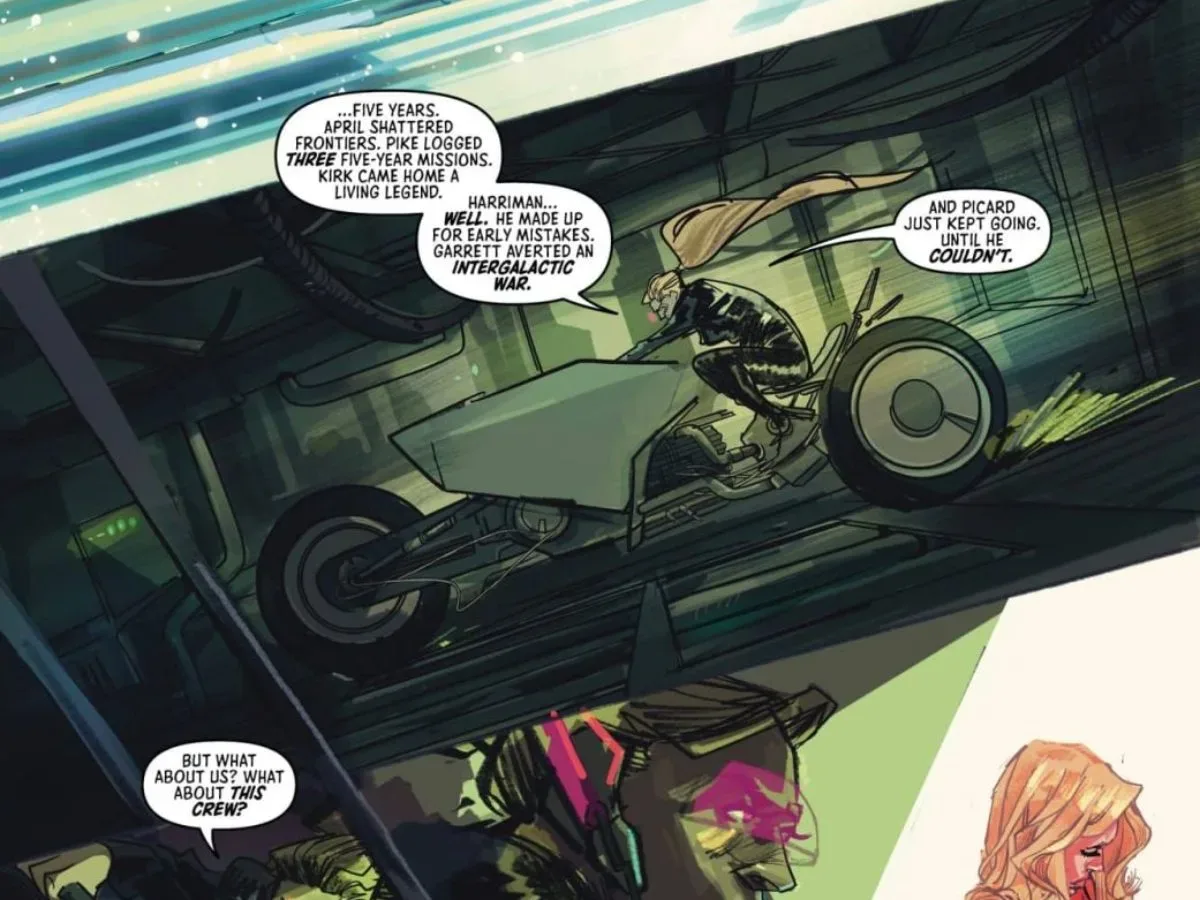
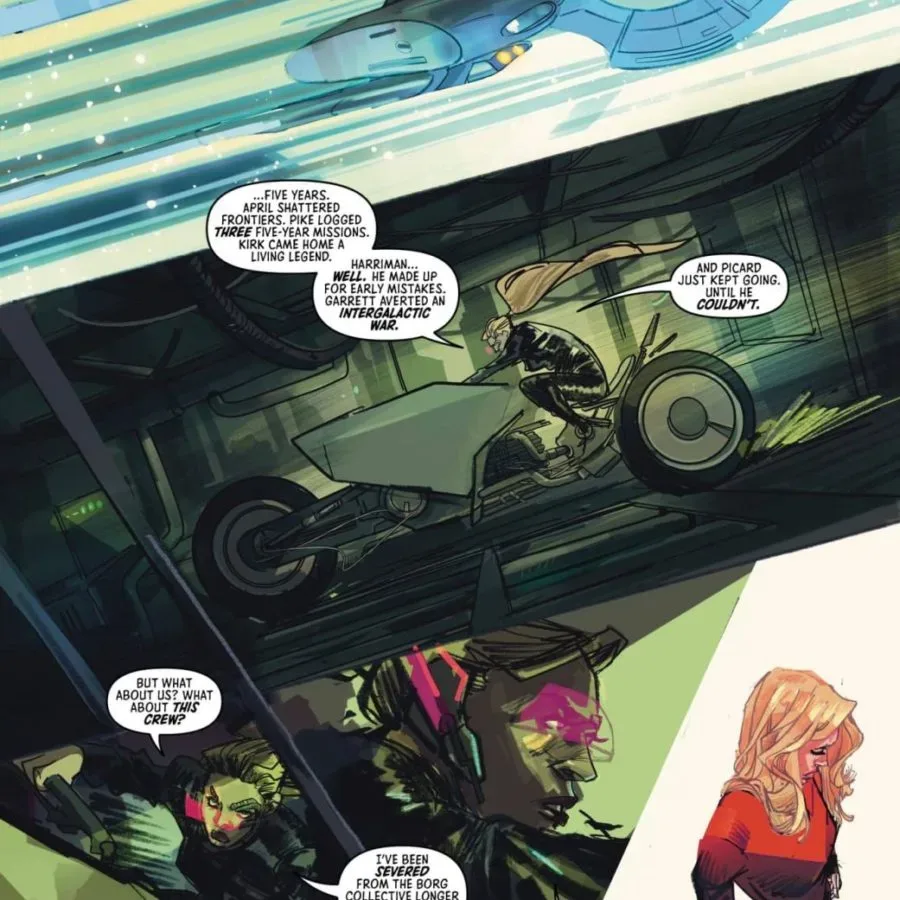
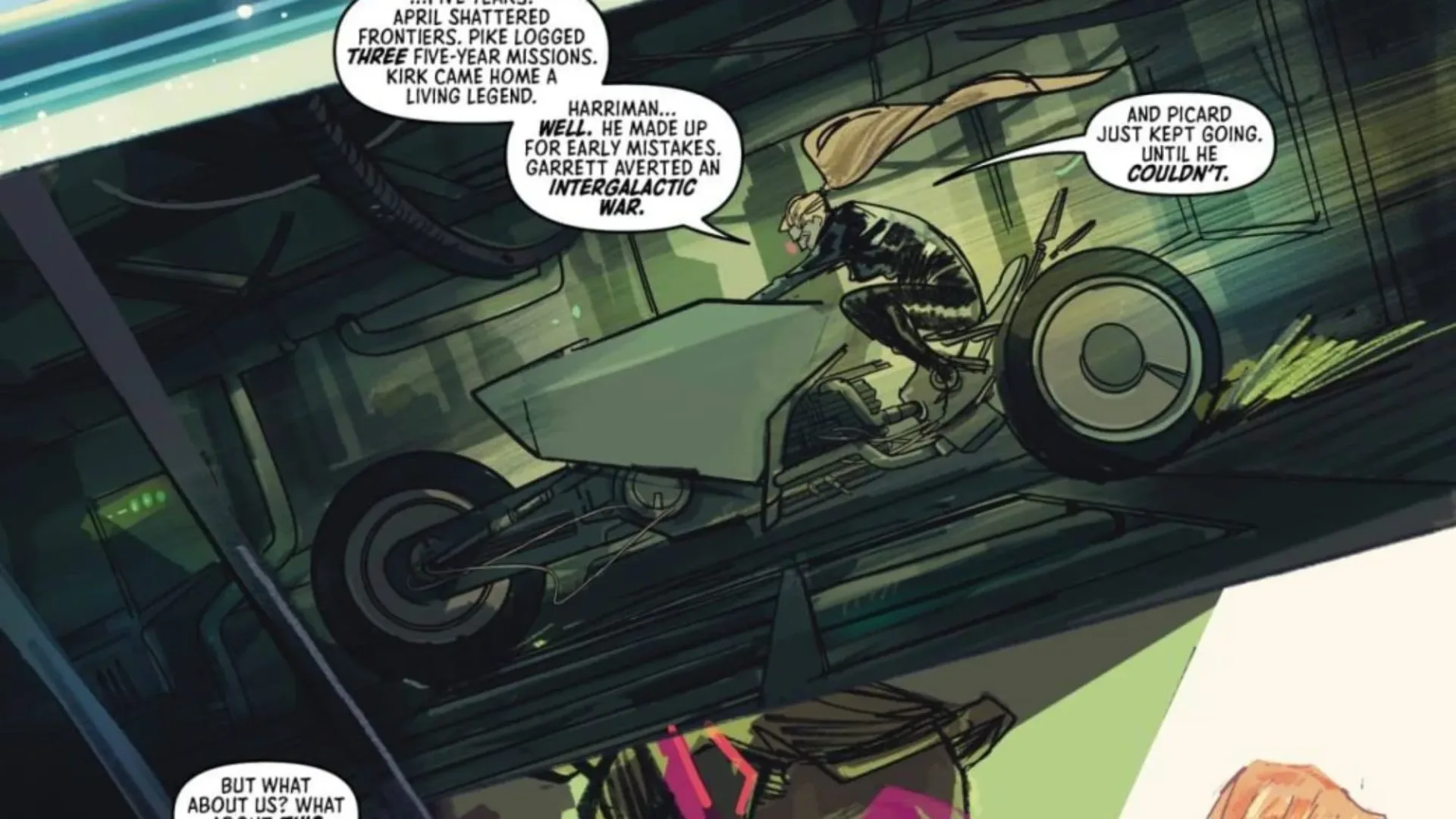
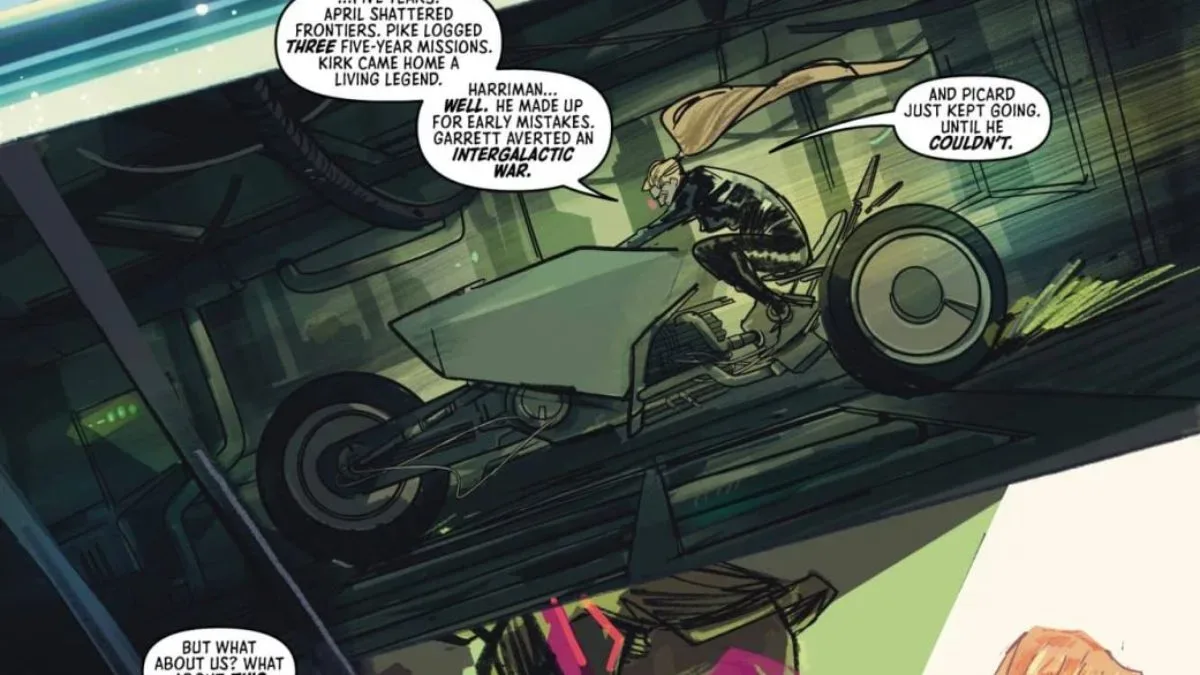
This series places Seven of Nine in the captain’s chair while making legacy part of the text rather than background decoration. The Enterprise-G crew is described as divided and fast-tracked, and the new mission is explicitly framed against the long shadow of earlier Enterprise captains and their celebrated five-year missions.
That makes Seven a fitting lead for a story about uncertainty, self-definition and institutional expectation. She is both a Starfleet captain and a character with a complicated relationship to collective identity. The early material also points toward emotional strain: Seven reflects on having been separated from the Collective for longer than she was connected to it. That line makes the captaincy feel less like a clean victory lap than another point of reckoning.
Jack Crusher and Crash La Forge are also named as major figures in the opening arc. Preview material indicates that Jack will encounter an alarming image or idea involving a “dead universe,” while Beverly Crusher appears at the bedside of a still-catatonic Picard. Those elements connect the book to familiar characters without revealing how its central Trinity mystery ultimately fits into their stories.
That distinction is important. The available material confirms the broad premise and character involvement, but it does not answer who made the worlds, what the apparent time disruptions mean, why older probes missed the signs, or what is threatening the Avurans and Enterprise-G. The first issue is being sold on those questions.
What a “flagship” relaunch means here
The comic is being presented as a new flagship Star Trek title. In practical terms, the pitch emphasizes a fresh starting point: a new mission, an unfamiliar space region, a new set of worlds and a crew facing dangers beyond Starfleet’s ordinary maps. It is not being framed as a quiet detour or a single-issue curiosity.
Cantwell arrives with prior Star Trek work including Star Trek: Defiant and Star Trek: Red Shirts. Menheere’s listed credits include Etheres and Little Nightmares. The stated direction—an existential, mystery-driven psychological thriller—suggests the series intends to use the vastness of its setting as pressure on the crew, not merely as a backdrop for planetary sightseeing.
There is also a useful tension in the premise: a refugee-relocation mission creates a moral imperative to find a solution, while every discovery on the Trinity gives the crew more reason to doubt the solution directly in front of them. Seven and her officers may need to decide whether an apparently ideal sanctuary is worth trusting before they can possibly understand it.
Issue #1 buying details and announced covers
The regular edition of Star Trek #1 carries the item code 82771403588900111, with a $4.99 US price. Menheere is credited for the cover. Collectors will also have multiple alternate covers listed at launch, including a photo variant, a Farro foil variant, a Horvath variant, a sketch variant, a Grummett variant, a J. Gonzo variant, a Quinones variant, a Menheere full-art variant and an LCSD Beals variant.
- Variant B, Photo Variant: $4.99 US
- Variant C, Foil by Farro: $12.99 US
- Variant D by Horvath: $4.99 US
- Variant E, Sketch Variant: $4.99 US
- RI (15) by Grummett: $4.99 US
- RI (25) by J. Gonzo: $4.99 US
- RI (50) by Quinones: $4.99 US
- RI (75), Menheere Full Art: $4.99 US
- LCSD by Beals: $4.99 US
The foil edition is the only announced variant listed above the standard $4.99 US cover price, at $12.99 US. The issue’s many cover choices give readers a range of presentation options, but the actual story entry point remains the same: the Enterprise-G arrives at three worlds that seem ready-made for a desperate people—and starts discovering that nothing about them should be taken at face value.
Why the Trinity setup is a strong first-arc hook
Star Trek has room for exploration, diplomacy, disaster stories and cosmic questions, and this launch combines several of those modes in one premise. The Avuran relocation gives the crew a concrete humanitarian objective. The Epsilon Corridor creates a setting outside familiar space. The Trinity then provides the central puzzle, with each planet promising a different kind of problem.
More importantly, the series does not treat the worlds simply as destinations to be visited and checked off. Their apparent perfection is the story engine. A safe new home would end the mission. A place that only pretends to be safe turns the mission into a test of leadership, trust and the crew’s willingness to reject a tempting answer.
Readers looking for a new Star Trek comic can expect a first issue designed around that uneasy proposition: three potential havens, a captain under considerable personal and professional pressure, and enough unexplained evidence to make even a Starfleet survey report feel like it needs a second opinion.