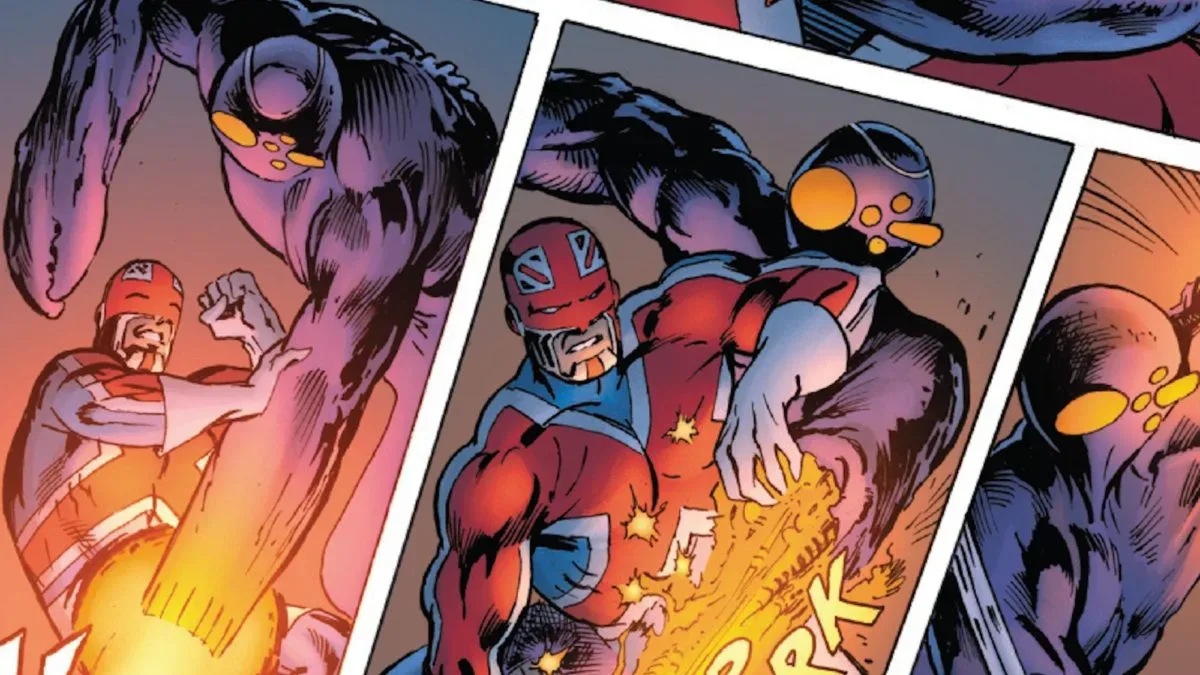
Spoilers follow for Captain Britain 50th Anniversary Special #1.
Marvel’s Captain Britain 50th Anniversary Special #1, released October 14, 2026, marks five decades of Brian and Betsy Braddock with stories from Alan Davis, Chris Claremont, Paul Davidson, Dan Abnett and Kelsey Ramsey. The anniversary issue is framed around the Braddocks’ role as champions connected to the multiversal Captain Britain Corps, but Alan Davis’s contribution makes a particularly pointed return to some of the character’s most unsettling mythology.
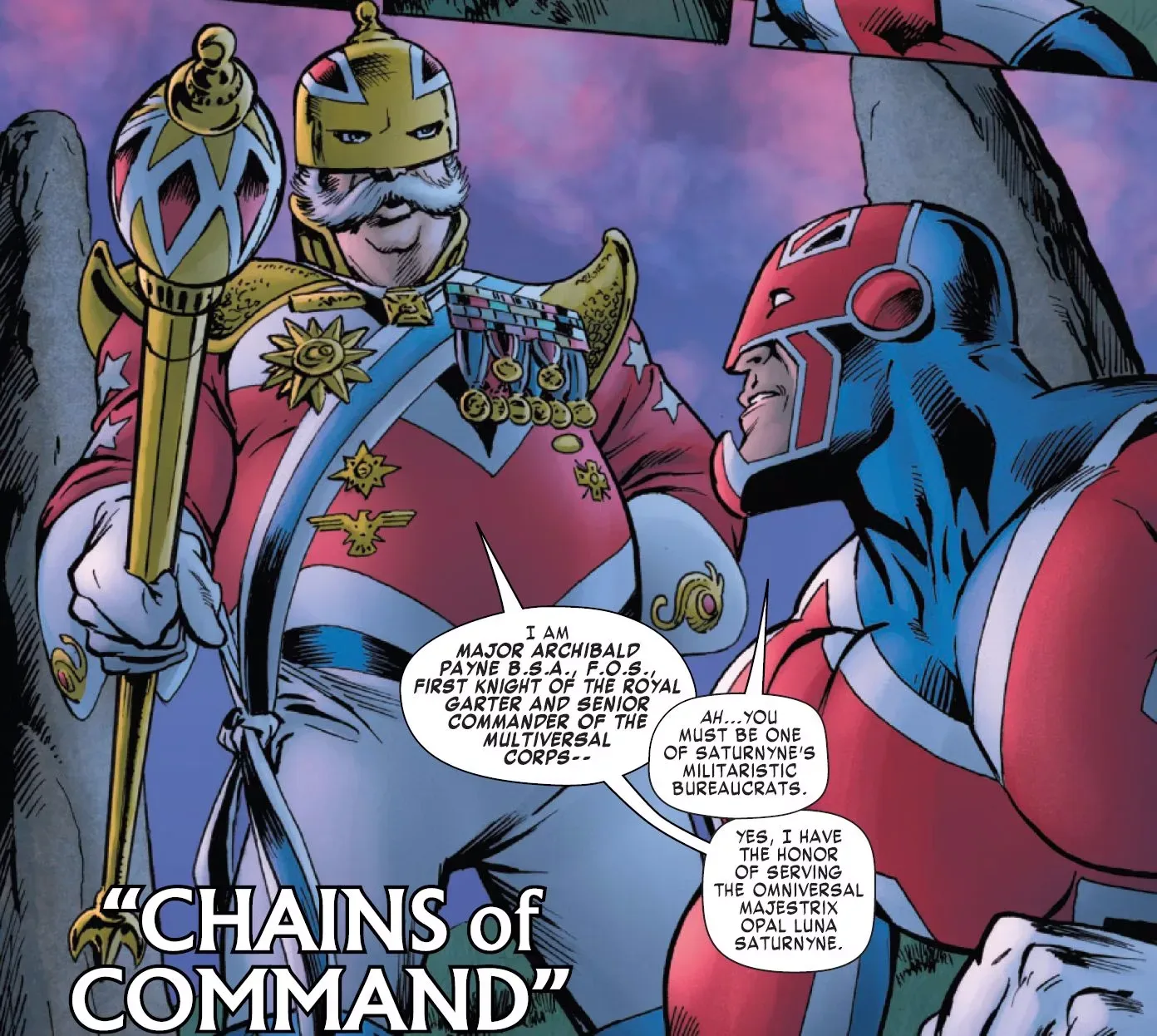
That means the Jaspers Warp is back in play, along with the Fury: a threat associated with reality distortion, destroyed worlds and the brutal history between Captain Britain and James Jaspers. Davis also introduces Major Archibald Payne, a parallel-world figure whose name deliberately recalls a real First World War soldier. It is a combination that gives an ostensibly celebratory special a much stranger, more ominous edge.
A milestone issue with two distinct Captain Britain entry points
The special’s solicitation promises a golden-jubilee story for Brian and Betsy Braddock. Chris Claremont and Paul Davidson handle a tale set in Brian’s earlier days as a defender of the realm, while Alan Davis explores the consequences of trying to contain “a Braddock.” Dan Abnett and Kelsey Ramsey are also credited on the issue.
That division matters because Captain Britain has room for several tones under one name. A story about Brian’s earliest hero work can serve as an accessible anniversary reminder of his core premise: a British champion defending his home realm. A Davis story invoking Jaspers and the Fury, meanwhile, reaches for the branch of Captain Britain lore where “home realm” stops being a stable idea. Reality itself becomes vulnerable, parallel worlds carry the weight of catastrophe, and survival does not necessarily make a character safe.
For readers primarily familiar with Marvel’s better-known American superhero settings, the Captain Britain corner is often defined by its willingness to treat alternate realities as more than a novelty. They can be political systems, historical what-ifs, traumatic ruins or sources of creatures that should not have endured. The anniversary special leans toward that last possibility.
Major Archibald Payne and the story’s real-world echo
Among the issue’s additions is Major Archibald Payne, described as an “Old Colonial” figure. The character’s name is shared with Archibald Payne, a real British soldier born in 1894 who died at age 19 during the Battle of the Somme in 1916.
In the comic’s parallel-world scenario, Payne survives and rises to the top. The distinction is central: this is not a claim that the historical soldier lived another life, but a fictional use of an alternate dimension to imagine a dramatically different outcome. Parallel-world fiction often works by changing one pivotal fact, then examining everything that follows from it. Here, the point of departure is survival itself.
There is an unavoidable tension in that choice. A name connected to a young man killed in the First World War brings real historical loss into a superhero story built around fantastical dimensions. The available details do not establish the full scope of Davis’s intent for the character, so it would be premature to assign a larger thesis to Major Payne. Still, the contrast is clear enough: the real Payne’s life ended at 19, while his fictional namesake appears to have had the time and opportunity to accumulate authority in another world.
It is also a reminder that alternate-universe stories can make history feel sharper rather than softer. The mechanism may be speculative, but the choice of reference point makes the altered path legible. A reader does not need every detail of Major Payne’s world to understand the emotional premise: in one reality, a life was cut short; in another, it was allowed to continue and reshape a person’s place in society.
What the Jaspers Warp means
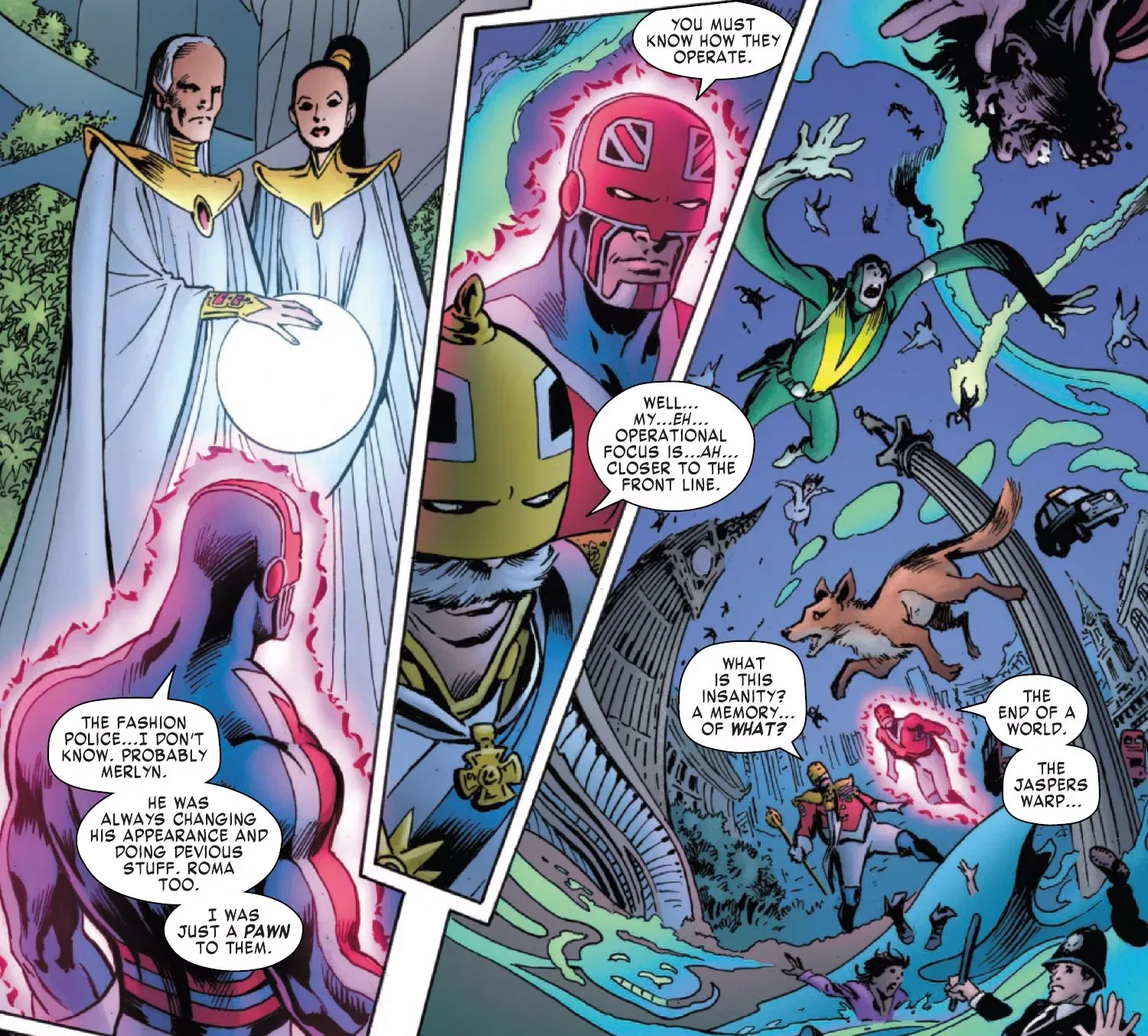
The Jaspers Warp is the engine that turns the story from multiversal intrigue into a direct threat to existence. It is associated with James Jaspers, a mutant politician whose descent into madness transforms reality around him. In ordinary superhero terms, a villain may endanger a city, country or planet. A reality-warping antagonist threatens the rules that let people recognize a city, country or planet in the first place.
Reality warping is the useful technical term here. Rather than simply projecting force, controlling technology or altering minds, a reality warper changes the conditions of the world. Cause and effect, physical forms, identities and environments can become unstable. The Jaspers Warp therefore suggests an expanding distortion rather than a conventional battlefield. The danger is not just whether a hero can defeat an enemy in combat; it is whether there will be a coherent world left in which victory can mean anything.
The new issue explicitly returns to that territory as the Warp arrives. That return gives the anniversary special a strong link to the Davis-associated material that made Captain Britain’s lore unusually surreal and severe. It also explains why the issue’s threat cannot be reduced to a nostalgic villain cameo. James Jaspers’s power creates the conditions in which something even more relentless can appear again: the Fury.
The Fury is not merely back; it is the nightmare that outlasts destruction
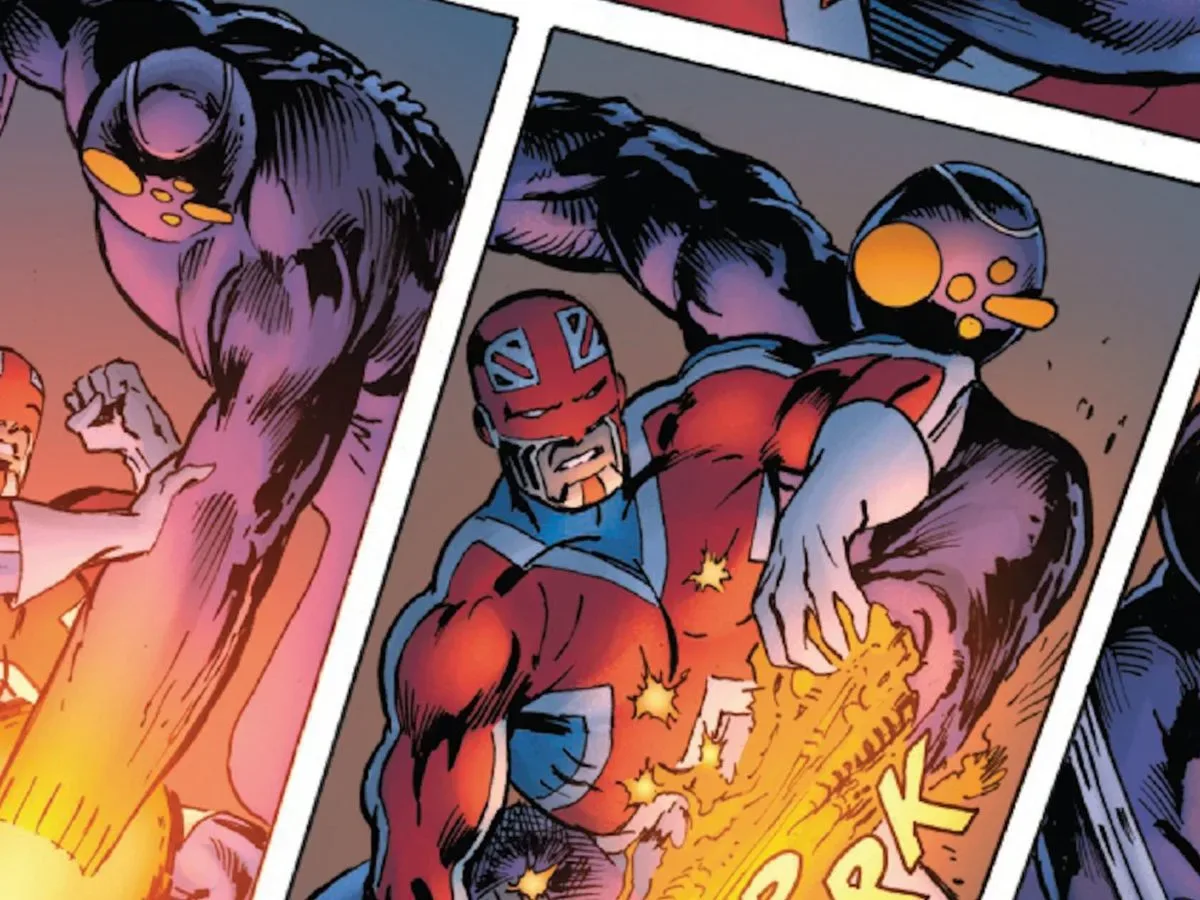
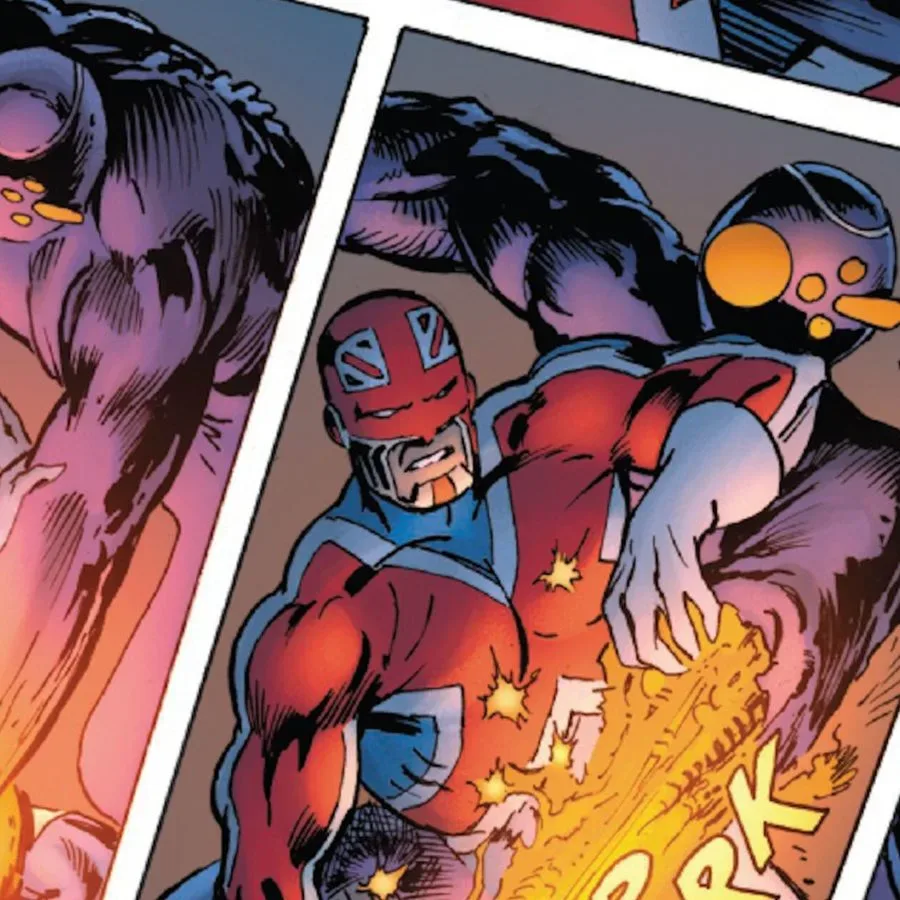
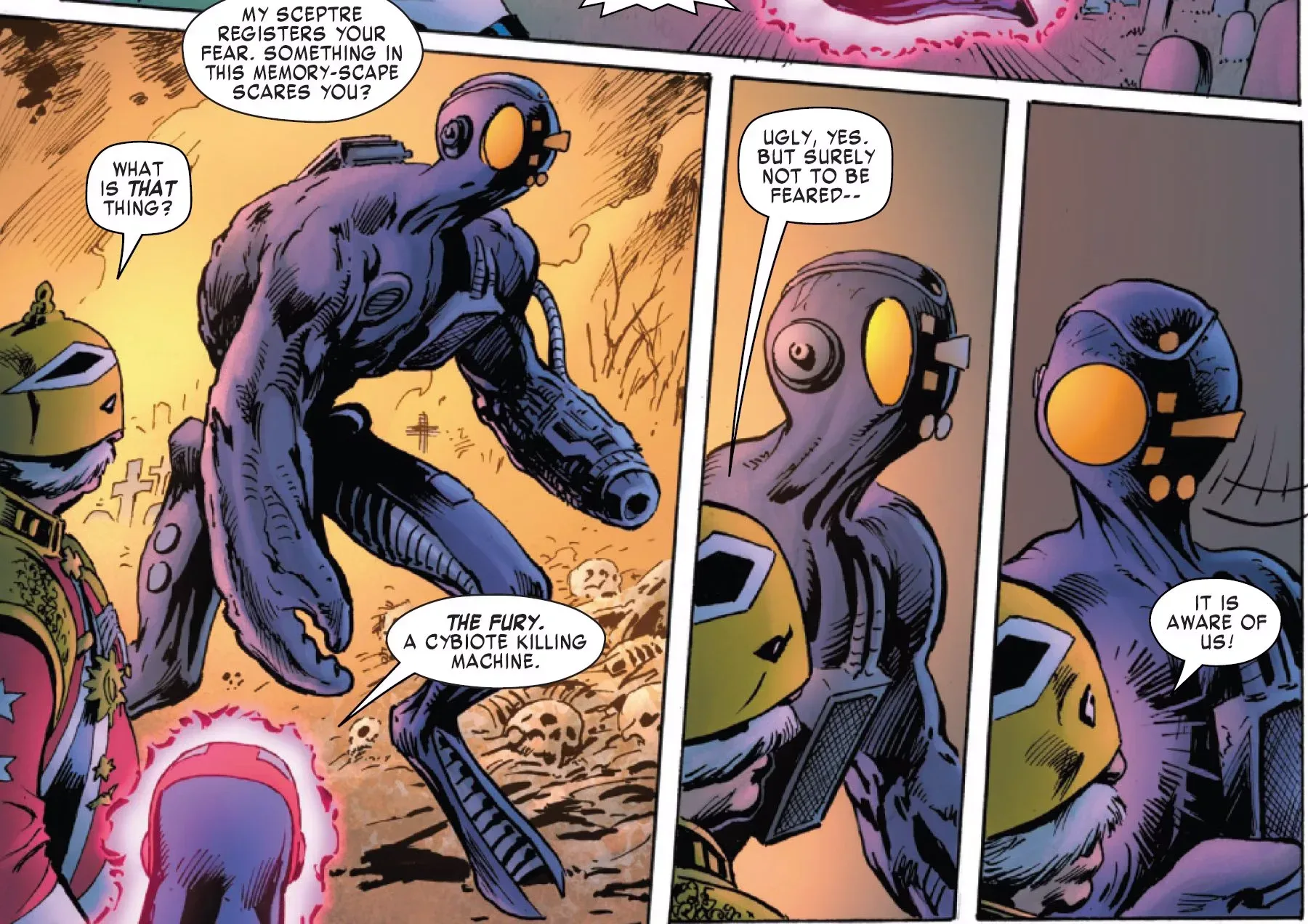
The Fury is described as a creation of James Jaspers from a world that was subsequently destroyed. The issue’s key horror is that destruction did not finish it. Even as a memory or historical fragment, the Fury persists and remains an extreme danger.
That concept is more unsettling than an ordinary return from apparent death. Superhero fiction has long accustomed readers to characters reappearing, but the Fury’s survival is presented as part of its nature. It is a thing that continues when normal narrative endpoints—defeat, death, even the loss of its world—should have stopped it.
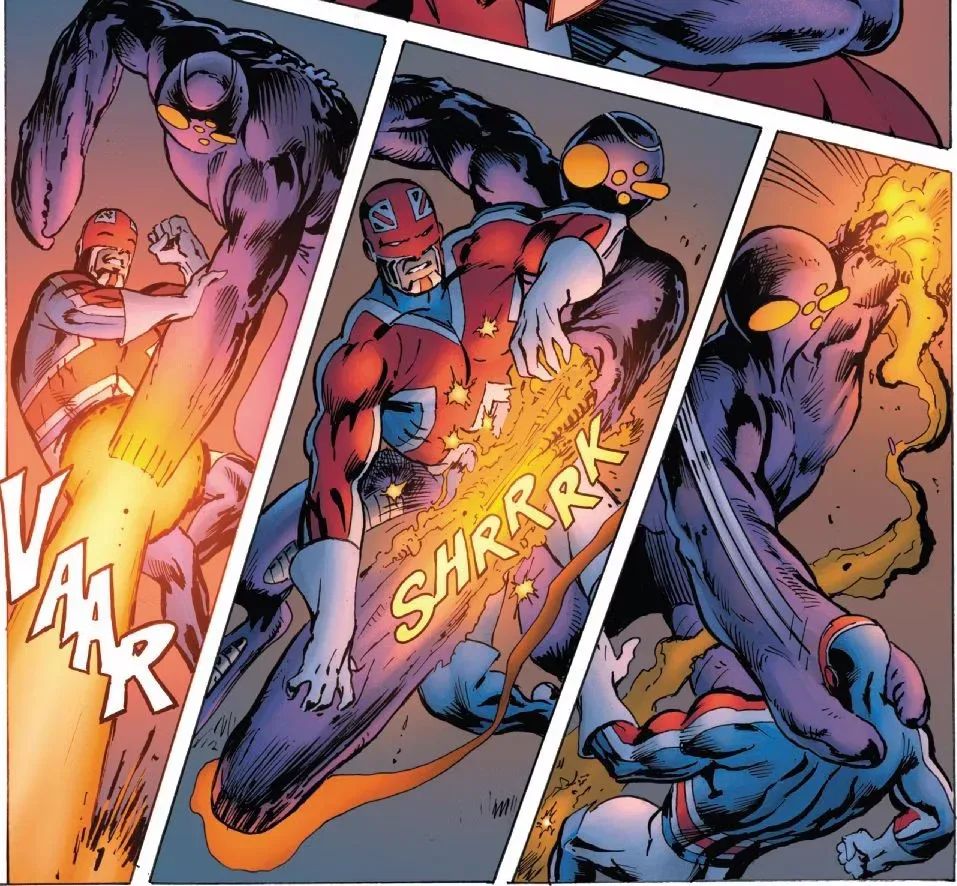
The special reinforces the scale of that menace by recalling its history: the Fury killed Captain Britain and killed the second James Jaspers. Those are not incidental victories designed to establish a villain’s credibility. They identify the Fury as a threat that has already crossed lines most comic-book adversaries are not permitted to cross. Captain Britain confronting it again is therefore a return to a conflict with a documented cost.
A historical fragment, in this context, is not simply an artifact sitting safely in a museum or archive. It is a surviving piece of the past with agency. The issue’s premise turns the comforting notion of history being over on its head. A fragment can move, kill and reassert itself. That is a clean fit for the Jaspers Warp, where boundaries between intact reality, ruined reality and remembered reality are no longer trustworthy.
There is a practical reading implication, too. Newer readers do not need to treat every reference as homework before opening the anniversary special. The immediate stakes are understandable from the setup: Jaspers destabilizes reality; the Fury is an exceptionally durable weapon or monster born from that chaos; Captain Britain has been killed by it before. Longtime readers, however, have a reason to pay close attention to the exact form the Fury takes and how the comic accounts for its continued existence.
Davis revisits a defining kind of Captain Britain danger
Alan Davis’s presence is especially significant because this is a return to characters and concepts tied to an earlier, defining era of Captain Britain storytelling. The issue’s setup points back to work Davis shared with Alan Moore and Jamie Delano, as well as material Davis later handled himself. The anniversary story is not presented as a clean break from that history; it deliberately activates its darkest elements.
That does not mean the comic is simply repeating an old confrontation. The new hook is the proposition that the Fury can endure as memory or fragment, and the new character of Major Archibald Payne adds another parallel-world consequence to the mix. In other words, the special uses recognizable mythology as a foundation rather than relying on recognition alone.
There is a fitting logic to choosing this material for a 50th anniversary. Captain Britain’s history is inseparable from the idea that a hero can have counterparts, replacements and distorted reflections across realities. Brian and Betsy Braddock are celebrated as champions of the Captain Britain Corps, an organization defined by a multiversal premise. Bringing back a reality-destroying anomaly and an adversary that seems able to outlive destroyed realities is an escalation of that same foundational idea.
The special consequently asks a more interesting anniversary question than “what has the character accomplished?” It asks what survives from a long-running superhero past—and whether survival is always good news. In this case, a historical reference creates Major Payne; a ruined world leaves the Fury behind; earlier Captain Britain conflicts return as current dangers. The past is not background decoration. It is active pressure on the present story.
Why the Braddock focus matters
The issue celebrates both Brian and Betsy Braddock rather than treating Captain Britain as a single fixed identity. That is appropriate for a property with deep ties to legacy, alternate versions and the Corps. The special’s advertised Brian-focused early-days story offers one view of the character’s roots, while the Davis material tests the Braddock side of the mythology against forces that cannot easily be contained.
The wording that someone has tried to “rein in a Braddock” hints at a conflict over control, a theme that sits naturally beside James Jaspers’s reality warping. Jaspers embodies uncontrolled transformation on a massive scale. The Fury represents the lethal consequence that keeps moving after transformation has consumed a world. Against both, the Braddocks stand not only as superheroes but as people whose family identity is inseparable from wider multiversal stakes.
For a broader Marvel-comics snapshot, readers can also see how a Spider-Man-focused news cycle recently intersected with discussion around Marvel’s comics business in this Marvel comics roundup.
What readers should take from the spoiler
The headline development is straightforward: the Fury returns, and Captain Britain must face it again. The important qualification is that this is not framed as a normal resurrection or a simple rematch. The Fury’s reappearance is tied to the Jaspers Warp and to its ability to persist despite the destruction of the reality from which it came. That makes it a continuation of Captain Britain’s most unnerving multiversal logic.
Captain Britain 50th Anniversary Special #1 is priced at $4.99. Its creative roster and split-story structure make it both a commemorative issue and a concentrated trip through the elements that have made the Braddocks’ corner of Marvel distinctive: early heroism, family legacy, mutant power, alternate realities and the alarming possibility that a nightmare from a dead world has not truly ended.
Shop the products
Check current price, model and availability at the retailer.