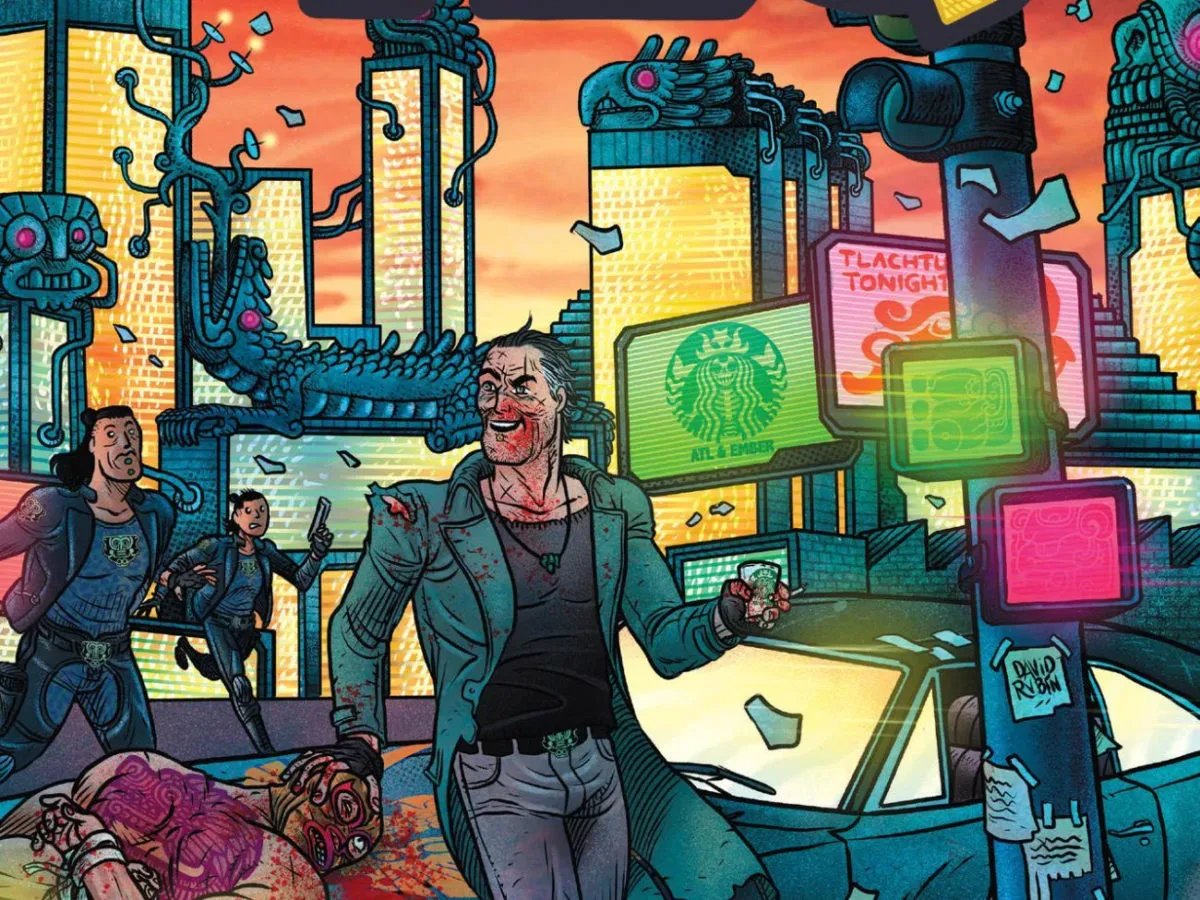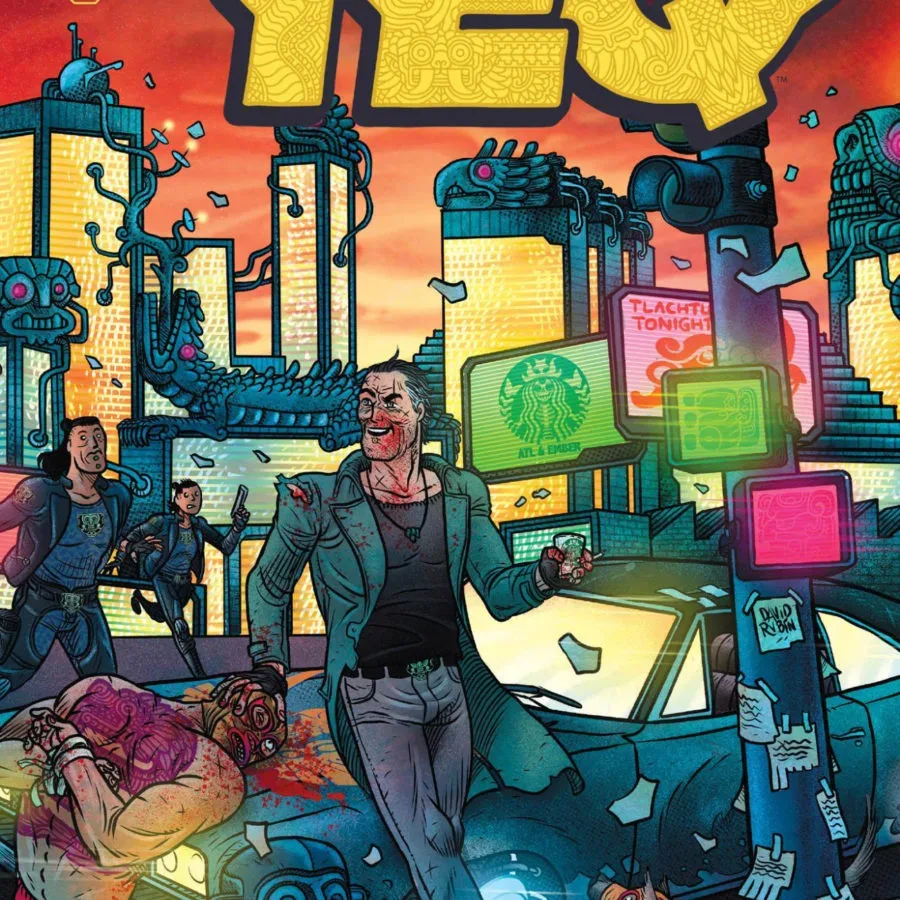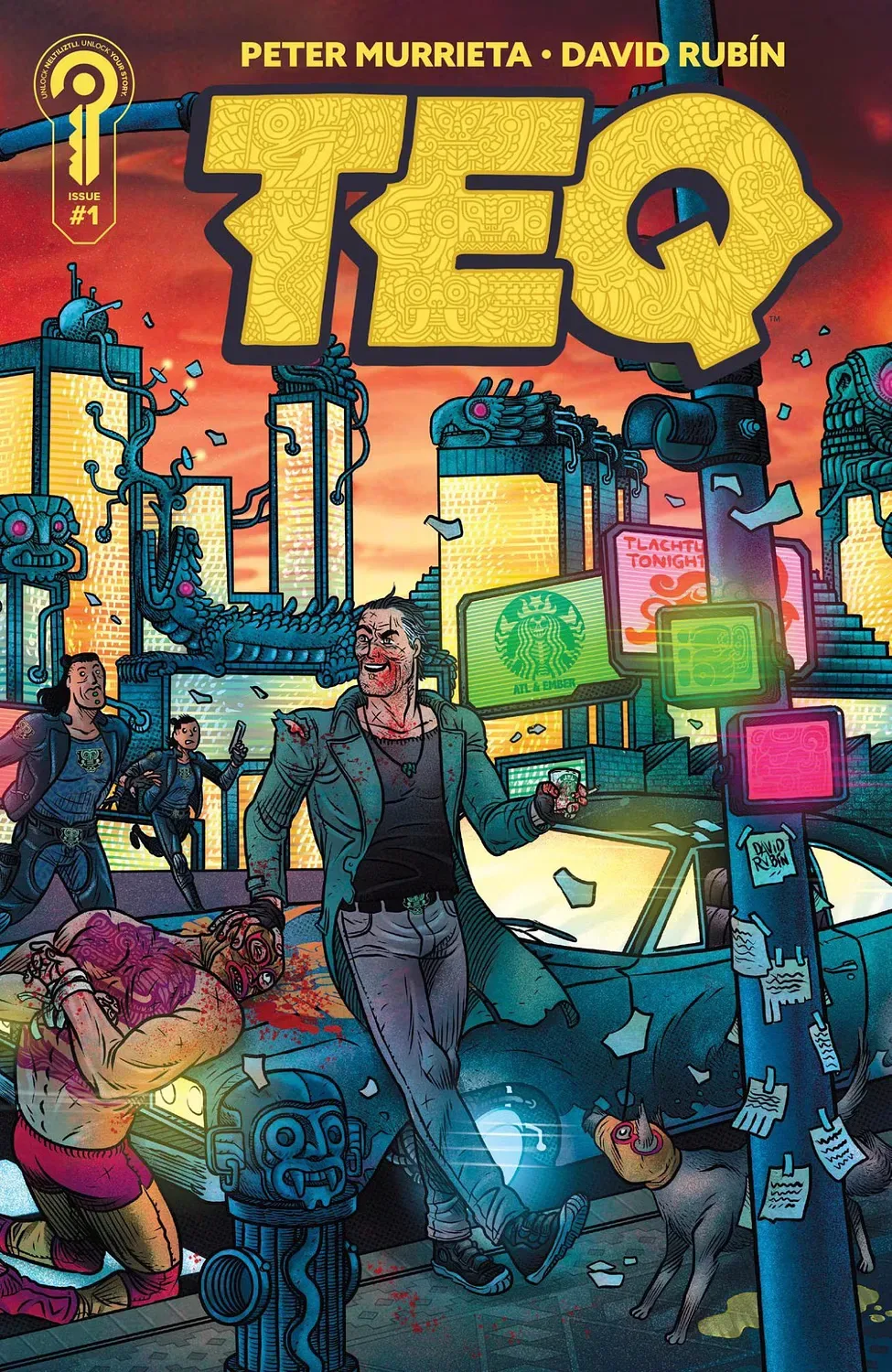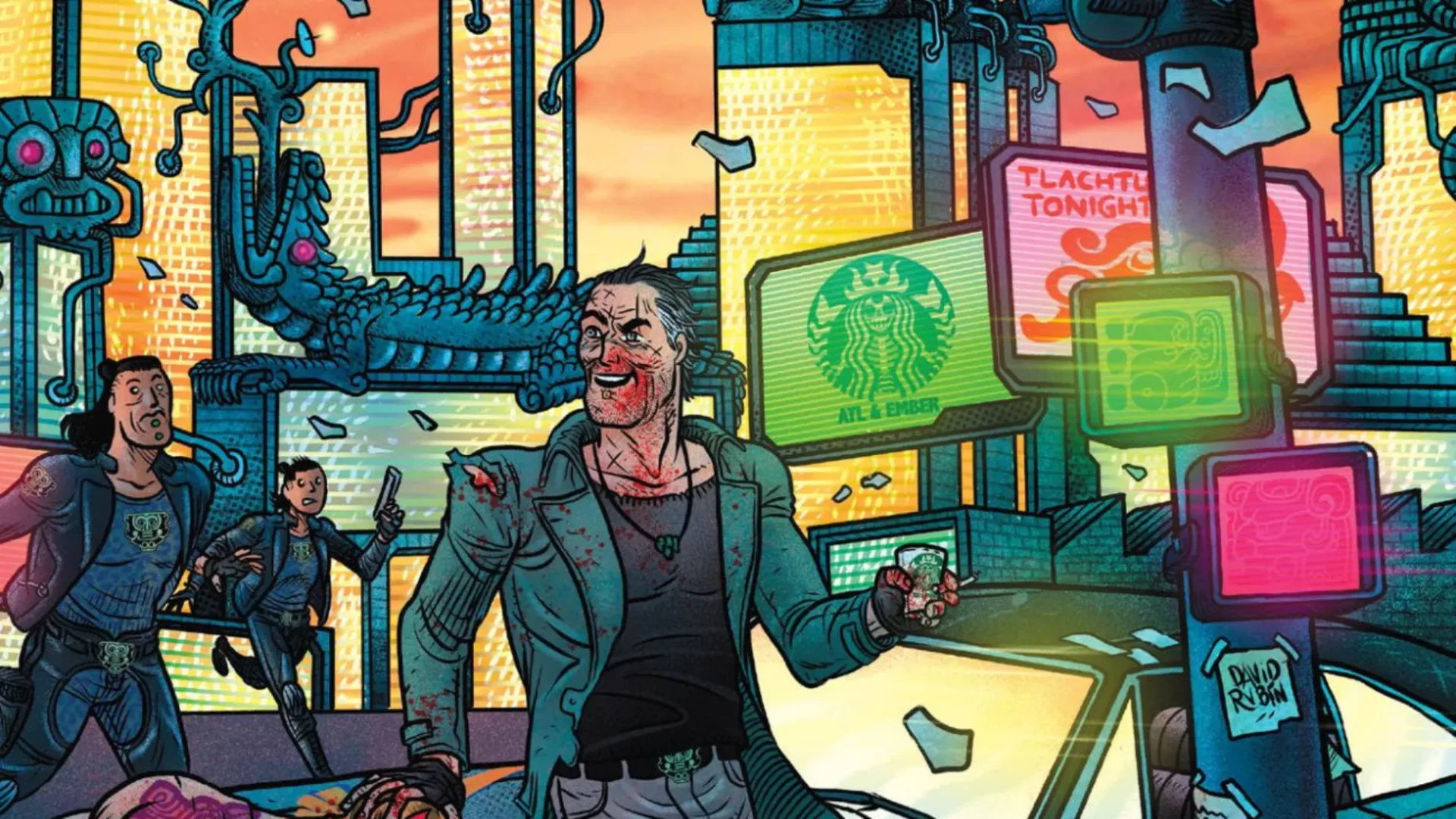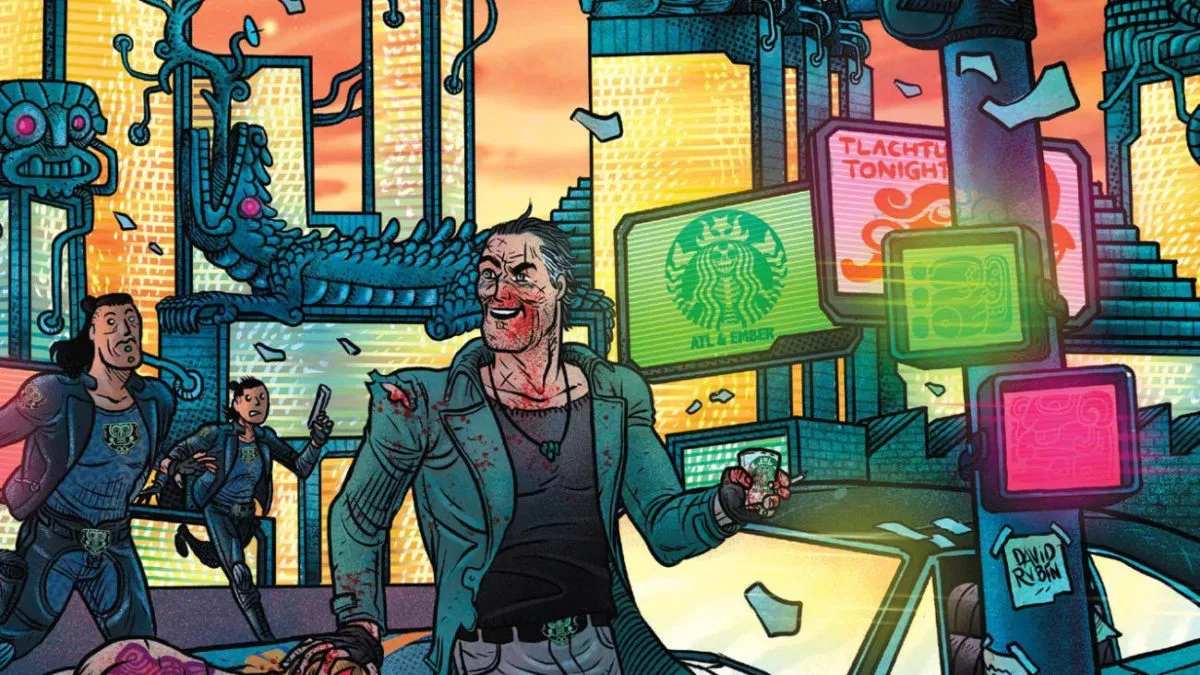
Teq, a five-issue alternate-history noir comic from writer Peter Murrieta and artist David Rubín, is planned to begin in February 2027. The series centers on its namesake: a hardboiled private investigator working in a Los Angeles shaped by the continuing rule of a thriving Aztec Empire.
The detective’s latest case concerns a sequence of brutal ritual murders. Those crimes are not merely a fresh assignment. They echo Teq’s prior service with the official police force and point toward old religious practices that have been dormant for a long time. The investigation also has immediate stakes at home: Teq’s daughter is moving into the next stage of her religious education.
That combination gives the premise several pressures at once. Teq is pursuing a conventional noir question—who is committing the murders, and why—but the answer appears connected to institutions, belief, family and the stability of the city itself. The series is being positioned as an Aztec noir rather than simply a mystery that borrows historical imagery.
What “Aztec noir” means for Teq’s premise
Alternate history is a speculative-fiction approach that imagines a world where a major historical outcome is different. Here, the changed premise is a Los Angeles under Aztec rule rather than the version of the city readers know. The supplied setup does not establish the precise historical divergence, the era in which the story occurs, or the full political structure of this Los Angeles. Those details remain to be seen on the page.
Noir, meanwhile, generally describes crime storytelling built around moral pressure, compromised institutions, dangerous revelations and protagonists who must navigate a world with no easy choices. Teq’s job as a private investigator makes him a natural fit for that framework. His previous police career suggests the case has institutional history, while the threatened resurgence of forbidden or long-suppressed practices gives the mystery consequences beyond an individual killer.
The crucial difference is that the setting is not decorative. Teq’s daughter’s education is part of the society around him, so the religious dimension of the case directly overlaps with his family. That makes the central conflict potentially more complicated than a detective simply confronting an external conspiracy. The material indicates that Teq’s professional instincts, history with law enforcement and role as a parent may all pull him in different directions.
A murder case with civic and personal stakes
The murders are described as ritual killings, and their connection to earlier practices threatens to destabilize the city. In mystery fiction, ritual elements can function as clues, a source of fear, or an organizing principle for the crime. In Teq, they also appear tied to the alternate society’s wider religious life. That makes it important to distinguish what is known from what is not: the announced premise confirms Teq will investigate the deaths and that the killings evoke long-dormant traditions; it does not identify a culprit, explain the rites, or reveal where Teq’s daughter stands in relation to the threat.
For readers, the five-issue length signals a deliberately finite arc rather than an open-ended launch with no stated endpoint. A limited series can give a murder investigation room for escalation while retaining a clear promise of resolution. It also means the creative team can build the setting in service of one case and one family conflict, rather than needing to introduce every aspect of this alternate Los Angeles immediately.
The premise leaves space for an especially useful noir tension: official knowledge versus private knowledge. Teq once worked for the police, but now operates as an investigator outside that force. His old career may give him insight into the murders’ history, yet it may also put him up against the limits and loyalties of the authorities he once served. That is an interpretation of the announced setup, not a confirmed plot detail, but it is the sort of friction the series’ detective premise invites.
The creative team behind the series
Murrieta writes Teq and will also provide additional prose material. His comics work includes co-creating Rafael Garcia: Henchman. His television credits include serving as head writer and executive producer for the first three seasons of Wizards of Waverly Place, along with work on Mr. Iglesias, One Day at a Time, Greetings from Tucson, Primo, Superior Donuts, Cristela and Lopez.
Rubín is the series artist. His work includes the Ether trilogy with Matt Kindt, as well as Black Hammer, Rumble, Cosmic Detective, Space Scouts and BRZRKR. Outside the United States, his published work includes El Circo del Desaliento, La Tetería del Oso Malayo, Cuaderno de Tormentas, El Héroe and Beowulf with Santiago García. He also co-directed the film El espíritu del bosque and co-founded the Polaqia collective.
El Torres will letter the comic. Lettering is a core storytelling role in a comic: it governs the presentation and flow of dialogue, narration, sound effects and captions, helping readers understand both sequence and tone. That craft could be particularly prominent in a detective story that may balance conversations, clues and Murrieta’s supplementary prose.
The announced cover artists are Gilbert Hernandez, J. Gonzo, Mexifunk, Dani and Rubín. Multiple cover contributors can offer collectors and readers different visual entry points, but no issue-by-issue cover breakdown or release details have been specified.
Why the prose component matters
Murrieta’s additional prose is a notable part of the announced package, though its format and frequency have not been detailed. Prose material in a comic can take many forms: reports, correspondence, diaries, historical excerpts or other documents. Nothing currently confirms which form Teq will use, so readers should not assume it will be an in-world case file or a backup story.
Even so, prose is a potentially fitting complement to the series’ structure. A noir investigation often relies on what is documented, concealed or misread. An alternate-history setting likewise benefits from tools that can communicate social context without requiring every explanation to happen in dialogue. Whether Teq uses its prose to expand the mystery, its city or Teq himself is one of the unanswered creative questions heading toward the 2027 debut.
Where Teq fits in its publisher’s slate
Teq comes from Ignition Press, a publisher founded in July 2024 by Eric Gitter, Filip Sablik, Jamie S. Rich and Jeremy Haun. The company began publishing creator-driven original series in the middle of 2025. Teq is part of a group of new 2027 projects being introduced by the publisher.
Its announced emphasis on a self-contained five-issue story gives the title a distinct identity within that creator-driven approach. Rather than leaning on an established superhero continuity or a licensed game world, the project starts with an original investigator, an unfamiliar political reality and a murder case that places a father’s personal life alongside a threat to his city.
It also arrives during a busy period for comics and graphic-novel announcements. For a wider look at the range of projects surfacing around that calendar, see our coverage of a packed week of comics news.
What has—and has not—been confirmed
- Confirmed: Teq is a five-issue alternate-history noir series scheduled to debut in February 2027.
- Confirmed: Peter Murrieta writes the series, David Rubín draws it, El Torres letters it, and Murrieta contributes additional prose.
- Confirmed: Teq is a private investigator in an Aztec-ruled Los Angeles investigating ritual murders connected to older religious practices.
- Confirmed: Teq’s daughter is entering a further stage of religious education, bringing the case close to his family.
- Not specified: Individual issue dates, pricing, format, complete cover assignments and the exact content of the prose material.
- Not specified: The complete history of this alternate Los Angeles, the murderers’ identities or how the daughter’s education intersects with the case.
For now, Teq has a focused hook: an investigator follows ritual killings through a radically different Los Angeles while the beliefs at the center of the case reach into his own household. The full implications of its Aztec noir label will depend on how Murrieta, Rubín and the wider team develop that collision of mystery, family and civic unrest across the five issues.