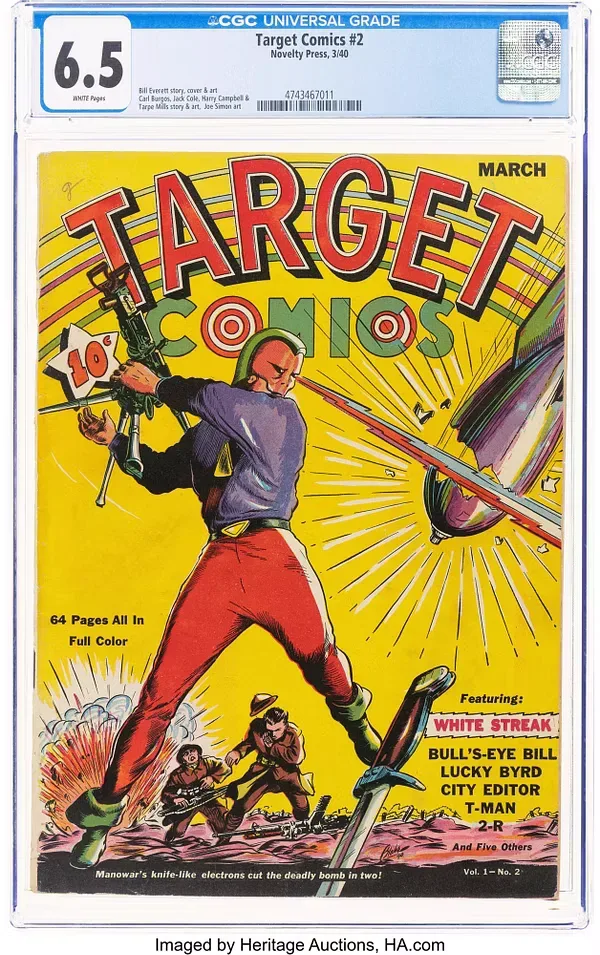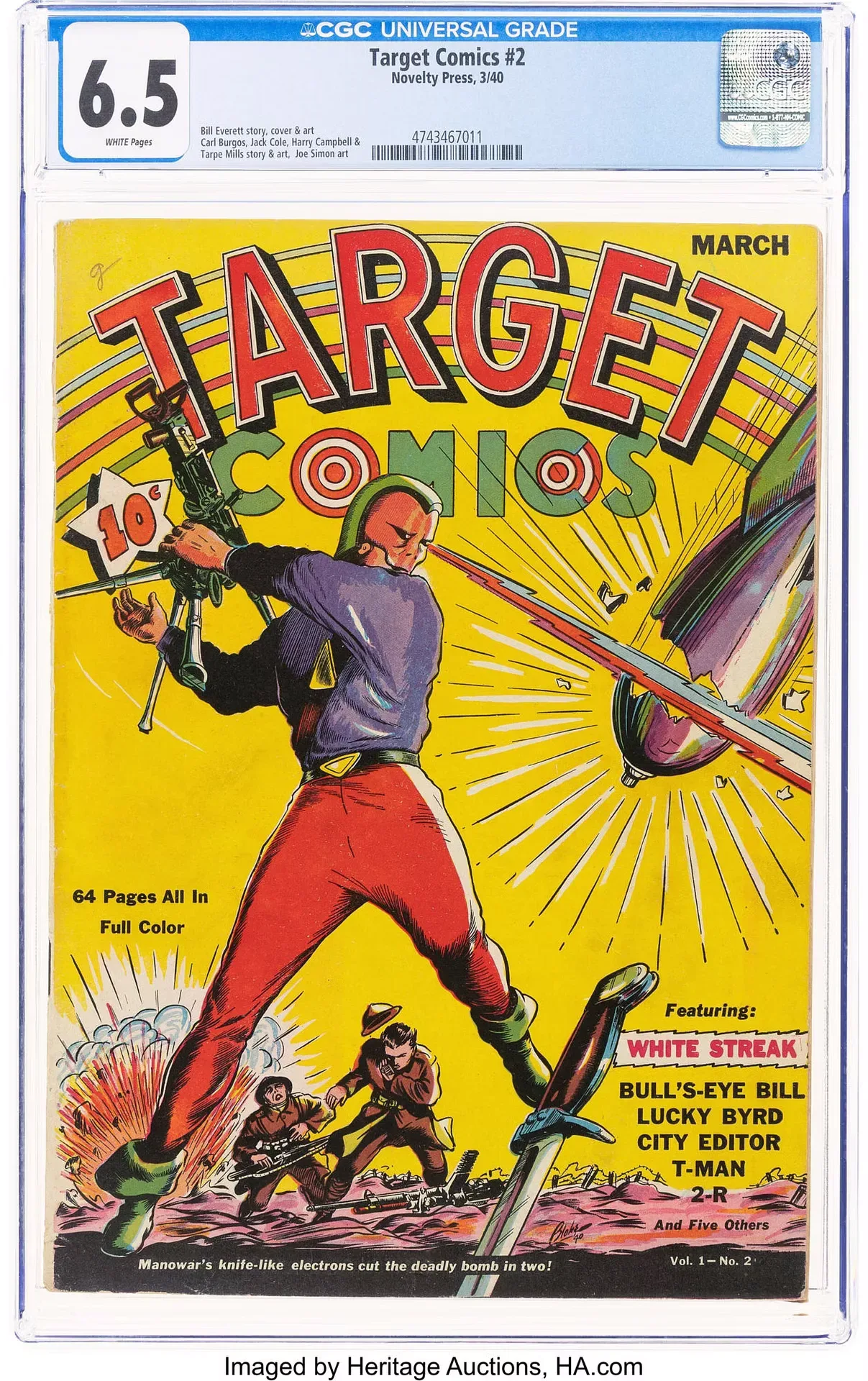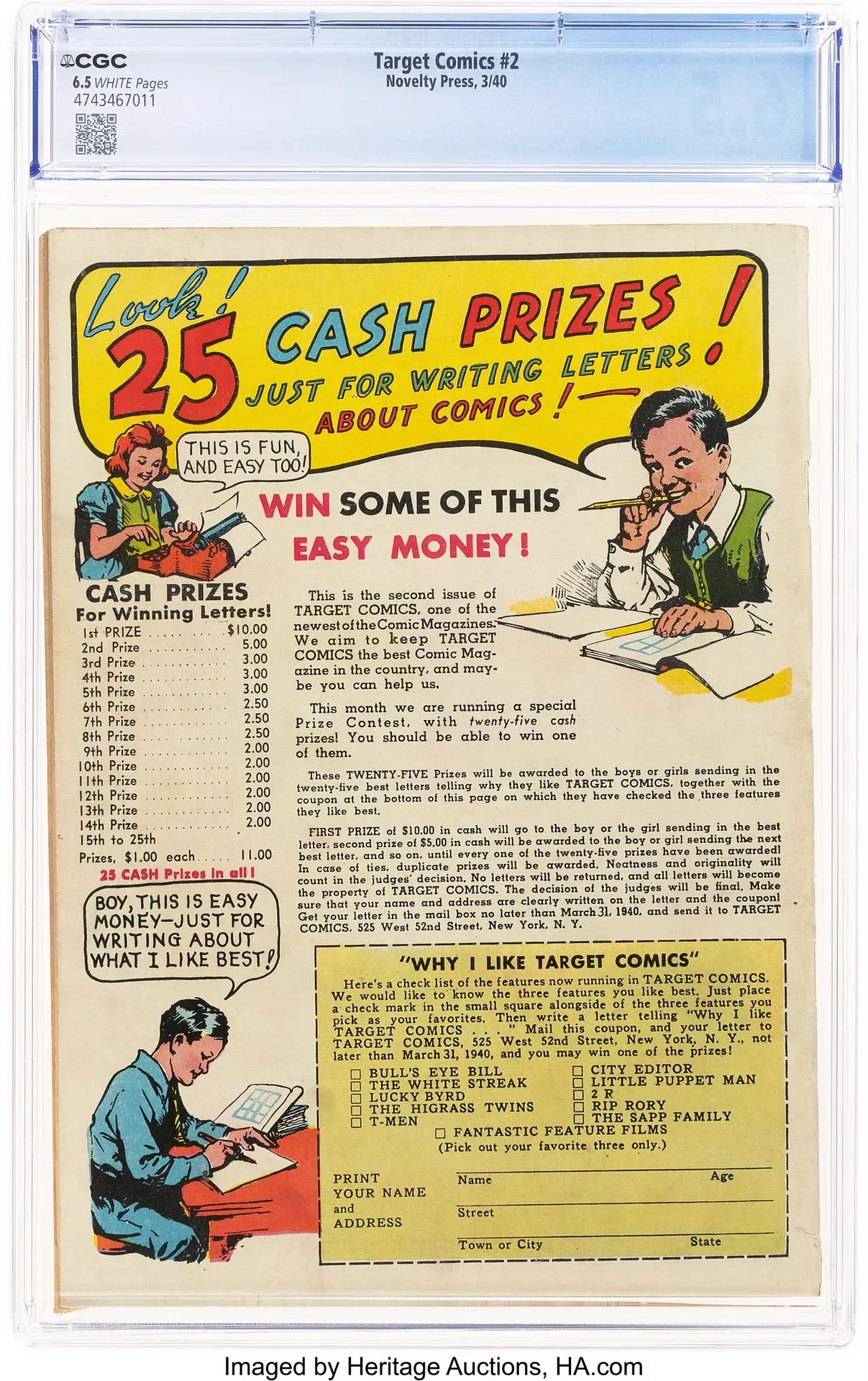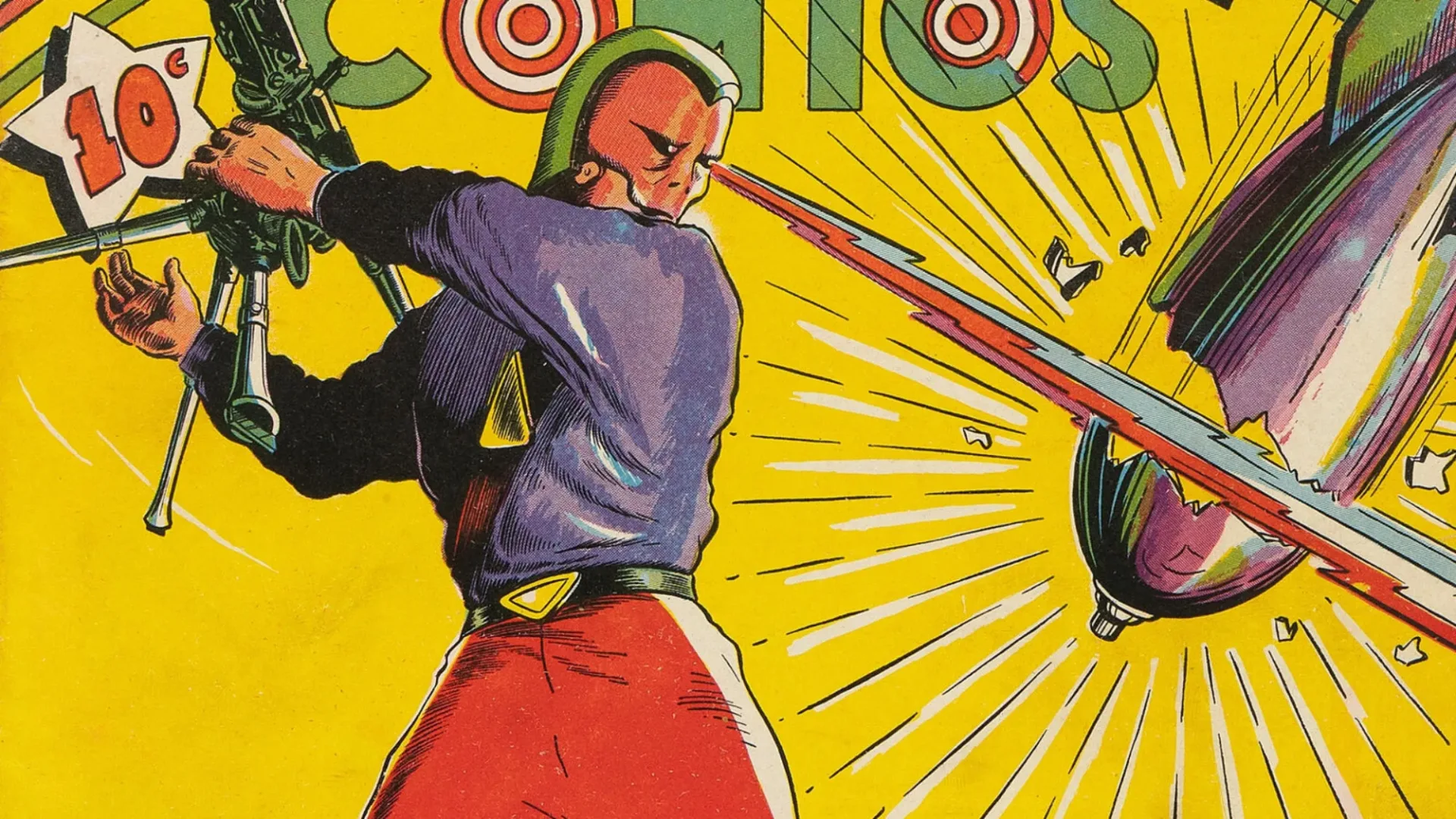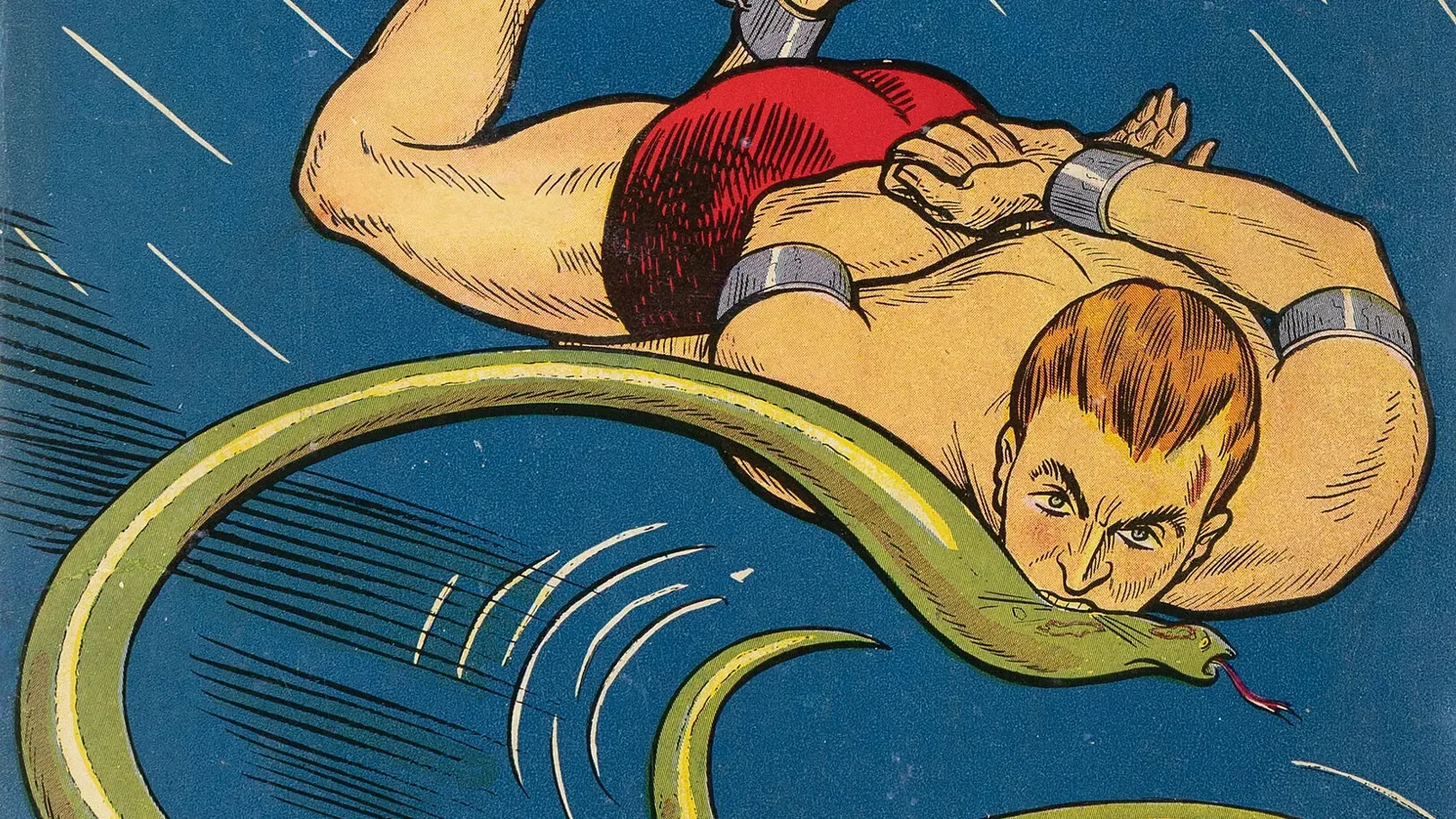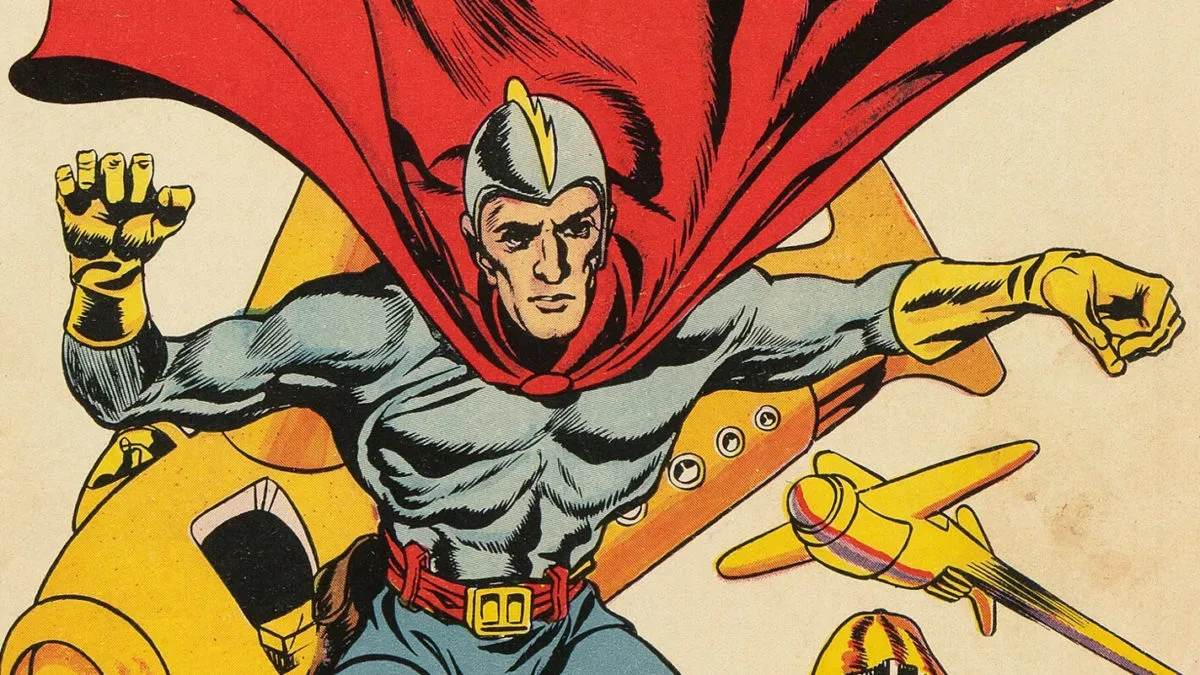
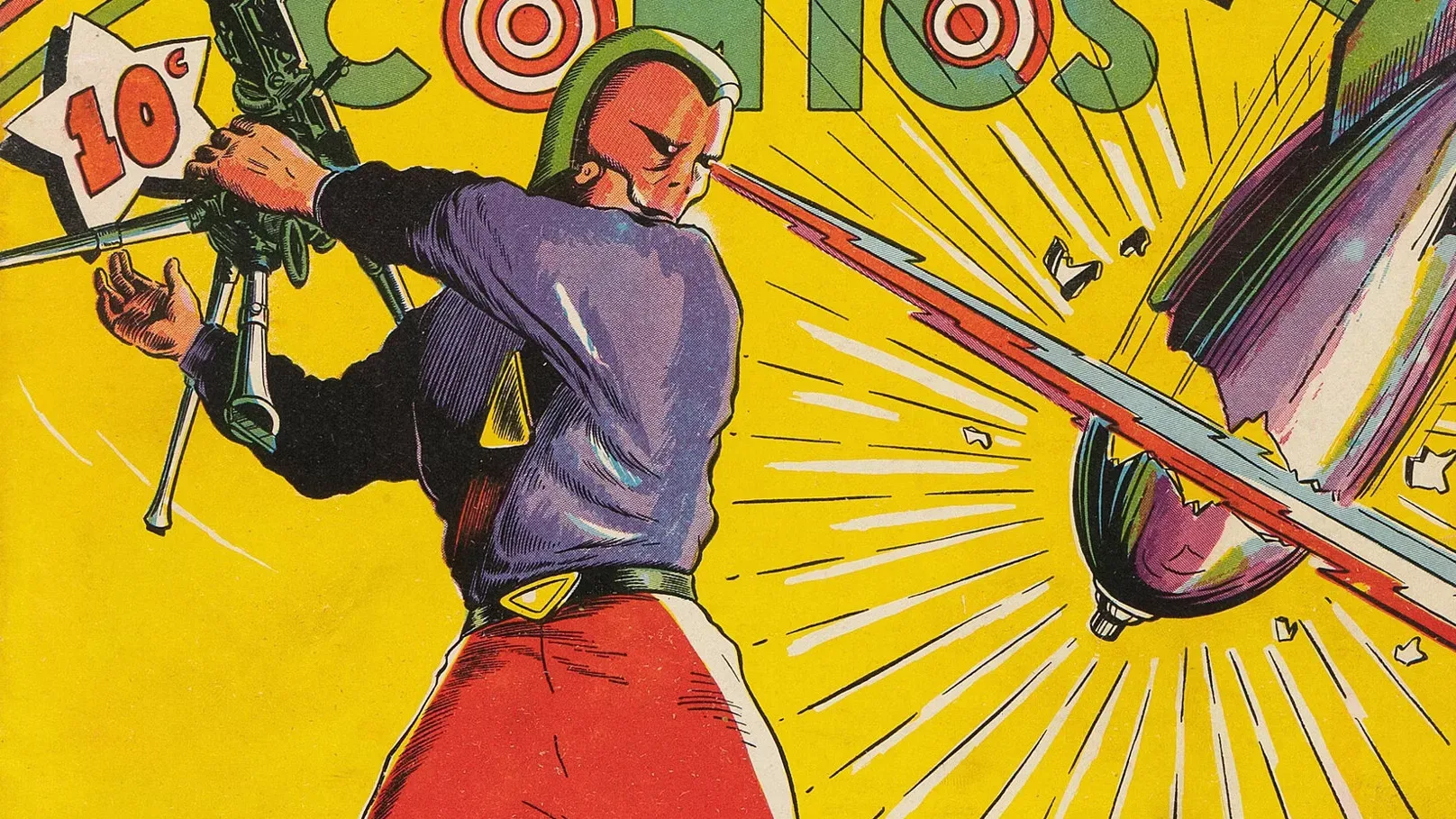
Target Comics #2, a 1940 issue from Novelty Press, is heading to auction in CGC FN+ 6.5 with white pages. Its appeal is not limited to its scarcity or to the cluster of notable Golden Age names in its credits. The comic also contains two stories that approach the growing reality of war from notably different angles: Tarpé Mills imagines a world in which weapons simply stop functioning, while Carl Burgos focuses on the commercial interests that can flourish around conflict.
The issue includes work by Mills, Burgos, Jack Cole and Joe Simon, with a cover by Bill Everett. That combination makes it an especially concentrated example of early comic-book talent in a single Novelty Press issue. For readers interested in comics as cultural artifacts, the stories offer as much to consider as the roster of creators: both confront warfare, but neither treats it as an unavoidable backdrop for ordinary adventure.
A scarce Target Comics issue with a major creator lineup
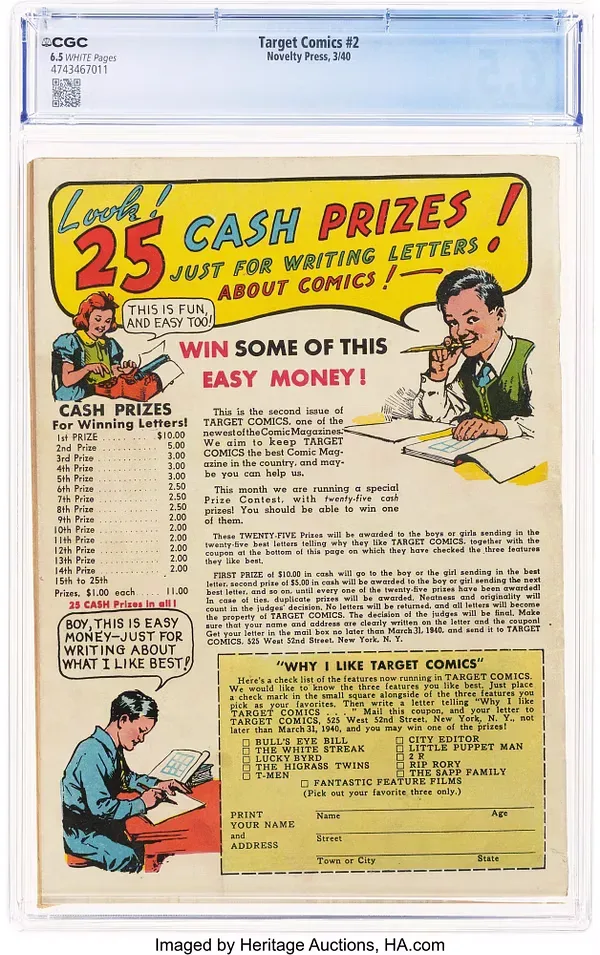
The offered copy is a certified Fine Plus 6.5. In comic grading, a numerical grade is an assessment of a specific copy’s physical condition, rather than a judgment of the issue’s writing, art or historical significance. “White pages” refers to the paper-page color designation assigned to the slabbed copy, an especially useful detail for collectors examining an old paper comic.
Population data supplied for the issue lists 12 copies on the CGC census, with three Universal-label copies at 6.5 and only one recorded higher. A Universal label generally denotes a standard unrestored collectible comic. Census totals are not a complete count of every surviving copy; they reflect comics submitted to that grading service. Still, a low total can help establish why an issue may be difficult to encounter in certified form.
The auction listing notes that a copy at this grade has not appeared through the auction house in 18 years. That does not establish an overall market value or guarantee a result, but it does frame the offering as an unusual chance to see a relatively high-grade example of a scarce 1940 comic with several consequential contributors.
Tarpé Mills imagines disarmament in “Devil’s Dust”
Before the 1941 debut of Black Fury, the character later known as Miss Fury, Tarpé Mills contributed “Devil’s Dust” to the issue’s Fantastic Feature Films feature. The setup adopts a movie framing device: the story presents fictional performers rather than simply introducing characters directly. Orson Black, billed as “The Man of a Thousand Faces,” plays Hugo the Hideous, while Bruce Brian is cast as American war correspondent Steve Mason.
Hugo is a French outcast whose appearance has isolated him from others. At first, he sees the prospect of war in bleakly personal terms. If violence leaves other people disfigured, he reasons, they may come to resemble him. Steve’s friendship shifts that outlook and creates the story’s central human change: Hugo gains a reason to want an end to the violence rather than a cruel leveling of suffering.
The title device is a powder located in a nearby cave. Its function is unusually selective. It dissolves metal while leaving living beings, clothing and paper intact. Rather than winning a battle through a larger weapon, the protagonists erase the material basis of fighting. Guns, tanks and barbed wire disappear after the powder is dispersed over opposing lines, and Steve says an armistice will follow.
It is an unapologetically fantastical solution, but it is also a clear expression of disarmament. The story does not solve war by making one side stronger, more technologically advanced or more destructive. It removes the tools of armed conflict from everybody. That premise gives “Devil’s Dust” an unusual focus for an early-1940 war story: peace comes not through triumph in battle, but through making battle mechanically impossible.
The story’s metal-destroying powder is fictional, of course, and its practical consequences are deliberately simplified. But the narrative rule matters. By sparing people and everyday non-metal objects, Mills directs attention toward military infrastructure rather than indiscriminate destruction. Hugo’s emotional arc also prevents the device from becoming only a clever science-fiction trick. His shift from alienation to hope is the reason the broader anti-war premise has personal weight.
Burgos examines war’s financial incentives
Carl Burgos, widely known as the creator of the Human Torch, takes a more economic route in his Manowar material. An industrialist named Tomsen creates an alloy called Chromelac and anticipates enormous profit as war expands. Dr. Simms, an associate of Manowar, fears that this pursuit of profit could help pull the United States into the conflict.
Where Mills imagines the removal of weaponry, Burgos asks who benefits when weaponry remains essential. The contrast makes Target Comics #2 more coherent than a random collection of adventure strips. Both stories are interested in disarmament and war, but one is built around a speculative physical solution and the other around incentives, industry and political anxiety.
The Chromelac plot has a real historical parallel in the controversy examined by the U.S. Senate’s Nye Committee during the 1930s. That inquiry investigated whether arms manufacturers had pushed the nation toward involvement in World War I. The Senate’s own historical account notes that the investigation found little hard evidence of an active conspiracy. That qualification is essential: the committee’s existence shows that public suspicions around arms makers and war were significant, but it does not validate every allegation that grew from those suspicions.
Burgos’s story reflects that atmosphere of concern rather than serving as evidence for it. Its industrialist embodies a fear that war can become profitable enough for private interests to view escalation as opportunity. Dr. Simms’s warning turns that fear into the story’s moral argument. The issue therefore preserves a piece of early comic-book fiction responding to contemporary anxieties without requiring readers to mistake its melodrama for a historical record.
Why the issue matters beyond the slab
Target Comics #2 offers several distinct reasons for comic collectors and historians to pay attention. It has a Bill Everett cover, early material from Mills before her better-known Black Fury/Miss Fury work, a Burgos story linked to themes that had real political resonance, and additional contributions from Jack Cole and Joe Simon. Those facts do not make every copy identical in desirability; condition, restoration status, page quality and individual buyer priorities still matter. They do, however, explain why the issue carries interest well beyond a single character’s debut or a famous cover alone.
Mills’s presence is particularly notable because “Devil’s Dust” lets readers see a creative concern that predates Black Fury’s 1941 arrival. The story is not presented as a prototype for that later feature. Instead, it shows Mills working with outsized genre concepts, a character shaped by social exclusion, and a plot resolved through a moral reversal rather than pure force.
For Burgos, the value is in the topical sharpness of the Manowar story. The Human Torch connection may be the name many readers recognize first, but Chromelac and Tomsen make this contribution worth examining on its own terms. The plot’s concern with profiteering adds a grounded, political counterpoint to Mills’s impossible cave substance.
The issue also sits within a broader ongoing interest in how comics travel across eras and formats. Modern comic projects continue to emerge around long-running game and genre properties, including the comic Kickstarter discussed in BloodRayne’s 25th-anniversary plans. Target Comics #2 comes from a very different moment, but it is a reminder that comic books can preserve the concerns, experiments and commercial pressures of their own time as vividly as they preserve familiar characters.
A collectible built around more than rarity
The Target Comics #2 CGC FN+ 6.5 with white pages is included in the November 5, 2026 Golden Age Century Comics Showcase Auction VI, numbered 40378. Potential bidders should distinguish the verifiable details of the offered copy from broader assumptions about scarcity. The certification grade, page designation and census count describe the offered collectible and its recorded grading population; they do not predict a final price.
What is clear is that the comic has an uncommon convergence of material. It is a scarce 1940 Novelty Press issue, it features a deep creator lineup, and it contains two stories that use popular-comics fantasy to wrestle with the question of how war begins, persists and might end. Mills removes the means of violence. Burgos interrogates the reward for supplying it. Eight decades later, that pairing remains the most compelling reason to look past the cover and open the book.