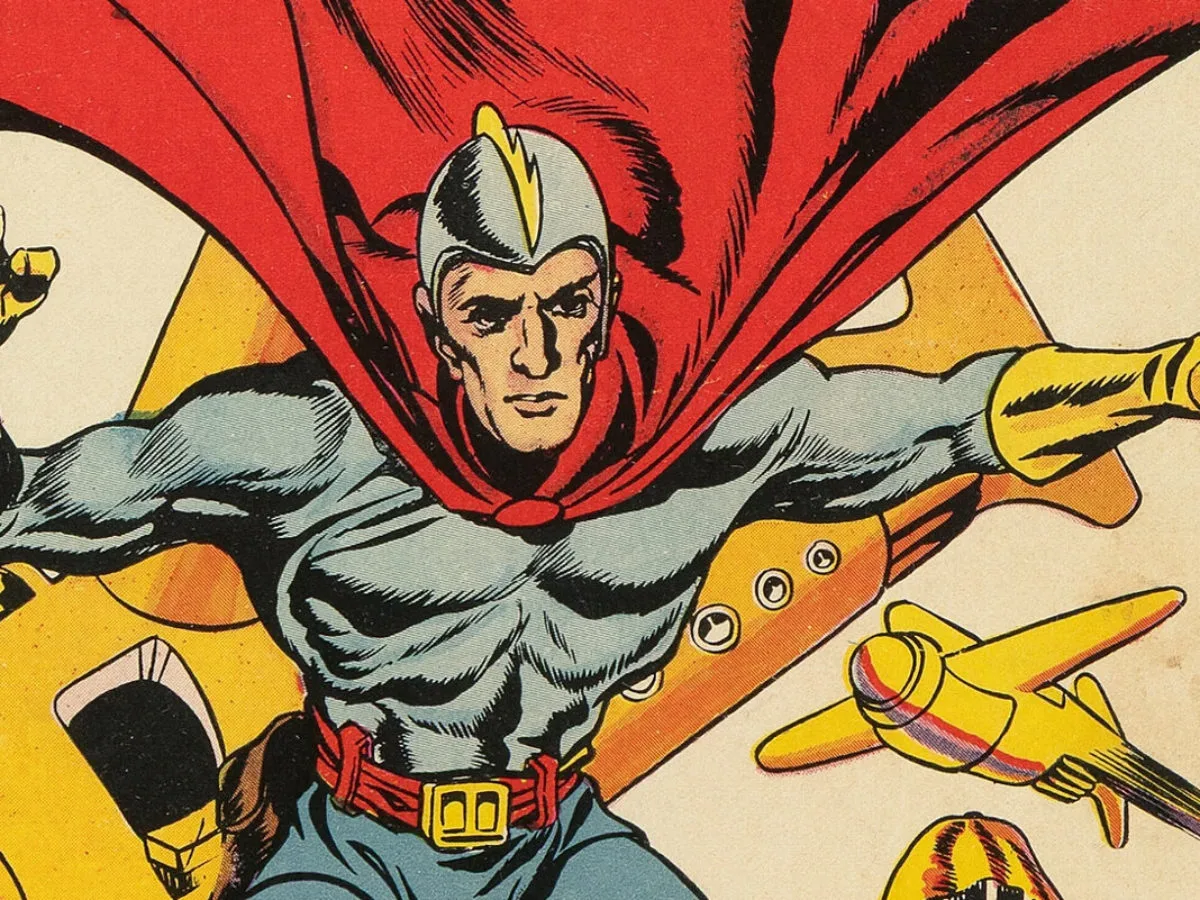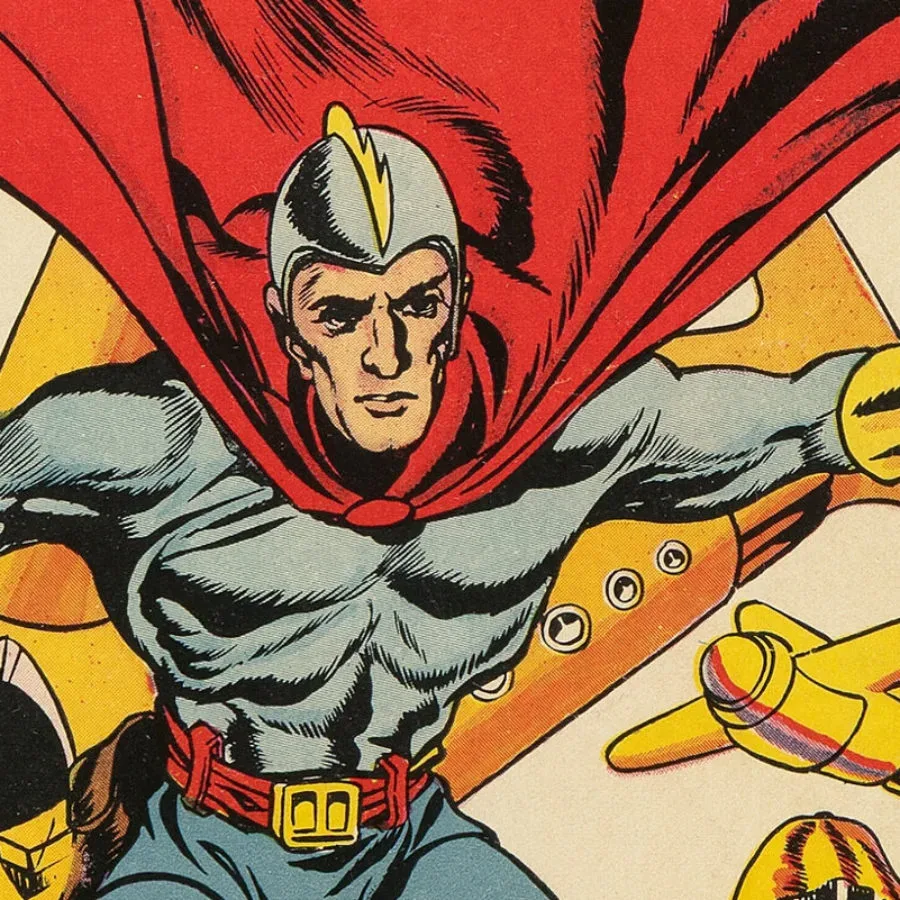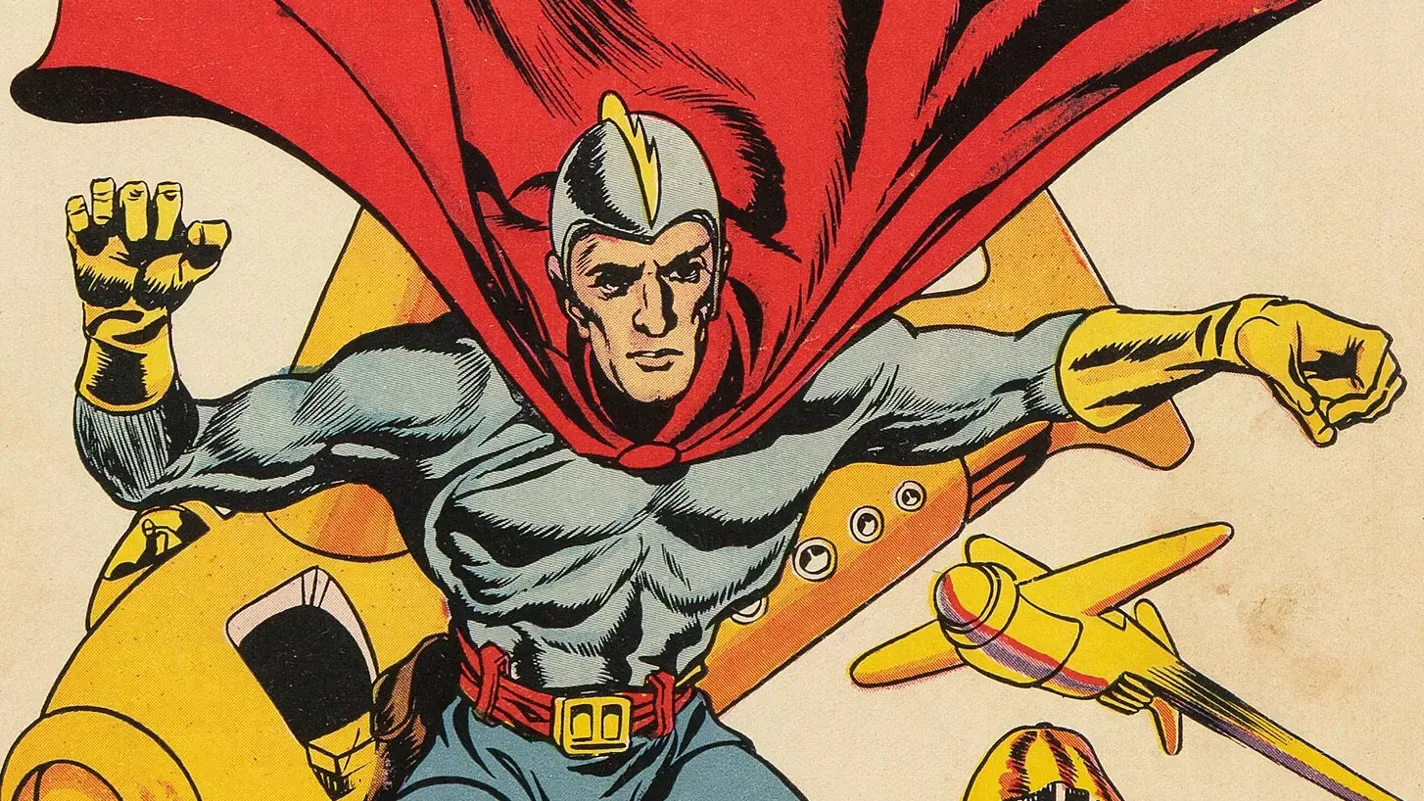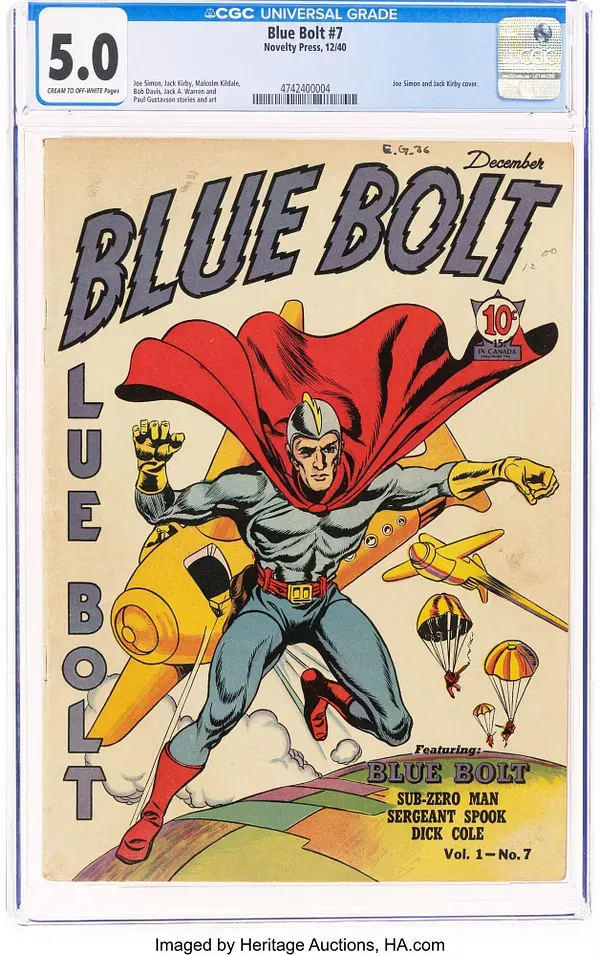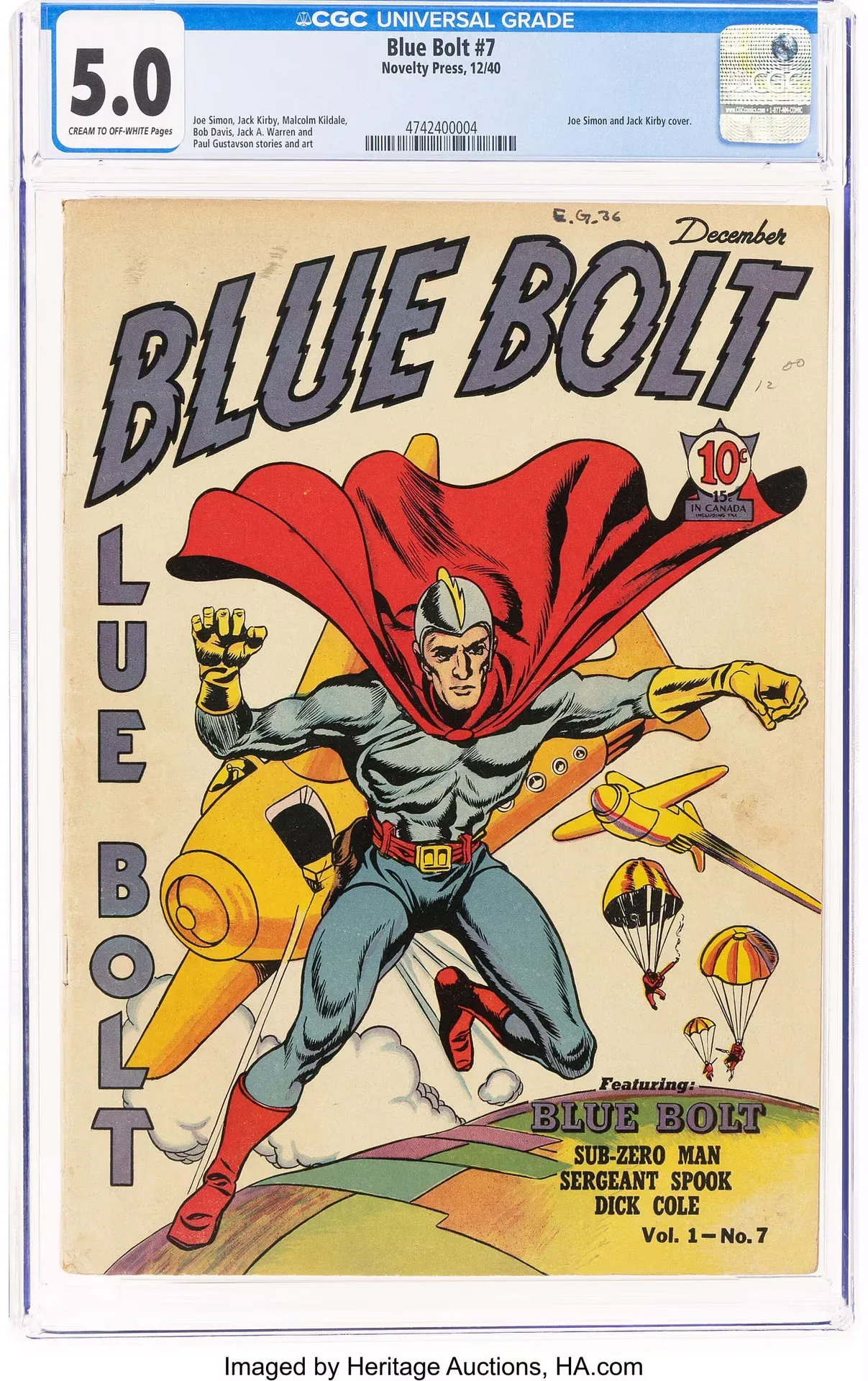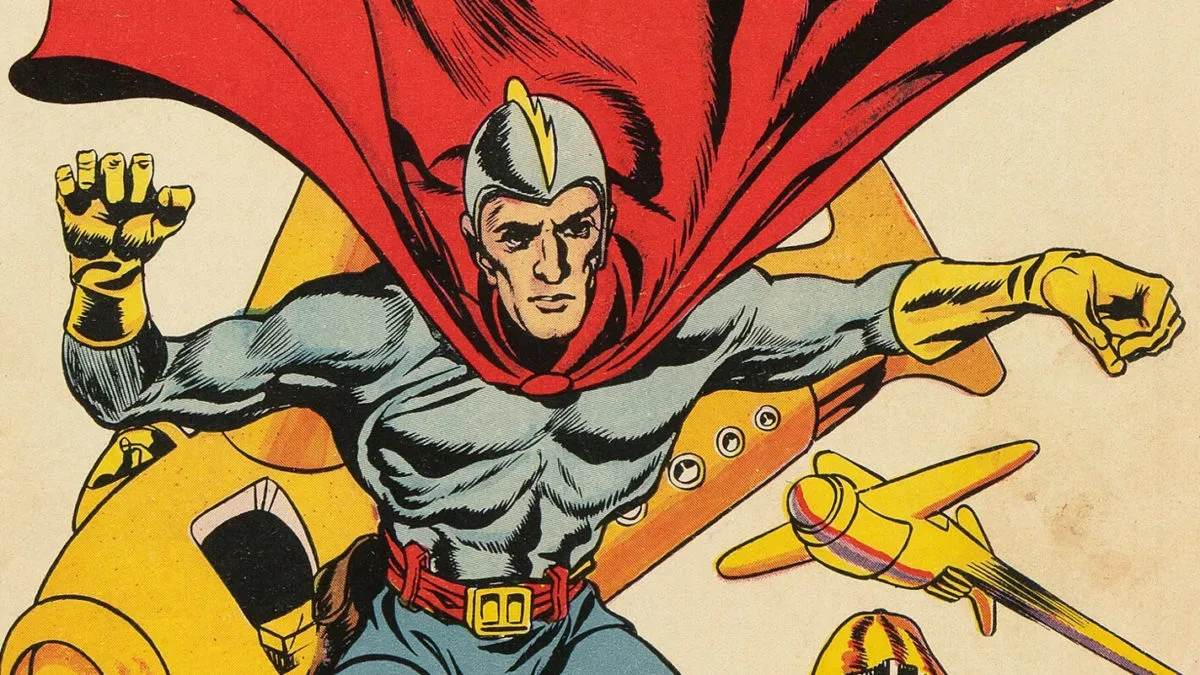
One of the more striking early intersections of superhero adventure, pulp-style science fiction and a rapidly darkening world situation is headed to auction in the form of Blue Bolt #7. The Novelty Press comic, dated December 1940, contains a key early collaboration by Joe Simon and Jack Kirby and places its conflict in direct conversation with the warfare readers were seeing unfold beyond the page.
A CGC VG/FN 5.0 copy with cream-to-off-white pages is listed for the November 5, 2026 Golden Age Century Comics Showcase Auction VI, identified as lot #40378. For collectors, the appeal is not solely the issue’s age or its credited creative team. It is an unusually concentrated example of a Golden Age comic turning contemporary anxieties into story machinery: the Green Sorceress witnesses the tactics of Europe’s dictators, learns from them, and uses that knowledge to reverse what had appeared to be Blue Bolt’s victory.
A villain finds a new playbook
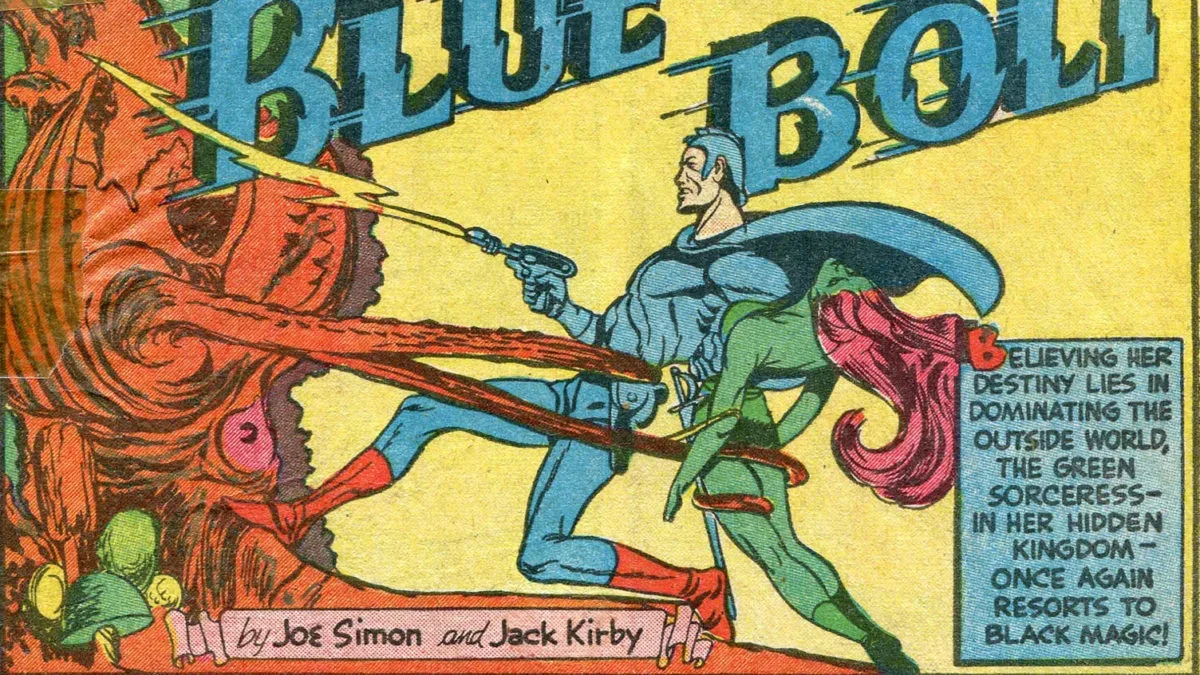
The premise begins after an apparent resolution. Blue Bolt has demobilized his troops, while the Green Sorceress seems to have surrendered. That calm is undone through Bertoff, Blue Bolt’s scientist colleague, whose telescreen reports on war from beyond a radioactive barrier surrounding Earth’s outer world.
What the Sorceress sees is grim and explicit: refugees being machine-gunned, airborne forces descending by parachute, mechanized tank formations advancing and dive bombers overwhelming opponents. Rather than merely serving as a backdrop, those scenes alter the antagonist’s strategy. The Green Sorceress escapes and applies the observed combination of speed, aerial power and psychological pressure to her own Green Army.
That is the issue’s crucial twist. The war references are not decorative shorthand for danger; they supply the antagonist’s tactical education. Blue Bolt and his allies believe the crisis has ended precisely when their opponent has gained a more effective way to fight.
Blitzkrieg, the term attached to her new approach, is central to that framing. In the story’s use of the idea, it means rapid, coordinated force: tanks, aircraft and airborne troops used to overwhelm an enemy before a conventional response can settle into place. The comic transforms that alarming real-world model into science-fiction spectacle without separating the fantasy conflict from the period’s wartime atmosphere.
Why this issue stands out in an early Simon and Kirby run
Simon and Kirby are credited here at an early point in a partnership that would become enormously significant in American comics. In Blue Bolt #7, their work is notable for pairing a large-scale genre conflict with a plot directly shaped by events readers would have recognized as urgent. The account of the issue describes the science-fiction visuals as especially spectacular, while also identifying both its cover and interior feature as high points of the Novelty-published series.
The premise gives the artists and writers a lot to stage: a defeated enemy, a distant telescreen delivering images of mechanized destruction, an escape, and a renewed attack under a doctrine of speed. It is a narrative structure built around escalation. The heroes’ confidence is not simply misplaced; it becomes a vulnerability that the villain exploits.
For a modern reader, there is a sobering quality to that mechanism. The issue dates from December 1940, and its fictional world absorbs reports of warfare into entertainment at the moment when the escalating conflict was already reshaping public life. Its science-fiction setting provides distance, but the details it chooses—parachutists, tanks, dive bombers, propaganda and refugees—keep the story tied to recognizable fears.
That makes the comic useful as more than an early superhero artifact. It demonstrates how Golden Age comics could respond to the political moment through exaggerated adventure forms. The Green Sorceress does not reproduce a single military event; she takes a composite view of modern war and converts it into an actionable villain strategy.
War stories beyond Blue Bolt
The wartime focus does not stop with the lead feature. Other material in the issue brings the conflict closer to the United States, using threats to military equipment and aviation as the basis for adventure.
In Runaway Ronson, a story attributed to Paul Gustavson, thieves divert railroad guns being transported from a Midwestern arms plant to an Atlantic coastal-defense site. Their intended sale abroad turns the plot into an arms-security story, with domestic infrastructure and coastal defense at its center.
Andrew McWhiney’s prose serial The Ray Master takes a different route. It involves U.S. Army Air Corps B-18 bombers, a mesa stronghold and a paralysis ray. The combination is quintessentially pulp-inflected: real military hardware shares the stage with an implausible super-weapon and a dramatic remote hideout.
Together, these stories make Blue Bolt #7 feel less like an isolated superhero chapter and more like a package shaped by wartime concerns. The main story imagines an enemy adapting foreign tactics. The backup material worries about weapons diverted before reaching a defensive destination and turns military aircraft into a vehicle for speculative adventure. The tonal approaches differ, but the through-line is clear: war had become a powerful source of stakes, imagery and plot devices.
What the listed grade and census figures tell collectors
The auction copy is graded CGC VG/FN 5.0. “VG/FN,” or Very Good/Fine, is the condition designation paired with the 5.0 numeric grade in the listing; the page description is cream to off-white. Those details matter because comic collecting places considerable emphasis on the physical state of a surviving copy, including the condition of the book and its paper.
The available CGC census figures underscore that the issue is not commonly represented in the grading records supplied for it. There are 15 Universal entries listed, including two copies at 5.0 and four at higher grades, alongside five Restored entries.
In straightforward terms, a census is a record of copies submitted and recorded in a grading population, not a count of every surviving copy in private hands. The figures are therefore a useful snapshot for comparing graded examples, rather than a definitive inventory of all existing copies. Likewise, the listed distinction between Universal and Restored entries matters because the census separates them into different categories; a buyer considering this specific 5.0 copy can see where it sits among the recorded Universal examples mentioned here.
The numbers alone do not establish a sale value, and no estimate or realized price is provided. They do, however, offer practical context for anyone following the auction: there are only two recorded Universal 5.0 examples in the cited census, with four Universal copies above that level. Condition-focused bidders will likely look closely at the book’s stated grade, page quality and category when weighing it against other known submissions.
A collectible with several stories to tell
Blue Bolt #7 has multiple collecting hooks that reinforce one another. It is a 1940 Novelty Press comic; it features an early Simon and Kirby collaboration; it contains a cover regarded as a possible series best; and its contents offer a concentrated wartime snapshot across superhero, crime and prose-adventure formats.
Its most distinctive trait is still the Green Sorceress’s transformation from defeated captive to tactician. By watching a telescreen, she recognizes the impact of mechanized warfare, airborne troops and propaganda, then puts those lessons to use when Blue Bolt’s side has relaxed. That plot turn gives the issue an edge beyond a conventional hero-versus-villain clash.
For readers interested in how comics build atmosphere from real events, the issue provides a particularly direct example. For collectors, the scheduled CGC 5.0 offering presents a documented graded copy of a comic whose importance rests on both its creative credits and its historically charged storytelling. Readers seeking another perspective on comics craft and editorial priorities can also explore this look at the relationship between stronger comics and bigger pitches.