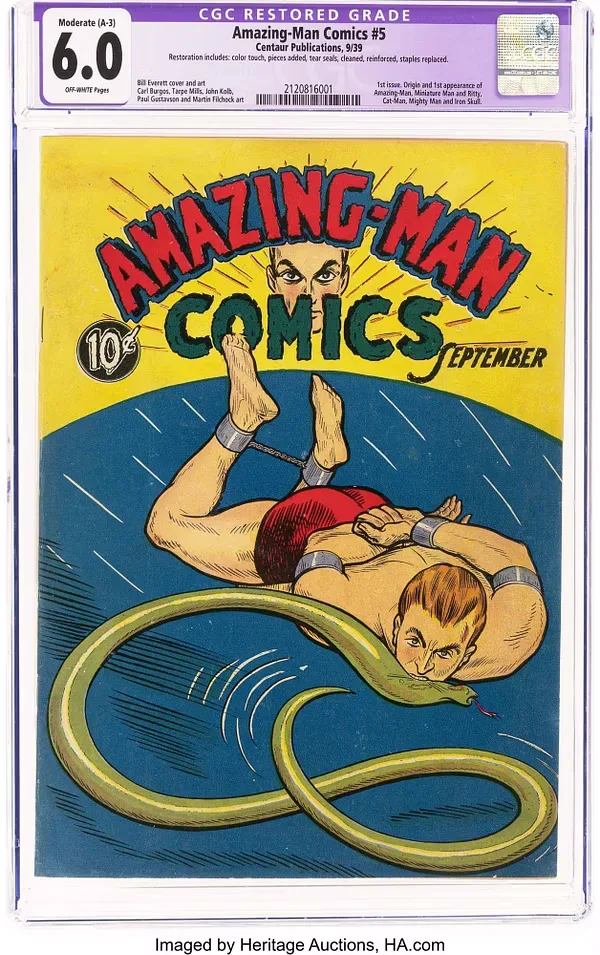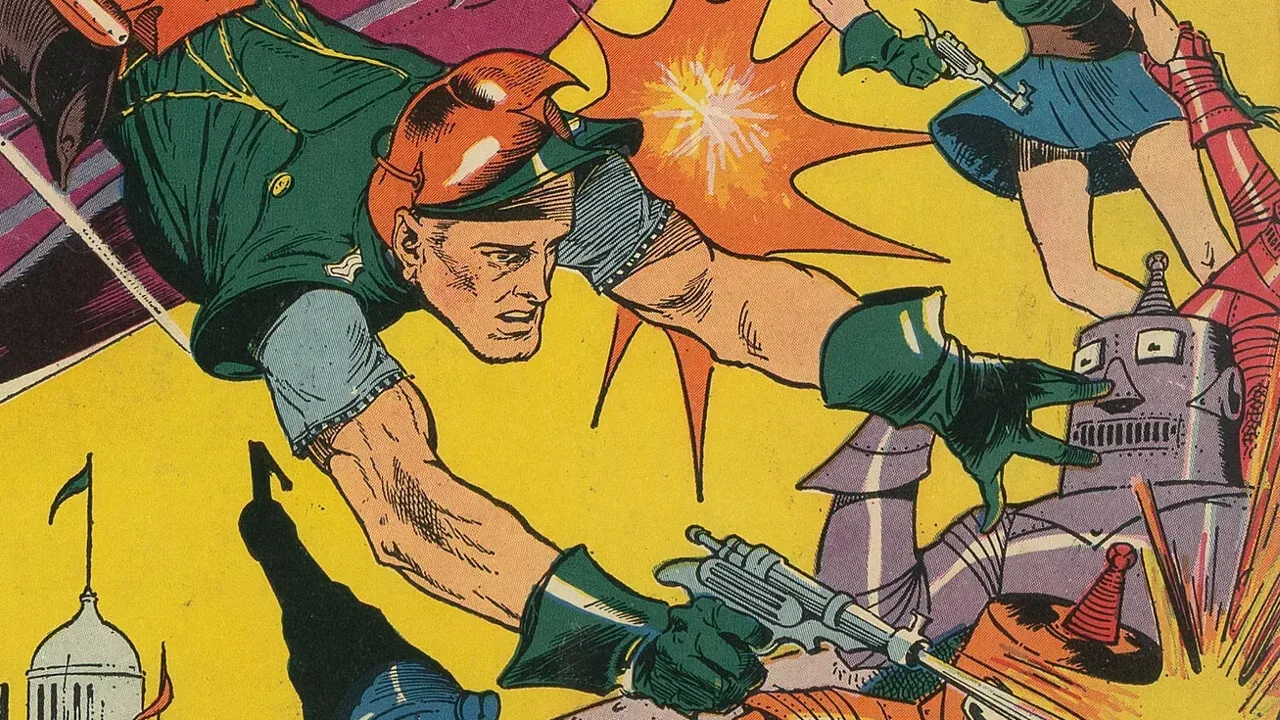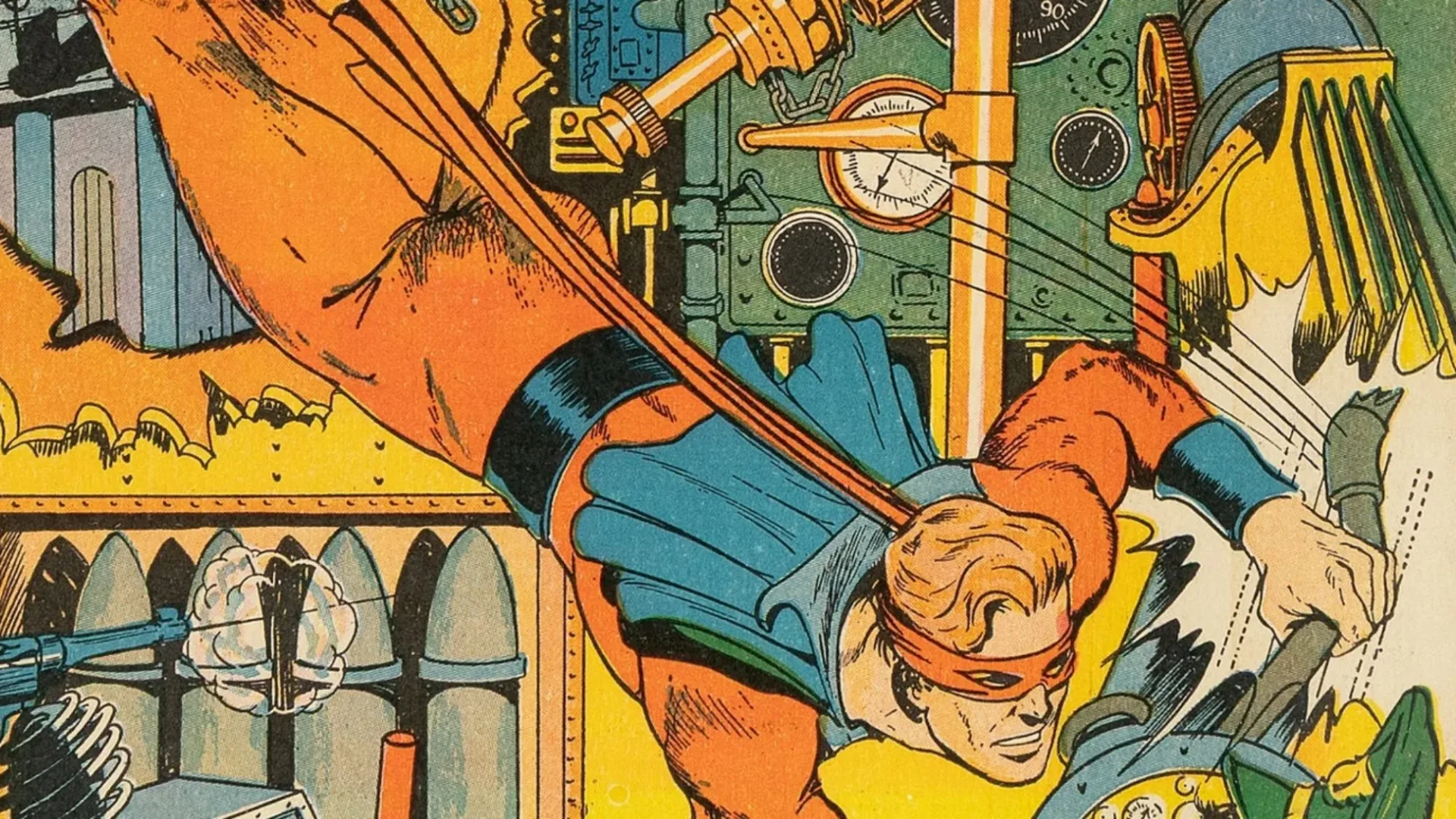
Before superheroes settled into familiar templates, the medium’s early creators were still testing every strange ingredient they could fit into a costumed adventure: lost worlds, mental powers, scientific transformations, criminal melodrama, and threats that barely resemble the clean-cut hero-versus-villain conflicts readers now expect. Amazing-Man Comics #5 (#1), cover-dated September 1939, is a particularly vivid artifact of that experimental moment.
The Centaur comic introduces Amazing Man, created by Bill Everett, in a story that appears to have emerged from a direct challenge: develop a hero capable of competing with Superman. Yet its answer was not merely another strongman in a cape. Everett’s protagonist, Aman, is shaped by a quarter-century in Tibet, tested by a secretive Council of Seven, menaced by an attempted telepathic takeover, and given a chemical ability to become green mist. The debut also has room for psychic detection. It is a superhero origin, certainly, but one assembled from several storytelling traditions at once.
A copy graded CGC Apparent FN 6.0, with Moderate (A-3) restoration and off-white pages, is scheduled for the November 5, 2026 Golden Age Century Comics Showcase Auction VI. The offered comic is significant not only because of Amazing Man’s first appearance, but because its contents capture a publisher and a creative field trying radically different ideas on the same pages.
A request for a Superman competitor, then a very different hero
The clearest window into Amazing Man’s development comes from a March 1, 1939 letter by Grace Everett, Bill Everett’s mother. She described a request for Bill to create a new strip while he was already occupied with three others. Lloyd Jacquet wanted a character that could stand against Superman in the fast-changing superhero marketplace.
Grace Everett’s account makes the creative process sound much less like an instant flash of inspiration than a deliberate hunt for raw material. She and Bill had been looking for a workable concept, and she intended to search the Public Library for old folktales, including stories from outside the United States, that might be adapted into something modern. Bill, meanwhile, was occupied finishing another strip and two covers.
That detail matters because Amazing Man does not read, at least in outline, as an imitation built from a single successful formula. The premise may have started with the commercial need for a Superman alternative, but the eventual character takes a far more eccentric path. Rather than being defined only by a conventional public identity and physical prowess, Aman’s beginning joins mystical instruction, intellectual and moral examinations, psychic peril, and an almost pulp-science transformation.
The chronology and Centaur connection make the relationship between the letter and the new feature compelling. They also show how rapidly creators were expected to respond to the emergence of a popular genre. The instruction was simple enough—find a competing hero—but the solution was a story that treated the new superhero form as wide open territory.
The Council of Seven and the green-mist origin
Aman begins as an orphan who has spent 25 years in Tibet under the guidance of the Council of Seven. That setup frames his origin as a long process of preparation rather than a sudden accident. His physical ability, intelligence, and moral character are all subjected to tests, the kind of trials that establish whether a prospective hero is worthy of power.
But the Council is not united. Six members mean to aid Aman, while the seventh, called the Great Question, seeks control over him through telepathy. This is an especially telling early-superhero wrinkle: the danger is not only whether the hero can defeat an external criminal, but whether another figure can seize his agency altogether.
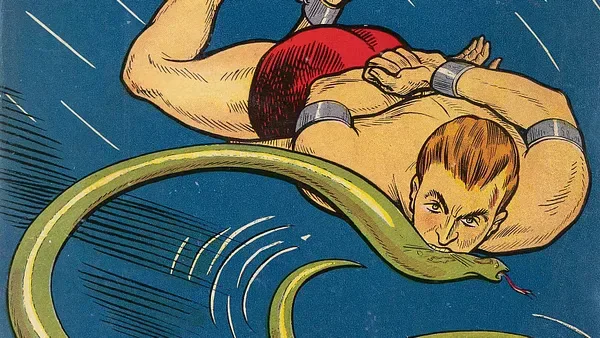
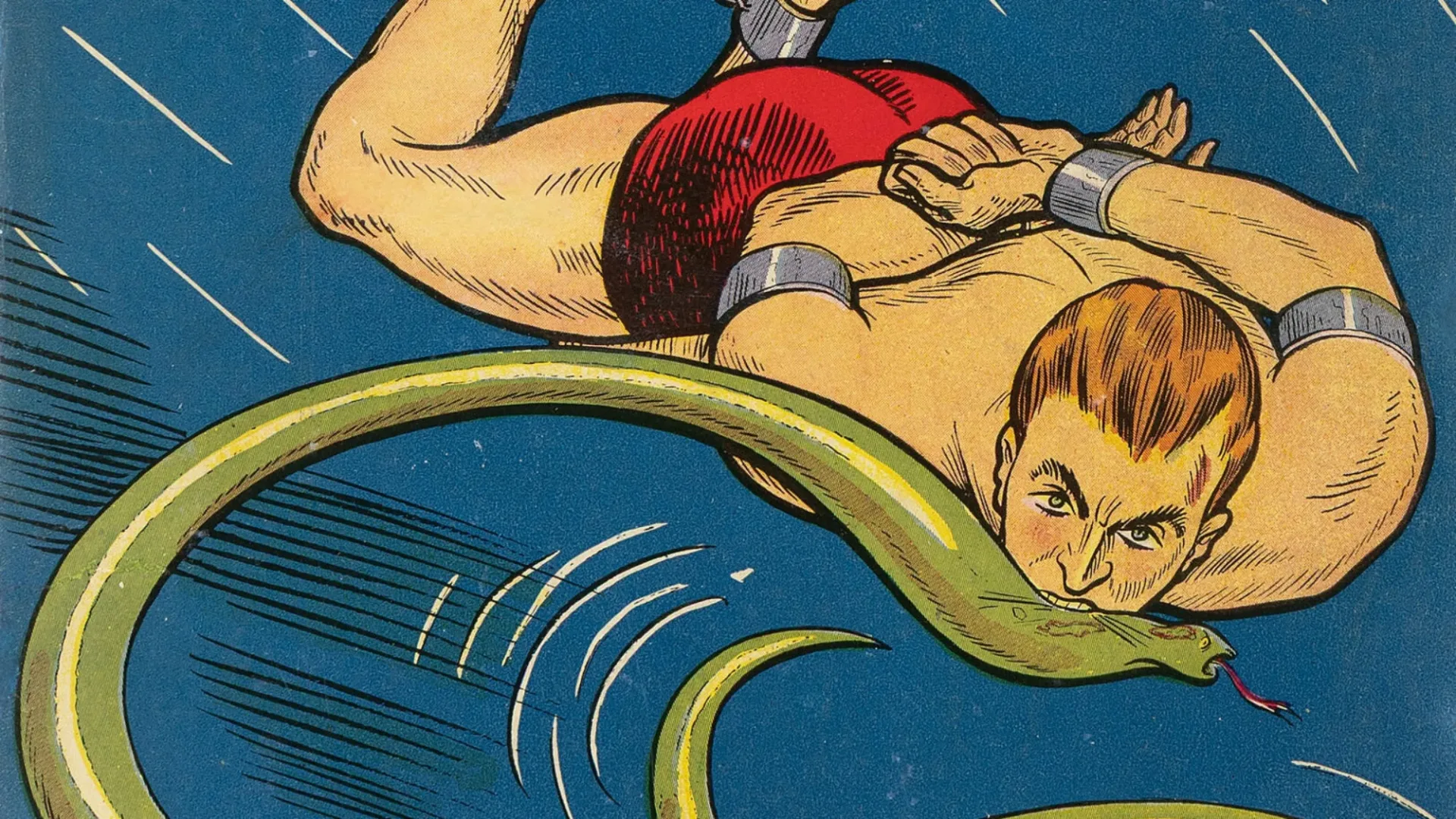
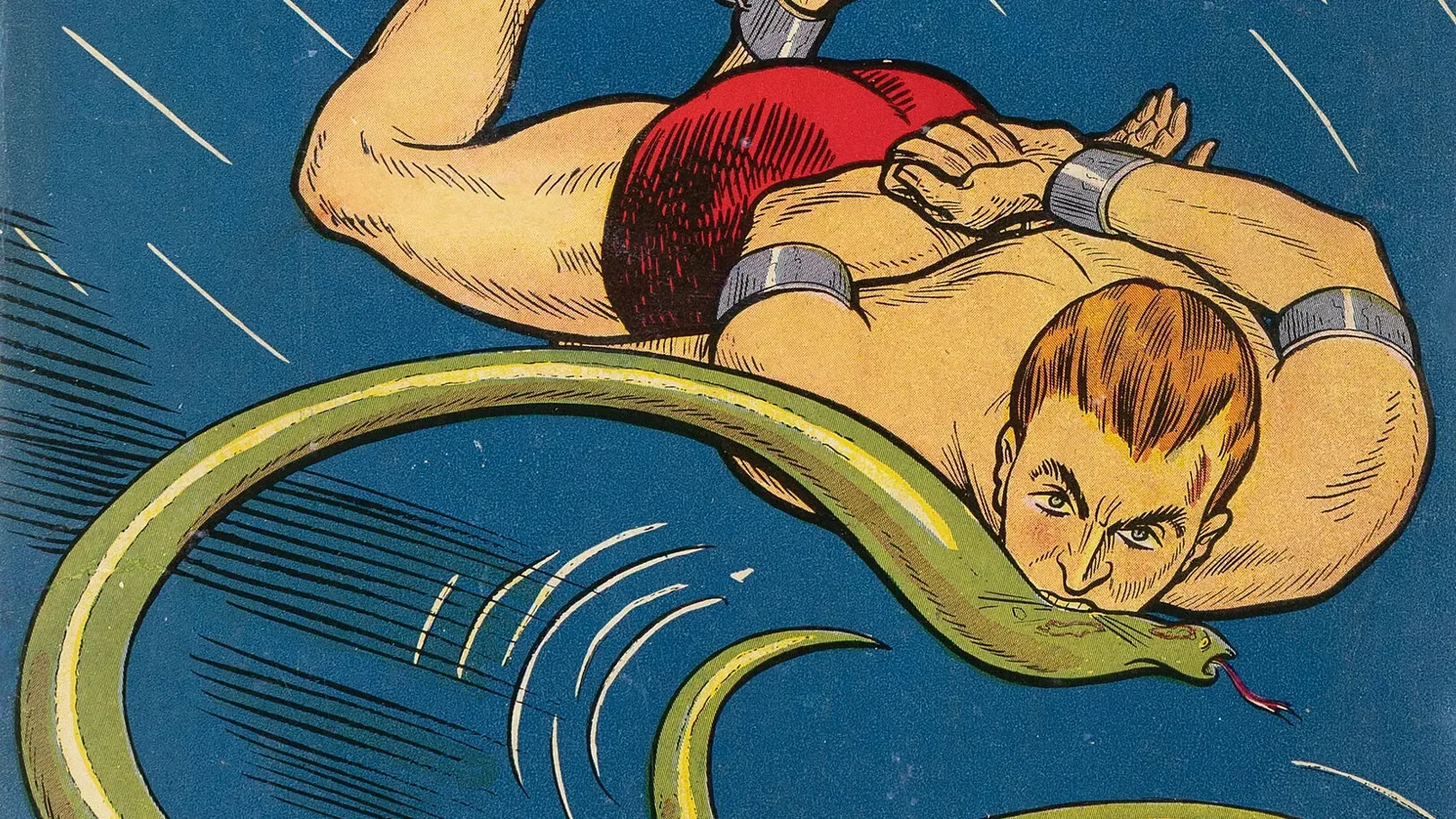
The snake ordeal on the issue’s cover is tied directly to those tests. It is not simply a random menace selected for a dramatic image; it belongs to the story’s framework of judgment and training. That connection gives the cover an unusually literal role in selling the premise. It advertises that Aman’s path to becoming Amazing Man is a challenge he has to survive and earn.
Then comes the feature’s most outlandish element: a chemical treatment that allows Amazing Man to turn into green mist. In practical story terms, that ability distinguishes Aman from the straightforward model of a super-strong competitor. In creative terms, it reveals how the strip fused its Tibetan-training premise and psychic elements with the imaginative chemistry associated with pulp adventure. The result is a hero whose powers do not feel restricted to a single, tidy explanation.
That lack of restraint is exactly what makes the debut interesting. Later superhero storytelling often encourages readers to understand what a character can do through a stable ruleset. Amazing Man’s origin instead promises a world where training, psychic danger, chemical processes, and investigative work can all coexist. It is an early example of a superhero feature using its origin not only to explain powers, but to declare an entire mode of storytelling.
One issue, several wildly different experiments
Amazing Man is the marquee historical attraction, but the book’s supporting strips make it more than a one-character collectible. Carl Burgos’ Iron Skull introduces an android, placing another noteworthy debut in the same issue. Its presence adds a second kind of speculative-fiction idea to a comic already full of unusual concepts.
Tarpé Mills’ Cat Man heads somewhere considerably darker. The feature follows former convict Barton Stone, who disguises himself as an elderly woman to pursue revenge against three former associates. His instrument of revenge is a cat with treated claws that kill. This Cat Man should not be confused with the Golden Age character associated with Cat-Man Comics; the two have no connection.
John F. Kolb’s Minimidget is equally grim in a different direction. The story introduces Minimidget and Ritty, human beings reduced to tiny size by a mad scientist named Barmell. Barmell controls Minimidget and sends him to commit murders tied to an inheritance. Instead of presenting miniaturization as playful fantasy, the strip turns it into a mechanism for coercion and crime.
Together, these features make the comic feel less like a unified superhero anthology than a sampler of the industry’s still-fluid genre boundaries. There is an android, a mist-form hero trained by a secret council, a revenge plot involving disguise and a deadly animal, and an inheritance-murder plot driven by miniature controlled people. The common thread is not a polished shared universe; it is a willingness to treat the comic page as a place for sensational, high-concept premises.
The Devil-Doll parallels—and why they are worth separating
Both the Cat Man and Minimidget stories have apparent points of contact with the 1936 film The Devil-Doll. The resemblance is strongest when the individual ingredients are considered. The film involves a framed convict, three former business partners, an elderly-woman disguise, and a family ruined by the situation. Those elements parallel the revenge circumstances in Mills’ Cat Man story.
Kolb’s Minimidget feature has a different overlap. Its tiny humans under mental control are closer to the film’s miniature-person concept, although the narrative purpose changes: Minimidget is pressed into murders connected to an inheritance rather than a revenge scheme.
The distinction is useful for collectors and comic historians because “inspired by” does not mean “the same story.” Mills repurposes familiar revenge components but gives the killings a cat-based method. Kolb borrows the unsettling potential of controlled small people while directing it toward another criminal plot. The issue therefore demonstrates how creators could break a film’s memorable ideas apart, recombine them, and produce separate strips with separate stakes.
What the census and restoration notation tell collectors
CGC’s census currently records 21 Universal copies and 14 Restored copies of Amazing-Man Comics #5. Those numbers are notable because the issue’s importance has been recognized for decades: it carries the first Amazing Man, an early Iron Skull appearance, and other historically distinctive material. Even so, the census totals remain modest.
The auction copy is listed as an Apparent FN 6.0 with Moderate (A-3) restoration, rather than as a Universal copy. For a prospective bidder, that distinction should be treated as central information, not fine print. This is an issue where historical content and copy-specific condition description must be considered together. A buyer is not simply choosing whether Amazing Man’s debut matters; they are evaluating the particular restored example being offered.
The modest census also should not be treated as a complete count of every surviving comic. It is a count of copies recorded in that census, divided into the listed categories. What it does establish is that the population represented there is not large, adding another layer of interest to a book already valued for its place in superhero development.
For readers drawn to how comics turn lived events into sequential storytelling, the medium continues to find new forms as well; a forthcoming graphic memoir project offers a modern example of the format being used for personal narrative rather than early genre invention.
Why this particular debut endures
There is a temptation to reduce early superhero comics to a competition to reproduce the success of Superman. The Grace Everett letter confirms that commercial pressure was real: a Superman competitor was explicitly wanted. But Amazing-Man Comics #5 is more revealing when viewed as the opposite of a simple copy. Its creators answered the prompt through a wildly hybrid hero and a package of features that ranged from android fiction to lethal-animal revenge and miniature-person horror.
That is the enduring appeal of this 1939 comic. It preserves an early point at which the superhero category was recognizable enough to be commercially essential, yet undefined enough to absorb mythology, psychic powers, chemicals, crime melodrama, and pulp-style fantasy without apology. The November auction’s restored copy offers bidders a chance to pursue that unusual piece of comics history in physical form.