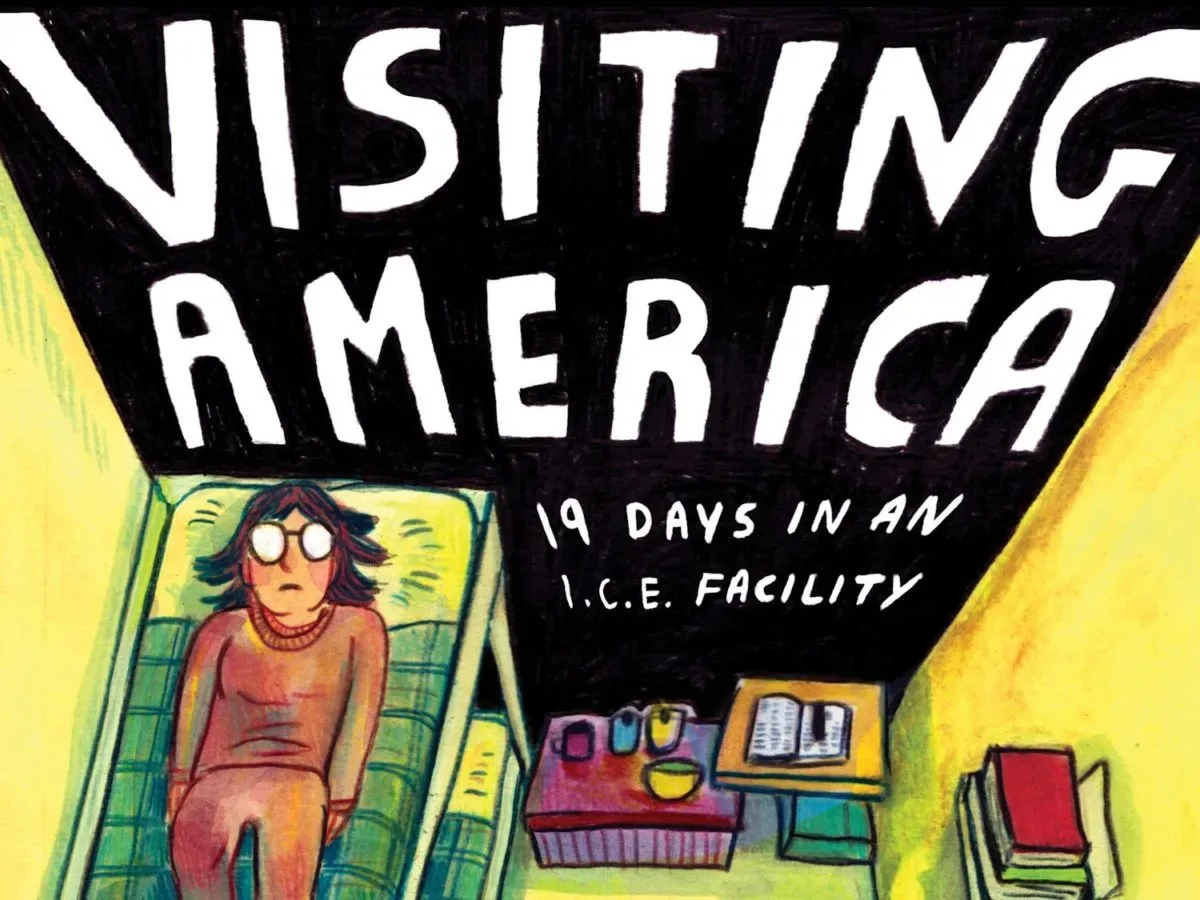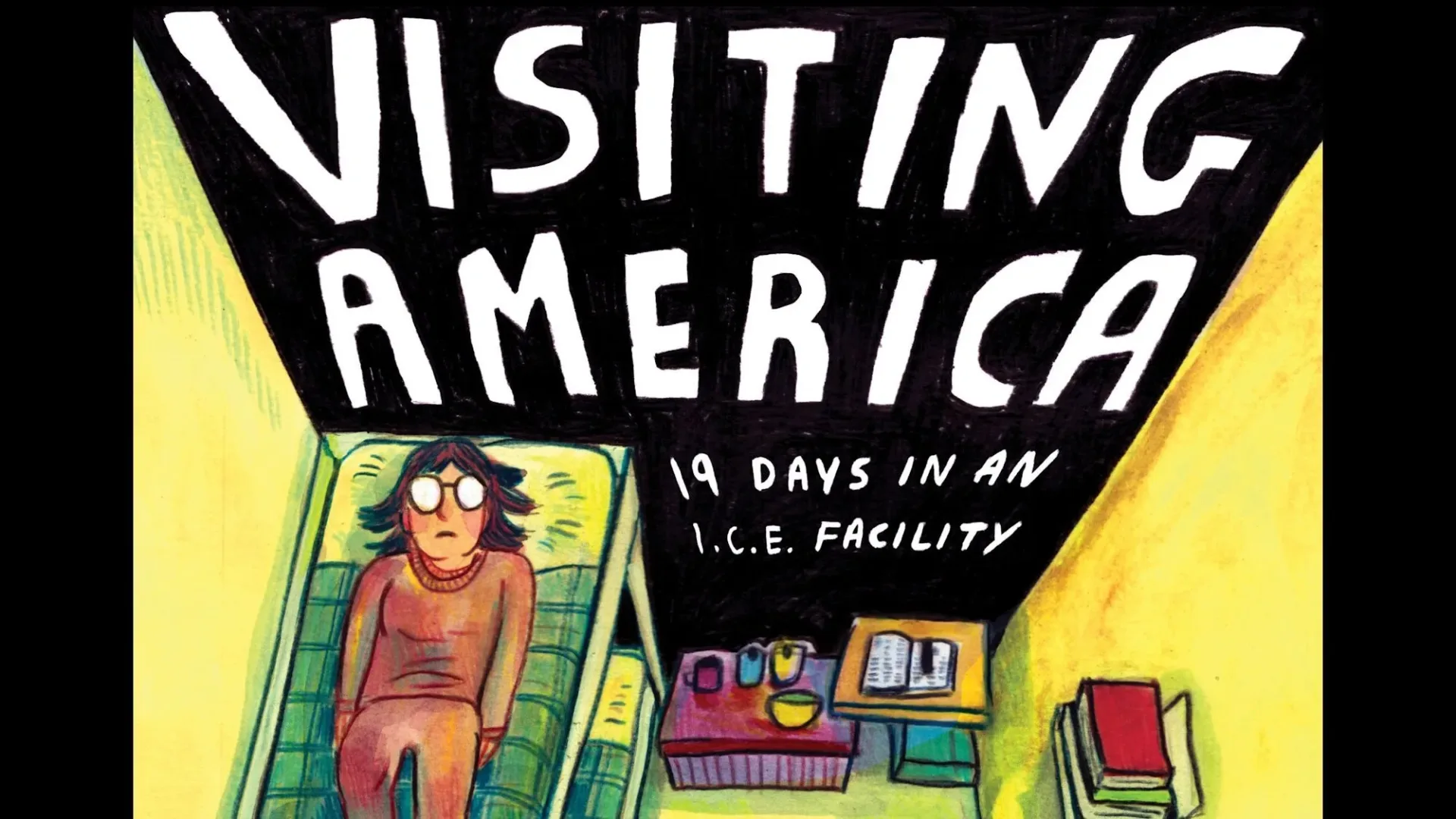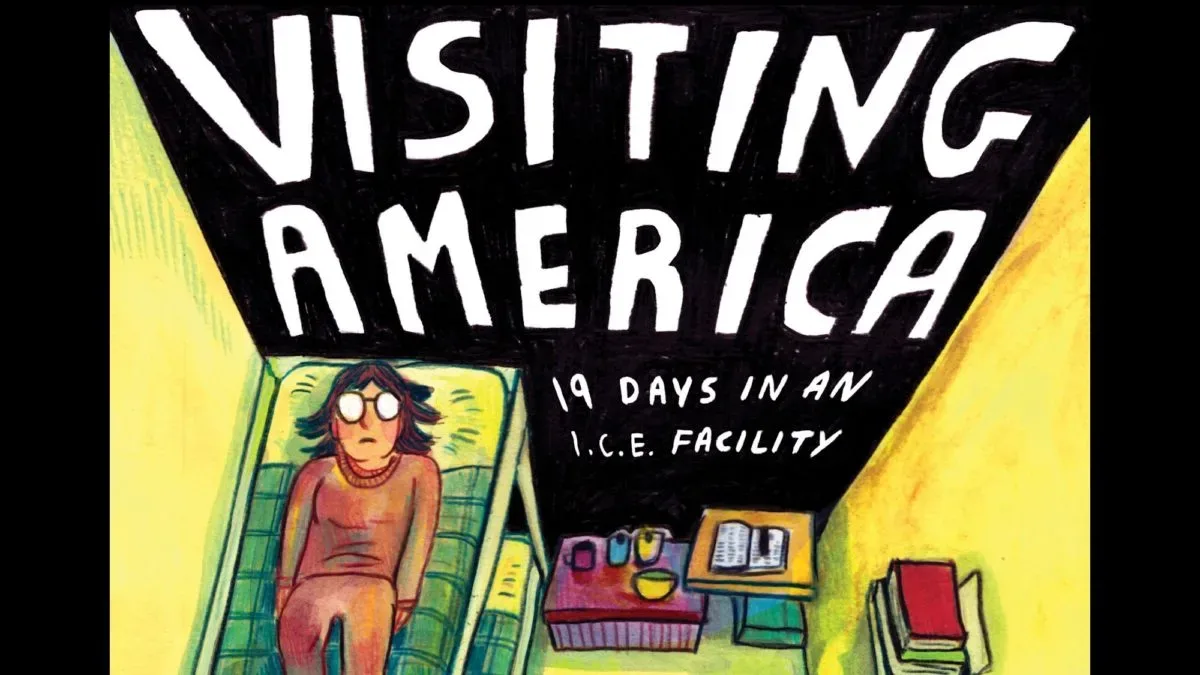
R.E. Burke’s Visiting America: 19 Days In An I.C.E. Facility is scheduled to arrive from Fantagraphics on May 11, 2027. The full-colour paperback graphic novel is listed at $29.99, and a digital edition is planned afterward.
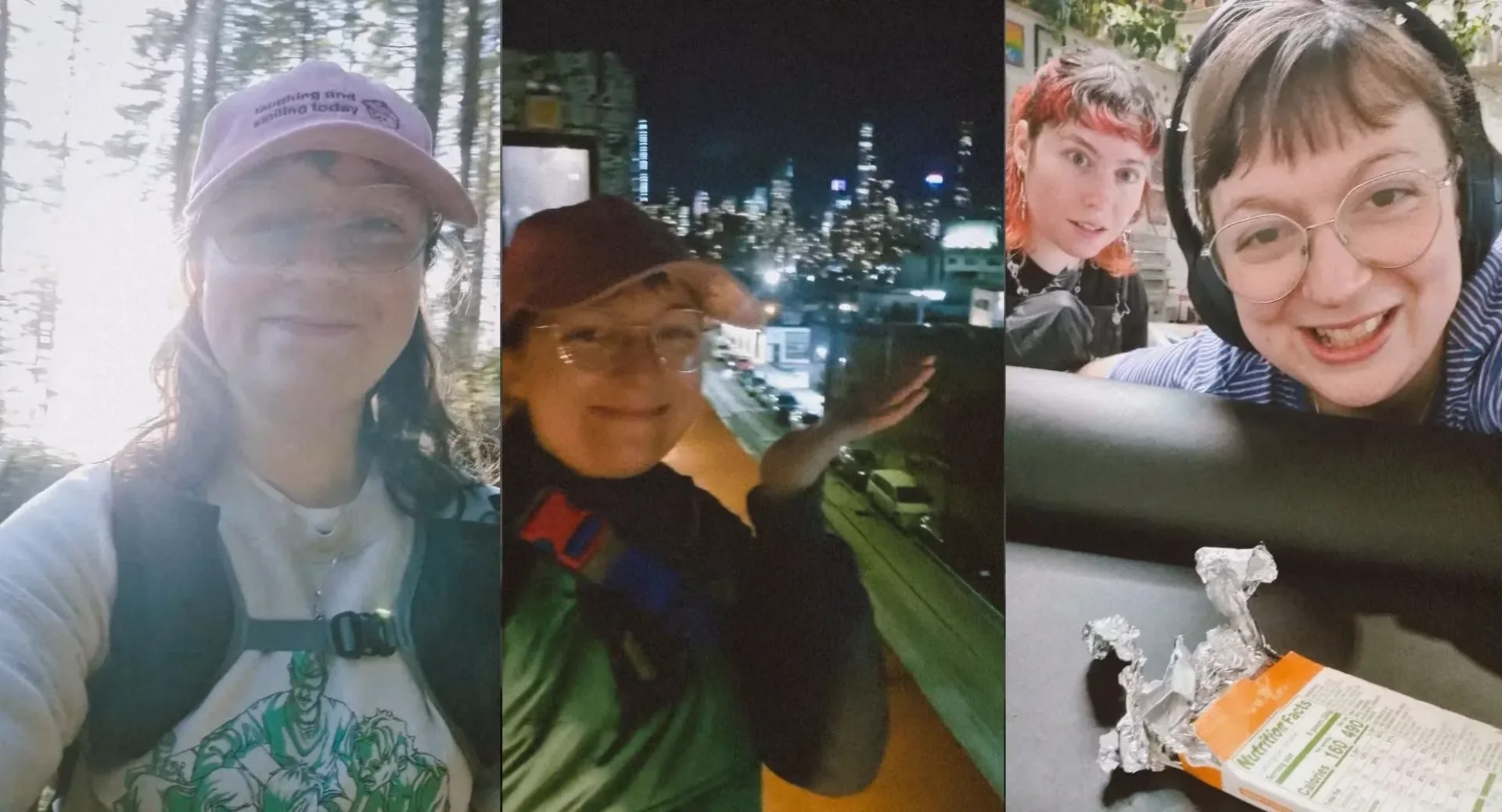
The book is presented as both a personal memoir and a work of comics journalism. It recounts Burke’s detention for 19 days after she encountered what is described as a technicality while attempting to cross from Washington State into Canada in February 2025. Burke, a British cartoonist who was 28 at the time, was on holiday in the Pacific Northwest.
Its subject is necessarily difficult, and the book’s stated scope reaches beyond a first-person account of an intimidating bureaucratic ordeal. Burke documents her fear, confusion and declining mental and physical condition, while also recording the experiences of women detained alongside her. The announced edition includes an epilogue updating readers on some of those women.
A memoir with a wider record of detention
The title’s “19 Days” establishes a concrete frame, but the project is not being described simply as a day-by-day prison diary. Burke’s account will place her own detention beside the lives and circumstances of fellow detainees: mothers, daughters and workers, as well as people said to be fleeing war, genocide and abuse. That structural decision matters. It means the book’s purpose is not only to reconstruct what happened to its author, but to preserve accounts of people whose situations may be far more precarious.
Fantagraphics describes the detention site as a facility operated by the for-profit GEO corporation. The book’s announcement characterizes the bureaucracy Burke encountered as haphazard and callous, involving misinformation, stonewalling and threats. Those descriptions are part of the work’s announced perspective and subject matter, rather than independent findings presented in the publication details.
Burke’s friends and family mounted a campaign to secure her release, which reportedly drew international support. Inside the facility, the book also focuses on mutual care among the detainees: women helping Burke acclimate and attempting to support one another despite the uncertainty surrounding them. The publisher’s description emphasizes not only fear and despair, but strength, humour and solidarity.
What “graphic memoir” and “comics journalism” mean here
A graphic memoir uses comics—sequential panels, written narration, dialogue, visual composition and pacing—to tell a lived experience. The form can show a remembered moment while also making room for reflection: a page can contrast what someone was told with what they understood at the time, or linger on the physical environment that made an experience disorienting. In a detention narrative, that flexibility can be especially important because confusion, waiting and incomplete information are themselves part of the story being conveyed.
Comics journalism applies many of those same visual tools to reported material. In Burke’s case, the announced book brings her own eyewitness account together with the stories of women she met while detained. That does not turn the work into a conventional news report, nor does it erase its personal point of view. Instead, it identifies a dual responsibility: recounting the author’s experience accurately while treating other people’s circumstances as more than background detail in someone else’s narrative.
The distinction is useful for readers deciding what to expect. A memoir is centered on the teller’s life; journalism seeks to document events and other people with public relevance. Visiting America is being positioned in the overlap. The promised epilogue is particularly significant in that context, since it suggests the narrative will not leave every fellow detainee frozen at the moment Burke met them.
The significance of comics as a documentary form
Comics are sometimes discussed as though they are inherently a lighter medium than prose or film. A book like Visiting America points in the opposite direction: drawing can make a reader slow down. Panel borders control the duration of a glance; repeated settings can establish monotony; a change in colour or page density can communicate emotional disruption. The format can also render scenes that may have no photography, video or official visual record.
That capacity comes with a responsibility not to confuse illustration with a claim of camera-like objectivity. The forthcoming book is explicitly a memoir, so readers should approach it as an authored account shaped by Burke’s memory, perspective and choices as a cartoonist. Its journalistic dimension broadens the book’s concern, but it does not make the author invisible. That transparency may be one of the form’s strengths: a comic can make clear that somebody is choosing what to show, what to revisit and whose words to carry forward.
For audiences accustomed to pop-culture storytelling being treated as disposable, the project is also a reminder that visual narrative can tackle urgent real-world subjects without making them less serious. Coverage of documentary work across media often comes back to a similar question: whether a work makes room for the people at its center rather than treating trauma as spectacle. That concern also sits near the heart of a recent look at a documentary series built around grief and public attention.
Why the title carries an uncomfortable irony
Visiting America sounds, at first, like a travel memoir. The circumstances described for Burke’s book sharply reverse that expectation. A trip in the Pacific Northwest and an attempted border crossing became an experience of interrogation, shackling and 19 days in immigration detention. The title therefore appears to set the ordinary idea of visiting the United States against the experience Burke says followed.
That irony is central to the practical stakes of the narrative. Border procedures can seem distant or abstract until they affect an individual traveller, yet Burke’s announced account concerns the consequences of becoming caught in a system she portrays as difficult to navigate and resistant to clear answers. The publisher’s description makes no claim that Burke’s circumstances represent every border crossing or every detention case. It does, however, frame one individual experience as a way into larger questions about power, process, legal vulnerability and human rights.
The book’s attention to fellow detainees is equally important on that point. Burke reportedly had friends and family able to organize on her behalf. Other women in the facility are described as facing different and, in some cases, more desperate prospects. By including their stories and later updates where possible, the memoir aims to challenge the tendency for detention systems to reduce people to status, paperwork or case numbers.
Release details and what has been confirmed
- Title: Visiting America: 19 Days In An I.C.E. Facility
- Creator: R.E. Burke
- Publisher: Fantagraphics
- Format: Full-colour paperback graphic novel
- Release date: May 11, 2027
- Price: $29.99
- Digital edition: Planned to follow the paperback
Fantagraphics’ Gary Groth has described the book as a work with a moral imperative and expressed enthusiasm that Burke chose the publisher for it. The announcement does not provide a page count, digital-release date or further format details, so those remain unconfirmed.
What is clear is the ambition behind the project. Burke’s book will use the intimate grammar of comics to address detention, bureaucracy and the relationships formed among people living through an acute period of uncertainty. Its value will rest not merely in recounting 19 days, but in how it gives sustained attention to the people whose stories intersected with Burke’s during them.