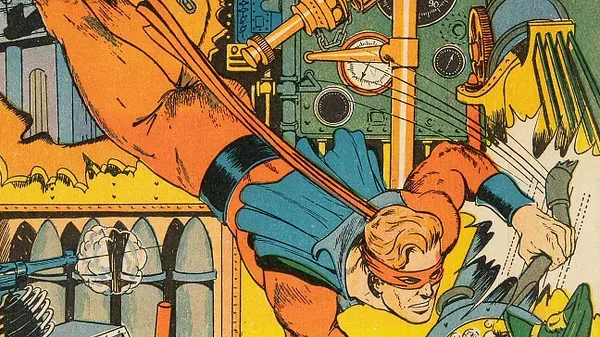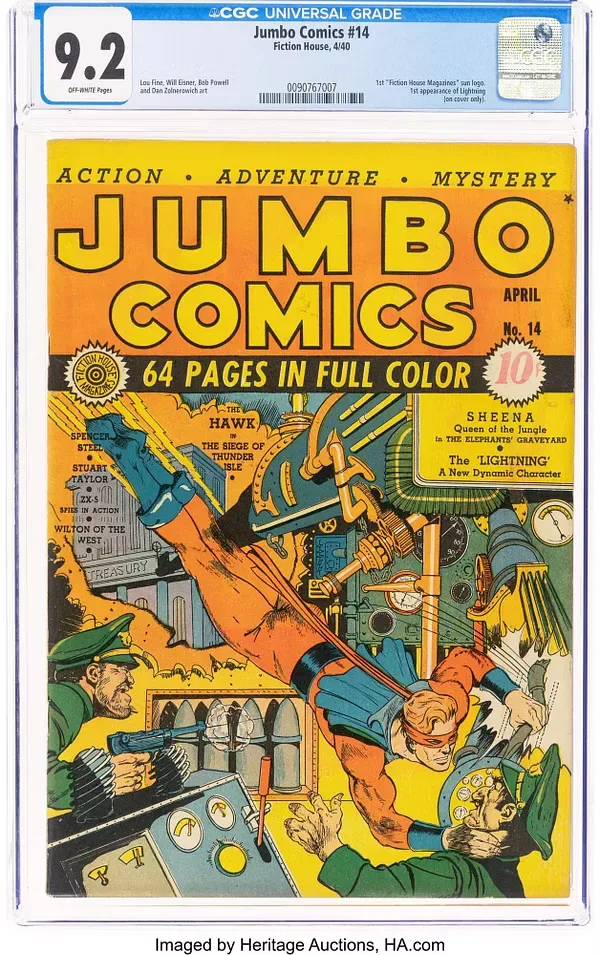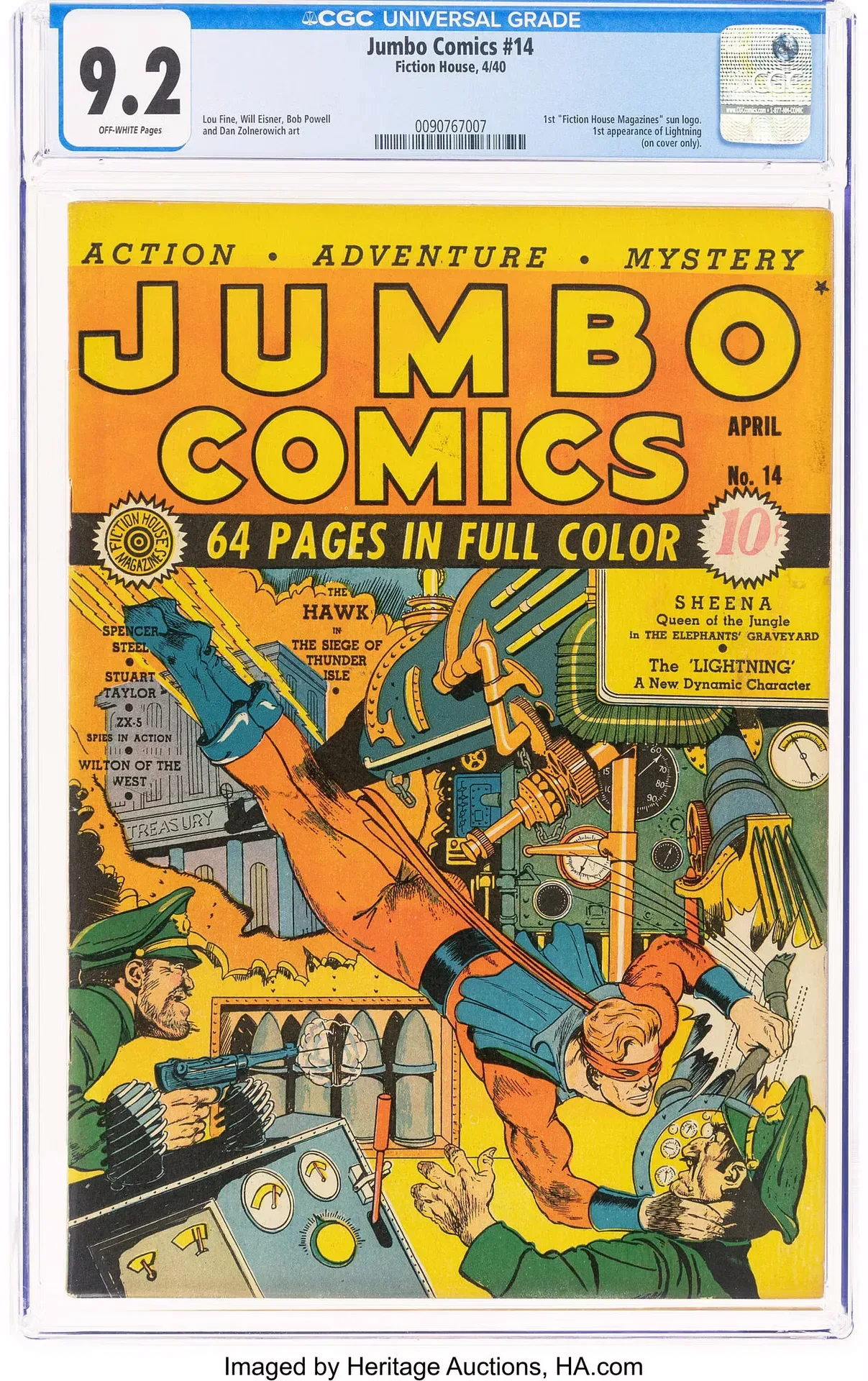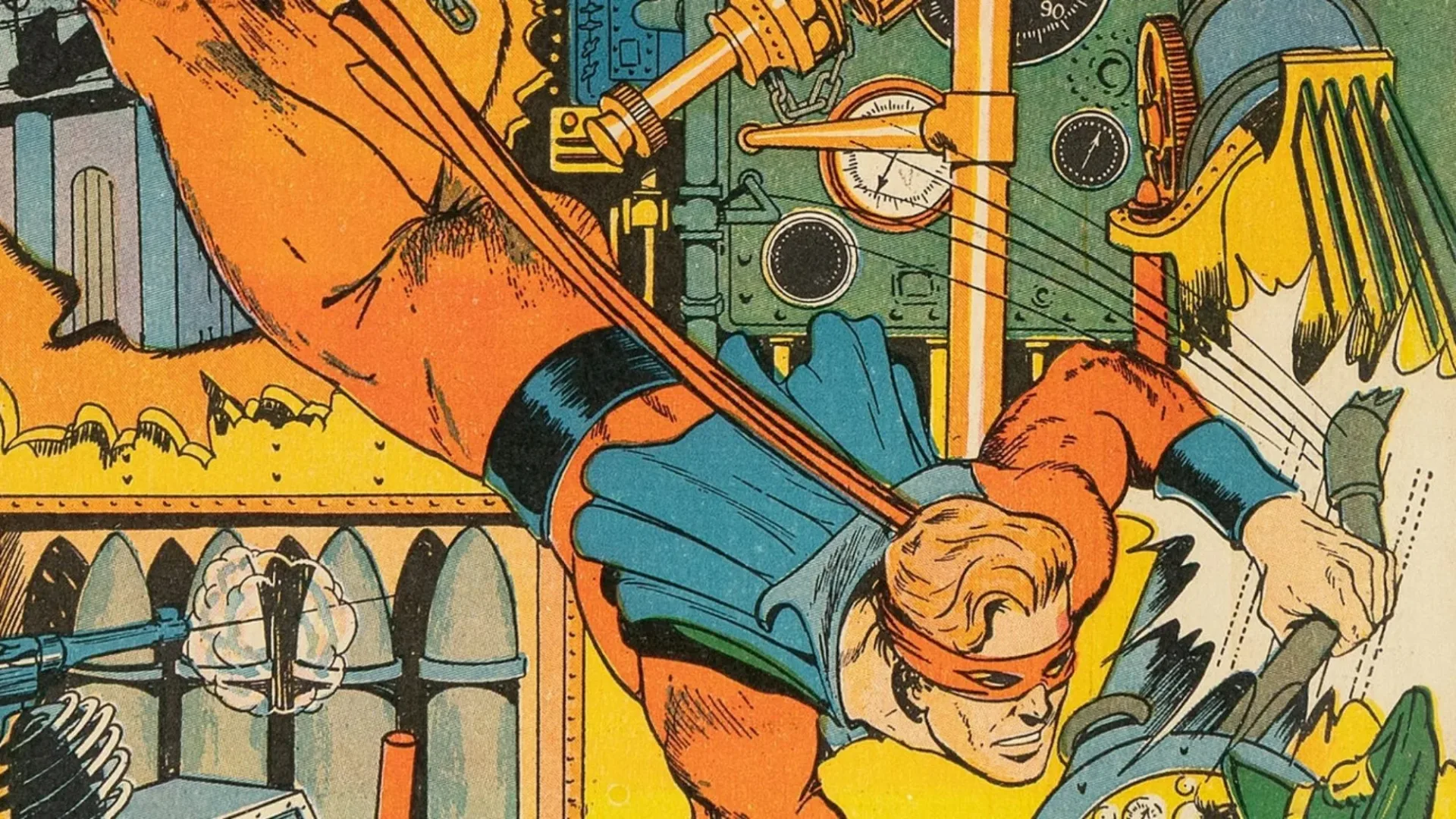
A superhero’s first appearance is usually treated as a neat piece of comic-book history: open the issue, find the first story, meet the character. Jumbo Comics #14 offers a much stranger version of that familiar collecting milestone. The April 1940 cover-dated issue presents Lightning on a cover by Bob Powell, establishing the character’s first appearance, yet Lightning does not appear in an interior story until Jumbo Comics #15.
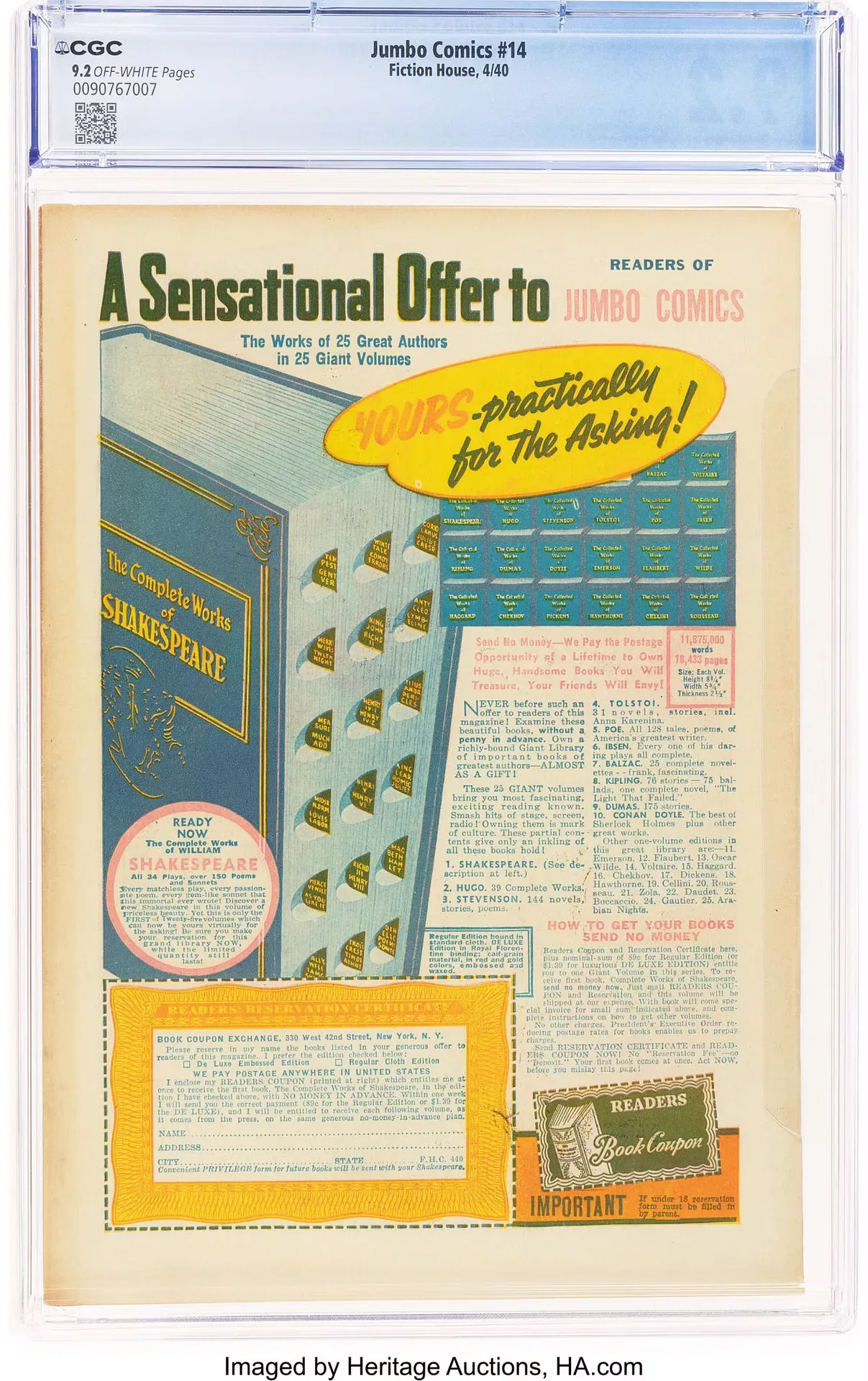
That discrepancy makes issue #14 more than a standard early superhero book. It is a surviving snapshot of a publisher working out what its title was supposed to be while the American comics market was rapidly embracing costumed adventure. A CGC NM- 9.2 copy with off-white pages is being offered in the September 24-26, 2026 Comic Books Signature Auction #7469, giving the unusual debut renewed attention.
A first appearance that stays on the cover
Bob Powell’s cover for Jumbo Comics #14 is the key historical document here. Lightning is visibly introduced to readers, but the issue does not give them a corresponding installment explaining who he is, what he can do, or why he is there. The character’s story debut follows one issue later.
For modern readers, that can feel like a missing scene—or the opening cinematic playing before the game has actually loaded the protagonist. In practical collecting terms, however, the cover matters. A cover debut is a real, identifiable form of first appearance: it records the first time a character was presented to the comic-buying public, even when the interior material has not caught up.
It is important not to blur the distinction. Jumbo Comics #14 is Lightning’s cover first appearance. Jumbo Comics #15 is the first issue with a Lightning story. Each issue represents a different stage of the character’s publication history, and each can matter for different reasons. One captures the earliest visual introduction; the other delivers the first narrative material.
Cover and interior did not always align cleanly in Golden Age comics. The period’s production process could yield covers that promoted characters or concepts not reflected inside a particular issue. In this case, the mismatch also sits within a larger editorial transition at Fiction House, the publisher of Jumbo Comics.
Jumbo Comics was still finding its identity
Jumbo Comics began with a different emphasis from the superhero-driven identity readers may expect from a 1940 comic book. Its first eight issues had humor-oriented covers, and the series had been presented to trade readers as a venue for previously published syndicated comic-strip material. Much of that content came from the UK and Australian editions of the tabloid Wags.
Then the market changed around it. Action Comics #1 reached newsstands roughly three months before Jumbo Comics #1, which went on sale July 7. By the time Jumbo Comics reached issue #8 in April 1940, superhero and adventure material had become a central force in the young comic-book business. The rise of Superman had made the commercial potential of a distinctive adventure lead hard to ignore.
Fiction House’s covers show a title trying options rather than following a settled blueprint. Sheena’s first cover appearance outside of insets came on Jumbo Comics #9, where she was placed in the background rather than immediately positioned as the book’s unquestioned main attraction. Issues that followed used a variety of adventure-style cover features. With issue #12, the title announced a shift to monthly publication, but it still had not clearly identified a permanent anchor character.
The publisher had additional demands on its attention as well. Fiction House had launched Fight Comics, Jungle Comics, and Planet Comics the previous month. Against that backdrop, Lightning appearing on a cover before receiving his interior launch looks less like an isolated oddity and more like evidence of a publisher experimenting across several books at once.
That context is what gives issue #14 much of its appeal. The comic is not merely early because of its 1940 date. It occupies a moment when a title built around humor and reprinted strips was adjusting toward the adventure-focused direction readers increasingly wanted.
Lightning’s actual debut: Fred Larkin and a powered belt
The next issue finally supplies the essential information that issue #14 withholds. In Jumbo Comics #15, Lightning is revealed as the costumed identity of inventor Fred Larkin. He is portrayed with the ability to fly, fire electrical bolts from his fingers, and demonstrate major strength and durability.
Even then, the character does not receive the kind of fully developed origin that later superhero readers may expect. The debut establishes Larkin as an inventor, while a later reference indicates that he turns on his powers using his belt. The available material does not lay out a more extensive explanation for how he obtained those abilities.
That economy is revealing in itself. Lightning arrived during a period when publishers were racing to populate their books with adventure characters, and the basic superhero formula could be conveyed quickly: a civilian identity, a costume, a memorable power set, and an ongoing series of threats. The cover of issue #14 supplied an immediate visual hook; issue #15 furnished the name and abilities needed to turn that hook into a recurring feature.
The character ultimately had a substantial run despite his unconventional rollout. Lightning appeared regularly through Jumbo Comics #41. That continuation changes how issue #14 can be read. It was not a cover tease for an idea that disappeared immediately. It became the first published image of a character who remained part of the title for a meaningful stretch.
The reader poll and the Sheena decision
Issue #15 also included a reader contest or poll intended to help establish which character should serve as the book’s star. The move echoes a similar reader-participation approach used in Action Comics #4. Whether such a poll was a straightforward decision-making tool, a method of encouraging reader engagement, or both, it demonstrates that Fiction House was still evaluating the direction of Jumbo Comics.
The eventual cover answer was Sheena. Two issues after the poll, she became the title’s regular cover feature. That outcome places Lightning’s debut in a particularly interesting position: he was introduced while the publisher was openly sorting through potential focal characters, then continued inside the book even as Sheena took the primary cover role.
For collectors and historians, this prevents a simplistic reading of the issue. Lightning was neither presented as the permanent face of Jumbo Comics nor absent from the book’s plans. He was a new adventure character launched during a period of editorial uncertainty, while the publisher tested what would define the series in a superhero-conscious marketplace.
What the census figure does—and does not—tell collectors
The CGC census records 17 Universal copies of Jumbo Comics #14. Two are graded 9.2, and only one is recorded at a higher grade. The offered NM- 9.2 copy therefore sits near the high end of the census population.
A few grading terms are worth separating. A census is a record of copies submitted to and graded by a particular certification service; it is not a total count of every surviving copy in existence. A Universal copy is part of that service’s standard graded population, as listed in the provided census figure. And NM- 9.2 is the assigned condition grade for the auctioned copy, while “off-white pages” describes the page quality noted for it.
Those details are useful because Golden Age scarcity and condition are not the same thing. The 17-copy figure signals a small recorded population within this particular census. The presence of only one copy above 9.2, meanwhile, identifies why a 9.2 example occupies a relatively elevated position among recorded submissions. Neither fact alone establishes an overall market value, and no auction result is known from the available information. They do, however, explain why this particular copy stands out as an example of the issue.
Condition language should also be read carefully. “Near the top of the census” describes comparative placement among recorded graded copies; it does not mean the book is the single best existing copy, nor does it promise any particular bidding result. For an old comic with a historically unusual first appearance, that distinction is especially useful. The issue’s importance comes from the combination of its cover-first status, its place in Fiction House’s changing editorial strategy, and the condition of this individual copy.
Why Jumbo Comics #14 has a story beyond the slab
There are many ways to frame Jumbo Comics #14: an early Lightning collectible, a Bob Powell cover, a Fiction House artifact, or a scarce Golden Age comic in high grade. The most compelling frame may be that it preserves an unresolved moment. The reader sees Lightning before the publisher has explained Lightning. The book signals a superhero future before Jumbo Comics has fully committed to its enduring cover star.
That makes the comic a useful reminder that publishing history is often less orderly than retrospective checklists imply. A first appearance can be visual before it is narrative. A character can be introduced amid experimentation rather than as the polished centerpiece of a line. And a cover can preserve a decision in motion rather than a finished plan.
For readers interested in how entertainment properties take shape over time, it is a compact piece of early superhero history. For those following broader genre culture, our coverage of Godzilla Minus Zero’s early reactions explores another case of a long-running pop-culture tradition continuing to evolve. Lightning’s peculiar launch is much older, but it speaks to the same basic truth: iconic genres are often built through changing ideas, uncertain priorities, and the occasional wonderfully awkward first step.