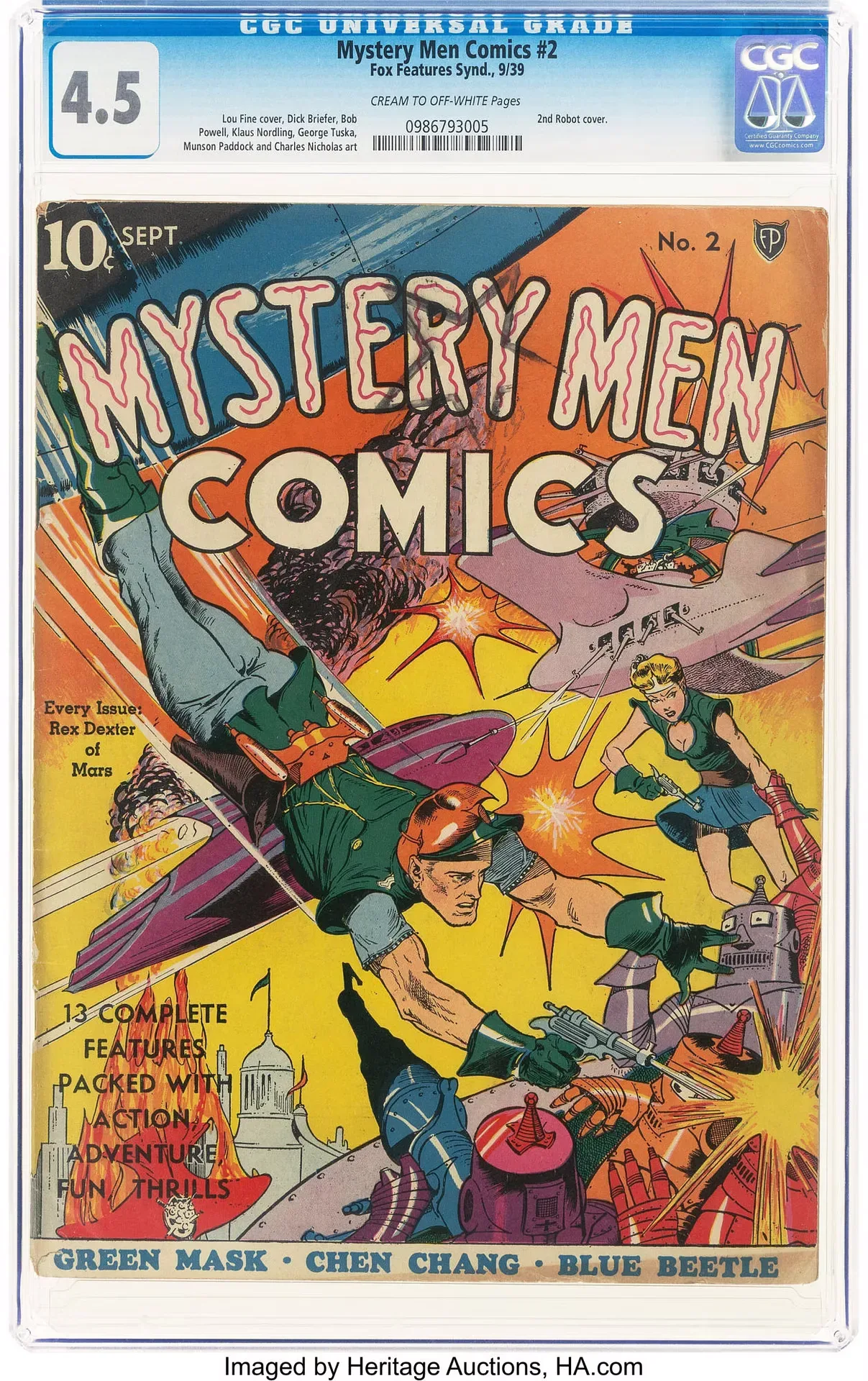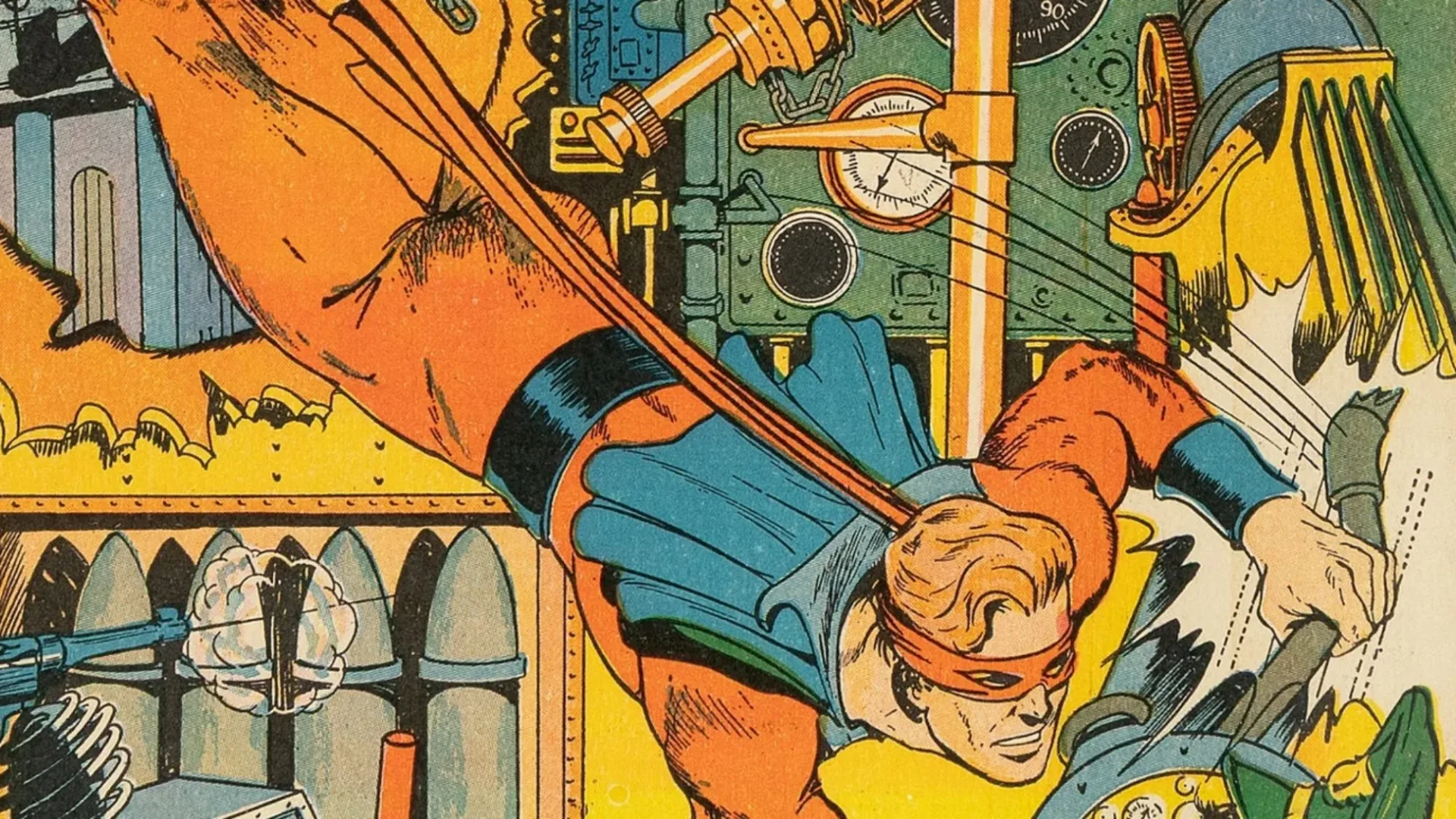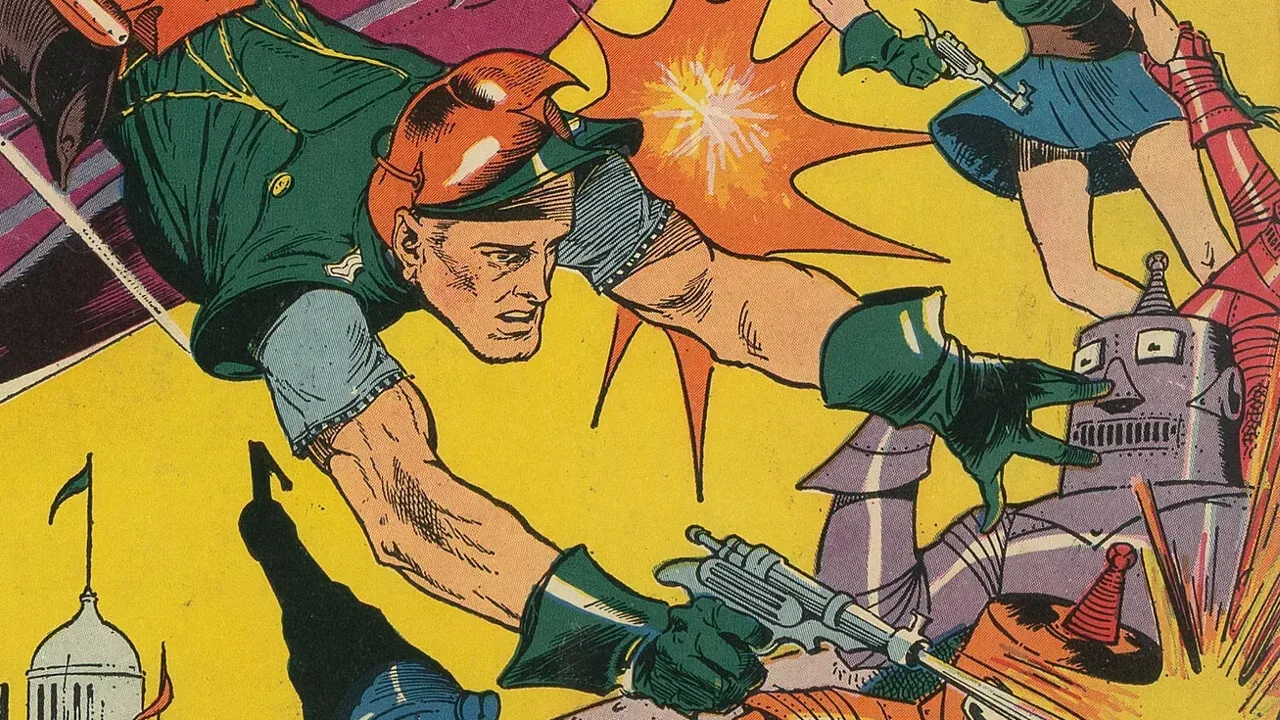
Mystery Men Comics #2 is an unusually concentrated slice of 1939 comic-book imagination: a Lou Fine robot cover on the outside and a Dick Briefer science-fiction serial inside that treats a medical-material shortage as a problem large enough to require moving an entire world. The Fox issue, cover-dated September 1939, is scheduled to appear as a CGC Universal VG+ 4.5 copy with cream-to-off-white pages in the November 5, 2026 Golden Age Century Comics Showcase Auction VI, lot #40378.
For collectors, the appeal is not limited to one familiar name or one dramatic cover element. Fine was in the opening phase of his comic-book career, while Briefer’s Rex Dexter story offers a particularly vivid example of early comics taking a real-world concern and turning its scale up past the stratosphere. The result is a book where cover art, story premise, publisher-era context and condition scarcity all point in the same direction.
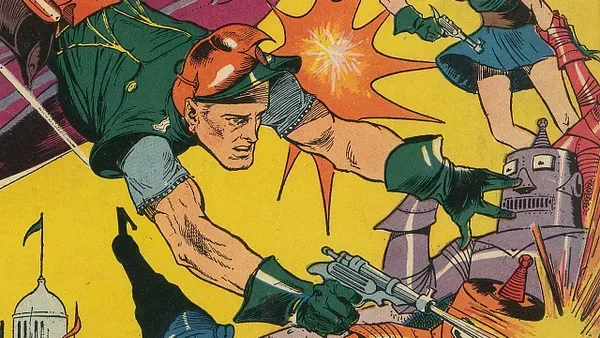
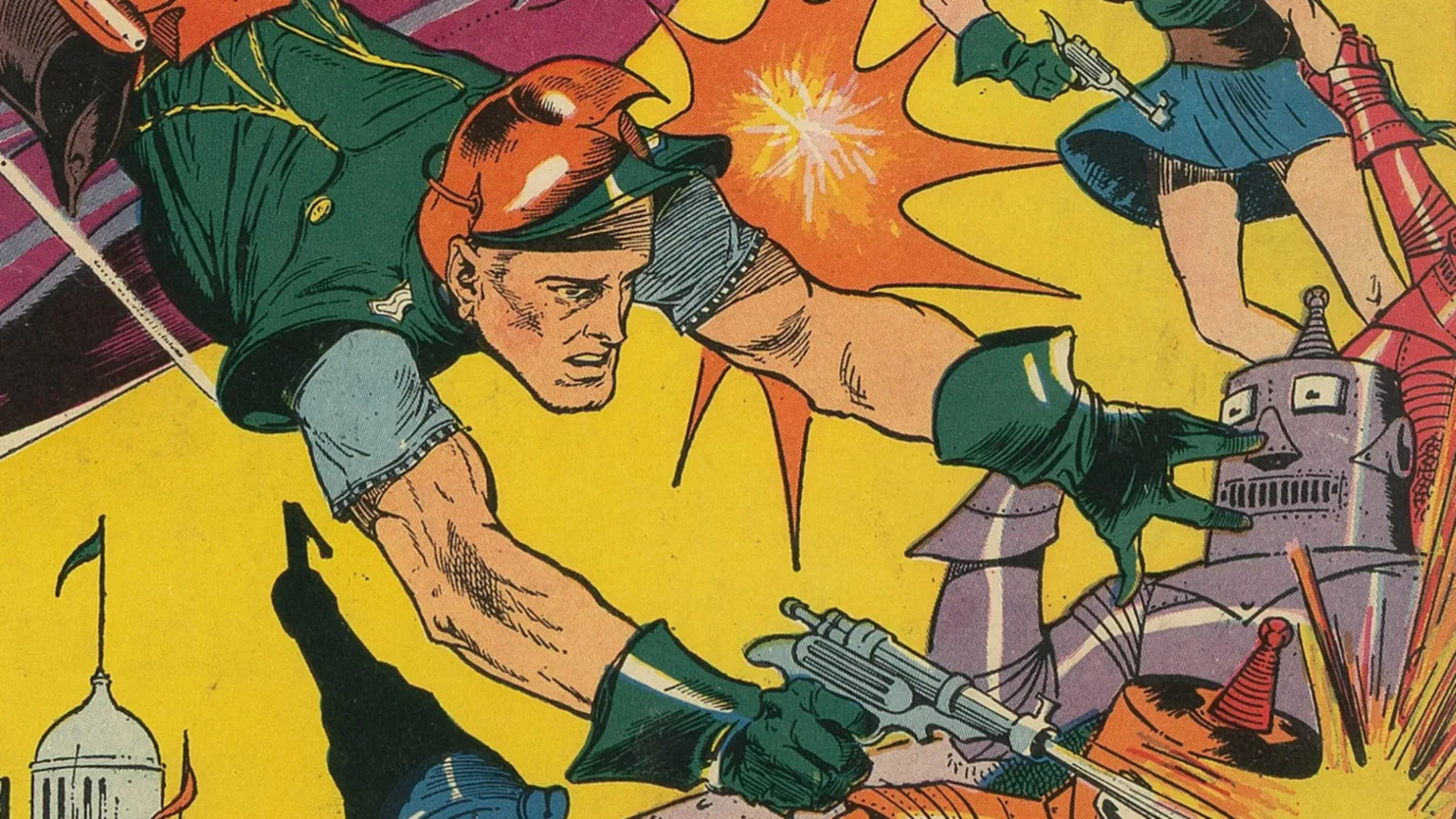
A robot cover from Lou Fine’s early comics period
The cover is the immediate attraction: a piece of mechanical mayhem by Lou Fine, an artist who would go on to become one of Fox’s premier cover artists. In September 1939, however, this was still early in his professional comics timeline.
Fine entered the Eisner-Iger studio in 1938. His professional comics debut was in Wags #72, cover-dated July 1938. His first Fox assignment arrived on the cover of Wonder Comics #2, cover-dated June 1939. That puts Mystery Men Comics #2 only a few months into his Fox cover work and within roughly a year and a half of his comics debut.
For more context, explore Kane Parsons’ ‘Dream Projects’ Spark Portal and Half-Life Speculation, but Valve Deal Is Unconfirmed.
That chronology matters because an “early” work is not merely old. It can document an artist before the later accomplishments that define their reputation, while still showing the visual instincts that made those accomplishments possible. Here, the robot imagery is an especially direct draw. Mechanical figures and threatened human-scale drama are instantly legible on a comic rack or in an auction preview, and the subject matter matches the unrestrained science-fiction pitch waiting inside.
Fine’s cover does not simply advertise a generic mystery. It primes the reader for a story built around machines, rockets, other planets and stakes so high that ordinary solutions are discarded. That clean relationship between exterior and interior gives the issue a cohesive identity as an artifact, not just a book with a desirable cover stapled around unrelated material.
Rex Dexter and the radium emergency
Dick Briefer’s Rex Dexter saga is set in the year 2000, a future framed by a family history tracing back to a rocket departure from the 1939 World’s Fair. Earth is suffering from a plague, and the planet needs more radium than it can supply. Rex and Cynde join an expedition of nine rockets bound for Capris, where radium-bearing pitchblende offers a possible answer.
Pitchblende is the term used for the radium-bearing material sought in the story; the comic spells it “pitchblend.” The mineral is not a stray bit of scientific decoration. It is the engine of the plot. Earth’s patients need the material, Capris has it, and the mission begins as a resource-gathering effort with a humanitarian purpose.
Then the story refuses to remain a straightforward extraction mission. An attack interrupts the group’s work, and the expedition returns to Earth with too little ore to treat everyone. Rex’s answer is not to locate another mine, ration the supply or stage a second rocket trip. He attempts something far more audacious: moving the entire planet Capris.
That escalation is the central pleasure of the premise. The story begins with a recognizable shortage and converts it into planetary engineering. It is classic pulp-comics logic in its boldest form: if the cure is on another world and a shipment cannot solve the crisis, bring the world itself.
Why the radium premise has real-world roots
The story’s solution is fantastic, but its problem had a recognizable basis in the period. During the 1920s and 1930s, difficulty and expense in obtaining even a gram of radium for cancer treatment were widely reported. The material was also difficult to handle. Briefer’s scenario magnifies that scarcity until it becomes a worldwide emergency, but it does not start from nothing.
That distinction gives the Rex Dexter feature more texture than a purely arbitrary “magic fuel” plot. Radium is presented as a coveted medical necessity. The comic’s plague creates an extreme demand; Capris supplies the needed ore; the interrupted mission leaves an impossible shortfall. Each turn follows the same basic resource logic, even as the eventual fix leaps into cosmic spectacle.
For modern readers, this is a useful reminder that Golden Age science fiction often processed contemporary anxieties through impossible machinery and distant planets. The basic concern in Mystery Men Comics #2 is access: who has the life-saving material, how can it be reached, and what happens when there is not enough for everyone? The comic’s answer is an adventure answer rather than a practical one, but the underlying tension is more grounded than the planet-moving climax suggests.
What makes this issue distinct as a collectible
Early Fox books can present a layered collecting case. In this instance, there is the publisher and era, the Fine cover, the robot motif, Briefer’s Rex Dexter material and a specific, memorable story hook. Any one of those elements may interest a buyer; together, they make the issue easier to identify and remember.
- Artist interest: The book comes from the early months of Fine’s work for Fox, before his later standing as one of the publisher’s leading cover artists was established.
- Cover interest: Fine’s robot imagery gives the issue a direct visual niche for collectors drawn to mechanical and science-fiction covers.
- Story interest: Rex Dexter’s attempt to relocate Capris is a sharply defined premise, tied to an Earth-wide radium shortage rather than a vague invasion or routine space voyage.
- Period context: The plot enlarges a real concern about the rarity, cost and medical use of radium during the preceding decades.
- Scarcity in stronger condition: The available CGC census figure lists 37 Universal and Restored entries, making high-grade examples difficult to encounter.
The last point requires careful reading. A census count records encapsulated copies included in that census; it is not a complete count of every surviving raw, graded or privately held copy. It is still useful as a narrow condition-and-availability reference. In the figures provided for this issue, one Universal copy is graded 4.5 and 10 Universal copies are higher. The offered book’s CGC Universal VG+ 4.5 grade therefore sits at a notable point in the recorded group, even though the census should not be mistaken for a total surviving population report.
“Universal” is CGC’s designation for a comic that has received its standard blue-label grading classification rather than a restored designation. “VG+ 4.5” identifies the assigned numerical condition grade, while “cream-to-off-white pages” describes the interior paper quality noted on the slab label. Those distinctions matter because a vintage comic’s appeal is often judged on more than cover presentation: completeness, restoration status, structural condition and paper characteristics can all affect how a specific copy is considered.
An auction lot with several ways to be read
The November 5, 2026 auction listing gives collectors several legitimate lenses through which to assess this copy. A Fine-focused buyer may see an early robot cover. A Fox-focused buyer may see a tough early issue in a scarce grade range. A reader interested in historic science fiction may see a story that transforms radium supply anxiety into a planet-scale rescue mission. None of those approaches cancels out the others.
It is also the sort of lot where it helps to separate documented details from inference. The documented details are clear: the issue is Mystery Men Comics #2, published by Fox in 1939 and cover-dated September; Fine created the cover; Briefer wrote the Rex Dexter scenario described here; the listed copy is CGC Universal VG+ 4.5 with cream-to-off-white pages; and its auction placement is Golden Age Century Comics Showcase Auction VI #40378. The book’s desirability, ultimate hammer result and buyer priorities are necessarily matters for the market to determine.
In practical terms, interested bidders should focus on the precise copy being offered rather than treating title-level reputation as a substitute for copy-level evaluation. The grade, page designation and auction presentation identify this individual example. The issue’s broader reputation explains why it may draw attention, but it does not eliminate the need to review the listing details for the exact slabbed book.
Why the cover and story work so well together
There is a satisfying structural symmetry in Mystery Men Comics #2. Fine supplies machinery in immediate visual form: the cover’s robot promises a future shaped by technology and danger. Briefer supplies machinery and scale in narrative form: rockets cross space, ore becomes the object of an urgent mission, and a planet ultimately becomes the proposed cargo.
The pairing is also a snapshot of how comics could turn the concerns of their own day into distant-future adventure without losing the emotional core. The problem is that people need treatment. The science-fiction premise turns the remedy into radium from another planet. The adventure complication is that the first attempt fails. Rex Dexter’s answer makes the material shortage physically enormous by deciding that Capris itself must move.
That is why the issue remains more than a robot-cover checklist entry. It has a compact but unusually legible identity: early Lou Fine artwork, Dick Briefer’s cosmic escalation, a 1939 Fox setting and a scarcity narrative supported by the available census figures. For a vintage-comics collector, those elements make Mystery Men Comics #2 a book with both an immediate visual hook and a surprisingly specific story to back it up.