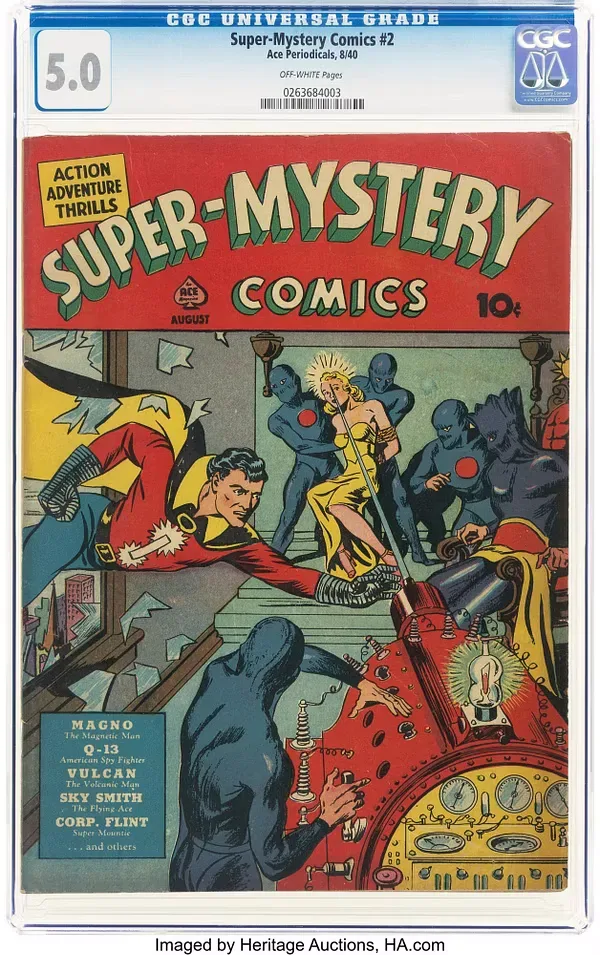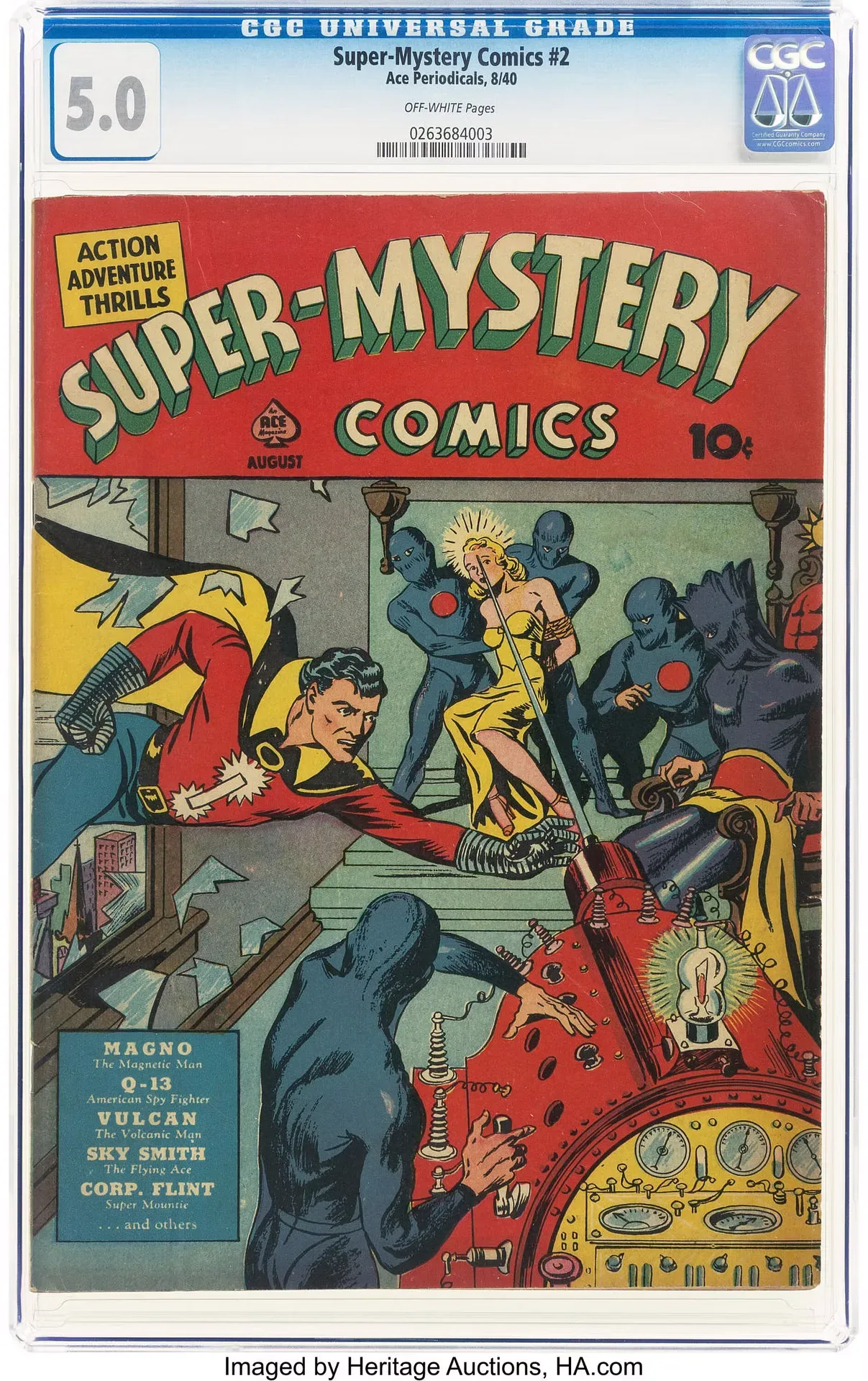
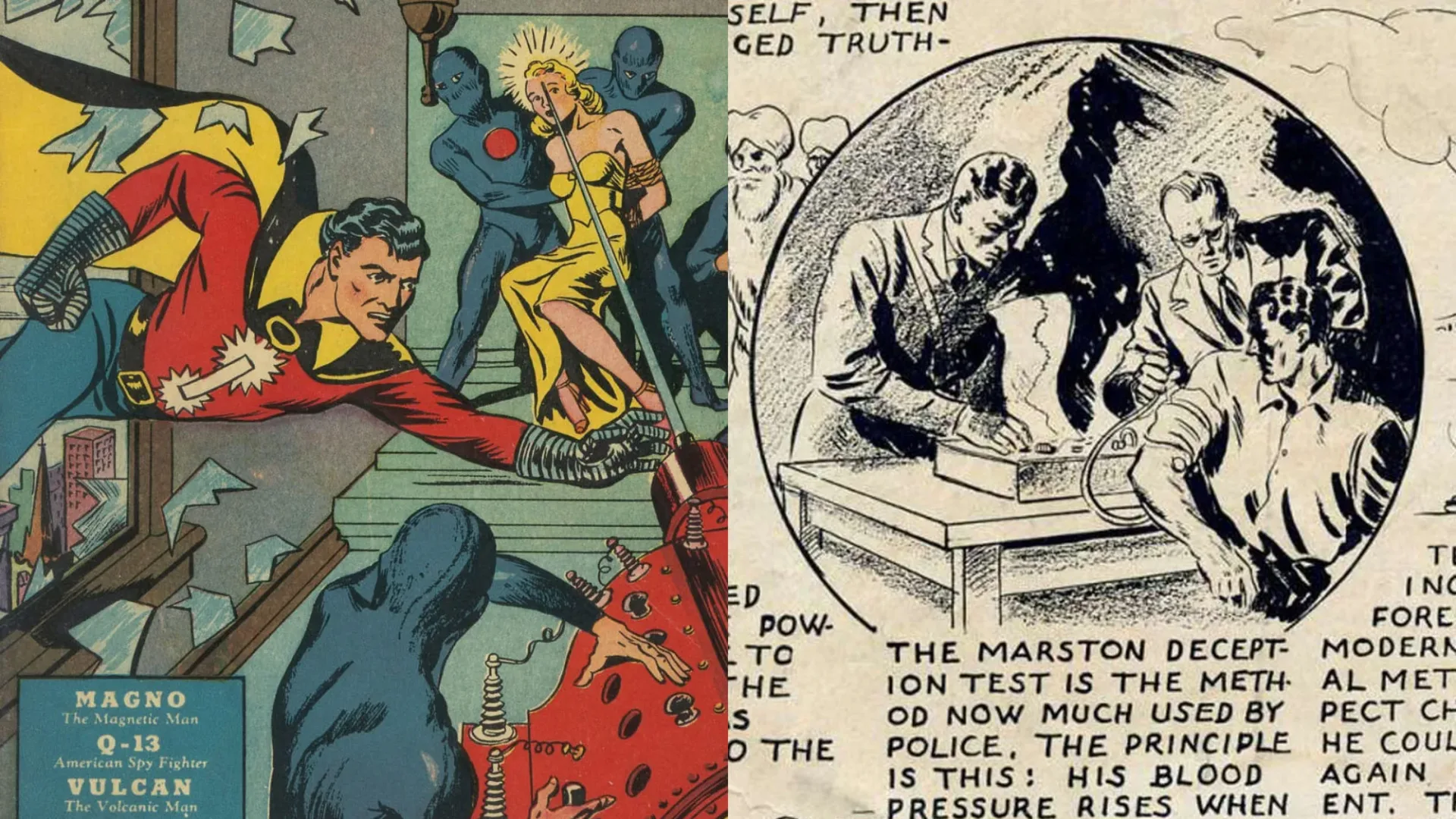
Super-Mystery Comics #2 is an unusual Golden Age comic-book artifact: its appeal rests not only on a superhero story and a Harry Lucey cover, but on an inside-front-cover feature involving William Moulton Marston before he became permanently associated with Wonder Woman. The August 1940 Ace Periodicals issue includes an explanation of the “Marston deception test,” placing his earlier work on blood pressure and deception directly in front of comic readers.
That placement matters because Wonder Woman would not arrive until All-Star Comics #8 in 1941, where Marston and artist H. G. Peter introduced the character. In other words, this comic captures Marston at an intersection of two public identities: a figure known for arguing that physiological testing could help detect deception, and, shortly afterward, the creator of one of comics’ most enduring superheroes.
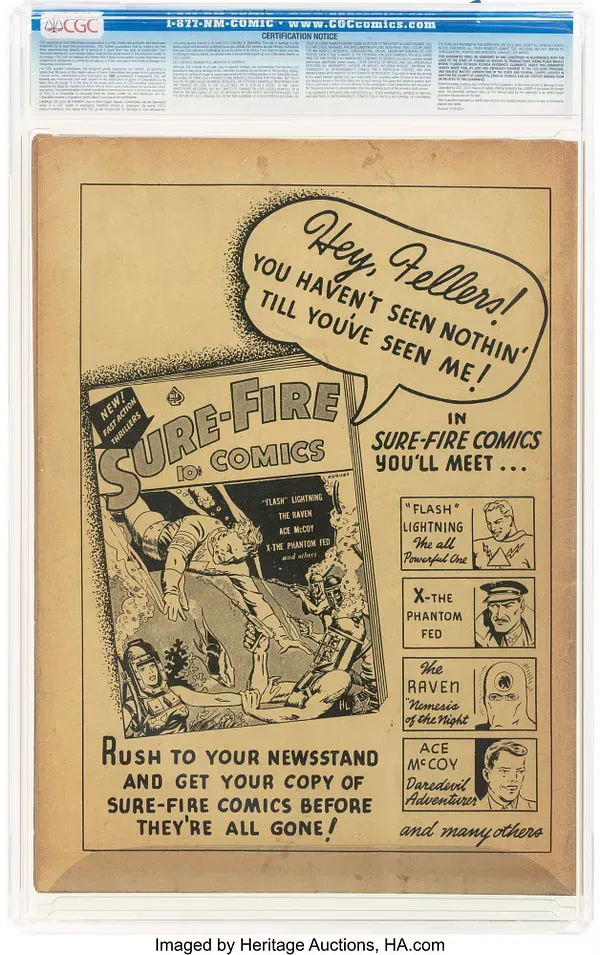
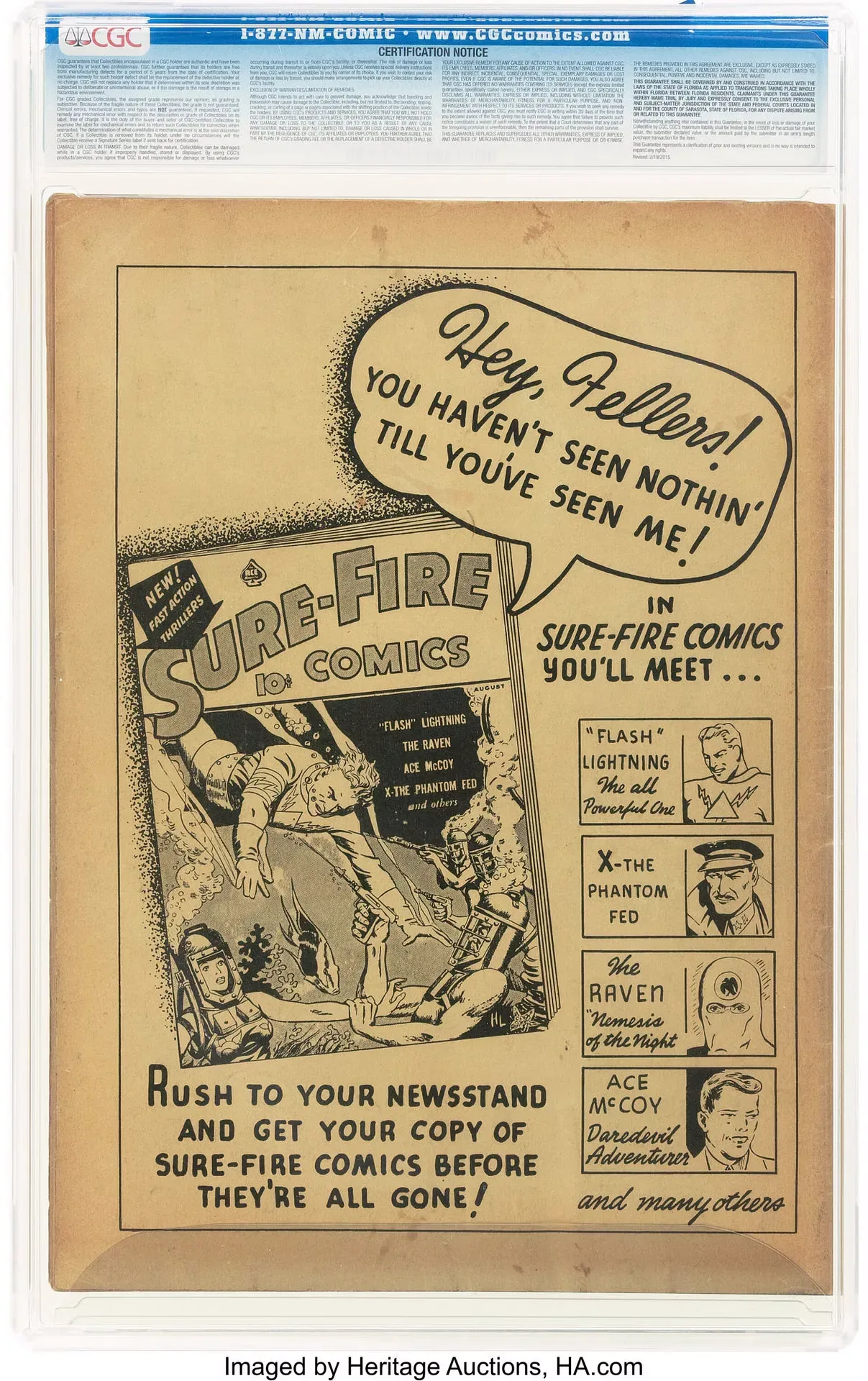
A CGC VG/FN 5.0 copy with off-white pages is listed in the November 5, 2026 Golden Age Century Comics Showcase Auction VI, identified as event #40378. For collectors, it is a book with several distinct points of interest—early Ace Periodicals material, Lucey art, a Magno story, and a Marston-related feature—rather than simply an issue whose value depends on one familiar superhero appearance.
The feature before the superhero legacy
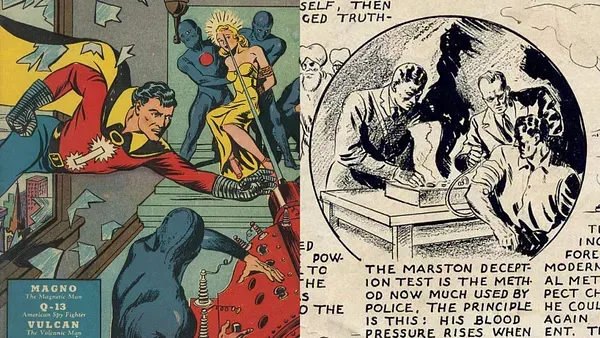
The inside front cover is titled The Lie Detector and How Suspects Were Treated in Earlier Times. Its focus is Marston’s testing process, while also looking at earlier efforts to determine whether a suspect was telling the truth. The page describes the phenomenon it calls the Marston deception test: an unexpected question may cause a suspect’s blood pressure to drop sharply before it rises higher again.
In practical terms, the feature is concerned with physiological responses—bodily changes measured during questioning—rather than a machine that can somehow read a person’s thoughts. In the account presented in the comic, blood pressure is the key signal. That distinction is useful when reading the page today: the claim was about interpreting a response connected to deception, not about proving a lie through an infallible mechanical verdict.
Marston had published a study of systolic blood pressure and deception in 1917. Systolic blood pressure is the pressure in arteries when the heart contracts, commonly represented by the first number in a blood-pressure reading. His work gave the 1940 comic’s educational feature a real-world subject with obvious dramatic potential: hidden information, sudden questions, danger, and the challenge of identifying truth under pressure.
The issue does not present the subject as a settled courtroom tool. That uncertainty is fundamental to the item’s historical interest. In Frye v. United States in 1923, an appeals court upheld the exclusion of testimony involving the test because it had not achieved sufficient scientific acceptance. Marston nevertheless continued advocating for its use publicly, including in his 1938 book The Lie Detector Test.
That legal outcome gives the inside-cover page more weight than a routine piece of comic-book trivia. It documents a period when a proposed deception-testing method had public visibility yet faced a major barrier to courtroom acceptance. The comic therefore packages a contested scientific and legal question for a popular audience, just before Marston would become a major name in superhero comics for an entirely different reason.
Truth and control in the Magno story
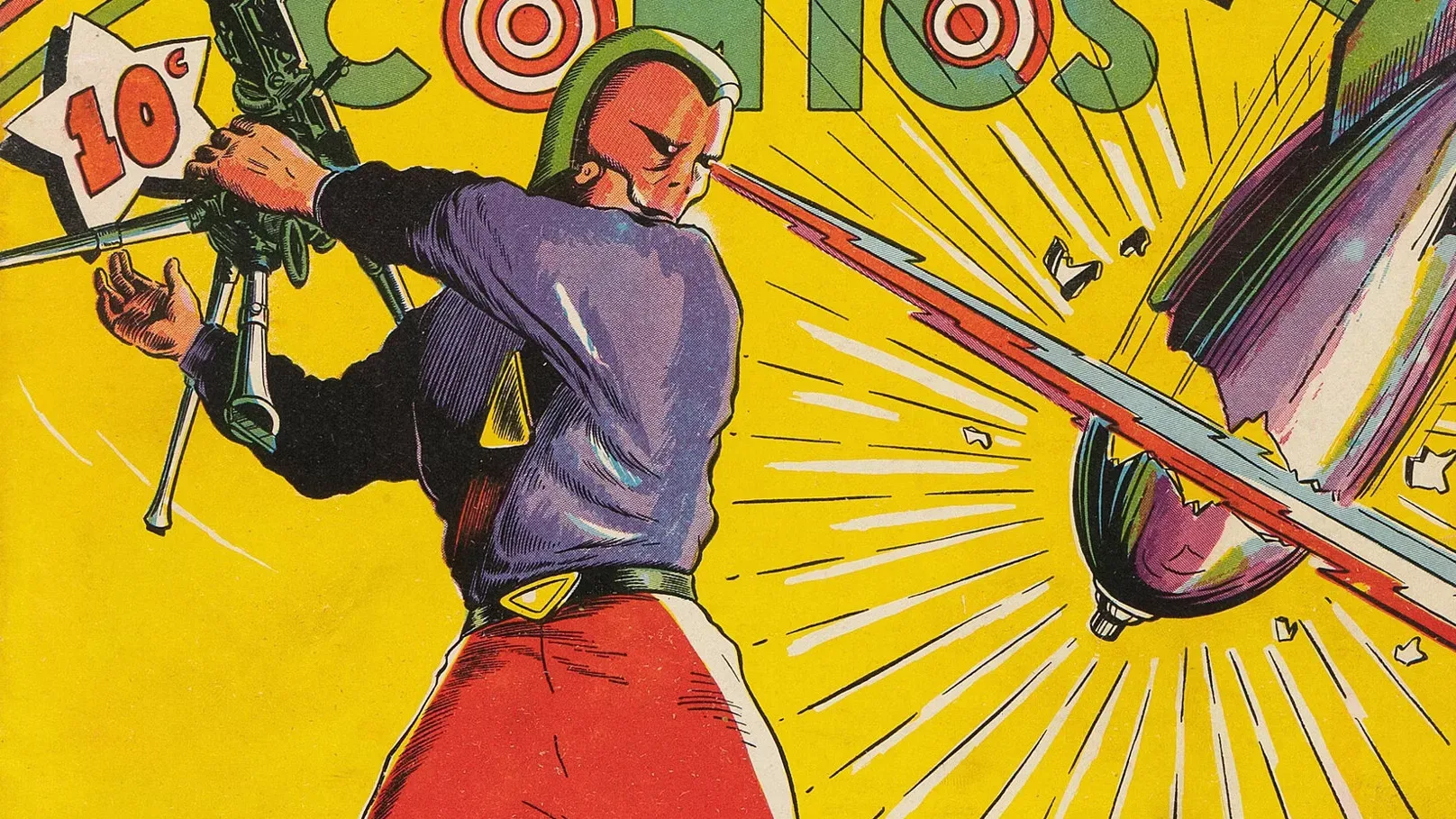
The theme of truth does not end with the feature page. The lead story stars Magno and was drawn by Harry Lucey, who also drew the issue’s cover. Its villain, the Blue Spark, uses an electrical ray to keep Ann Borden from telling the truth. The setup turns the issue’s nonfiction concern—whether someone can reveal what they know—into a superhero threat involving coercion and control.
Ann and Magno are prevented from warning a train about what could become a fatal trap. Magno battles through the danger, but the Blue Spark and his associates maintain control over Ann with their device. They then try to use her in a bank robbery. The story ultimately ends with Magno breaking the Blue Spark’s hold on her.
The juxtaposition is striking. On one page, readers encounter a discussion of blood pressure, questioning, and deception. Elsewhere, a villain makes truth impossible through an electrical device. These are not the same concept: the Marston material is about attempting to interpret an involuntary physical response, while the Blue Spark’s ray actively suppresses a person’s ability to speak truthfully. But both sections make honesty, evidence, and manipulation central to the issue.
For a collector evaluating why a comparatively obscure 1940 comic stands out, that thematic overlap adds coherence. The book is not merely a Magno issue with an unrelated text feature tucked into the front. Its nonfiction page and lead adventure both revolve around the precariousness of truthful testimony—one through a claimed method of measurement, the other through colorful pulp-science menace.
Why Marston’s name changes the book’s context
Marston’s later connection to Wonder Woman is the clearest reason this issue reaches beyond a standard early Ace Periodicals release. The timing is unusually close: Super-Mystery Comics #2 dates to August 1940, while Wonder Woman first appeared in All-Star Comics #8 in 1941. The book does not offer a Wonder Woman appearance, preview, or origin; its relevance lies in showing a subject for which Marston was known before that character changed his place in comic-book history.
This is also why careful wording matters. The issue features a page about Marston’s deception test; it is not evidence that Wonder Woman had already appeared in the title, or that the Magno story was created by Marston. Lucey is credited here as the artist of the cover and lead Magno adventure. The Marston connection is specifically the inside-front-cover educational feature and its treatment of his blood-pressure work.
Collectors interested in creator context often look for objects that illuminate a career before a defining work. This comic offers that kind of connection. It places a pre-Wonder Woman public topic associated with Marston in a medium he would soon influence through a landmark character. The result is a comic with historical texture even for readers whose main interest is not Magno.
Scarcity, grading, and what the census figure says
The issue is described as difficult to obtain, consistent with its status as an early Ace Periodicals comic. The CGC census records 17 Universal copies of Super-Mystery Comics #2. Of those, only six are graded higher than the offered CGC 5.0 copy.
Universal is a CGC label category generally used for comics without the special qualifiers that accompany certain other label types. In this context, the supplied census count is a record of copies graded by CGC in that category, not a complete count of every surviving copy. A census can demonstrate that an issue is seldom submitted or encountered in graded form, but it cannot establish the full number still held in collections or otherwise ungraded.
The offered grade is VG/FN 5.0, shorthand for Very Good/Fine. The copy is also described as having off-white pages. Those details give prospective bidders a concise description of the particular book, while the census comparison provides a limited sense of where it sits among CGC-recorded copies. Six examples registering above it means the offered copy is not presented as the highest graded, but it is also not near the bottom of the reported population.
That distinction is valuable in a niche Golden Age auction. The collector case is broader than chasing a top census position: the book combines relative scarcity with a specific cover and story artist, a Magno lead, and a feature connected to Marston’s pre-Wonder Woman public profile. Buyers should still separate those facts from broader assumptions about demand or value, neither of which can be determined by a census number alone.
A compact piece of comics, science, and pulp history
Super-Mystery Comics #2 makes an unexpectedly layered historical document. Its Marston feature preserves a popular presentation of a deception-testing theory that had already faced legal resistance over scientific acceptance. Its lead Magno story turns the question of truth into a direct threat, with the Blue Spark using an electrical ray to silence Ann Borden’s warning. Its 1940 publication date places both elements immediately before Marston’s 1941 Wonder Woman debut with H. G. Peter.
That combination is what gives the auction lot its unusual character. A buyer is not simply pursuing an old superhero comic, nor simply a Marston-adjacent curiosity. The issue offers a tightly dated snapshot of the ideas surrounding Marston before Wonder Woman became the work most closely linked with his name, alongside Lucey’s cover and lead-story artwork. Readers interested in another character-driven illustrated project can also see Sir Reginald & the Clockwork Heart.