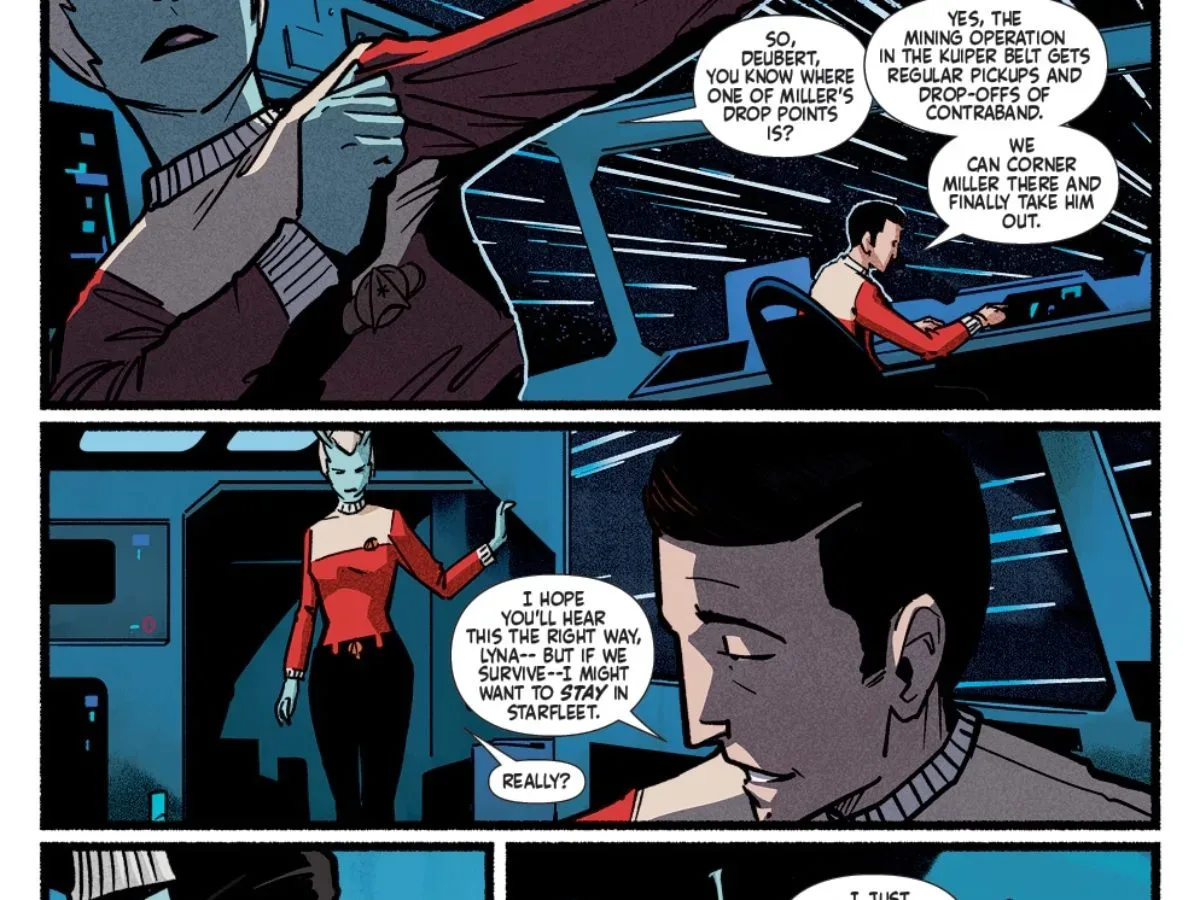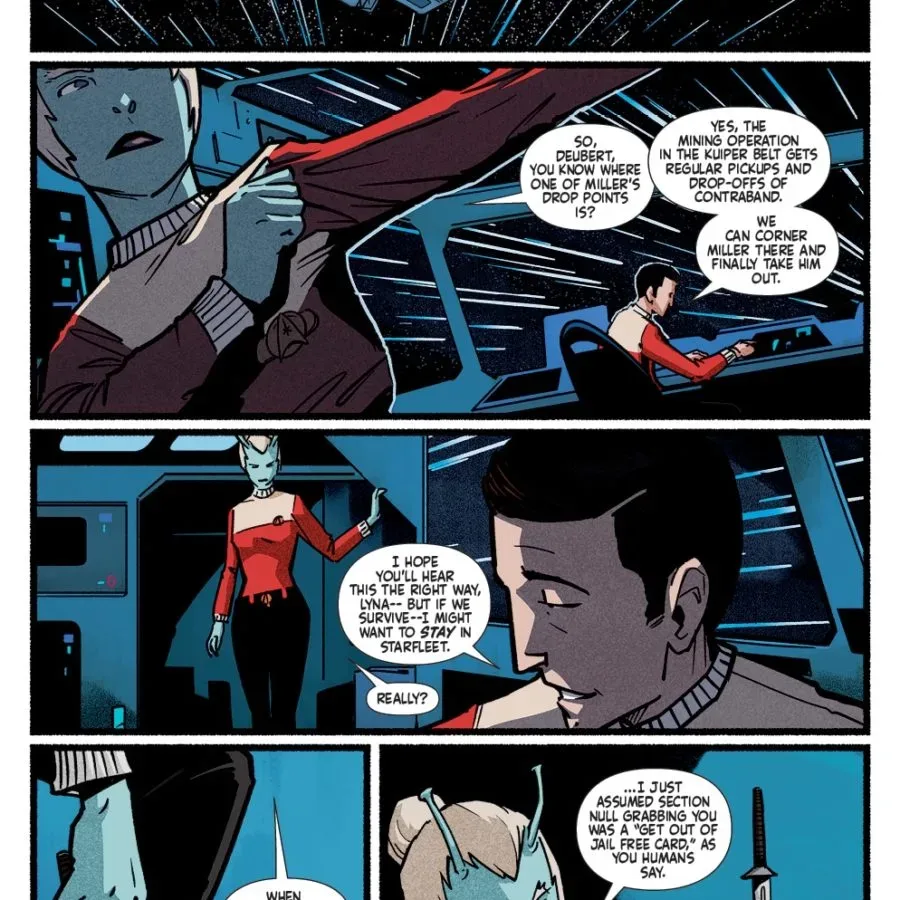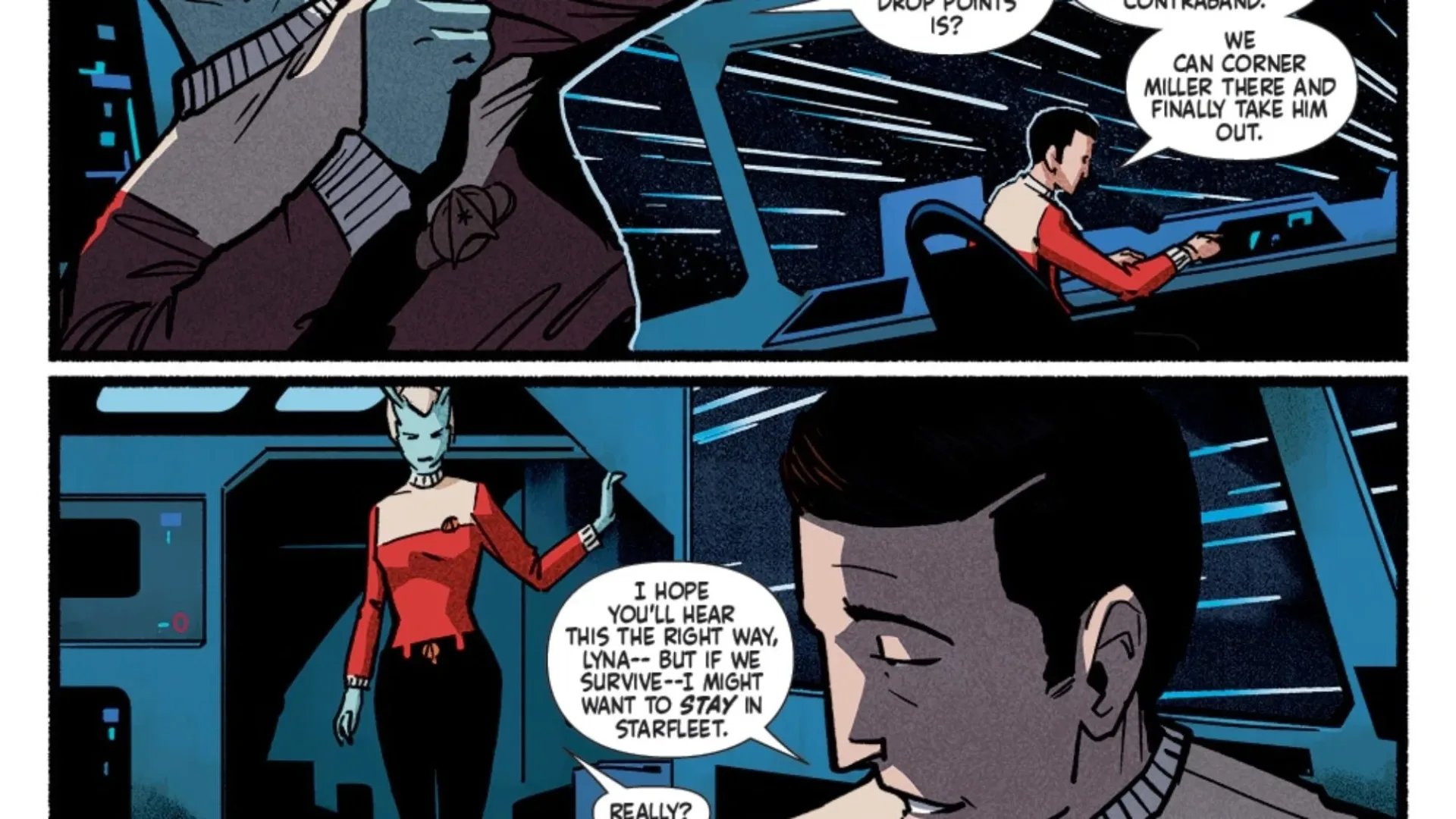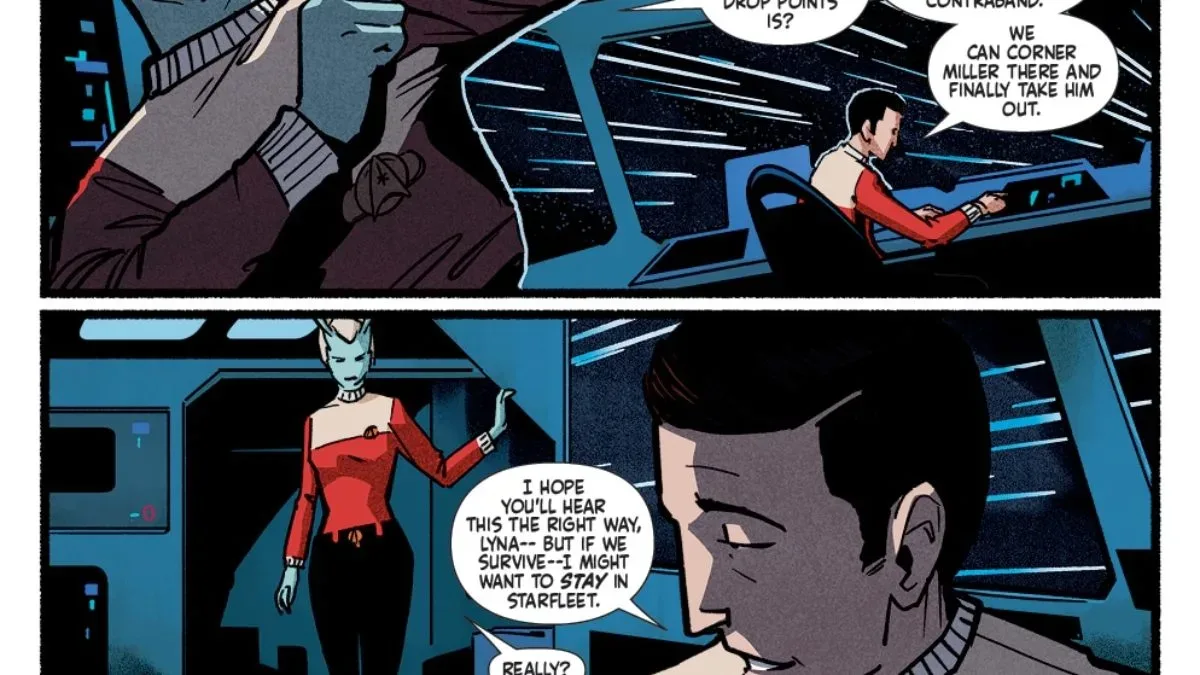
Star Trek: Red Shirts – Ghost of the 21st Century #3 is scheduled to go on sale October 14, 2026, from IDW Publishing. The 32-page, Rated T issue continues a conspiracy story in which the apparent threat is no longer confined to a distant enemy or a single compromised official: Section Null may be present anywhere within Starfleet, including at its highest levels.
The central predicament belongs to Andorian spy Lyna Taval and former bomber Harry Deubert. They have been driven toward the edges of the quadrant, and the solicitation frames their remaining option as taking the fight to Chip Miller, described as their greatest betrayer. Miller is tied to an unsettling operation involving latinum and the bodies of Starfleet personnel in red uniforms. Yet the issue’s setup is clear that removing one man will not necessarily solve the larger crisis. The corruption inside Starfleet runs more deeply.
A conspiracy built around uncertainty
Section Null’s stated ability to be “any where and any one” establishes the governing tension for this chapter. In practical story terms, it means identification is unreliable. A recognizable uniform, rank, or place in the command structure does not automatically establish that a character can be trusted. Even the senior leadership of Starfleet is presented as potentially compromised.
That is an especially useful premise for a thriller because it changes how every encounter can function. A character who offers help may have another purpose. An institutional order may be part of the danger rather than a route out of it. Information itself becomes suspect, since a group capable of reaching “every level” can potentially shape what the protagonists are told and where they are sent.
The title’s focus on red shirts also carries specific narrative weight within the material provided. The conspiracy is connected to deaths among personnel in red uniforms, while the description of Miller’s scheme makes those deaths part of a mysterious endgame. Rather than treating casualties merely as background stakes, the issue appears positioned to ask who benefits from them and how a system might conceal that benefit.
Lyna Taval and Harry Deubert are allies under strain
Lyna and Harry have only each other to rely on, but that does not make their partnership simple or safe. Both are sought by their enemies, and the setup additionally says they are wanted by each other. That wording suggests a relationship defined by competing motives as much as shared survival. It leaves room for suspicion, obligation, conflict, or goals that do not entirely match.
Analysis: This is the key personal pressure point in an infiltration story. A conspiracy can feel enormous and abstract; placing two people at its center gives the reader a smaller, more immediate test of trust. If neither character can confidently rely on Starfleet, then their ability to work together becomes crucial. At the same time, the premise makes that reliance difficult, because either partner may be holding back information or pursuing a separate answer.
The description does not reveal exactly what each character wants from the other, nor does it establish that their tension is romantic. The firmer reading is simply that their mutual dependence exists alongside a mutual threat. That contradiction should keep Chip Miller’s pursuit from being a straightforward mission.
What “the rot runs deeper” means for issue #3
The solicitation directly warns that Chip Miller is not the whole problem. He is an important target and a named betrayer, but Section Null’s reach means the protagonists may be confronting an organization rather than just an individual. In conspiracy fiction, that distinction matters. Catching a single operative can expose a link in the chain, but it does not necessarily reveal who holds the chain or what its final purpose is.
The phrase “mysterious end game” accordingly does more than preserve a plot secret. It identifies the larger unanswered question surrounding the bodies, the latinum, and the red-shirted personnel. Readers should not expect the basic premise to be resolved simply by locating Miller. The issue is more likely to make his role meaningful within a broader network whose aims remain obscured.
“Death flirts at the edge of every shadow” also signals the intended mood: danger is ambient rather than limited to obvious confrontations. The characters are chased, marked by enemies, and operating in an environment where authority itself may be unreliable. That setup promises a tense entry in which travel, meetings, and apparent refuge can all carry risk.
Creative team and edition details
The issue is credited to writer Gerry Duggan and artist Scott Buoncristiano, with a cover by Chris Shehan. Its standard edition carries item code 82771403550600311 and is listed at $4.99 in the United States.
Two additional covers are listed at the same U.S. price:
- Variant B (Ward), item code 82771403550600321, listed at $4.99 US and $6.99 CAN.
- Variant RI (10) (Vilchez), item code 82771403550600331, listed at $4.99 US and $6.99 CAN.
The “RI (10)” label identifies the Vilchez edition as an incentive variant designation. The supplied listing does not spell out ordering terms beyond that label, so readers looking for that cover should check with their preferred comic retailer rather than assume it will be stocked in the same way as the standard edition.
For readers looking at the wider October comic slate, Archie vs. The Terminator #1 is another upcoming crossover issue with a markedly different premise.
Why this chapter’s setup matters
Issue #3 is positioned as a pursuit story, but its real engine is distrust. Lyna Taval and Harry Deubert are not only moving toward Chip Miller; they are moving through a Starfleet structure that may be working against them. The named target provides direction, while Section Null supplies the larger uncertainty that makes the route dangerous.
That combination gives the comic several active questions: What does Miller gain from the operation linked to fallen red-shirt personnel? How far has Section Null penetrated Starfleet? Can Lyna and Harry cooperate long enough to reach him? And if they do, will they find a culprit, a clue, or a deeper layer of the conspiracy?
Those questions are more important to the preview than any promise of a clean victory. The issue is framed as a point where the leads must act because retreat has run out, even though the people and institutions around them may not be what they seem.