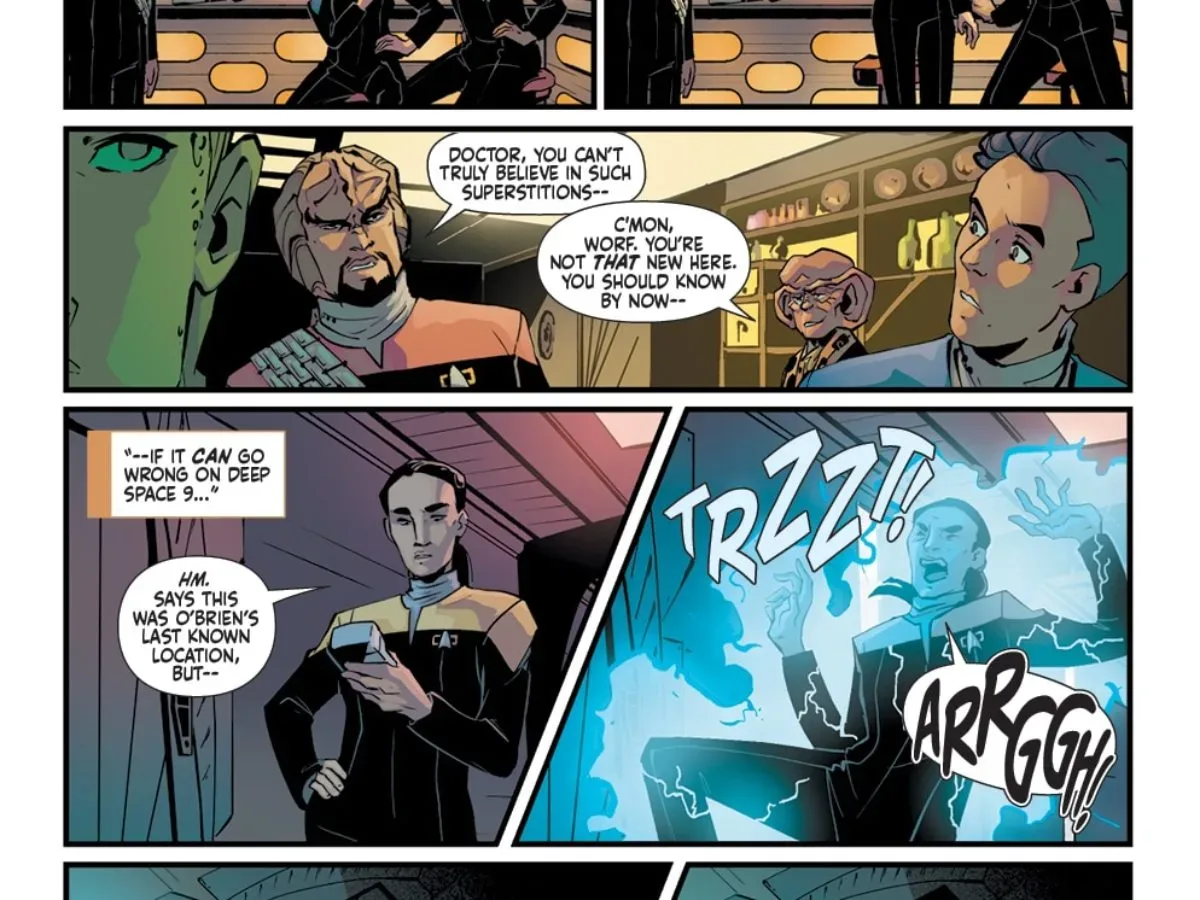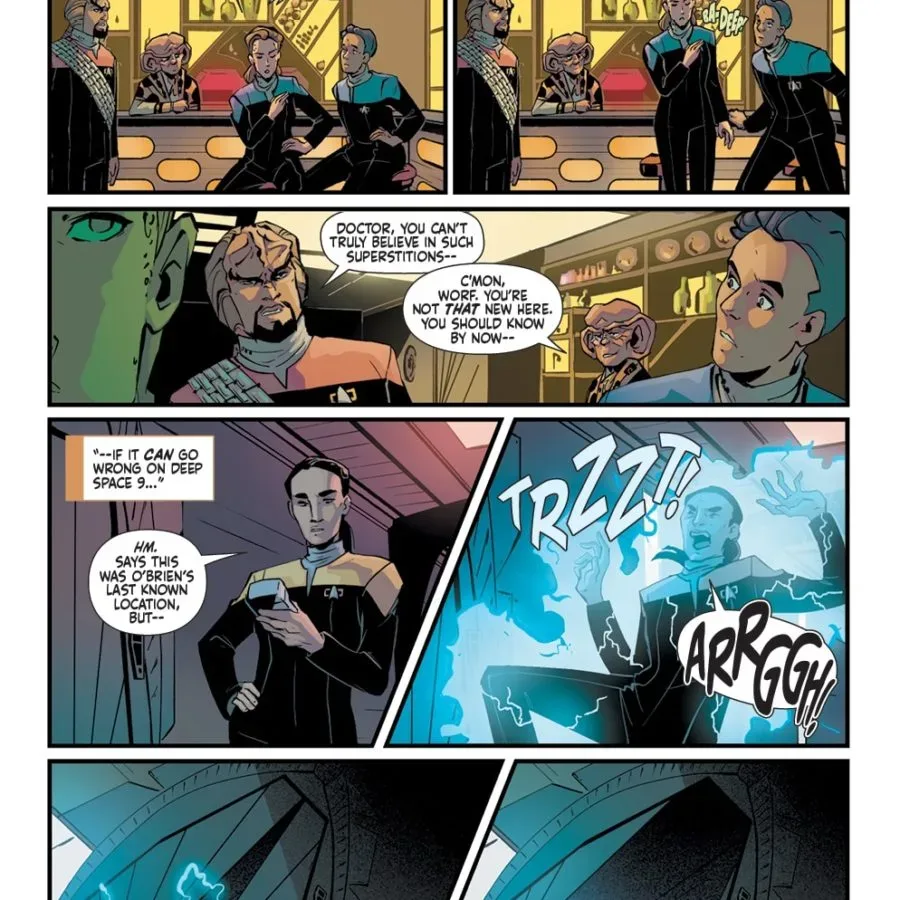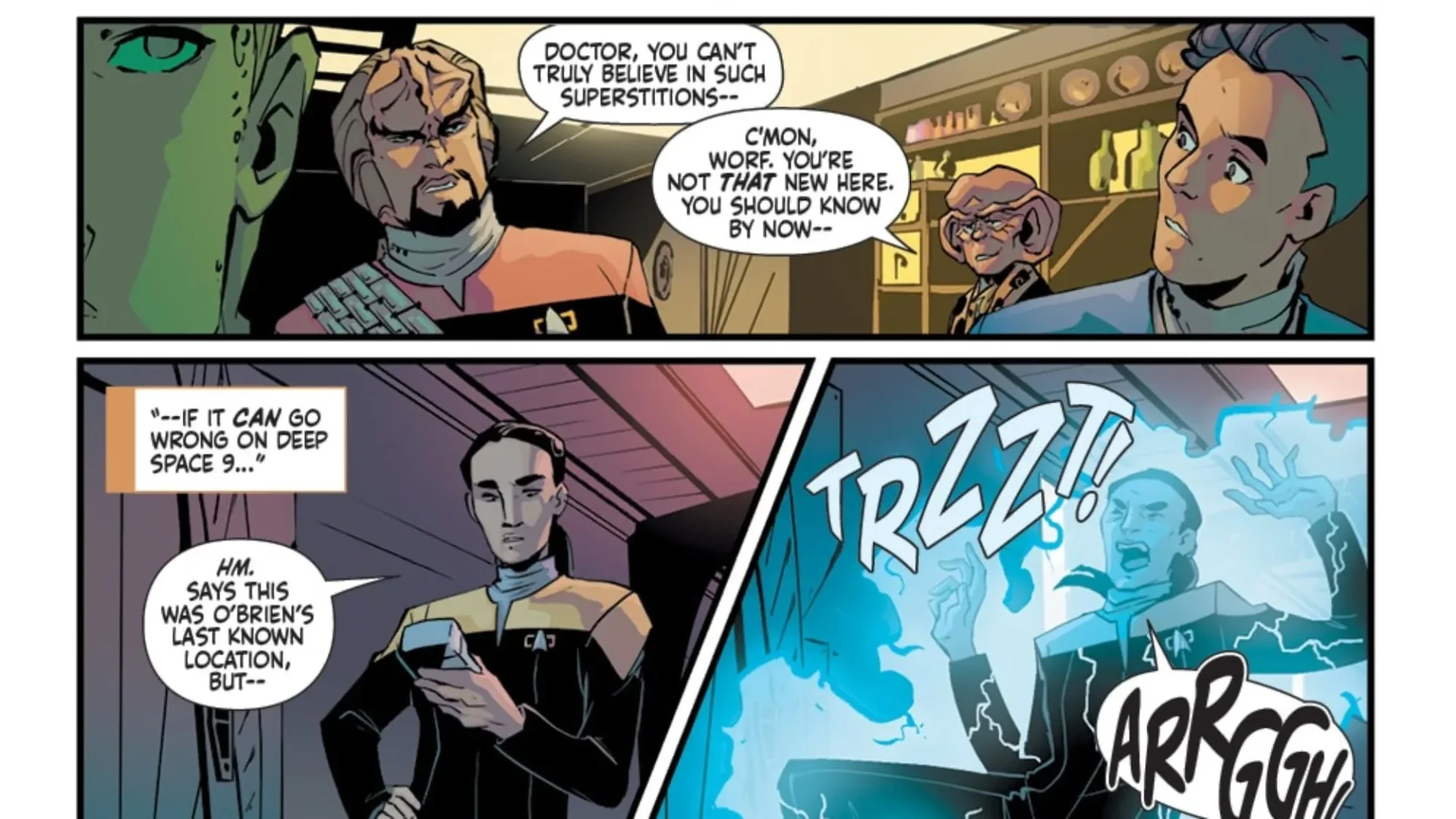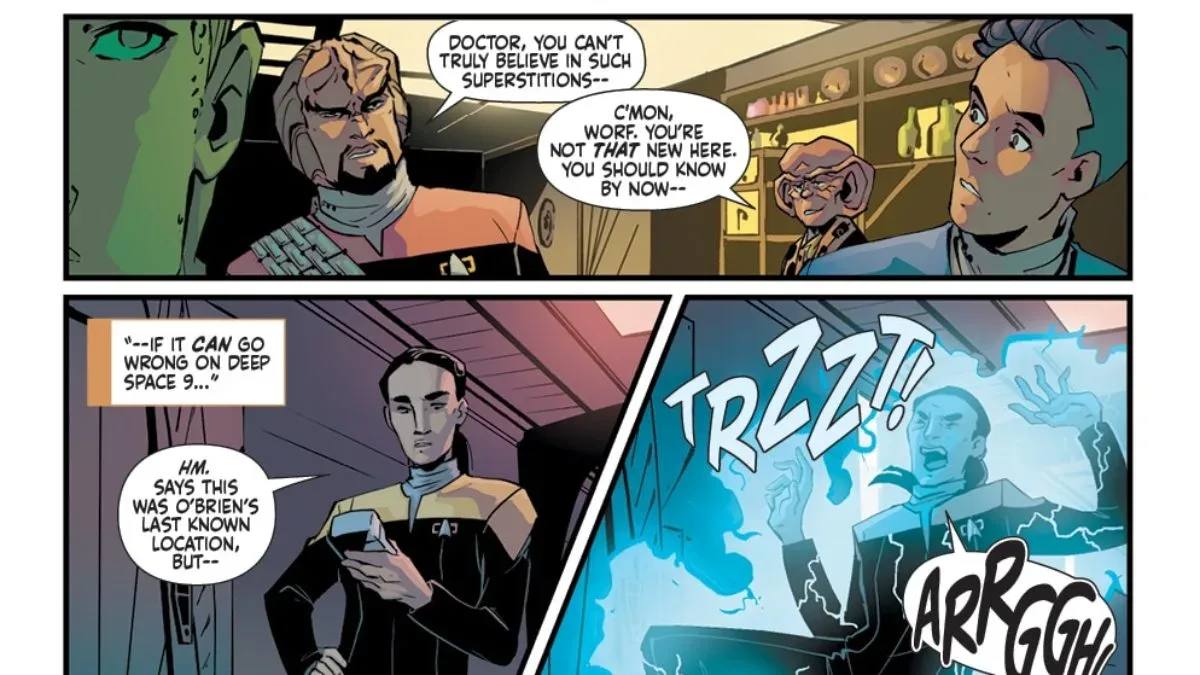
Star Trek: Holo-ween II #1 is set to bring Halloween-season unease to Deep Space 9 on October 7, 2026. IDW Publishing’s 32-page, Rated T comic opens a locked-station thriller in which a communications blackout, alarming incidents and a murder accusation collide on the eve of a major diplomatic summit.
Alex Segura and Bailie Rosenlund are credited on the issue, with Rosenlund also providing the cover. The stated setup puts Worf, Dax, Odo and Bashir in the difficult position of holding the station together after senior leadership is called away. That is already a precarious assignment before a distressed starship arrives with serious allegations: a member of the DS9 crew is accused of murder.
For a setting built around travelers, diplomacy and competing interests, cutting off communication changes the temperature immediately. Deep Space 9 is not simply a ship that can fly away from trouble. It is a fixed hub, and the premise turns that quality into the central source of pressure. Visiting dignitaries remain on the station while the summit approaches, the available crew has to manage a possible criminal investigation, and nobody has the easy reassurance of outside contact.
A Halloween mystery built around isolation
The solicitation describes the comic as a locked-station thriller. That term adapts the familiar locked-room mystery idea to a much larger location. Rather than narrowing a puzzle to one room, the story makes the entire station feel sealed off: communication is down, suspicion is growing, and the people who need answers are stuck inside the same environment as the possible danger.
The distinction matters because a station can contain far more than a conventional crime scene. The Promenade is specifically identified as a place where the unease spreads, while the holosuites are said to be experiencing something that has gone seriously wrong. Those are separate sources of tension. One is social and public, where visitors and crew may watch one another with increasing distrust. The other involves the station’s simulated environments, where the normal rules of a physical location may become much harder to trust.
Holosuites are a natural fit for a Halloween story because they bring uncertainty into the setting itself. A holosuite is a space designed to generate immersive simulations. In a mystery framework, that raises simple but potent questions: what is real, what is programmed, and who has control over the environment? The announced premise does not disclose the nature of the malfunction, its cause, or whether it is connected to the murder accusation. Keeping those details unrevealed gives the first issue room to establish the puzzle rather than answer it at the outset.
The crew left to run the station
The choice of Worf, Dax, Odo and Bashir gives the story a compact working group at the center of a much broader crisis. The key point is not that they are merely present on DS9, but that the senior leadership has been summoned elsewhere at exactly the wrong moment. The crew members who remain must protect a summit, respond to a distressed ship and deal with a charge leveled at one of their own.
That setup makes the alleged murder more than a standalone whodunit. An accusation against a crew member has the potential to strain internal confidence just as diplomatic visitors are assessing whether the station is safe and competently run. The synopsis explicitly emphasizes rising tension among the dignitaries, paranoia and dread on the Promenade. In practical story terms, the investigation will have a reputational and political clock ticking beside it.
Odo’s presence is particularly suited to the investigative side of the premise, but the issue does not present this as a case he can simply solve in isolation. Worf, Dax and Bashir are described as sharing responsibility for the station during the emergency. That signals a crisis story where operations, security, diplomacy and a possible murder inquiry all compete for attention.
What the first issue is promising—and not revealing
The available details deliberately establish circumstances rather than identify the accused crew member, the alleged victim, the visiting parties or the source of the blackouts and disturbances. That restraint is useful for a murder-mystery launch. The hook is not a named culprit or a pre-sold explanation; it is the escalating convergence of systems failure, political stakes and a frightening holosuite problem.
Readers should therefore expect the opening chapter to concentrate on suspicion and containment. The communications loss limits certainty. The summit creates an external reason for characters to conceal, exaggerate or misinterpret events. A starship arriving in distress introduces testimony and claims that may disrupt the station’s understanding of what happened. And the holosuites offer a possible thread that is eerie on its own, whether or not it ultimately intersects with the central accusation.
The subtitle’s “Holo-ween” pun also frames the book as seasonal genre play rather than a routine station emergency. It pairs Star Trek technology with horror-mystery atmosphere: an institutional setting becomes a place where familiar systems no longer feel dependable. The emphasis on “creeping” dread suggests that the comic is aiming for accumulating unease, not only an action-driven disaster.
Release details and cover options
Star Trek: Holo-ween II #1 is due in stores on Wednesday, October 7, 2026, from IDW Publishing. The standard issue is listed at $4.99 US and $6.99 CAN. It has a 32-page count and is rated T.
- Standard edition: cover by Bailie Rosenlund; item number 82771403591900111.
- Variant B: Lendl variant; item number 82771403591900121.
- Variant C: Price IDW Goes Dark variant; item number 82771403591900131.
- Variant RI (10): Rosenlund Full Art variant; item number 82771403591900141.
The listed US and Canadian prices are the same across the standard issue and the named variants. The “RI (10)” label identifies the Rosenlund Full Art cover as an incentive variant tied to a 1:10 retailer ordering ratio, rather than a standard cover designation. Availability at individual shops can therefore differ from the regular edition.
For readers planning a physical pickup, it is worth checking with a local comic retailer about their ordering approach and any desired cover reservation. The broader value of local shops—and the ways creators can put independent retailers in view—also comes up in this look at comic-shop stops putting indie retailers in the spotlight.
For now, the first issue’s appeal rests on a clean genre engine: Deep Space 9 loses its lines of communication just when it needs order most, an accusation turns suspicion inward, and the holosuites become another reason that no one can be entirely sure of their surroundings.