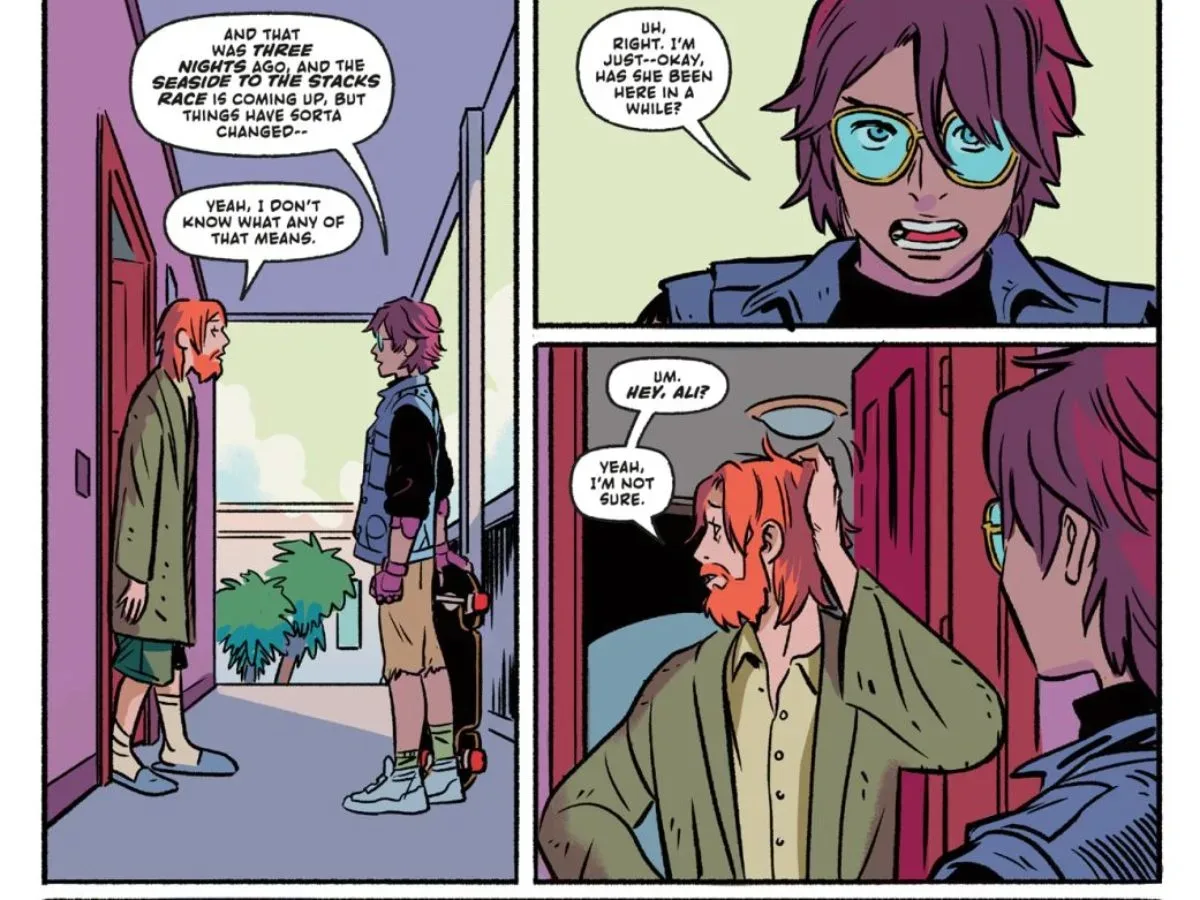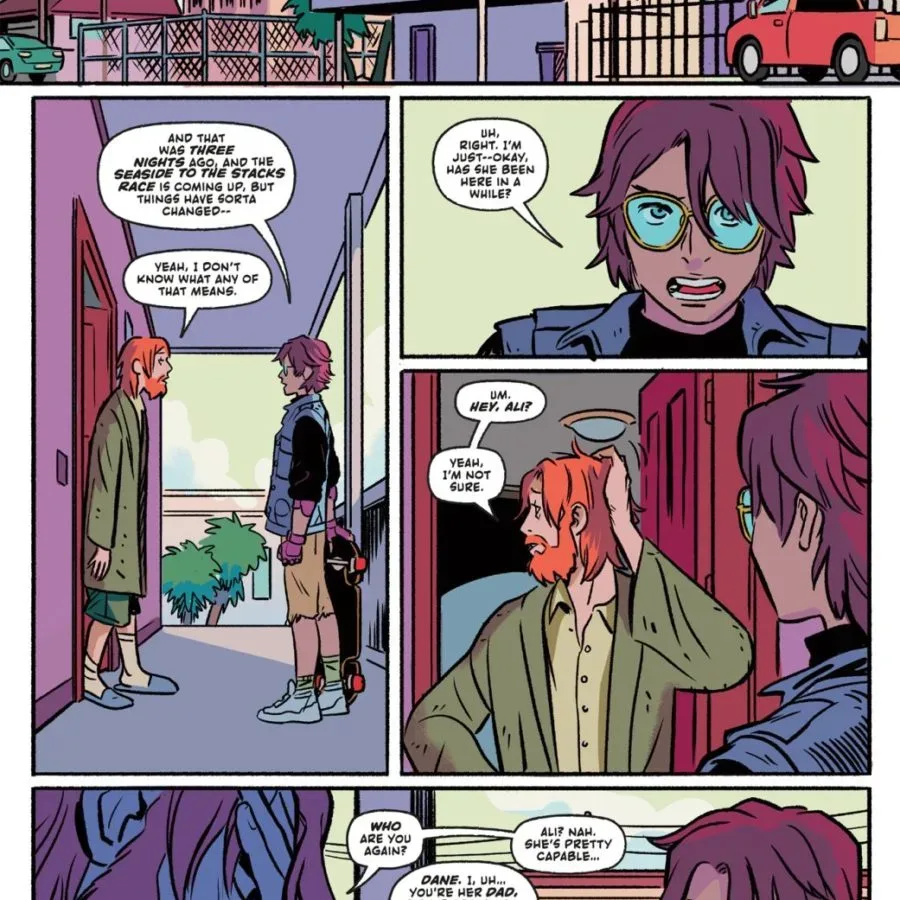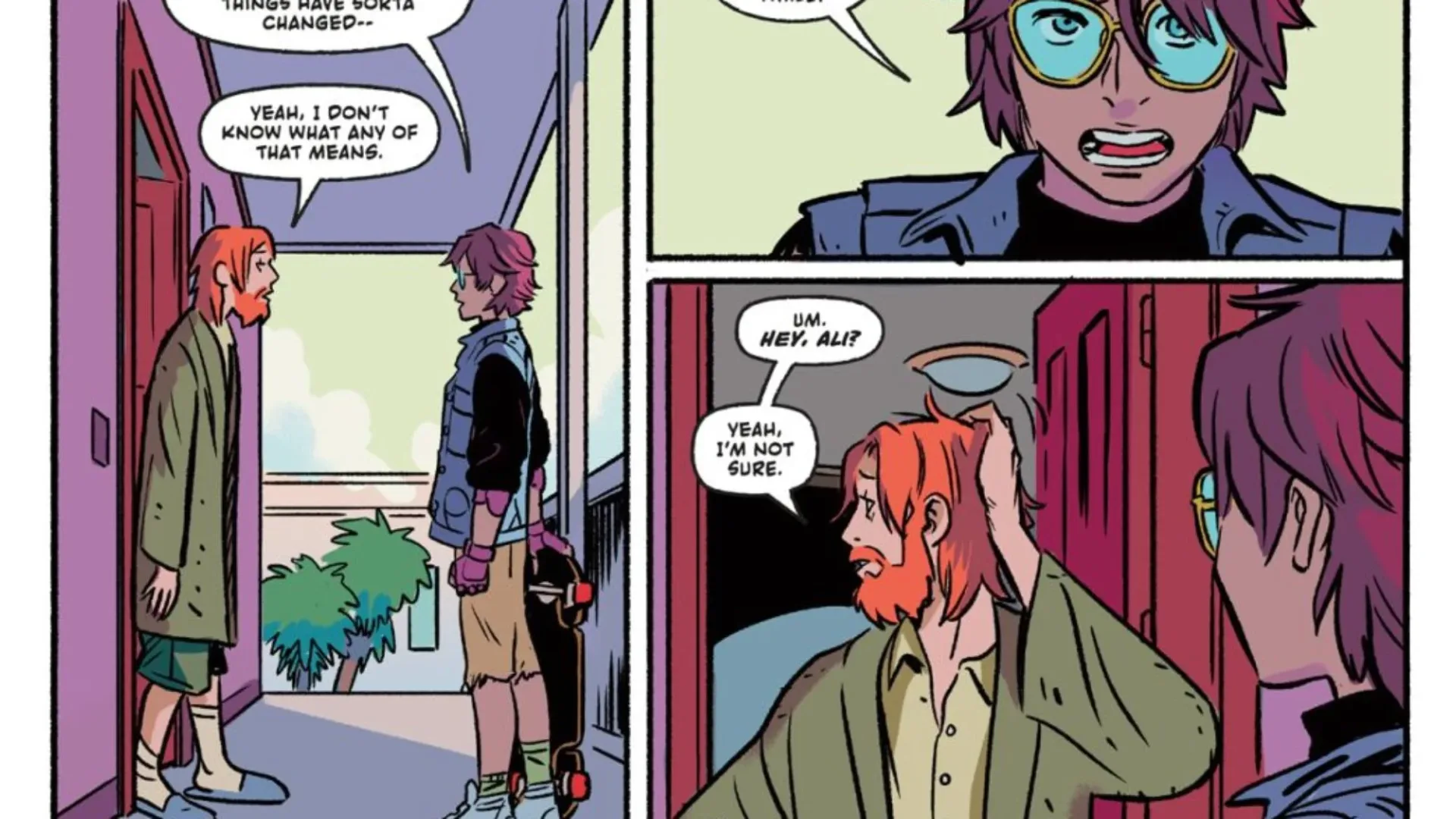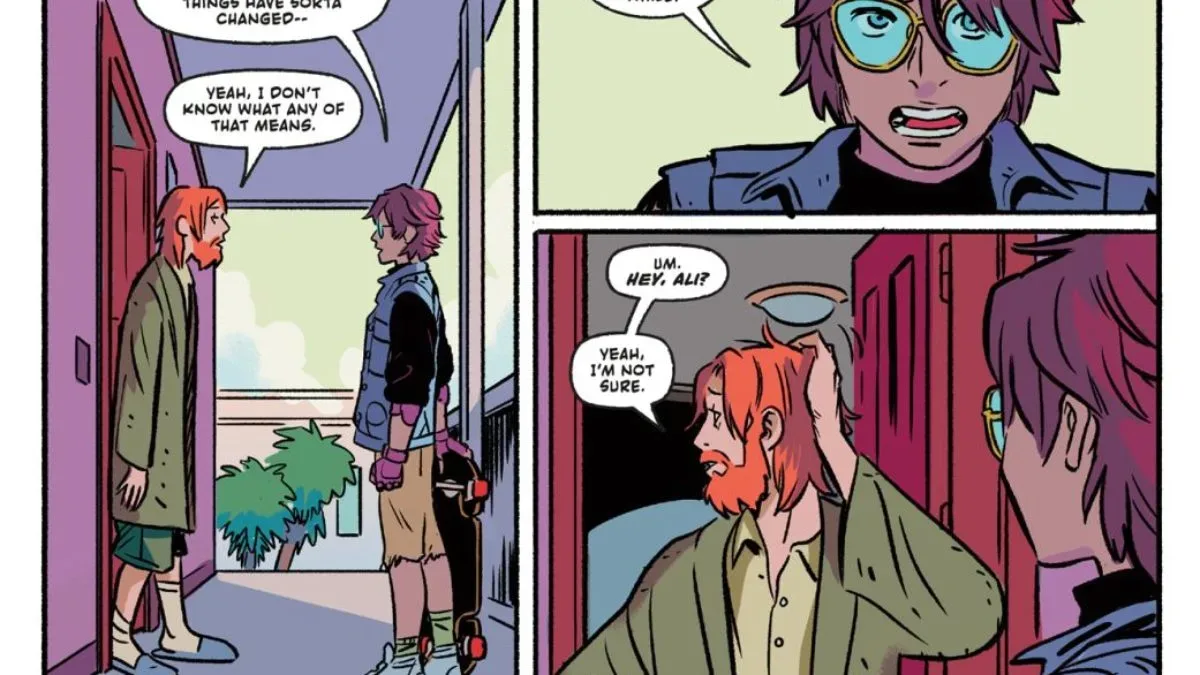
Skate Ali #4 is set to arrive from Dark Horse Comics on September 30, 2026, and its premise places its young skater at the sharpest point yet in a five-issue story. Ali has burned out on the Skull Clan, cannot bring herself to go home, and is moving through a city where anti-skate patrols make an already unstable situation more dangerous. Her reckless path ends in containment. Her father is the person who gets her out.
That setup makes the fourth issue sound less like a simple escape chapter than a collision between two pressures Ali has been avoiding: a controlling public system on one side and a painful family relationship on the other. The solicitation makes clear that getting out of containment does not solve the core problem. Ali and her father face a long-delayed reckoning, with rebuilding trust presented as tentative rather than guaranteed. Meanwhile, the streets still have a claim on her attention.
Sam Humphries and Kelly Sue DeConnick are credited as the series writers, with Natacha Bustos on art and the cover, and Josh Reed also credited on the issue. The comic is a 32-page release priced at $4.99, with an age recommendation of 9 and up. As the penultimate chapter of a five-issue limited series, issue #4 carries the useful but substantial job of forcing its protagonist to face consequences before the final installment.
Ali can no longer skate away from the problem
The conflict described for Skate Ali #4 is personal, but its sci-fi skatepunk setting gives that personal conflict a harder edge. Ali is not merely taking space after a disagreement. She is described as missing, dodging anti-skate patrols and navigating the aftermath of her rupture with the Skull Clan. In practical story terms, that means her isolation has become visible enough that her father must intervene.
“Containment” is the issue’s key word. It suggests more than being grounded or stopped by a worried parent. Within the supplied setup, it is tied directly to Ali’s risky behavior and the city’s enforcement apparatus. The exact nature of the facility and its rules have not been detailed, so readers should not assume more about it than the published premise establishes. But its narrative function is clear: it interrupts Ali’s ability to keep moving and forces a conversation she has spent the series avoiding.
That distinction matters because skating, as framed by the series description, is connected to Ali’s freedom, rebellion and sense of direction. The series uses the phrase “finding your line,” a skateboarding term that broadly refers to a planned route or sequence through terrain. Here it also works as a character idea. Ali must work out where she is going, who she can rely on and whether the direction she has chosen is actually hers.
Issue #4 seems designed to test that metaphor. Ali has found a path through the city, but it has taken her away from home, away from the Skull Clan and into the hands of the authorities. A line can be daring and expressive, but it can also be a route that carries a rider toward a bad landing. The comic’s central tension is likely to come from whether Ali sees that difference in time.
A family reunion without an easy reset
The father-daughter material is not framed as a clean reconciliation. The solicitation describes a fragile step toward rebuilding trust. “Fragile” is doing important work there: Ali’s father can secure her release, but he cannot instantly repair whatever led her to disappear, nor can Ali’s return automatically undo the fear and damage created by her absence.
That makes the father’s intervention more interesting than a conventional rescue beat. He is not simply an adult who arrives to remove Ali from danger so the story can return to normal. His appearance demands that both characters acknowledge that normal is no longer available. Ali has been unable to face home; her father has had to learn that she is effectively missing. Their reunion therefore begins with unequal information, worry and anger, even before the larger pressures of the city return.
For a series identified with friendship and rebellion, that domestic reckoning provides a valuable counterweight. Rebellion can sound abstract or automatically heroic when it is only described in terms of style, speed and resistance to authority. Skate Ali #4 instead positions rebellion alongside its cost. Ali’s decisions affect not just the patrols pursuing her or the friends she has fallen out with, but her father as well.
The premise does not say whether Ali will return home, rejoin the Skull Clan or reject both possibilities. It also does not establish that her father and Ali will resolve their differences in a single issue. Those unanswered questions are a strength of the setup rather than a gap to fill with assumptions. With one installment remaining after this one, the immediate goal appears to be honesty and a first step—not a final repair.
The streets remain an active force
If containment and family force Ali to stop, the city seems determined to set her in motion again. The issue’s description ends by warning that the streets are not finished with her. That gives the comic a structure built on competing momentum: the emotional need to pause and confront what has happened versus the external danger and pull of life outside.
The anti-skate patrols are part of that external pressure. The supplied information does not spell out their authority, equipment or motives, but their presence establishes a setting in which skating is not treated as harmless recreation. For Ali, riding is bound up with surveillance, pursuit and risk. A skatepunk story takes a culture and visual language associated with street movement and places it in a speculative world where that movement is actively policed.
That is also why the Skull Clan split matters. Ali is said to be burned out on the group, not simply separated from it by an accident. The phrase points to exhaustion and a relationship that has become unsustainable. Yet being done with the clan does not automatically make the city safer or make home easier to face. Issue #4 finds Ali in the uncomfortable space between affiliations, without a dependable place to land.
Readers looking for a straightforward explanation of every faction and supernatural-looking image should be cautious about drawing conclusions from a preview premise alone. The issue is promoted as genre-smashing sci-fi skatepunk, and the supplied material alludes to unsettling green figures during Ali’s solitary riding. Their identity and significance have not been confirmed in the available details. What can be said is that the imagery appears to reinforce Ali’s isolation and mounting pressure rather than offer an uncomplicated escape.
Why the fourth issue is a pivotal one
Limited series often reserve their largest resolution for the finale, which makes the chapter before it especially important. It has to deepen the central conflict while putting the protagonist in a position from which the final choice will mean something. Skate Ali #4 has a naturally strong route into that role: Ali’s worst run of decisions catches up with her, then the person she has avoided must help her.
Rather than treating the issue as a checklist of plot turns, readers can watch for a few grounded questions:
- What specifically has pushed Ali away from the Skull Clan?
- How much does her father understand about the situation she has been living through?
- Does containment alter Ali’s view of the patrols and the city, or simply harden her resolve?
- What does rebuilding trust require from Ali beyond accepting help?
- What new demand does the street place on her after her release?
None of those questions requires the comic to abandon its action-oriented premise. In fact, the promise of another dangerous ride means the book is likely trying to make action and character consequences inseparable. A chase or a trick sequence has more weight when Ali is no longer skating only for exhilaration or defiance, but while carrying the consequences of a family confrontation and a fractured friendship.
DeConnick’s cited work includes Bitch Planet and FML; Humphries is cited for Harley Quinn and Guardians of the Galaxy; and Bustos is cited for Moon Girl and Miles Morales. Those credits identify a creative team with experience across character-driven comics and energetic superhero storytelling, but they should not be read as a guarantee that Skate Ali follows the same tone or structure as those projects. The explicit description here is its own: a sci-fi skatepunk saga about friendship, rebellion and finding a way forward when the world keeps trying to push someone down.
Release details for Skate Ali #4
Skate Ali #4 goes on sale Wednesday, September 30, 2026. It is published by Dark Horse Comics as the fourth issue of a five-part series. The listed format is 32 pages, with a $4.99 cover price and an age recommendation of 9 and up. Natacha Bustos provides the cover as well as interior art.
For readers following current comics built around character conflict as much as escalating genre stakes, Ali’s move from the streets into containment sets up a consequential installment. The immediate danger is no longer limited to patrols or a risky route through the city. Ali must decide what it means to accept her father’s help when accepting it means facing the hurt she has left behind.
For more comic-book coverage with high stakes and escalating personal conflict, see this look at Gambit’s fate in Uncanny X-Men #36.