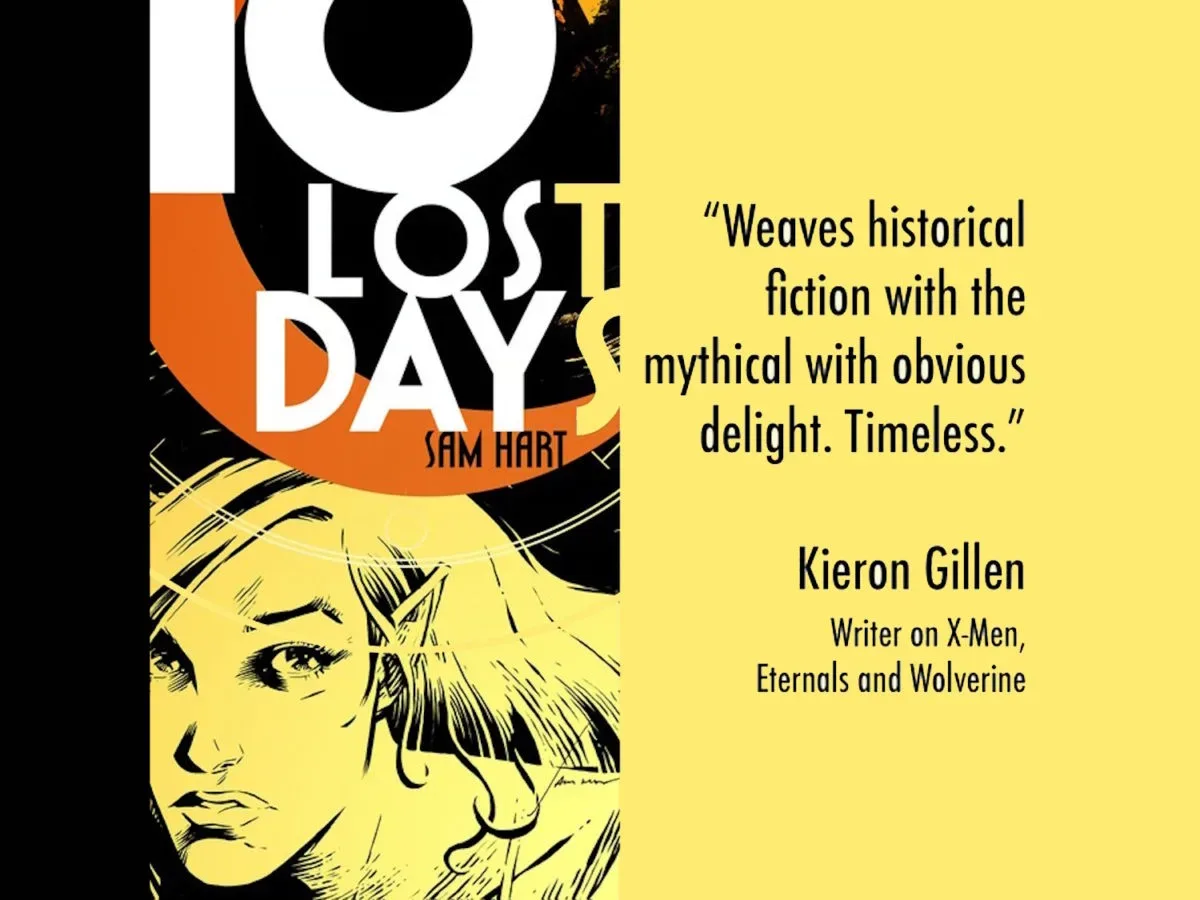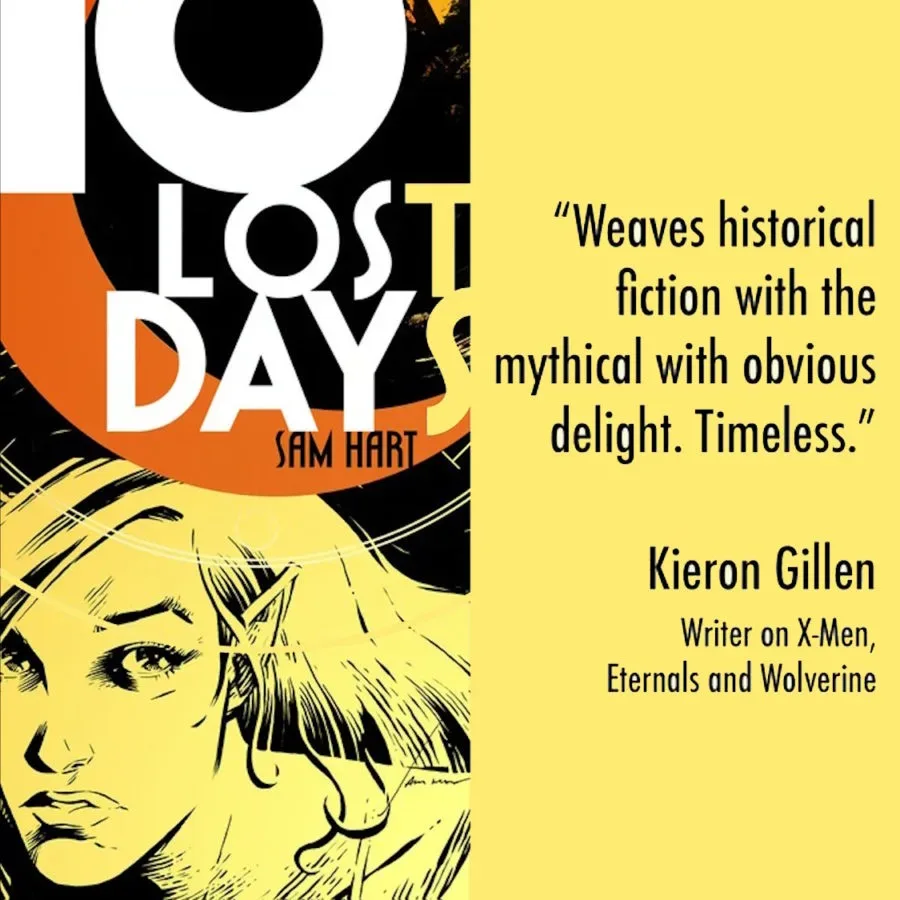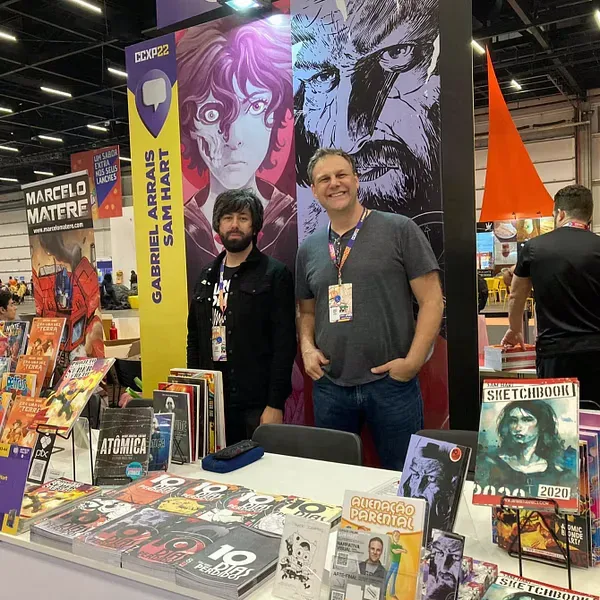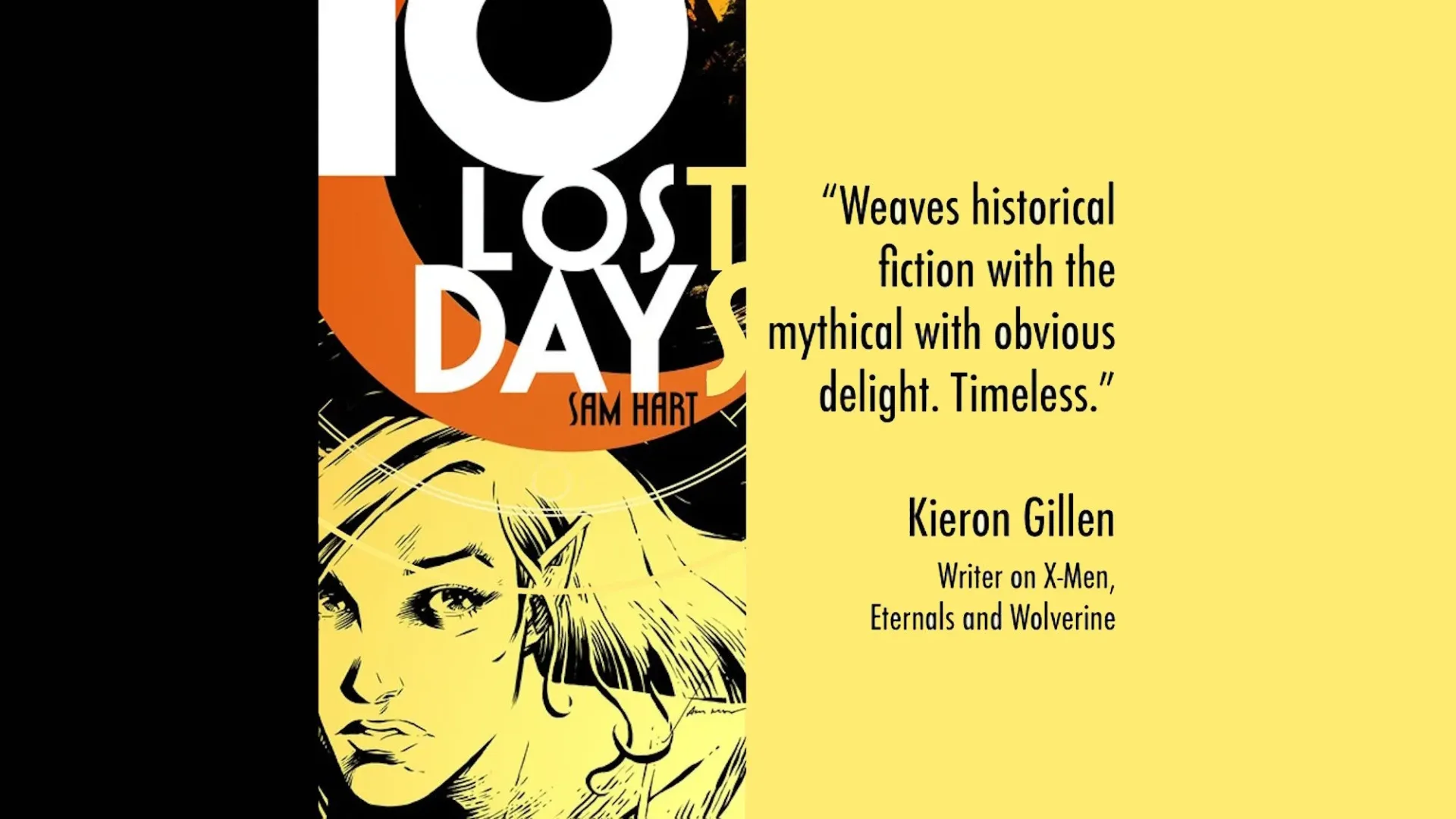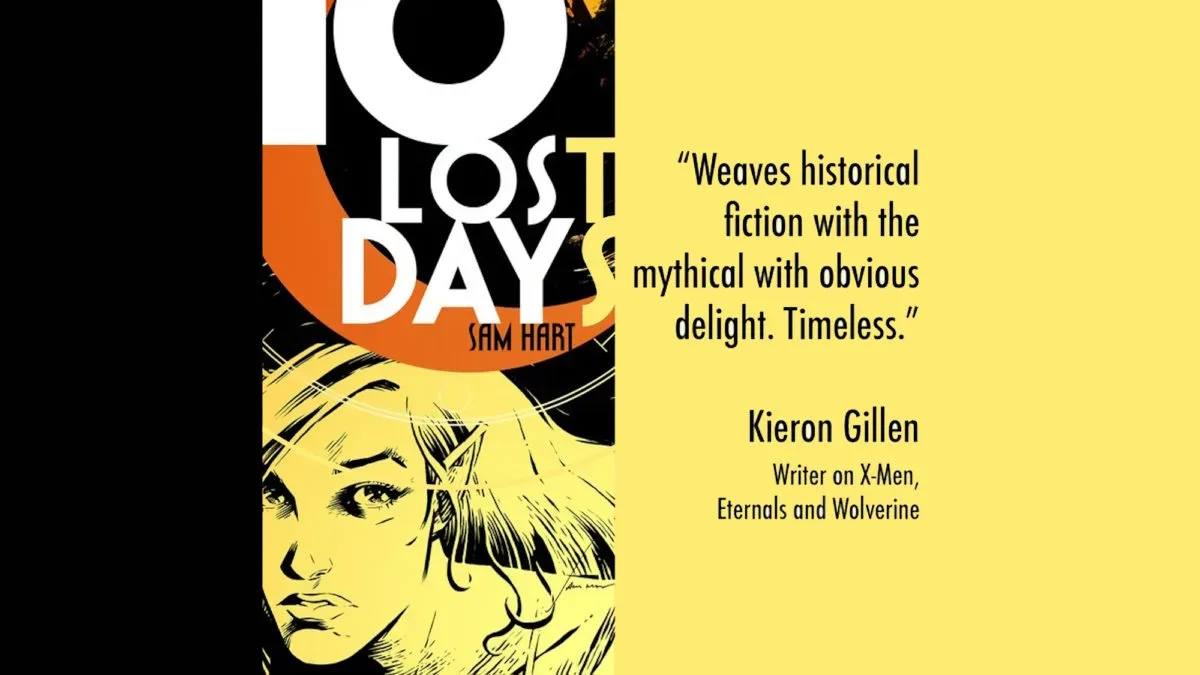
Sam Hart’s 10 Lost Days is approaching the end of its Kickstarter campaign, with the 186-page black-and-white historical fantasy reported to have only hours remaining when the campaign update was published. The project had passed its funding target at that point, standing at $8,050 from 165 backers against a $4,717 goal.
For English-language readers, the campaign represents a new route into a story that first appeared in Brazil between 2018 and 2022 as an eight-issue crowdfunded miniseries. The new Scratch Comics edition has been translated from the subsequent Portuguese hardback collection, re-edited, and expanded with nine new pages and backup material.
Hart is known as co-creator of The Coldest City, the comic later adapted into the Charlize Theron-led film Atomic Blonde. But the premise of 10 Lost Days points in a very different direction: a time-limited fantasy adventure set against the 1582 calendar change, where scientific inquiry, folklore and mythology occupy the same world.
A race set inside the calendar’s missing days
The title refers to the ten days skipped in the shift from the Julian to the Gregorian calendar. 10 Lost Days turns that historical calendar discontinuity into the frame for a high-stakes supernatural crisis. Its central character, the young astronomer and astrologer Sophya Brahe, has 240 hours to cross Europe and stop a plot that threatens humanity.
That is an especially direct use of a deadline. The ten omitted days are not merely period texture or an intriguing historical footnote; they establish the story’s clock. The campaign description makes the link explicit: the antagonist’s plan must be completed during these ten lost days, and Sophya’s journey is measured in the same 240-hour span.
In practical storytelling terms, “240 hours” gives the adventure a built-in structure. A large geographical mission can otherwise feel abstract on the page. Here, every delay carries an implied cost because the reader knows the total amount of available time. The fact that the comic is collected in a single 186-page volume may make that countdown particularly suited to a sustained reading experience rather than a long gap between serial installments.
Science and magic coexist in 1582
The setting is not presented as a strict historical reconstruction. In Hart’s version of 1582, gods and mythologies are real, while science and magic coexist. A spell freezes people and deities alike, leaving Sophya in a position to act after she is warned by a fairy named Kirsten about an attempt to drain magic from the world.
She is given a magical crystal and sent across Europe to undo the threat. Along the way, her party includes a Nordic god, a forest sprite, a Greek goddess and the Golem of Prague. Their opponents include powerful supernatural forces aligned with the Russian armies of Ivan the Terrible, whose objective is described as the world’s largest magical heist.
The phrase historical fantasy is useful here because it identifies the balance the book appears to be pursuing. The story uses a real period, a real calendar transition and a figure connected to the historical Tycho Brahe—Sophya is described as his sister—but allows mythological beings and overt magic to reshape the stakes. It is not asking readers to treat the supernatural elements as hidden folklore at the edge of ordinary history. They are central actors in the conflict.
Similarly, Sophya’s description as both an astronomer and astrologer signals a deliberate blending of disciplines that the book’s premise treats as compatible. In this fictional world, observing the heavens and navigating magical forces are not opposing paths. That framework supports the larger concept of a Europe where deities from different traditions can join one expedition against a single magical threat.
What the English edition changes
The new edition is more than a straight translation of the original eight-issue run. It is based on the Portuguese hardback published by Conrad, then translated into English and re-edited for Scratch Comics. The project adds nine new pages as well as extra backup content.
That distinction matters for potential readers deciding whether the campaign is simply collecting pre-existing work. The core story was previously released and recognized in Brazil, including a win for Best Miniseries at the 35th HQ Mix Trophy in 2023. However, the English release has a revised presentation and additional material, making it a distinct edition rather than only a language swap.
The campaign offers several physical formats and extras. Listed options include softcover and hardback editions, a dustjacket, variant covers by Mark Stafford and Ju Loyola, original art, and add-ons. Free shipping within the UK is also included, an important practical detail because delivery costs can significantly change the final commitment on crowdfunded print projects.
Backers should still distinguish between a campaign’s funding status and its end date. The reported total shows that the stated funding goal had been exceeded at the time of the update, but it does not change the fact that the project was then in its final hours. Anyone considering support should rely on the live campaign page for its remaining time, current tiers, shipping terms and availability, since those details can change as a campaign closes.
From Brazilian serial to collected graphic novel
10 Lost Days has already traveled through several publishing forms. It was initially crowdfunded in Brazil across eight issues from 2018 to 2022. A Portuguese hardback collection followed through Conrad. Now the Scratch Comics campaign is positioning the work as an expanded English-language graphic novel.
That publishing path helps explain why the book can arrive with both an award credential and new-edition features. The miniseries format established the story over multiple installments, while the collected format can frame it as one long countdown narrative. The English edition’s new pages and backup material further give the release its own identity for readers encountering it for the first time.
It also illustrates one of crowdfunding’s useful roles for comics: it can provide a route for work that already has an audience in one language or territory to reach a different readership in another format. That does not guarantee broad accessibility by itself—translation, editing, physical production and shipping all remain material parts of the process—but the campaign’s stated plan directly addresses the English-language edition.
Why the premise stands apart
There are several moving pieces in the setup: a calendar correction, a continent-spanning journey, a crystal, an angry tyrant, frozen gods, and an ensemble drawn from multiple mythological traditions. The unifying idea is the race against a clearly defined window. Rather than treating the lost days as a mystery to be slowly decoded, the book uses them as a temporary arena in which a catastrophic magical operation can take place.
Sophya gives that framework a human focal point. She is not introduced simply as a chosen warrior; she is an astronomer and astrologer who receives a warning too late and must cover enormous ground in limited time. Her alliance with gods, sprites, a goddess and a golem puts collaboration at the center of the mission. The group’s varied origins also reinforce the cross-European scale promised by the journey.
For readers interested in comics that cross into screen culture, Hart’s association with The Coldest City supplies an obvious point of reference, even though 10 Lost Days is built around a fantastical historical setting rather than the espionage premise of that earlier work. Those following adaptations across genre entertainment may also be interested in recent discussion of the upcoming Resident Evil reboot.
The campaign’s strongest immediate appeal is likely its combination of a finished, award-winning foundation with an expanded translation for a new audience. With the funding goal already exceeded in the reported update and the clock nearly expired, 10 Lost Days presents itself much like its own premise: a project driven by a deadline, centered on a countdown, and built around a set of days that are about to disappear.