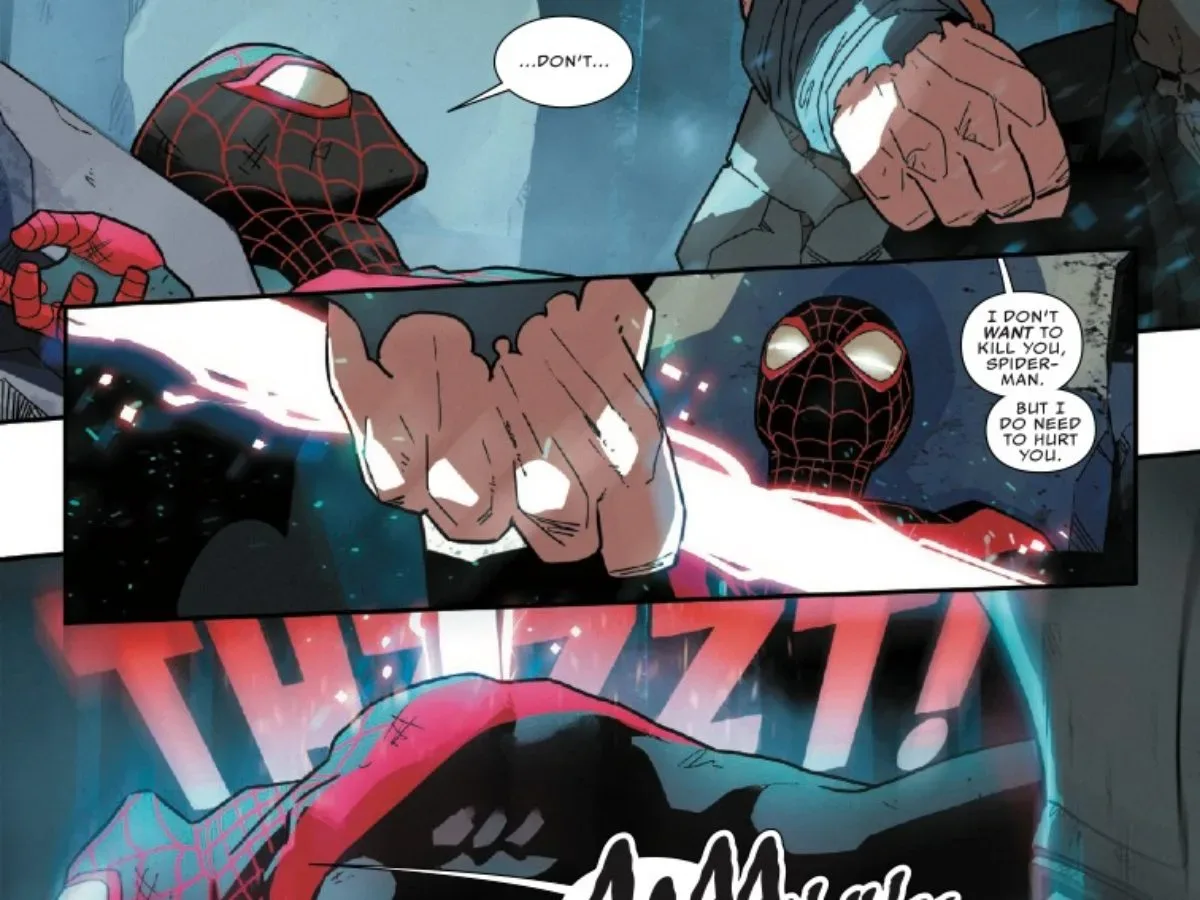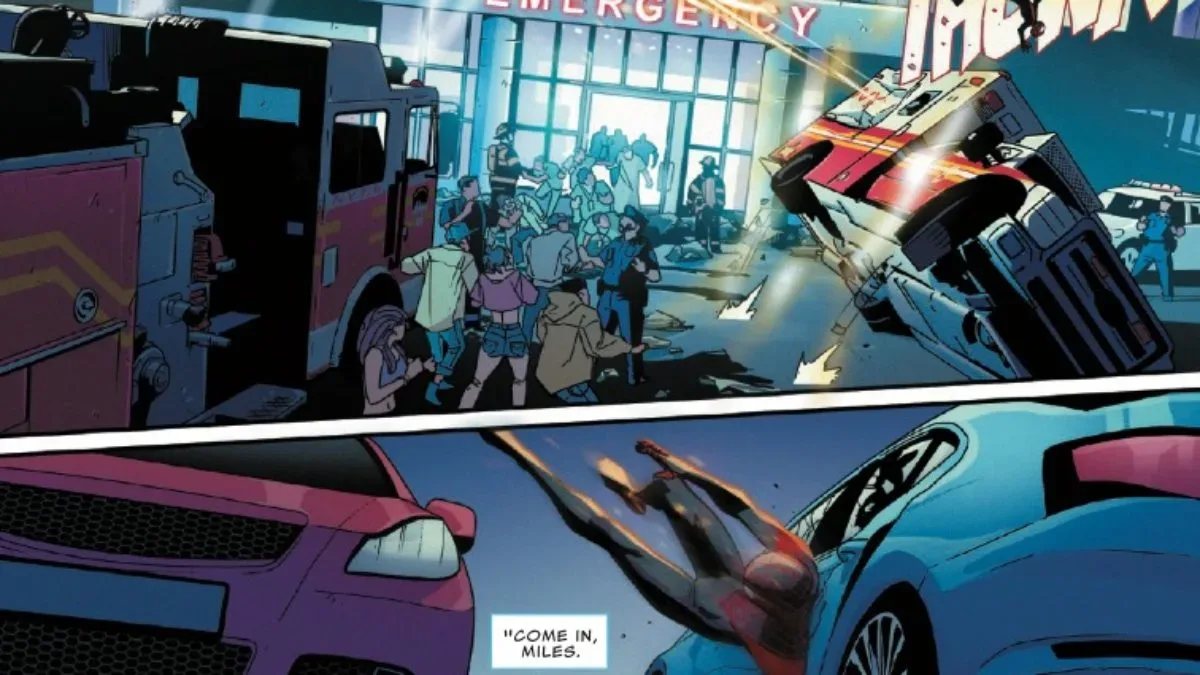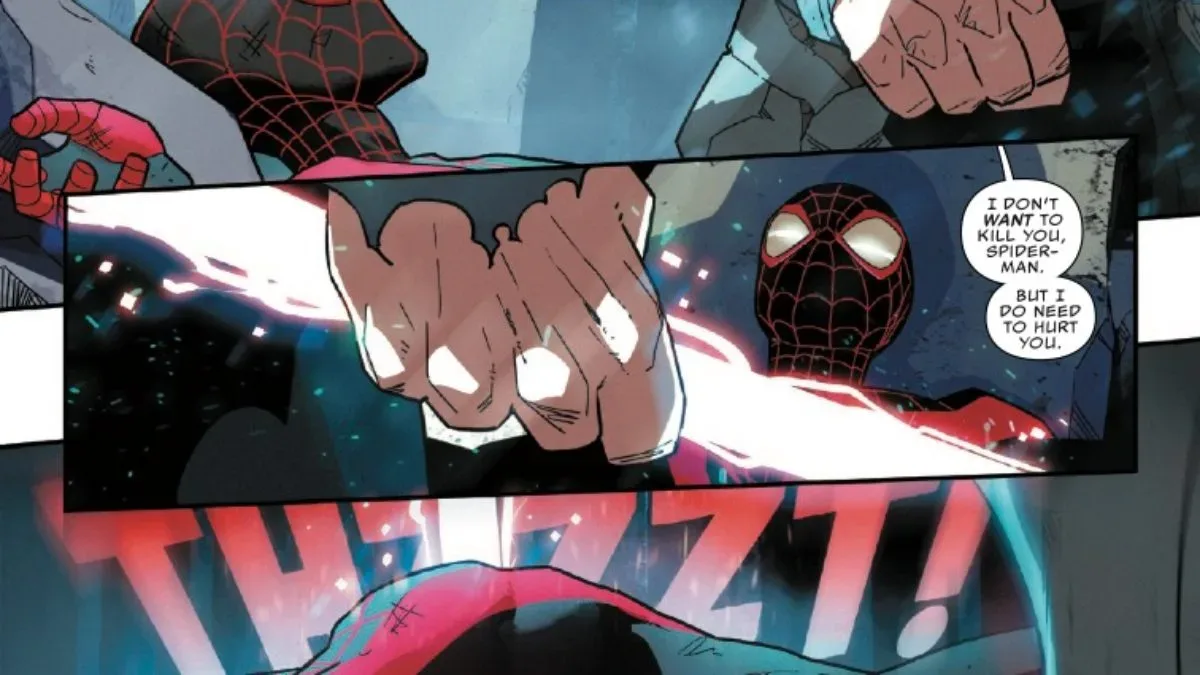
Miles Morales: Spider-Man #3 arrives October 21 from Marvel, continuing the three-part-labeled storyline Sins of the Father with the danger moving well beyond a routine Spider-Man fight. The issue’s setup places Jeff Morales’ past at the center of the story, while Miles’ friends and family are identified as potential collateral damage.
The immediate complication is that Spider-Man “got in the way,” an act that apparently escalated an existing situation rather than solved it. A villain identified as Revenant is tied to the threat, and the central questions are deliberately personal: whether Jeff Morales played a part in the foe’s rise, what involvement the Kingpin of Crime may have had, and how Miles can respond when his own spider-powers can be disrupted.
That combination gives issue #3 a distinctly different pressure point from a simple physical showdown. Miles is still Spider-Man, but the solicitation frames his father’s history and the safety of people around him as the real battlefield. When a hero’s abilities are unreliable, the problem becomes not only what they can do in a fight, but what choices remain when the people closest to them can be targeted.
What “Sins of the Father Part III” is setting up
The title Sins of the Father signals a story about consequences passed from one generation to another. In this case, the available details do not establish precisely what Jeff Morales did, why he may be connected to Revenant’s emergence, or how far back that connection goes. They do establish that Jeff’s past is no longer safely buried—and that Miles may be forced to live with its consequences.
That distinction matters. “Complicit” is not the same as proven guilty. The issue description asks whether Jeff may be complicit, leaving room for a revelation, a misunderstanding, coercion, an omitted detail, or another complication. Readers should treat it as a key question the comic intends to explore rather than a final verdict on the character.
The Kingpin’s mention adds another unresolved layer. His possible role is raised directly, but no specific act is confirmed. Within the issue’s premise, he represents an additional question mark hanging over a story already concerned with concealed history and an enemy’s rise. Whether that thread becomes direct involvement, indirect influence, or misdirection is information the preview setup does not answer.
Collateral damage is the story’s clearest stake
“Collateral damage” is a term generally used for unintended harm caused by a conflict. Here, it is especially pointed because Miles’ friends and family are named as the people who could pay the price. The danger is not described as a broad citywide disaster; it is framed as a threat trained on the people around Miles.
That makes the issue’s family focus important. Jeff’s hidden or unresolved past does not stay confined to Jeff. Miles inherits the immediate danger because he is Spider-Man, while the rest of his circle may be exposed despite having no say in whatever happened before. It is a setup built around proximity: the closer someone is to the Morales family, the more personal the consequences may become.
For Miles, that creates a difficult overlap between his responsibilities as a hero and his role as a son. The solicitation does not reveal how much he knows, how Jeff responds, or whether the family has already learned the full truth. But it does make clear that the story is interested in the strain that secrecy places on a family when an outside enemy knows how to exploit it.
Why the power disruption changes the fight
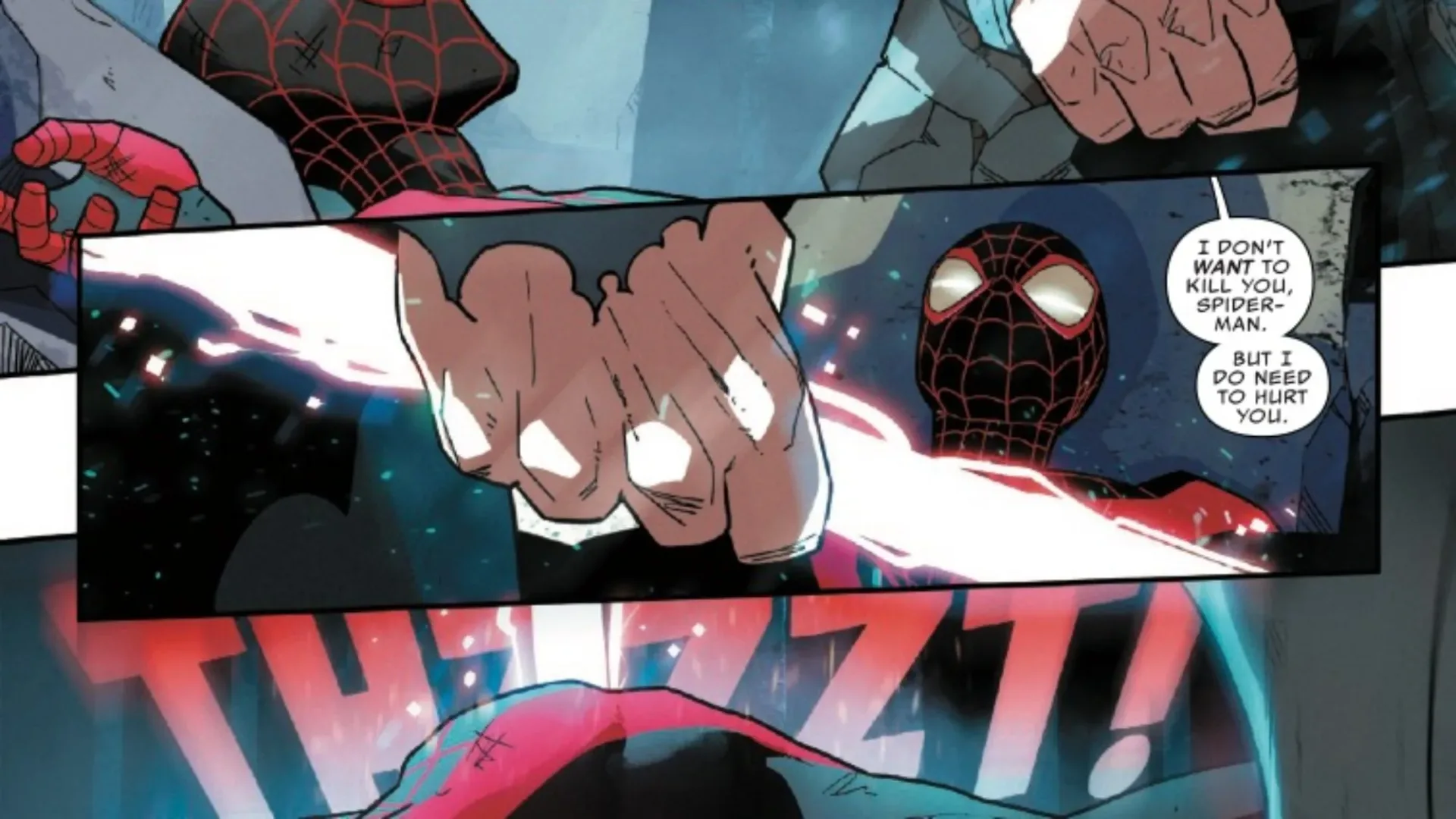
The threat in issue #3 can interfere with Miles’ “uncanny spider-powers.” The precise mechanism is not explained, so it would be premature to call it technology, magic, a drug, or any other specific method. What is clear is the practical effect: abilities Miles normally relies upon may not be dependable when he needs them.
Power disruption is a useful superhero-story device because it changes the terms of a confrontation. A hero accustomed to solving part of a problem through extraordinary movement, resilience, perception, or other abilities must reassess every decision when those advantages can be compromised. In Miles’ case, that vulnerability lands at the same time as a threat to his family, raising the cost of an error.
It also means the phrase “Spider-Man made a mistake” carries more weight than a standard teaser line. The synopsis does not say what Miles did or why it was a mistake. Still, the stated chain of events is clear: he intervened, the past returned to haunt Jeff, and people close to Miles may now be endangered. The issue is positioned as an escalation, not a standalone reset.
The uncertainty around Miles’ powers also creates a tactical question for the character. Stopping the opponent may demand more than overpowering them, especially if that opponent can turn Miles’ own gifts into an unreliable resource. Readers looking for a story centered on pressure, investigation and character consequences—not merely a contest of strength—have a strong indication of where this chapter is headed.
The creative team and covers
Bryan Hill, Nico Leon and Val de Landro are credited on Miles Morales: Spider-Man #3, with a main cover by Simone Di Meo. The issue is 32 pages, rated T, and carries a $4.99 U.S. price.
Three listed variants expand the cover options:
- Chris Campana variant
- Michael Cho variant
- Jorge Fornés variant
Each listed variant is priced at $4.99 U.S. and $6.25 in Canada. Those variants offer collectors alternate cover art, while the core story details provided for the issue remain the same. For readers primarily interested in the narrative, the relevant choice is simply ensuring they pick up issue #3 rather than accidentally treating a variant as a separate chapter.
What readers can expect—and what remains unknown
The confirmed setup supports several expectations: the issue continues Sins of the Father; Jeff Morales’ past is a direct source of danger; Revenant’s actions threaten Miles’ personal circle; the Kingpin’s connection is being questioned; and Miles faces an enemy capable of interfering with his powers.
Much else remains purposefully unresolved. There is no confirmation of Jeff’s exact history, the nature of his alleged complicity, the Kingpin’s specific actions, how Revenant disrupts Miles’ abilities, or who will be most directly affected. Those unknowns are not gaps to fill with assumptions; they are the engines of the chapter’s suspense.
For the wider Marvel-comics audience, the issue is another reminder that the publisher’s stories often run on both superhero spectacle and personal stakes. Readers following other Marvel casting news may also be interested in Inde Navarrette’s planned Rogue role, though it is separate from Miles’ comic storyline.
Miles Morales: Spider-Man #3 goes on sale October 21. Its premise promises a chapter where a father’s past, a criminal power player and a power-disrupting adversary all converge on Miles at once—and where protecting his family may be harder than winning the immediate fight.