Spoilers for Midnight Spider-Man #2 follow.
Midnight Spider-Man #2 takes a familiar superhero premise and pushes it decisively into horror. Peter Parker is not simply a gifted young man learning how to use strange new abilities. The issue frames him as the center of a missing-person mystery, a target of Oscorp interest, and the site of a grotesque transformation that appears inseparable from violence.
Written by Phillip Kennedy Johnson with art by Scietronc, the second issue builds its tension around a basic question repeated in its solicitation: where is Peter Parker? It is a useful question because the comic’s answer is not merely geographic. Peter is absent from several parts of his former life: an Oscorp employee has vanished, a New York City teaching assistant is missing, and a Queens municipal-services worker failed to report in. Oscorp defense contractors, meanwhile, are reviewing security footage in search of a spider.
That setup recasts the usual early Spider-Man story as an institutional and personal emergency. Peter has been studying and working under Dr. Curt Connors at a university while writing as a science blogger. Oscorp has been pursuing him during a period in which mutant experimentation is producing monsters. Those details establish a world where scientific work, recruitment and corporate power carry a menace that Peter’s normal origin story does not require.
A Spider-Man origin built around mutation rather than empowerment
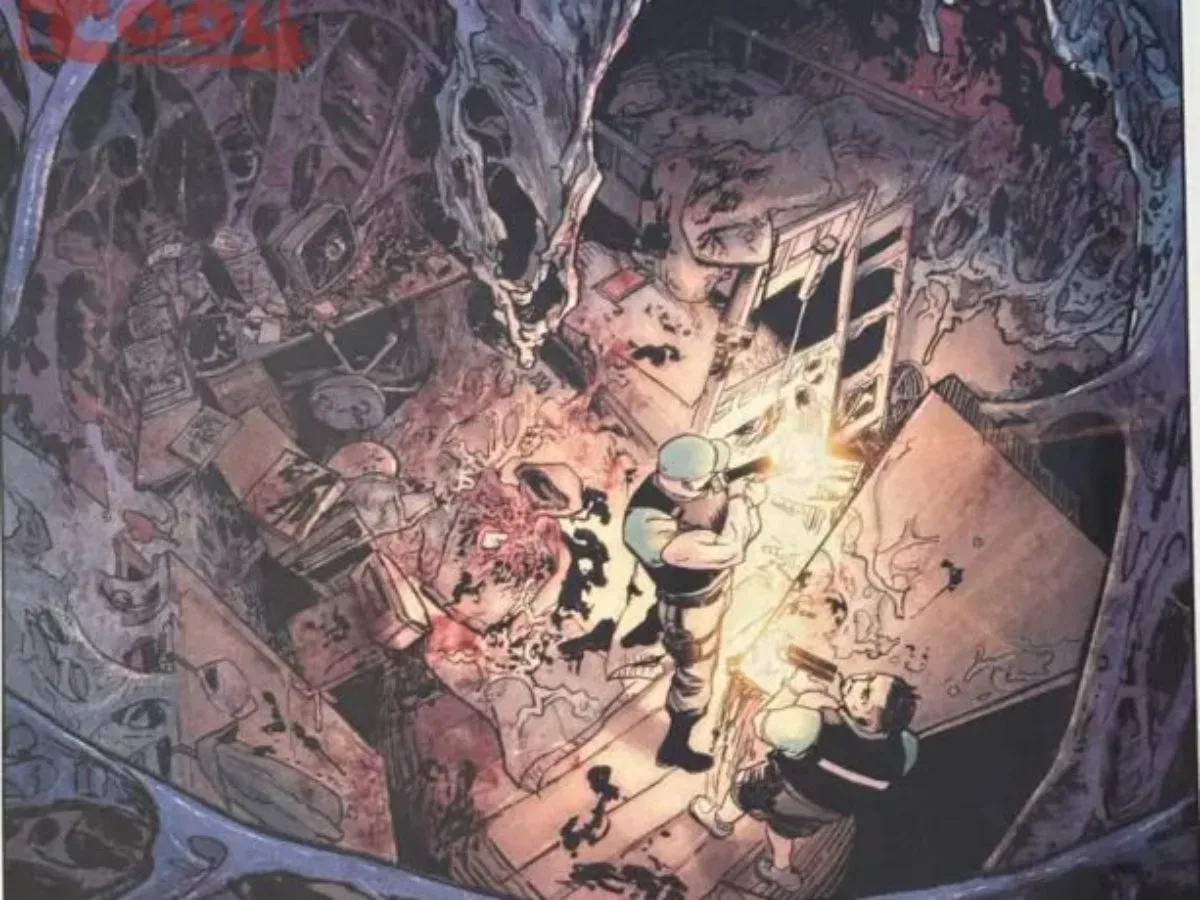
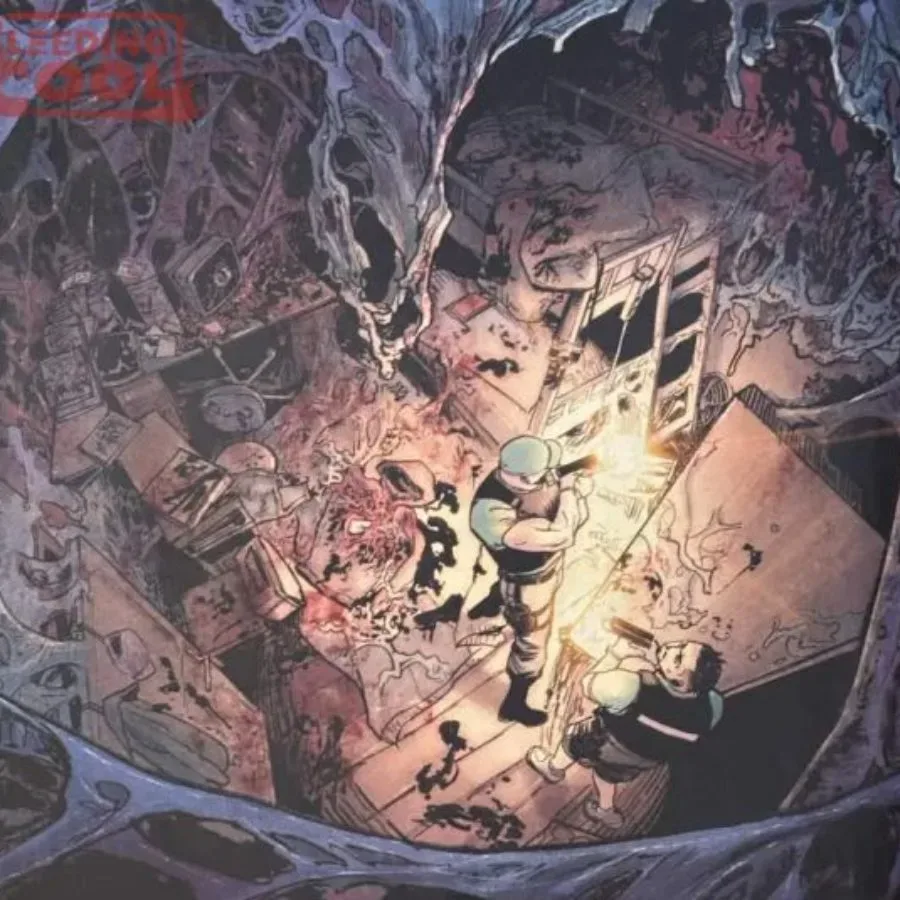
The crucial reveal is that Peter’s transformation is physical, invasive and horrifying. Felicia Hardy returns to the Parker home on a search for answers and finds Uncle Ben’s body. She also finds Peter with a mutant spider embedded in his chest.
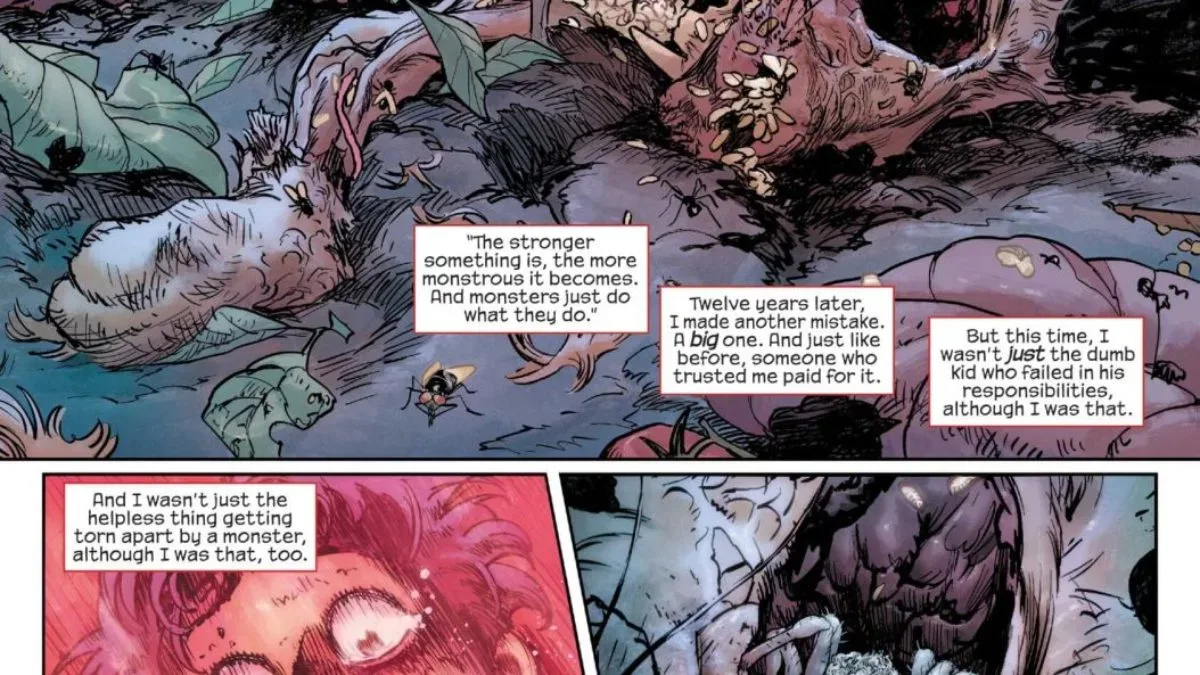
It is an image that clarifies the series’ approach. In conventional superhero language, an “origin” explains why a character gains powers. Here, the origin operates more like body horror: a horror mode focused on the loss of bodily autonomy, mutation and the fear that a person’s body has become unfamiliar or uncontrollable. Peter has not simply received a spider-themed power set. The spider is an active, visible part of the nightmare.
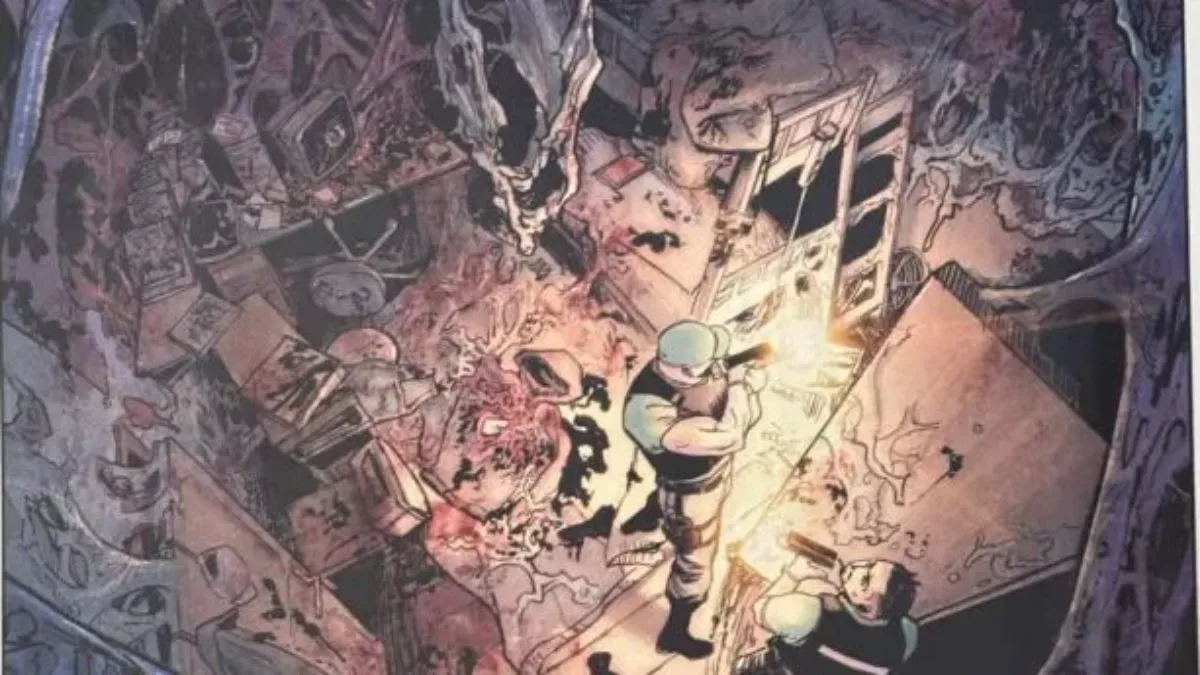
The issue confirms that the Midnight Spider-Man emerged through this transformation, and it establishes a brutal consequence when the creature takes control of Peter. Faced with Oscorp gunmen, the Midnight Spider-Man survives the gunfire and kills with overwhelming force, tearing people apart.
That distinction matters for the character. The concern is no longer whether Peter can master responsibility alongside power. The immediate danger is whether Peter remains present when the thing inside him acts. The series is therefore using Spider-Man iconography—spider sense, agility, danger perception and the Parker household—to tell a darker story about possession, identity and corporate experimentation.
Spider-sense becomes a survival mechanism
The issue retains a recognizable Spider-Man concept in altered form: the Midnight Spider-Man appears to possess a potent spider-sense, allowing it to react to threats including a burst of gunfire from Oscorp personnel.
Spider-sense, in basic terms, is Spider-Man’s precognitive danger awareness: the ability to recognize an immediate threat quickly enough to evade it. In this incarnation, the ability is not presented as a reassuring heroic advantage. It is part of the creature’s defensive arsenal. It helps make a direct armed response to Peter’s disappearance much more perilous, because the transformed figure can detect and answer danger before ordinary attackers can contain it.
That creates a grim practical problem within the story. Oscorp’s interest in locating Peter appears entwined with the company’s experiments and its defense contractors. But sending armed personnel after an unstable, hyper-aware monster only escalates the threat. The comic turns the familiar chase between Spider-Man and hostile forces into something closer to a containment failure.
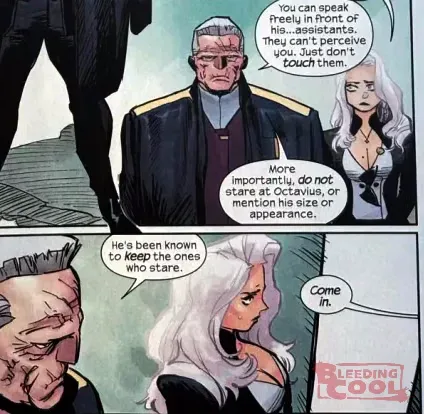
Felicia Hardy and Curt Connors sit on opposite sides of Oscorp
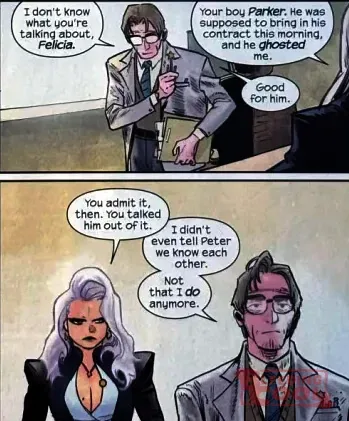
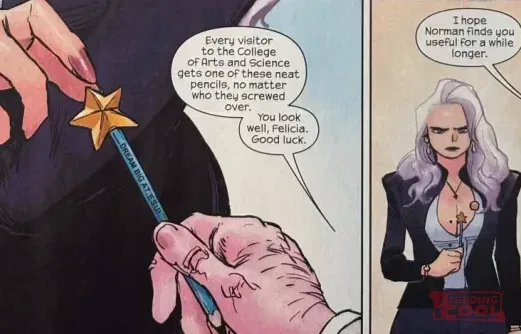
Felicia Hardy has a major role in connecting the story’s human conflicts to its horrific discovery. Earlier in the issue, she is pushing Peter toward Oscorp. Dr. Connors is firmly opposed to that path, and the issue exposes a history between Connors and Felicia that gives their disagreement more weight than a routine employment dispute.
Neither character’s position should be flattened into a simple label based on the available events. Felicia’s attempt to steer Peter toward Oscorp comes before her search at the Parker house leads to the discovery of Uncle Ben and Peter’s condition. Connors’s resistance, however, positions him as somebody unwilling to participate in Oscorp’s program. In a series already centered on mutant experimentation, that refusal naturally becomes an important moral dividing line.
There is an additional layer of unease for readers familiar with the names involved. Curt Connors and Felicia Hardy arrive with immediately recognizable Marvel associations, but this Midnight setting is reshaping the expected roles around a monster narrative. The issue’s version of Connors still has both arms, while the newly introduced Midnight Misty Knight does as well. Those details signal that the series is treating its cast as altered versions rather than relying on their familiar trajectories.
For Felicia, the closing discovery changes the scale of the problem. Peter is not simply missing, and the Parker house is not just a place where clues might be found. It is the location where the human cost of the transformation becomes impossible to ignore.
Doctor Octopus joins a growing gallery of Midnight monsters
Midnight Spider-Man #2 also introduces Midnight Doctor Octopus and points toward further monstrous versions of Marvel characters in the shared Midnight setting. The debut expands the book beyond Peter’s personal crisis and suggests that the experiment-driven horror is not isolated to one victim or one laboratory.
The word “Midnight” functions as more than a branding addition in this context. It indicates an alternate, horror-leaning framework in which recognizable figures can be reinterpreted through mutation and monstrosity. That is why the arrival of Doctor Octopus is less about checking a famous adversary off a list and more about widening the story’s implied threat. If Peter’s origin has been transformed into something parasitic and lethal, other characters can be expected to carry similarly distorted concepts.
The issue also brings in Midnight Misty Knight. Her appearance is brief in the information currently available, but it fits the larger rollout of altered Marvel identities. With Peter capable of inflicting catastrophic physical harm, and Connors noted as still having both arms, the detail that Misty Knight still has both of hers feels pointed rather than incidental. It underlines the immediate danger posed by the new Spider-Man while leaving the consequences unresolved.
How the issue fits the wider Midnight line
The issue arrives alongside Midnight X-Men #2, by Jonathan Hickman and Matteo Del Lucca, and Midnight Fantastic Four #2. That release pattern makes the Midnight setting feel designed as a broader line rather than a standalone detour for Spider-Man.
For readers deciding where to start, Midnight Spider-Man #2 is rooted in a clear horror hook: Peter Parker’s disappearance, Oscorp’s hunt for a spider, and the revelation of what the transformation has done to him. The accompanying titles indicate that the same dark reworking extends to other corners of Marvel’s character roster. The Doctor Octopus and Misty Knight appearances reinforce that this issue is part of a widening cast, not just a closed Parker-family tragedy.
It is also a week that leans hard into dark comic-book premises more broadly. Readers looking for another newly arriving horror-tinged first issue can see how Vampirella: Paradise #1 opens a corrupted new heaven.
What readers should take from the ending
The most important development in Midnight Spider-Man #2 is not simply that Peter has become dangerous. It is that the comic makes the source of the danger materially explicit. The mutant spider embedded in his chest turns the origin into evidence. Felicia sees Peter’s condition firsthand, Uncle Ben is dead, and Oscorp’s armed pursuit proves that outside forces are already trying to manage—or exploit—the situation.
The violence that follows makes the stakes clear. Peter is not safely hidden behind a mask, operating as a secret vigilante on the edge of New York. He is a missing person whose altered self can emerge under attack and kill with devastating force. The title’s central mystery consequently has two linked parts: where has Peter been, and what remains of him when the Midnight Spider-Man is in control?
That is a strong engine for the next issue. Felicia now has direct knowledge of the horror at the Parker house. Connors has reason to oppose Oscorp, though the exact history between him and Felicia is now another source of tension. Oscorp has resources, contractors and surveillance, but its apparent target is not a manageable research subject. And the expansion to Doctor Octopus and Misty Knight implies that Peter’s fate may be the first visible fracture in a much larger monster story.
Release details
- Title: Midnight Spider-Man #2
- Writer: Phillip Kennedy Johnson
- Artist: Scietronc
- Release date: November 18, 2026
- Cover price: $4.99
For a series that places Spider-Man in a setting shaped by experimentation and monsters, the second issue does not soften its premise. It makes Peter Parker’s predicament more concrete, more gruesome and harder for the people around him to deny.
Shop the products
Check current price, model and availability at the retailer.