Minor spoilers for Midnight Fantastic Four #2 follow.
Midnight Fantastic Four #2, written by Benjamin Percy with art by Kev Walker, takes the team’s scientific curiosity somewhere much less reassuring than a conventional superhero laboratory. Reed Richards, Sue Storm, Johnny Storm and Ben Grimm are investigating apparent tears in reality: sites connected to enormous impacts, nuclear explosions and dimensional gateways. Yet the issue’s real engine is not simply the discovery of another strange realm. It is the discomfort of approaching it.
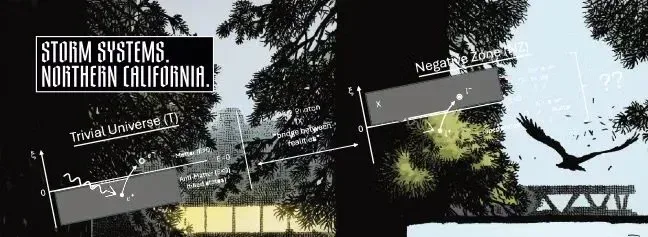
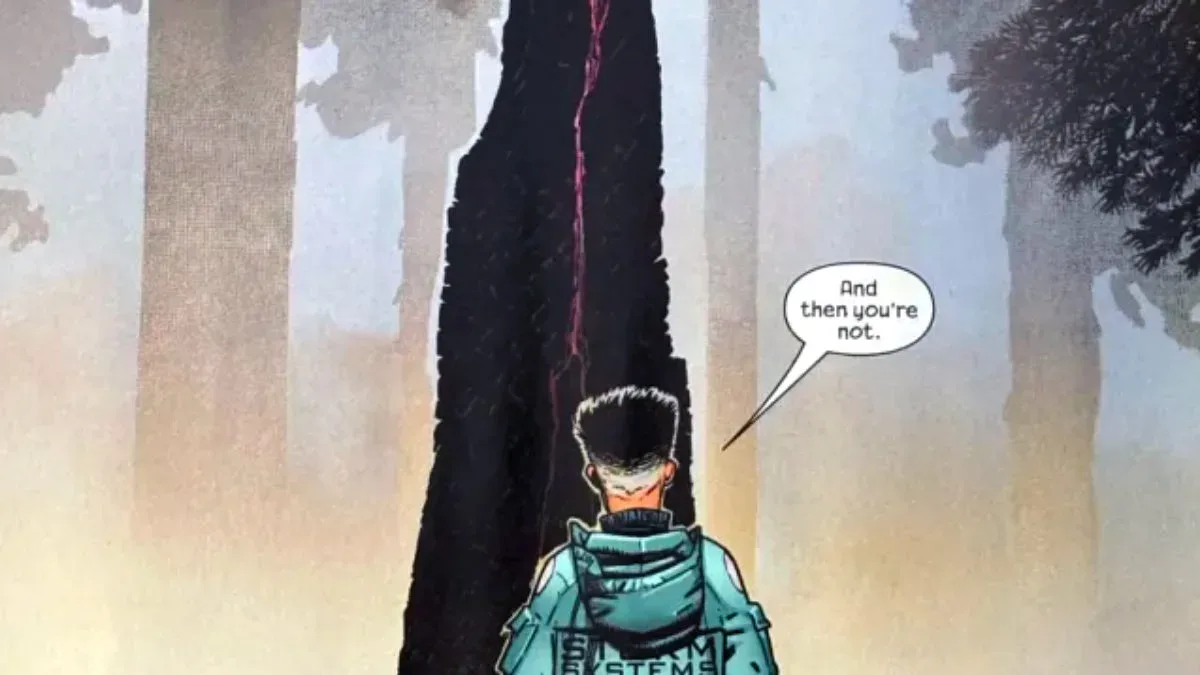
The series is positioning its version of the Fantastic Four at a threshold, both literally and psychologically. Reed is haunted by a past he cannot properly remember and a breakthrough he cannot fully explain. Sue, Johnny and Ben begin a tentative working relationship with him at Storm Systems, where the group plans to test a theory that revisits the dangers associated with the atomic age. That setup gives the comic’s horror a distinctly Fantastic Four shape: scientific advancement is necessary, but it is also potentially ruinous.
Rather than presenting discovery as a clean path to knowledge, the issue treats knowledge as an unstable force. The characters are not merely opening a door to a dangerous place. The door seems capable of changing the people who find it, and perhaps changing the world around them before anyone knowingly crosses through.
For more context, explore Can You Play GTA VI on a Phone, PC or Smart TV at Launch? Official Streaming Options Explained.
A Fantastic Four story built around thresholds
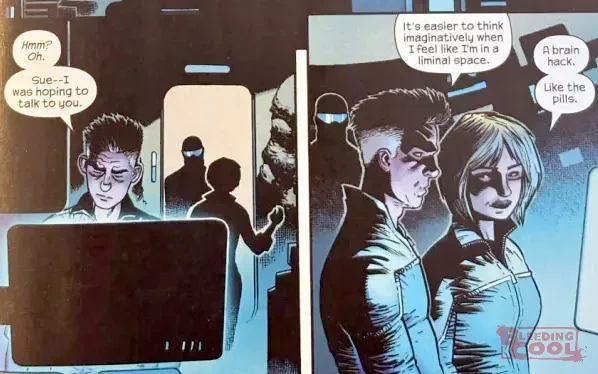
The important idea running through the issue is liminality. A liminal space is an in-between place: a border, doorway, coast, staircase, abandoned room or other zone that is neither fully one thing nor another. In horror, these spaces are useful because they unsettle rules that normally feel dependable. A room should be a room; a shoreline should mark the separation between land and sea; a tower should be a building. When those ordinary locations become passages into something unknowable, familiar geography stops feeling safe.
That is a natural fit for a story about dimensional fractures. The Fantastic Four have long been associated with exploration beyond ordinary human experience, and the Negative Zone is specifically invoked as an example of the kind of divide between known reality and a hostile elsewhere. In Midnight Fantastic Four #2, the reality tears under investigation carry the same conceptual weight. They are borders that may not remain borders.
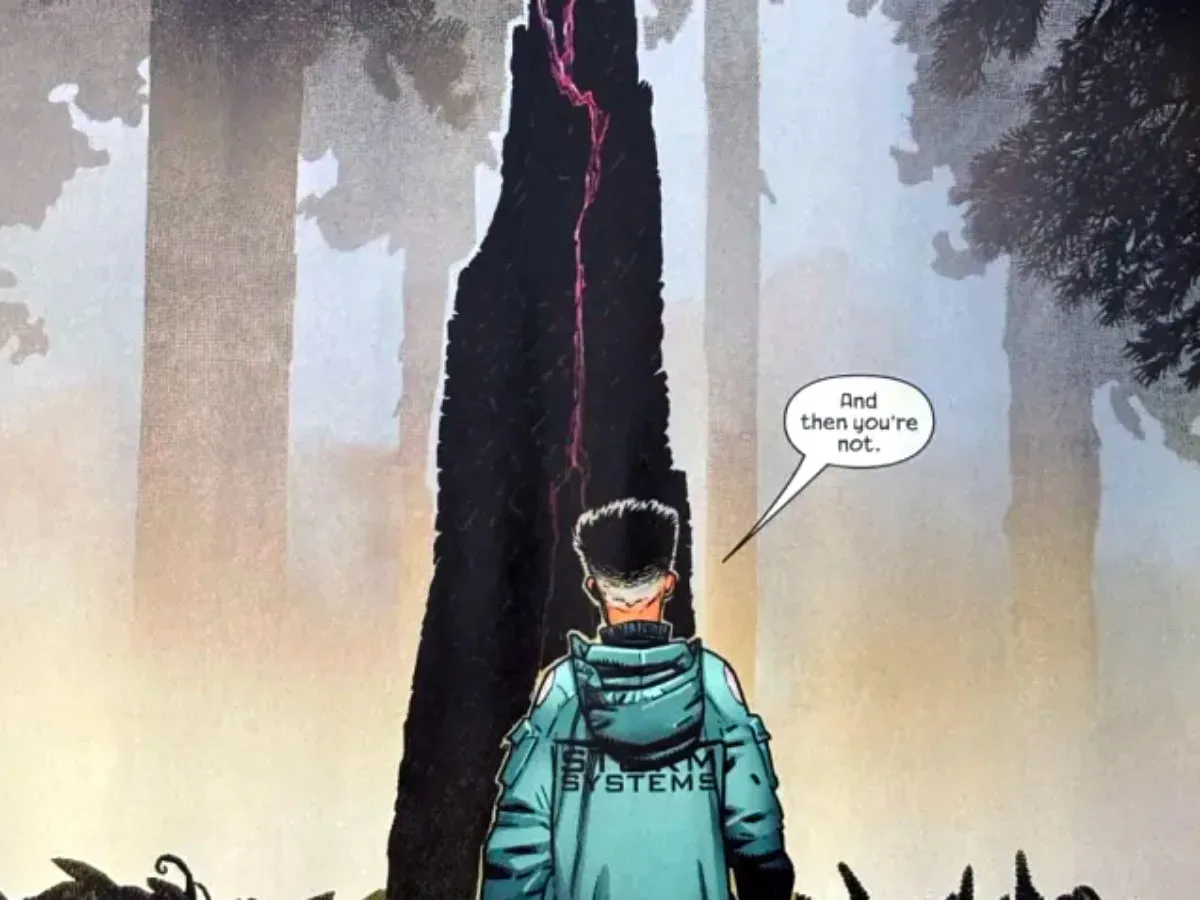
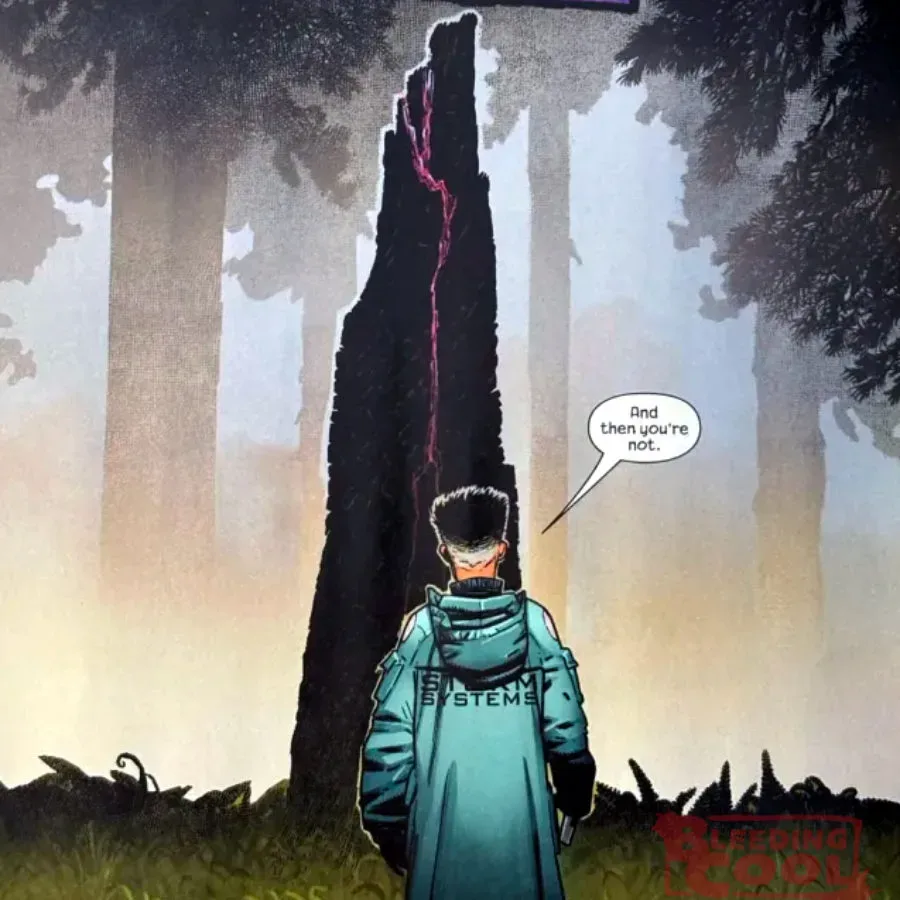
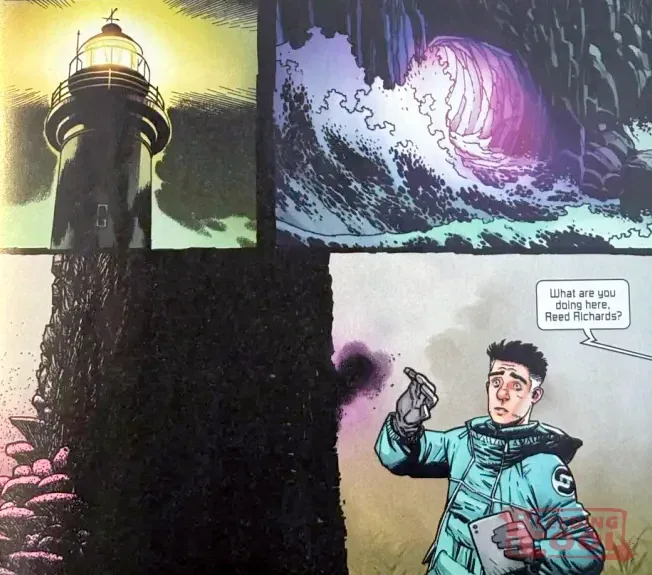
The book’s imagery repeatedly supports that tension. Reed dreams of a lighthouse, cliffs, caves and ocean waves. Those are locations defined by edges: the lighthouse stands between sea and sky, cliffs separate solid ground from a drop, caves lead from daylight into buried darkness, and the shore is a constantly shifting boundary. The images do not need to announce a monster to feel threatening. Their function is to suggest that the world has seams, and that Reed is beginning to see them.
The Lovecraftian vocabulary of the comic
The issue draws on a set of horror images closely associated with H.P. Lovecraft’s cosmic fiction: mist, isolated coasts, ancient cities, strange geometry, looming towers and places that appear to sit outside ordinary time. This is not merely an aesthetic of tentacles and monsters. Cosmic horror is generally concerned with human beings encountering a reality too old, large or indifferent for them to master. The resulting fear comes from scale and uncertainty as much as from physical danger.
Lovecraft’s stories frequently turn architecture into a warning sign. Slanted rooms, irregular angles, sealed spaces, towers and decaying structures become hints that the physical world is not operating as people expect. A building can become frightening not because it is haunted in a conventional sense, but because its shape suggests that it belongs to rules humanity cannot comprehend.
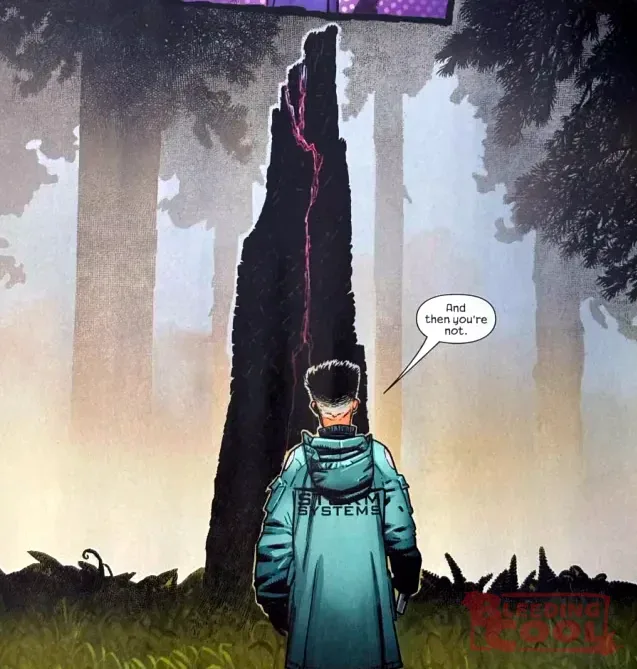
That framework makes Reed’s interest in building upward especially ominous. Towers have a clear practical role in the visual language of science fiction and superhero comics: they are laboratories, observatories, headquarters and symbols of ambition. But within cosmic horror, vertical structures can also mean isolation, forbidden perspective and a dangerous attempt to reach beyond human limits. Reed’s desire to build towers is therefore more than a design preference. It connects scientific ambition to the possibility that the structure is already present in some form, depending on the observer’s state of mind.
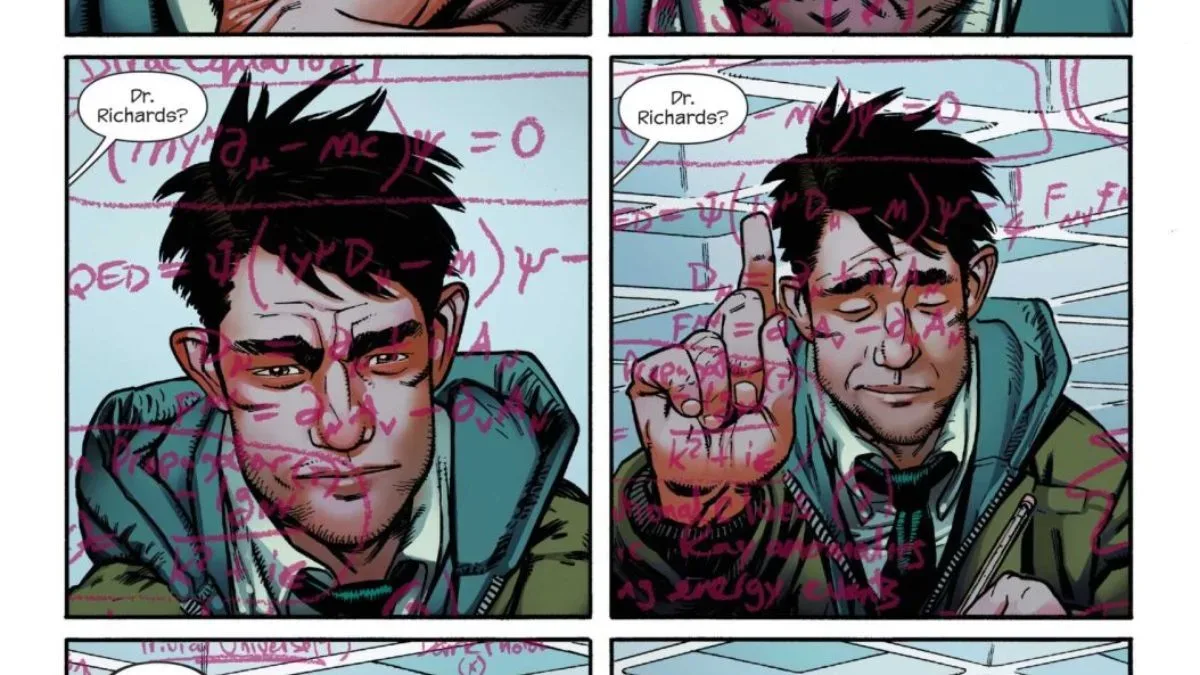
That final uncertainty matters. If a tower may already exist, but only certain people can perceive it, then the line between external reality and hallucination becomes difficult to defend. The issue does not frame that ambiguity as an abstract puzzle. It makes it personal through Reed’s dreams and hallucinations, while disturbances also reach Johnny through the audio he is listening to. Reality’s instability is not confined to a remote research site; it can intrude through the senses and through routine technology.
Atomic-age dread meets superhero science
The official premise states that the group’s theory will revisit and redefine the perils of the atomic age. That detail provides a useful thematic bridge between the comic’s science-fiction premise and its horror approach.
Atomic-age anxiety is, at its core, anxiety about a technological threshold. Humanity develops the ability to manipulate nature at extraordinary scale, only to discover that the consequences can exceed its capacity to control them. The issue’s reality tears are associated with nuclear explosions as well as massive impacts and dimensional gates, placing destructive historical and cosmic forces alongside each other. In this interpretation, the boundary between a scientific experiment and a catastrophe may be alarmingly thin.
That is particularly potent for the Fantastic Four. Their mythology is often built around the fantastic consequences of pushing into the unknown. This series appears to ask what happens when that same impulse is treated as a horror premise rather than a launchpad for optimistic adventure. Reed’s scientific breakthrough is not simply difficult to explain; it is difficult to remember. The uncertainty suggests an investigator whose own mind cannot be assumed to be a reliable instrument.
There is also a significant difference between solving a dangerous problem and understanding it. The team may be able to map sites where reality has been breached, identify common elements and build devices to test theories. None of that guarantees that the force on the other side can be contained, negotiated with or even accurately named. Cosmic horror often makes this distinction painful: information can reveal the problem without granting the power to fix it.
Transformations are the cost of contact
The comic signals that exposure to these spaces comes with consequences. Transformations await the Fantastic Four, while effects can bleed back into the supposedly real world. That is an essential escalation for a story of thresholds. If characters can visit the unknown, return unchanged and lock the door behind them, the boundary remains manageable. If they return altered—or discover the unknown has followed them home—the boundary has failed.
The existing character setup gives this threat extra force. Reed has already suffered hallucinations and destroyed his university. Victor Von Doom, once a student attempting to break reality, was arrested and later freed by Sue, Johnny and Ben. Sue’s space-flight experiments had separately revealed similar tears. Each of these facts points toward people approaching the same mystery from different directions, with serious damage already done before the new working arrangement can fully settle.
Victor’s status is particularly unsettling because the story suggests that little may remain of him after his transformation. He, too, hears “The Eater.” The name is effective precisely because it is blunt. Where the comic’s locations are defined by ambiguity—mists, borders, distorted perceptions—the entity’s designation describes an appetite. It implies not a villain motivated by ordinary conquest, but a presence that consumes.
What “The Eater” could signal
Any connection between The Eater and Galactus remains inference rather than confirmation. Still, the name naturally invites speculation about a Midnight version of Galactus. Galactus is an especially logical figure to reinterpret through cosmic horror: a world-consuming being is already an entity of overwhelming scale, and a horror framing can emphasize the helplessness of those who recognize the threat long before they have a way to answer it.
The story’s language of ancient towers, impossible spaces and mental disturbance would suit that direction. In Lovecraftian terms, the terror is not only that something powerful exists. It is that people are forced to realize their own systems of meaning, science and preparedness may be too small for the encounter. A Galactus-adjacent threat, if that is where the book is heading, would give the series a familiar Marvel concept while allowing Percy and Walker’s horror-inflected approach to remain central.
It is worth separating what the issue establishes from what it teases. The comic features The Eater, altered characters, reality fractures and a looming sense of a presence beyond the threshold. A Galactus connection is a possibility suggested by those elements, not an announced resolution. That uncertainty is part of the appeal: the series is constructing dread before it defines every rule.
Why the visual concepts matter
Kev Walker’s art is central to a comic built around architecture, scale and distorted perception. The reported motifs—lighthouse, ocean, cliff faces, caves, towers and uncanny city-like structures—are not interchangeable spooky backdrops. Each gives form to the book’s concern with crossing from one state into another.
- Lighthouses guide travellers, but also stand alone against dangerous water and weather.
- Cliffs offer perspective while making every step toward the edge risky.
- Caves conceal depth and turn forward movement into a descent.
- Towers promise a higher view, yet isolate whoever climbs them.
- Mist and ocean erase clear distances, making it difficult to tell where solid reality ends.
In a superhero story, these images can amplify action. In this story, they appear to do something more unsettling: they make exploration itself feel suspect. A team that normally investigates wonders is confronting sites that may be less like destinations and more like wounds.
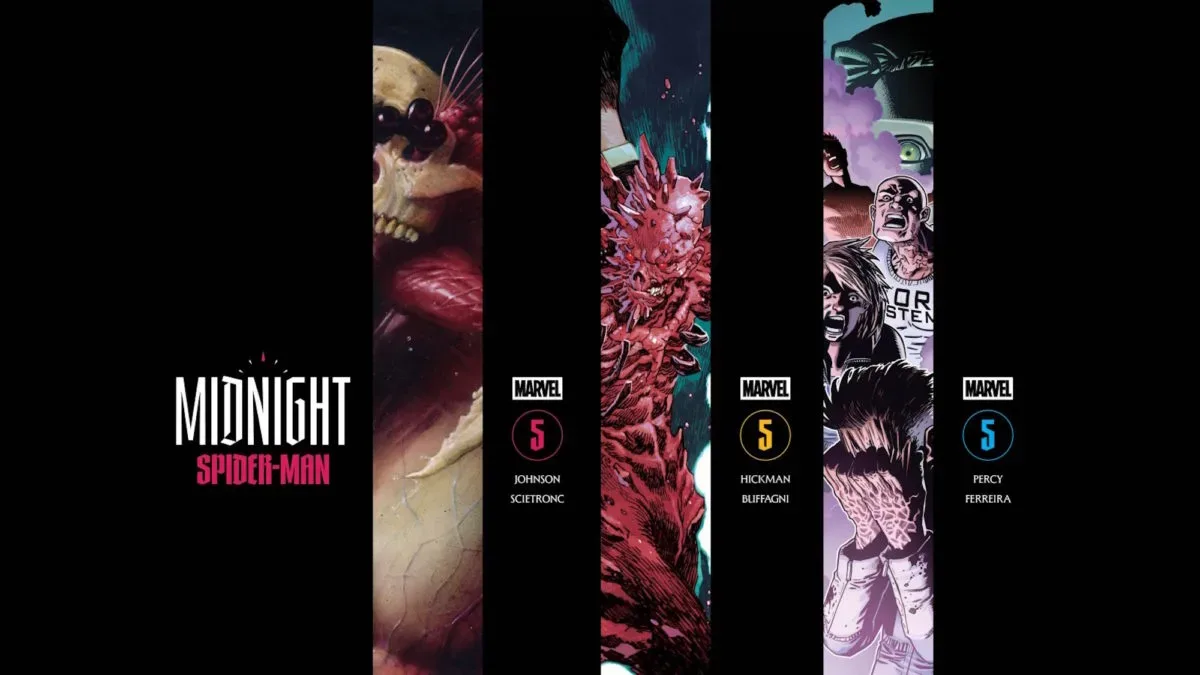
Midnight Fantastic Four #2 is scheduled for November 18, 2026, at $4.99. It arrives alongside Midnight X-Men #2 and Midnight Spider-Man #2, but its immediate focus is the increasingly unstable relationship among Reed, Sue, Johnny and Ben—and the possibility that their attempts to understand reality’s fractures will give those fractures a way to look back.
Shop the products
Check current price, model and availability at the retailer.