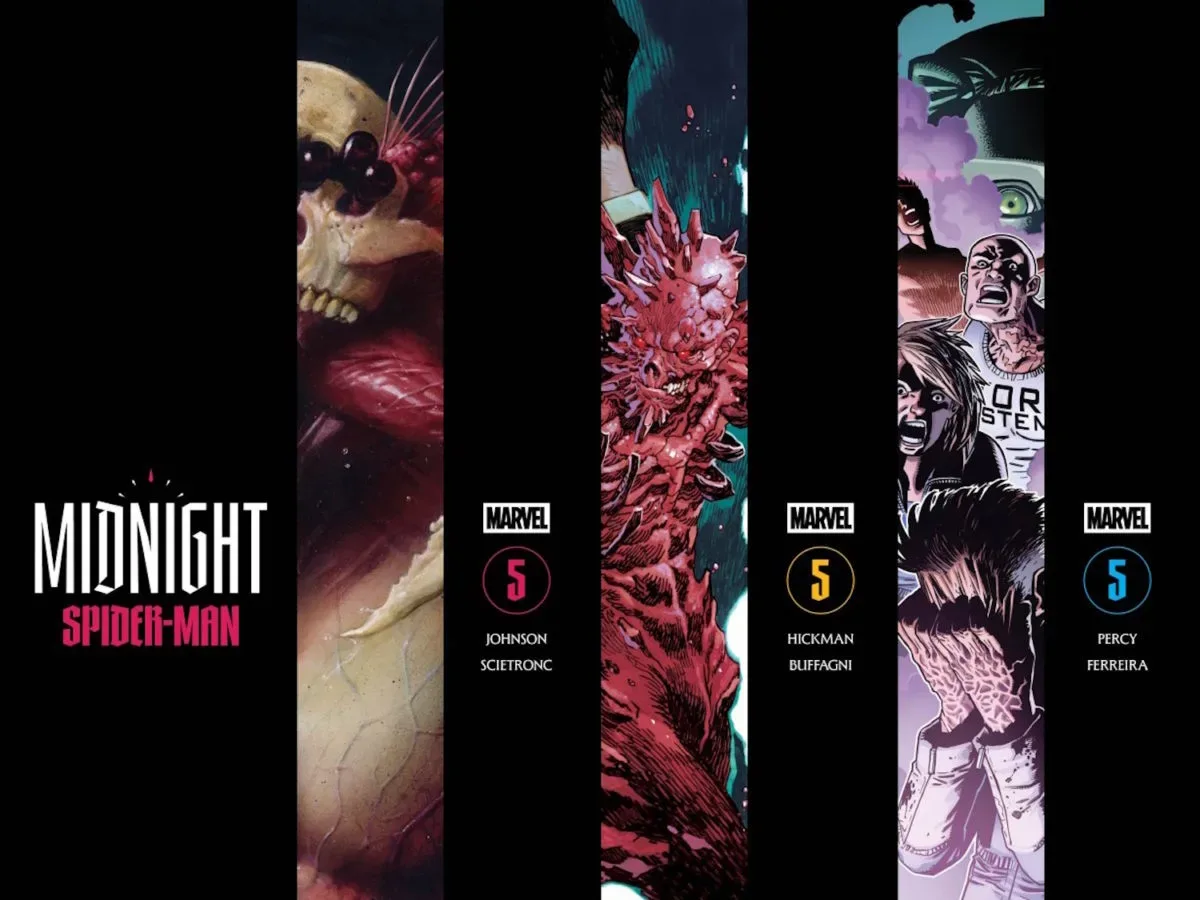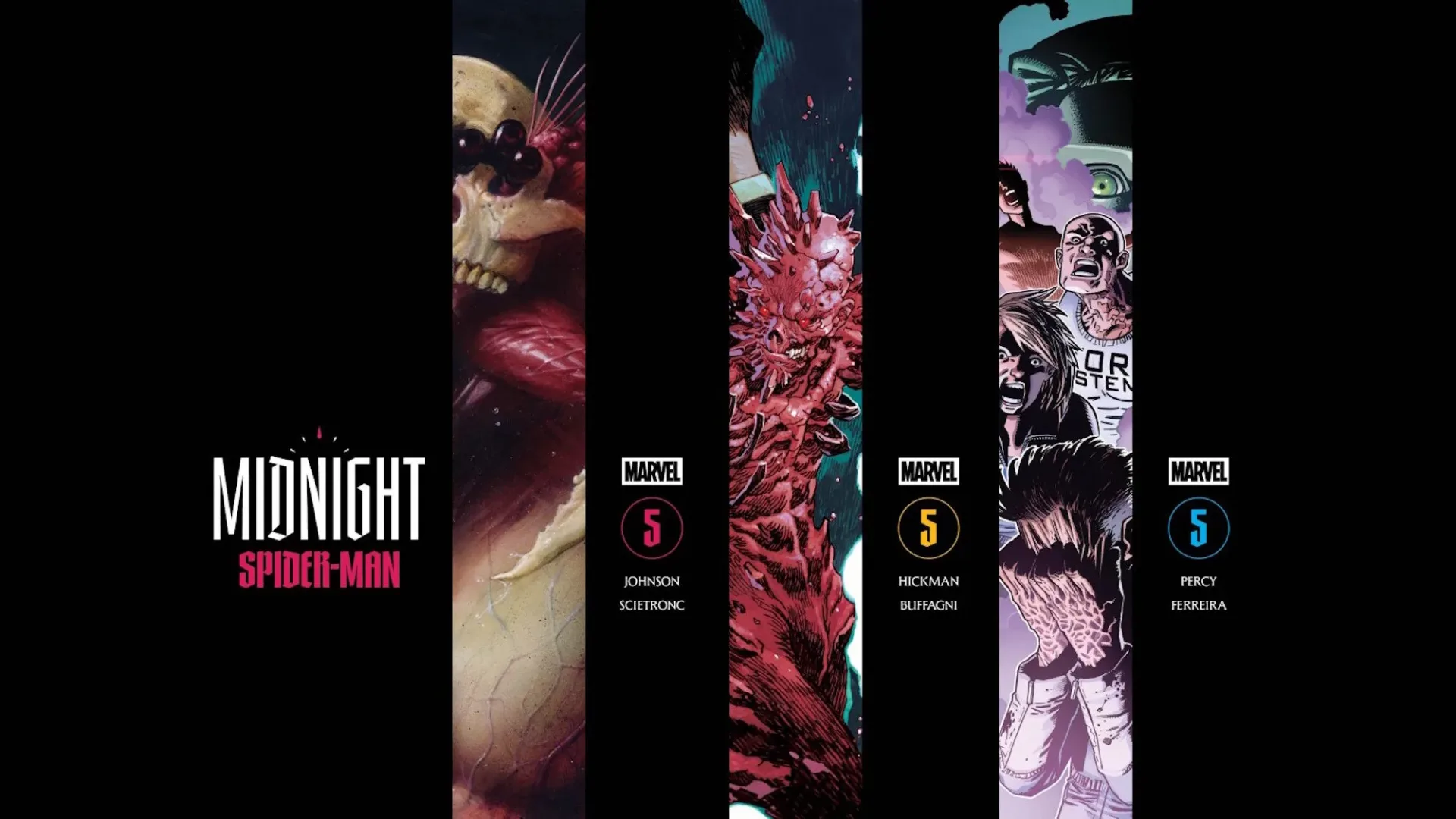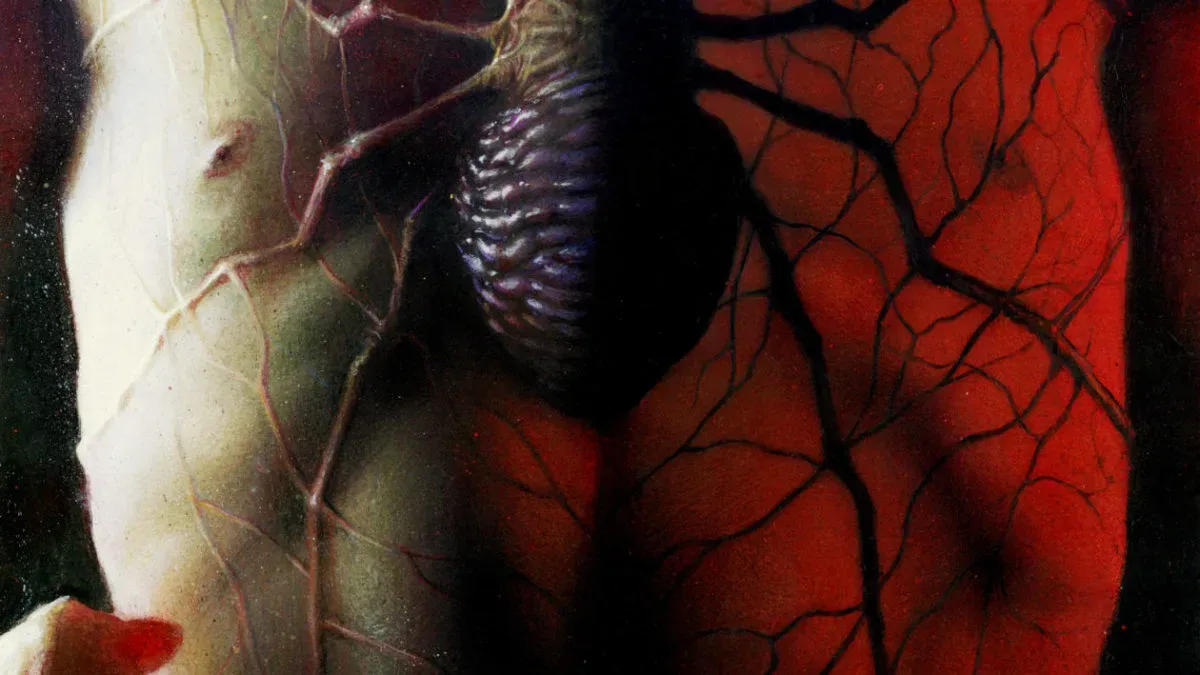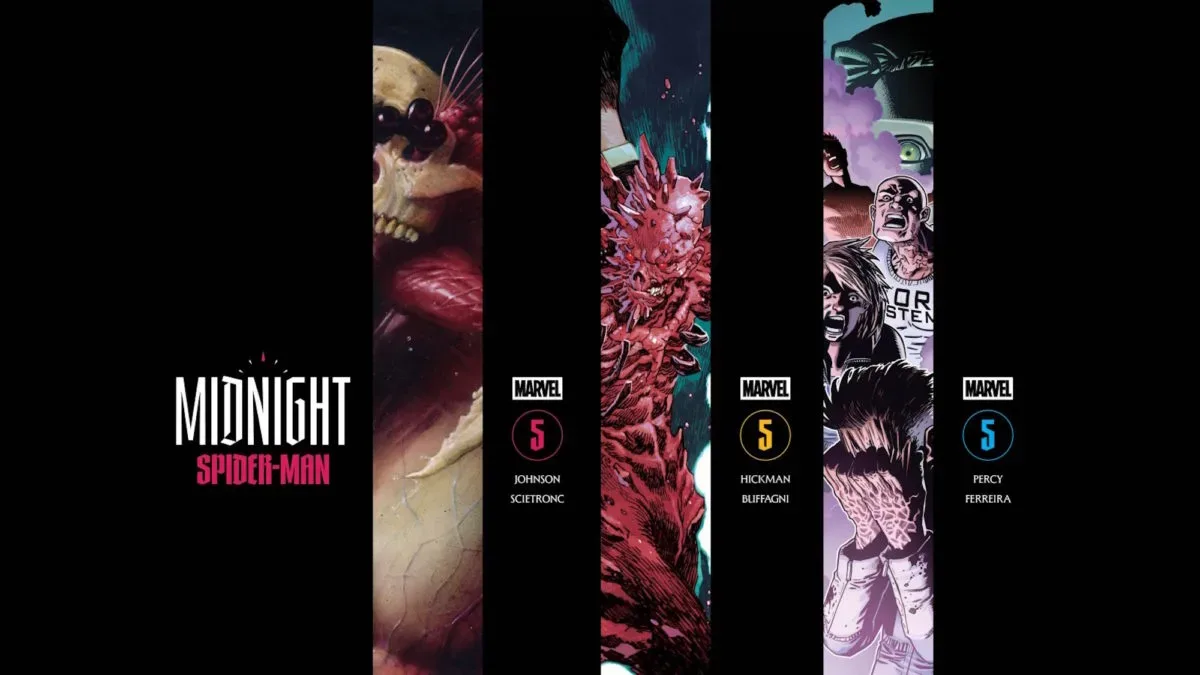
Marvel’s Midnight books are heading into their fifth issues with three deliberately unsettling problems: a new Oscorp-created creature hunting Spider-Man, the Fantastic Four struggling with unexplained bodily changes, and the X-Men facing a conflict framed around a ronin, a Reaver and a pact made in Hell.
Midnight Spider-Man #5, Midnight Fantastic Four #5, and Midnight X-Men #5 are each listed as 32-page, Parental Advisory comics priced at $4.99. The Spider-Man issue arrives first, on February 10, 2027. The Fantastic Four and X-Men installments follow on February 17, 2027.
The solicits offer only controlled flashes of what is ahead, rather than full story summaries. Still, the three descriptions make the wider Midnight initiative’s intended tone clear: superhero identities and powers are being treated as sources of dread, science is producing consequences nobody can readily explain, and familiar Marvel conflicts are being dragged toward horror territory.
Midnight Spider-Man #5 puts Oscorp’s new creation on the hunt
Midnight Spider-Man #5 is written by Phillip Kennedy Johnson and drawn by ScieTronc. Its central threat is described as Oscorp’s “second generation” monstrosity, now loose and targeting Spider-Man first. At the same time, the mutation responsible for creating Spider-Man has apparently passed into another host, with results being held back for the issue itself.
The fifth issue follows a steadily escalating chain of solicit teases. Issue #2 asks where Peter Parker is while several people connected to New York and Oscorp have gone missing; Oscorp defense contractors are shown reviewing footage for a spider. Issue #3 then has Peter attempting to regain his humanity as Oscorp hunts an urban legend called the Spiderman and Doctor Octavius engineers a second synthetic mutant. By issue #4, New York is hiding indoors from the horror it calls Spider-Man, while an outcast police officer investigates the Parker Incident and the second synthetic mutant is born.
That progression matters because it frames the February chapter as more than a standard fight with an escaped laboratory experiment. The apparent story engine is a reversal of Spider-Man’s usual public image. Peter is not simply protecting New York from something monstrous; New York appears to fear what it believes Spider-Man has become, while Oscorp keeps advancing its own program.
What “synthetic mutant” means here: the phrase is presented as an in-story description for something engineered by Doctor Octavius, not as a technical real-world term. The available material establishes that this is Oscorp-linked scientific experimentation, that the result is intended to be frightening, and that it may render Spider-Man obsolete. It does not establish the creature’s name, powers, appearance, or whether it is the exact same threat described as the second-generation monstrosity in issue #5.
The fifth issue has covers credited to Marcelo Ferreira for the Midnight Bloodbath edition, Peach Momoko for the Midnight Special edition, an as-yet-unidentified artist for a Midnight Horror Homage cover, and Benjamin Su for a Midnight Gallery variant carrying a 1:25 designation. In comics distribution, a 1:25 is an incentive-cover ratio: retailers generally qualify to order one copy of that variant after meeting a specified threshold of regular-cover orders. That designation does not reveal a final scarcity figure for copies in circulation, but it does differentiate the Su cover from the standard ordering options.
The Fantastic Four’s unanswered condition gets worse
Benjamin Percy writes Midnight Fantastic Four #5, with Marcelo Ferreira on interior art and a cover by Kev Walker. The solicited premise is direct: changes to the Four’s physiologies are continuing, the team expects Reed Richards to find answers, and the pressure rises as he cannot provide them. Elsewhere, an unknown threat is stalking the woods around Storm Systems HQ.
“Physiology” is the study or functioning of living bodies. In this context, the wording signals that the problem is not merely an external enemy attacking the Fantastic Four. Their bodies themselves are changing, and the question of what that means appears inseparable from the book’s plot.
The earlier issue descriptions provide the clearest available trail. In issue #2, Reed is haunted by a past he barely remembers and by a scientific breakthrough he barely understands as he begins a fragile working relationship with Sue, Johnny, and Ben at Storm Systems. That issue has the group testing one of Reed’s theories, a theory connected to the perils of the atomic age.
Issue #3 takes the Four to the Jornada del Muerto desert in New Mexico, identified in the solicitation as the location of the first atomic-bomb detonation and the Los Alamos labs. There they find evidence of another world left by a fracture in the firmament. Issue #4 says they return from a monolith in the desert without memories or a record of what happened, while their minds and bodies behave strangely after an encounter with a cosmic artifact.
Issue #5 therefore seems positioned as the point where that mystery stops being only Reed’s intellectual puzzle and becomes a group crisis. The solicitation does not specify the precise effects on Reed, Sue, Johnny, or Ben. Nor does it identify the figure or creature in the woods around their headquarters. What it does confirm is that the Four’s lack of answers has become a source of interpersonal tension, not just a strange scientific anomaly.
For readers tracking the line’s connective ideas, the Fantastic Four title appears to combine atomic-age anxiety, memory loss, a cosmic object and biological instability. Those are themes rather than confirmed explanations. The material does not say whether the changes stem directly from the artifact, the monolith, the desert expedition, or something else. The distinction is worth keeping: solicitations are designed to establish stakes, and this one withholds the answer Reed is seeking.
Midnight X-Men #5 promises a grim meeting and a fragile peace
Midnight X-Men #5 brings Jonathan Hickman together with artist Matteo Buffagni, with a cover by Dike Ruan. Its compact description says a ronin meets a Reaver, an infernal compact has been made, old scores will be settled, and “the Peace Must Hold.”
The language suggests a collision between competing forces rather than a standalone monster encounter. A ronin, in the broad historical sense, is a samurai without a master; the solicitation uses the term as an identifier but does not provide a civilian name. “Reaver” similarly appears as a character or faction label in the promotional copy, without enough information here to define which individual is involved or what their specific role will be.
What can be traced is the book’s mounting conflict. Issue #2 carries the provocative phrase “Eat. Prey. Love.” Issue #3 advertises a setting of “No Mutants. No Mercy,” with weapons of earthly and heavenly construction and realms situated between old failures and newer acts of expedience. Issue #4 continues the “No Mutants. No Mercy” framing: letters summon all sides, both humans and mutants issue threats, a one-eyed ronin uncovers a clue linked to long-laid plans, and a partially healed wound is concealed by shadow.
By issue #5, the phrase “Peace Must Hold” introduces an important tension. It implies that some form of peace already exists, but it is vulnerable enough that settling scores and negotiating with Hell could break it. The solicited material does not name the parties bound by that peace, disclose the terms of the infernal agreement, or explain why a Ronin-Reaver meeting is central to it. Those omissions are the hook, rather than a contradiction in the pitch.
Hickman’s issue #2 and #3 art is credited to Matteo Della Fonte, while Buffagni is credited for issues #4 and #5. That makes issue #5 the second consecutive issue with Buffagni listed as artist. Readers following the visual side of the title should note that the supplied credits indicate a change in interior artist before the February issue, while Ruan remains the credited cover artist for the fifth installment.
What readers can take from the February listings
The three books are separate series, but their descriptions share a clear vocabulary: mutation, monstrous transformation, altered minds and bodies, hidden projects, cosmic intrusion and threats that turn superhero premises toward unease. Spider-Man’s mutation spreads to another person as Oscorp creates a new horror. The Fantastic Four deal with physiological changes after a mysterious encounter. The X-Men story uses the language of no-mercy conflict, heavenly and infernal forces, and a peace in jeopardy.
That is a useful way to read the Midnight label on these solicitations. It is not presented simply as a darker visual rebrand. The supplied issue summaries repeatedly place identity under pressure: Peter wants his humanity back; the Four cannot trust what happened to their own bodies and memories; the X-Men face forces that make diplomacy sound precarious.
There is also a practical release-order point for anyone planning to follow the February chapters:
- February 10, 2027: Midnight Spider-Man #5, by Phillip Kennedy Johnson and ScieTronc, $4.99.
- February 17, 2027: Midnight Fantastic Four #5, by Benjamin Percy and Marcelo Ferreira, $4.99.
- February 17, 2027: Midnight X-Men #5, by Jonathan Hickman and Matteo Buffagni, $4.99.
All three are listed at 32 pages and carry a Parental Advisory designation. That label indicates content aimed at a more mature readership than an all-ages comic, but the specific material prompting it is not detailed in these listings.
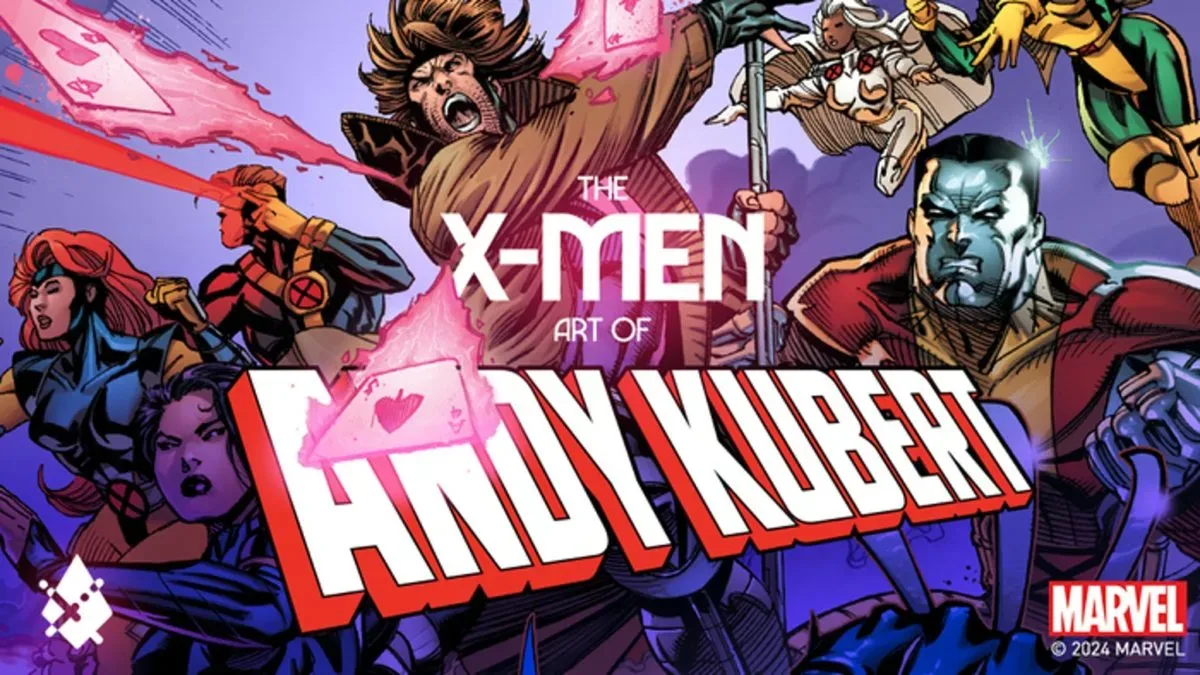
For X-Men readers interested in another upcoming Marvel-related art-book release, Joking Joystick has also covered The X-Men Art of Andy Kubert paperback planned for January 2027.
The important unknowns remain intact
February’s solicitations establish direction, not resolution. They do not identify Spider-Man’s new mutated host, clarify how the second-generation Oscorp creature relates to Doctor Octavius’s synthetic mutant, explain what has transformed the Fantastic Four, or name the terms and participants of the X-Men’s infernal compact.
That restraint is especially significant for a line built around horror. The descriptions reveal consequences first: a city afraid of its Spider-Man, a team whose physiology is changing, and peace that may not survive a reckoning. The causes are being kept in shadow. For now, that leaves the fifth issues as escalation points rather than answers—and gives each title a distinct kind of nightmare to pursue.