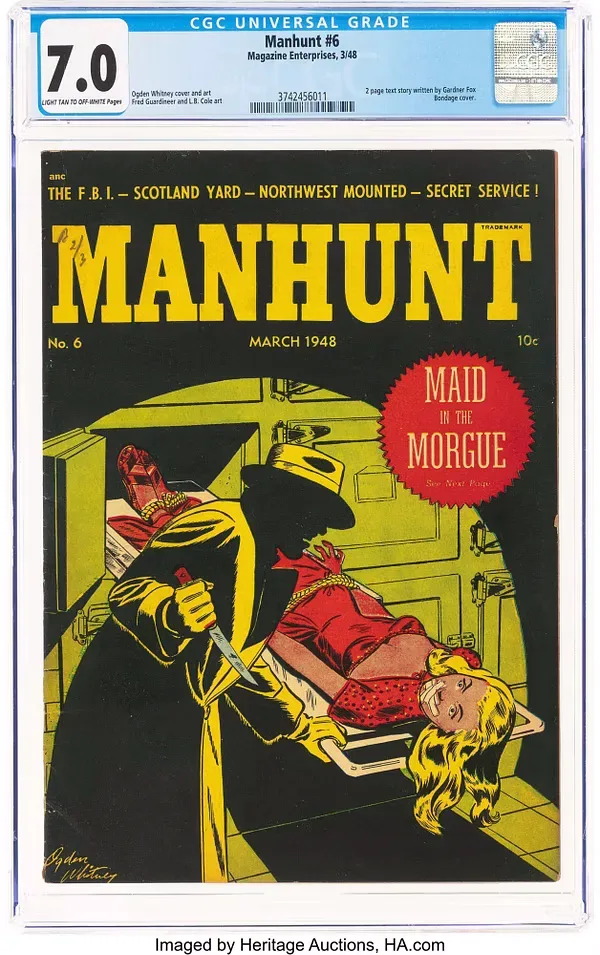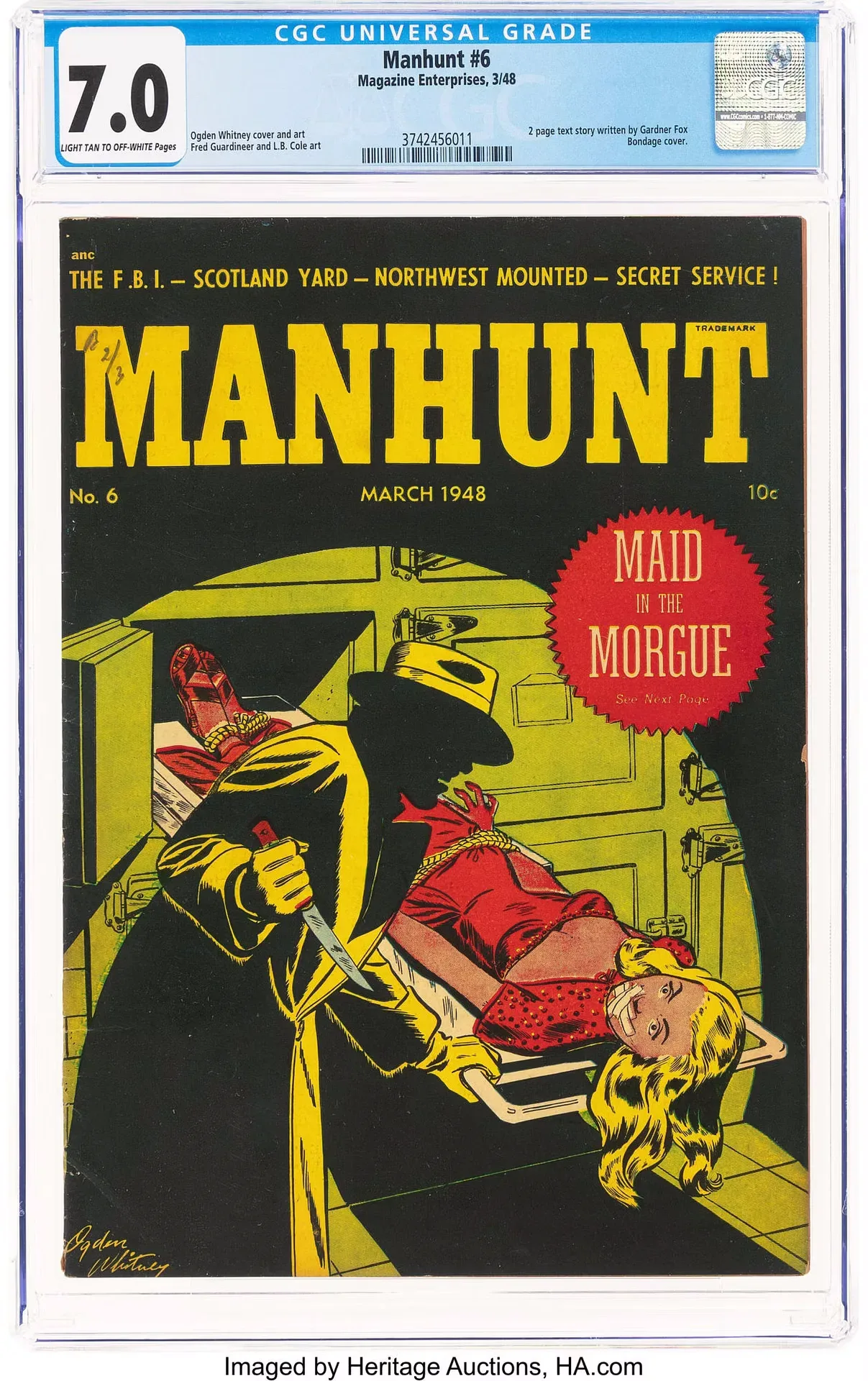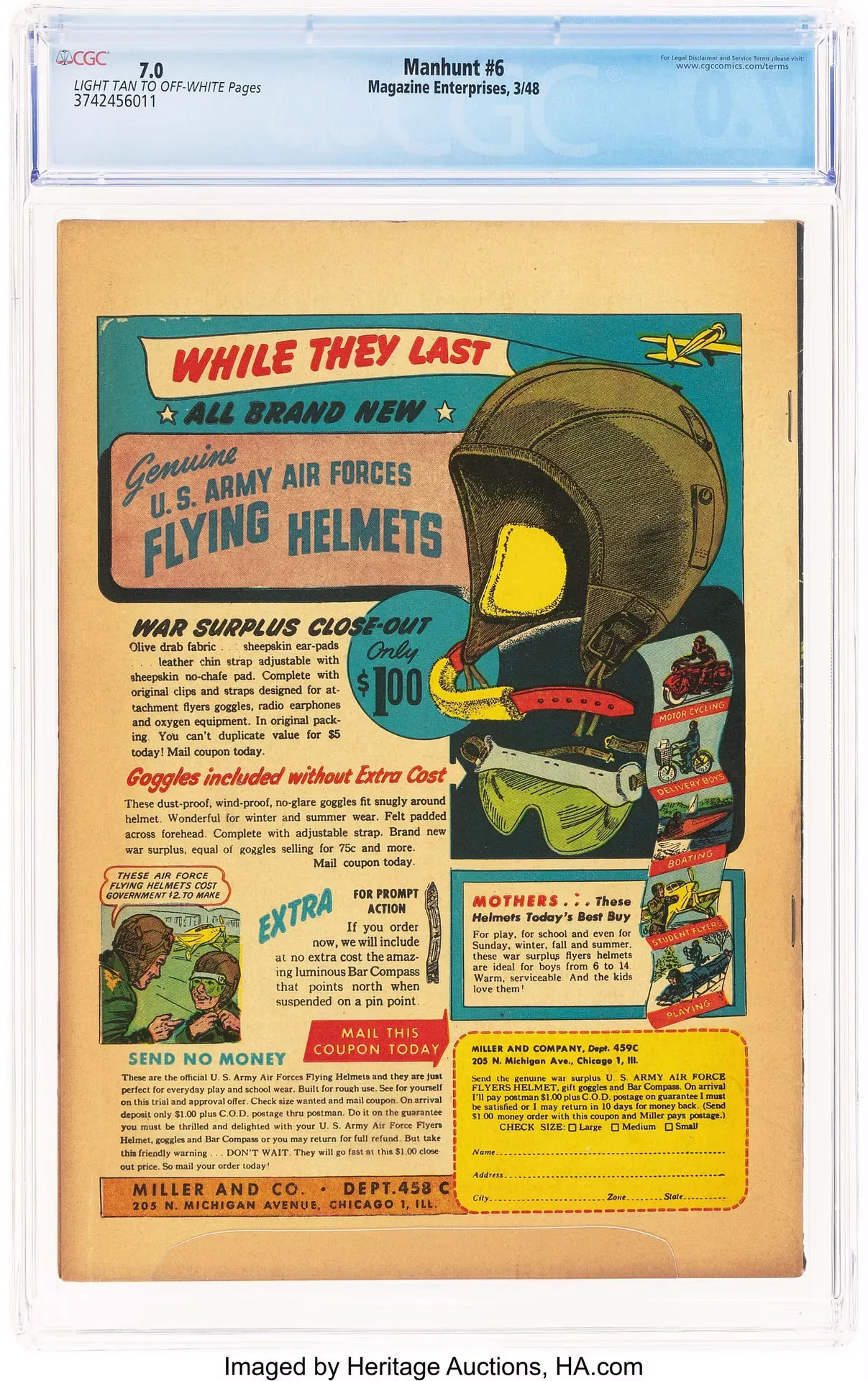
A 1948 copy of Manhunt #6 is headed to the September 24–26, 2026 Comic Books Signature Auction #7469, carrying an unusual combination of vintage-comic appeal: an Ogden Whitney cover that directly advertises a Gardner F. Fox mystery printed inside the same issue.
The offered copy is graded CGC FN/VF 7.0, with light tan to off-white pages. CGC’s census records 30 Universal-label copies of the issue, including two at 7.0 and six that grade higher. That does not settle an item’s value or predict auction results, but it gives prospective bidders a useful snapshot of the issue’s recorded graded population.
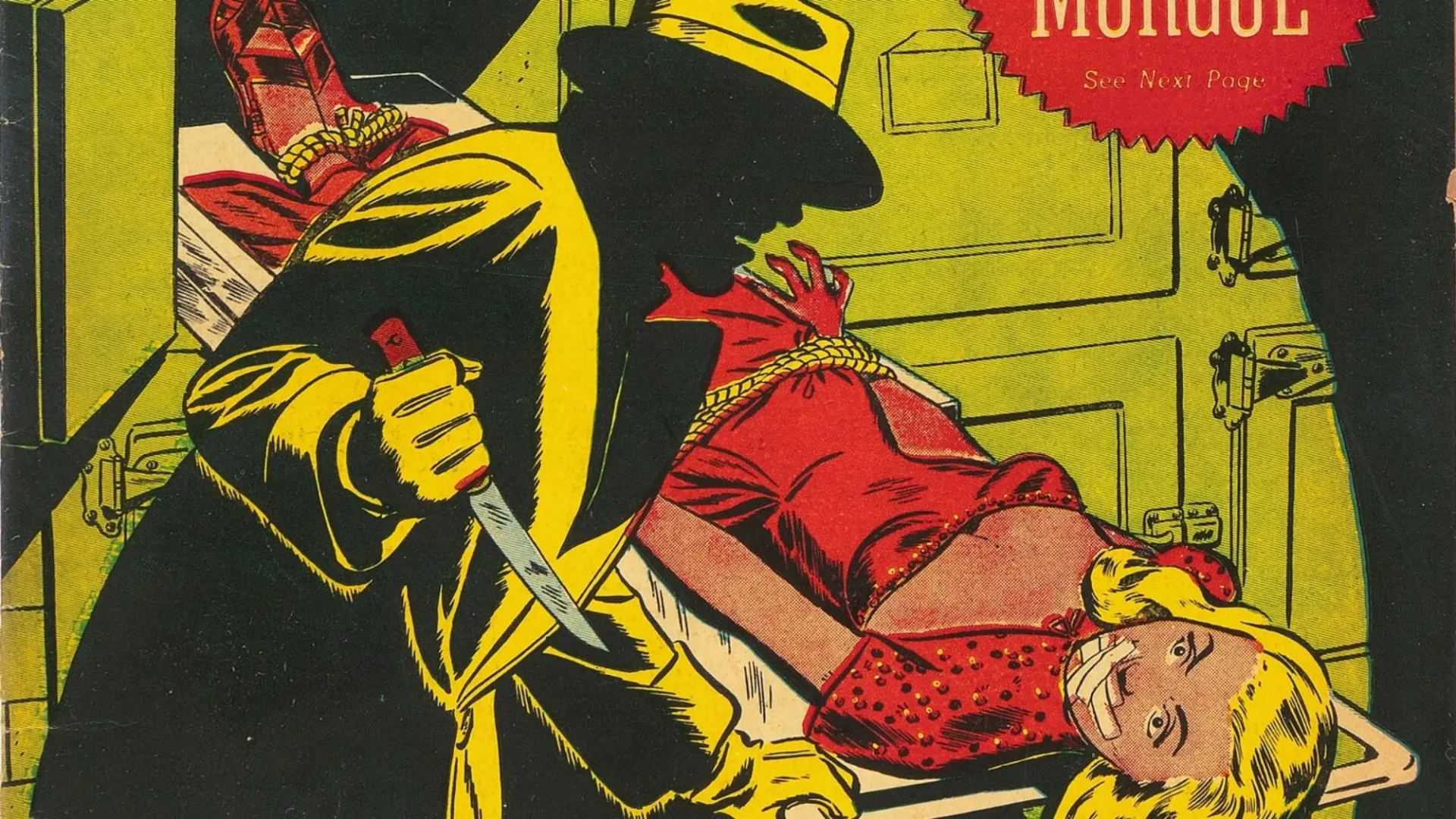
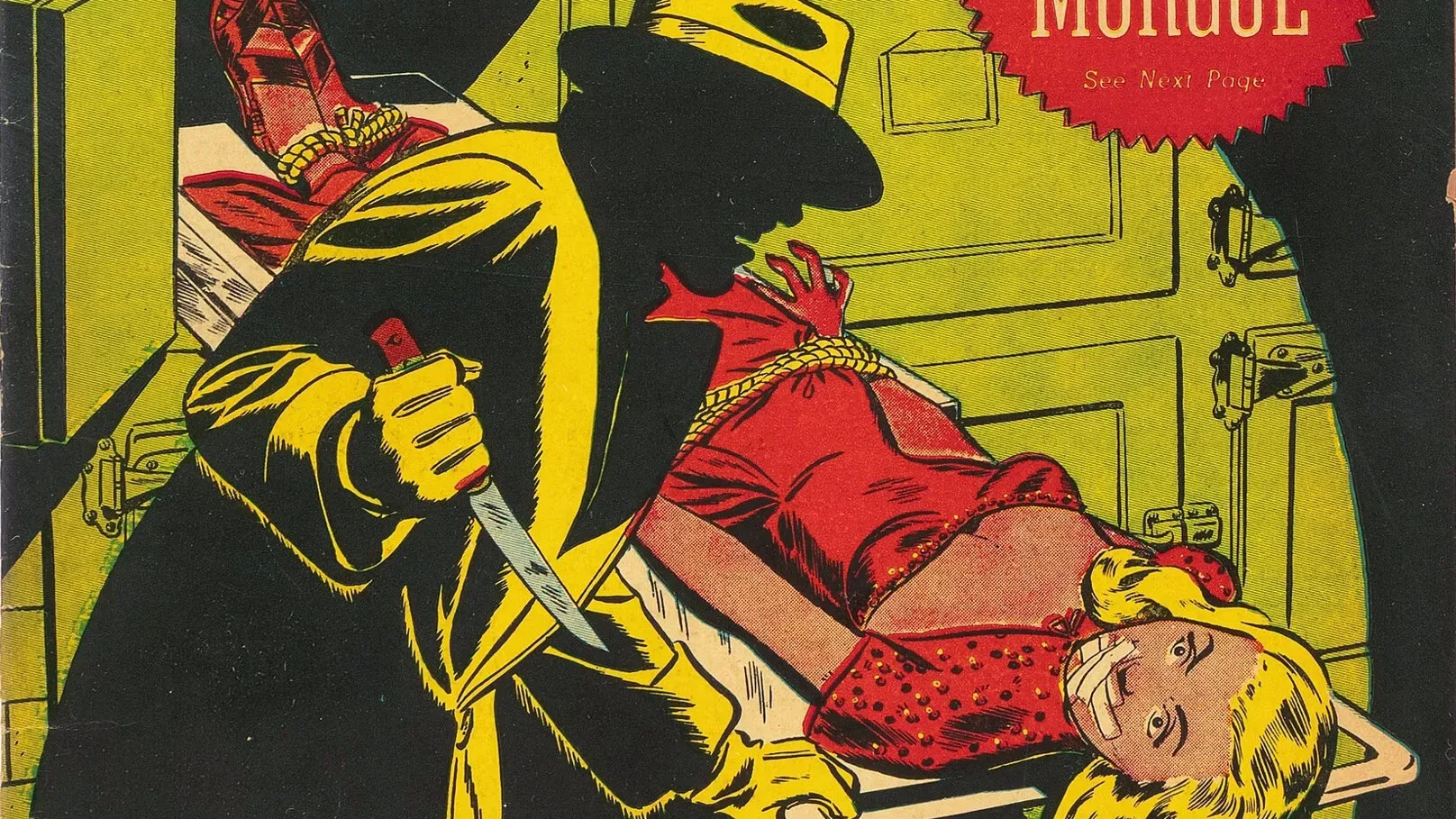
Most importantly, the book is more than a cover-driven crime-comics curiosity. Its visual hook and its text are explicitly connected. Whitney’s cover tells readers, “Maid in the Morgue. See Next Page,” directing them to Fox’s two-page prose feature. In an era when cover scenes could be only loosely related to a comic’s contents, that kind of immediate signposting is a notable bit of issue design.
A cover that leads somewhere specific
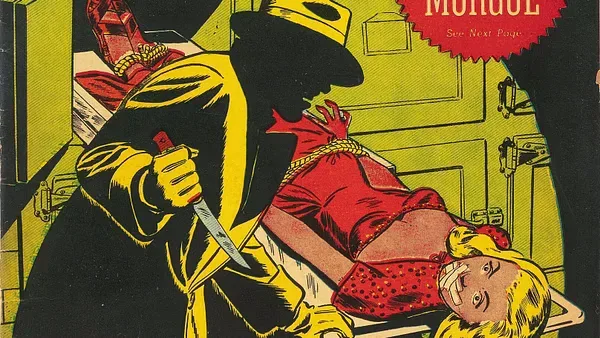
The cover’s imagery is blunt, sensational and built to stop a reader at the newsstand: a woman is bound beside a morgue drawer while a knife supplies the menace. Its composition belongs to the provocative crime-comic tradition often described by collectors as a bondage cover, meaning a cover that prominently depicts a restrained figure in a peril scenario.
That label describes the image, not the complete narrative function of the feature inside. The image foregrounds vulnerability, but Fox’s prose gives its central character, reporter Myra Hallowell, the agency. Myra is not merely present at a crime scene or awaiting rescue. She recognizes that the official explanation does not fit the evidence, then pushes far enough into the case to endanger herself.
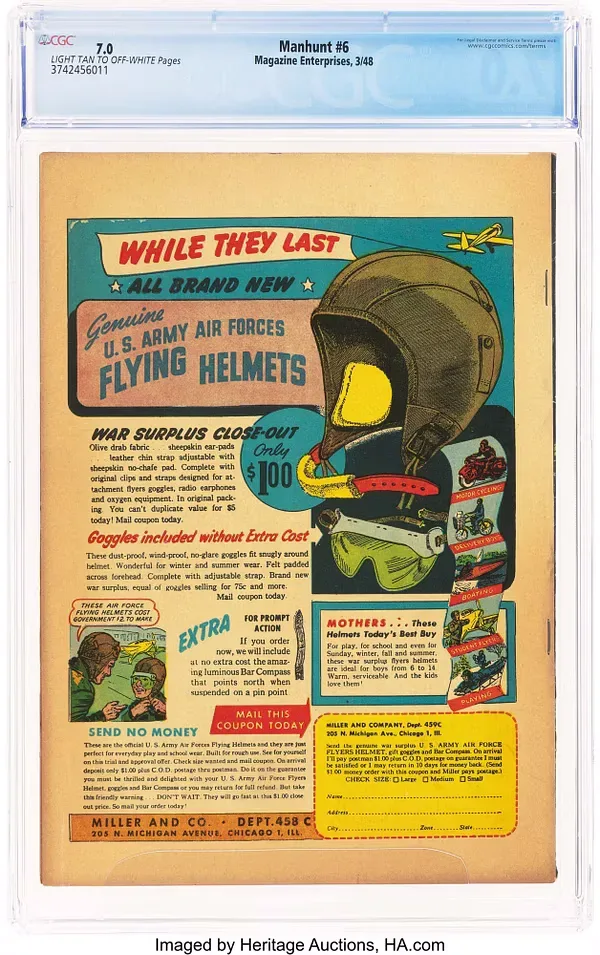
There is also a practical collecting lesson in the issue’s design. A buyer drawn in by the cover should not treat the inside-front and back-cover material as incidental. “Maid in the Morgue” occupies those locations, making the story physically split across the book’s cover interiors rather than presented as an ordinary sequential-comics feature. Completeness and condition therefore matter not just in the abstract; they directly affect the readability and presentation of the Fox material that the cover promotes.
Fox builds the mystery from physical evidence
“Maid in the Morgue” begins with what is presented as a suicide: Billy Morany’s wife has died, and the scene appears to offer a straightforward answer. Myra Hallowell sees contradictions instead.
The most immediate detail is handedness. The dead woman was right-handed, yet the gun has been placed in her left hand. On its own, that detail raises suspicion rather than proving every element of what occurred. Fox then gives Myra a second clue: another bullet mark, positioned behind a radio cabinet. Together, the details turn the alleged suicide into a murder mystery based on the arrangement of the room and what the evidence implies.
This is a compact example of deductive mystery plotting. Rather than asking the reader to accept an accusation because a character declares it, the story places observable facts in front of Myra and lets her draw a conclusion from their inconsistency. Handedness matters because it challenges the apparent staging of the gun. The hidden bullet mark matters because it suggests events in the room may have unfolded differently than the simple suicide explanation allows.
Fox’s premise also changes the meaning of the cover’s threatened heroine. Myra gets into trouble because she has solved too much, not because she is passively caught in someone else’s adventure. The dramatic image remains unapologetically lurid, but the prose feature underneath it turns its reporter into the person who identifies the lie at the center of the case.
That contrast is part of what makes the issue historically interesting. Cover art, prose fiction and interior comic stories were all doing different jobs in a periodical like this one. A single striking image could sell threat and danger in seconds. A two-page text piece could provide a concise puzzle and a conclusion rooted in close observation. Neither needs to be mistaken for the other, and the cover’s “See Next Page” instruction makes their relationship unusually explicit.
The Fox and Whitney connection
Fox and Whitney had a working relationship reaching back to 1939. Whitney’s earliest identified work was on a Fox-written story in Adventure Comics #42. The pair later co-created Skyman for Columbia Comics, while Whitney became especially well known as the co-creator of Herbie Popnecker at American Comics Group.
That background gives Manhunt #6 a little more texture than a random pairing of recognizable names. Fox supplied the mystery on the cover interiors, and Whitney did not merely provide the attention-grabbing cover. He also drew the issue’s Fallon of the FBI and Undercover Girl stories. For readers and collectors, the result is an issue where Whitney’s contribution is spread through the package while Fox’s name is attached to the specific feature being advertised from the front.
Whitney had worked intermittently for Magazine Enterprises from 1943, with that work increasing after the war and eventually encompassing crime and espionage material. Manhunt #6 fits that broad territory. Its contents place detective work, federal-investigation adventure, undercover scenarios and Cold War-era anxiety near one another in the same book.
There is no need to flatten that mix into a single genre. “Maid in the Morgue” is a short prose murder mystery. Fallon of the FBI is an adventure strip built around investigation and espionage. Undercover Girl is another separate story. The appeal of the issue lies partly in that variety: it is a crime-oriented anthology object whose cover and prose feature form a particularly memorable pairing.
“The School for Spies” and its political atmosphere
One of Whitney’s interior assignments, Fallon of the FBI’s “The School for Spies,” concerns an agricultural operation in upstate New York that conceals a Communist school intended to infiltrate labor unions. The story’s premise reflects an anxiety already circulating in contemporary news coverage. A September 8, 1947 report in the Neosho Daily News described an account by UP correspondent Lyle Wilson concerning a Communist school in New York.
The connection is useful context, but it should be stated carefully. It establishes that the issue’s premise drew on a topic that had appeared in news reporting; it does not demonstrate that every element of the comic story was factual. In popular fiction, topical fears often become raw material for melodrama, villains and concealed institutions. The important point for a modern reader is that the story participates in the political climate surrounding it rather than arriving in a vacuum.
That political material sits beside Fox’s more traditional clue-driven murder puzzle. The juxtaposition reveals the breadth of mid-century crime and suspense publishing: a domestic death scene can be examined through physical evidence, while another feature turns to conspiracy and infiltration. The issue’s tension comes from both the intimate scale of a suspicious death and the larger, ideologically charged threat imagined by its espionage material.
What the grade and census actually tell collectors
CGC’s Universal label is the company’s standard label for comics that do not receive a qualified, restored or signature-series designation. A census entry records a graded copy in that company’s population data. It is useful for comparing known submissions, but it is not a total count of every surviving copy. Raw, unsubmitted copies and books graded elsewhere are not represented by that number.
The offered 7.0 designation falls in CGC’s FN/VF range, shorthand for Fine/Very Fine. The listed page quality, light tan to off-white, is another condition detail separate from the numeric grade. Paper color can matter significantly with older comics because oxidation, storage and handling over decades affect the interior pages differently from the exterior’s overall appearance.
For a buyer considering this particular copy, the essential facts are straightforward: it is a 1948 Magazine Enterprises issue; it bears Whitney’s cover and interior art; it includes Fox’s “Maid in the Morgue”; it is encapsulated at CGC 7.0; and the recorded CGC census has 30 Universal copies, with eight at or above 7.0. Those facts provide a better starting point than assuming either rarity or condition from the cover alone.
They also point to why this issue has a coherent identity. The cover is not simply an unrelated shock image. It advertises Fox’s mystery. Fox’s story supplies a reporter who notices the staged evidence. Whitney’s work continues through other stories in the book. And the surrounding contents offer a compact window into crime, espionage and political suspense in a late-1940s comic anthology.
For readers interested in how older visual storytelling is preserved and reconsidered across media, our look at Ninja Scroll’s 4K return and Yoshiaki Kawajiri’s career explores a very different kind of archival pop-culture conversation.