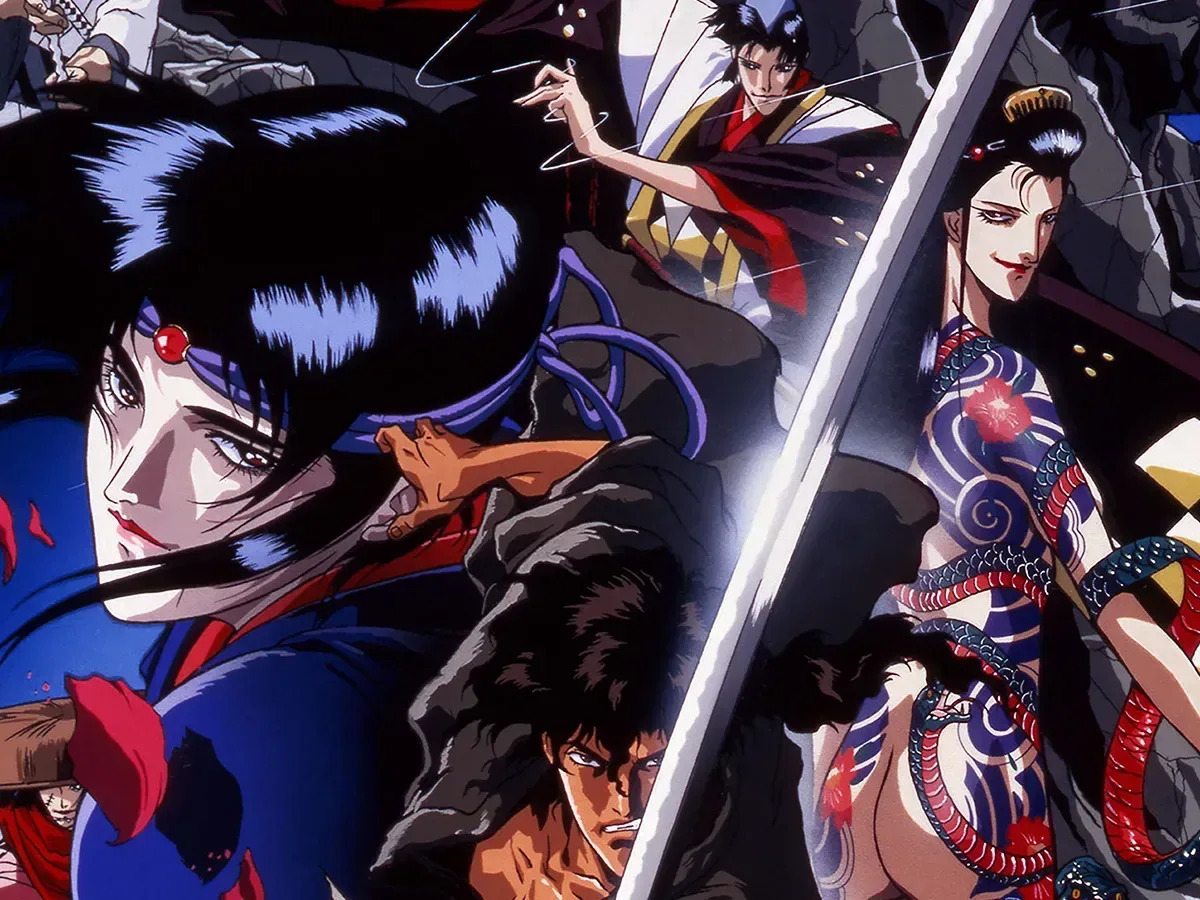
Yoshiaki Kawajiri is not presenting his long absence from the director’s chair as a mystery, a retirement slogan, or a tease for an imminent comeback. As Ninja Scroll prepares for a limited 4K theatrical run in the United States and Canada, the filmmaker has explained that directing at the scale and level of personal involvement he requires is no longer physically feasible for him.
Kawajiri, now 75, says he is unable to hand a work over entirely to other people. That is the central issue: not a lack of interest in animation, but the endurance required to oversee a film or series without compromising the vision he believes it needs. His last time helming a project was nearly 20 years ago, yet he remains active in a different capacity through storyboard work.
“I am the type of person who cannot leave a work entirely in someone else's hands, so at my age, and given my physical stamina, directing is no longer possible for me.”
It is a notably direct explanation from a creator closely associated with stylized, adult-oriented anime including Vampire Hunter D: Bloodlust, Goku: Midnight Eye, Wicked City, and Demon City Shinjuku, alongside Ninja Scroll. It also gives the forthcoming restoration a different context. The film’s theatrical return is not positioned as the opening act for a newly directed Kawajiri feature. It is an opportunity to revisit an earlier work with its original visual character protected during the move to a modern presentation format.
Directing and storyboarding demand different things
Kawajiri’s continued credits on storyboards demonstrate that stepping away from directing does not mean stepping away from the craft. He has contributed storyboard work to series including Beastars, Frieren: Beyond Journey’s End, and Jujutsu Kaisen. His comments draw a useful distinction between a supporting creative role and taking ultimate responsibility for an entire production.
A storyboard is a planned sequence of drawings that maps out shots, staging, pacing, action and transitions before animation is completed. In practical terms, it helps a production turn a written script into a visual blueprint. Storyboarding can be hugely influential, especially in action, suspense, or character-driven scenes, but it is not the same job as directing a whole film or series. A director must maintain an overall creative target across the project while managing the accumulated demands that come with that responsibility.
For Kawajiri, the prerequisite for taking on storyboard work is straightforward: the material must genuinely interest him. He frames audience engagement as the principal question he brings to a script and its boards, and describes curiosity as his strongest tool. He specifically singled out Frieren and Beastars as projects he enjoyed.
“I approach the script and storyboards with the understanding that the most important point is how to keep the audience interested. I cannot work on storyboards unless I find the work interesting. In other words, my curiosity is my greatest weapon.”
That perspective helps explain why his present-day work is meaningful rather than merely ceremonial. He is still contributing to the stage where storytelling choices become visible: how a scene is framed, how information is revealed, how momentum is built, and where viewers are asked to focus. His role may differ from directing, but the stated priority remains audience attention.
A restoration designed to retain an analog film’s character
Ninja Scroll is returning to select theaters across the United States and Canada on October 4, 5, and 7 through Iconic Events Releasing and AMC Global Media’s HDIVE. Kawajiri supervised the film’s 4K restoration, which involved extensive work to recover and present the original artwork without stripping away qualities that belong to an analog production.
“4K” refers to a high-resolution image format. In a restoration context, however, higher resolution is only part of the challenge. The underlying materials and visual intentions matter just as much. Kawajiri said the work focused on bringing back the beauty and richness of the original cels and background art while preserving both the film’s atmosphere and its grain.
Cels, short for celluloid sheets, were traditionally used in hand-drawn animation. Characters or moving elements could be painted on transparent layers placed over a separately painted background. The technique made it possible to combine animation layers into a finished shot. Because Ninja Scroll was an analog production filmed roughly 30 years ago, physical aging and damage are practical restoration concerns rather than abstract technical footnotes.
Film grain is the textured visual pattern associated with photographic film. It can be tempting to treat grain as a defect when preparing an older work for a sharp digital presentation. Kawajiri’s description makes clear that it was not approached that way here. The aim was to clean the film without flattening its texture or replacing its atmosphere with an overly processed image.
“By focusing on reproducing the original beauty and richness of the cels and background artwork, without compromising the atmosphere of the work or the texture of the film grain, I believe the result has an even more powerful look and feel.”
The staff’s work included removing scratches, dirt, and dust from the cels. That is painstaking because cleanup must improve an image while avoiding accidental loss of meaningful detail, linework, color texture, or the intended character of the artwork. Kawajiri acknowledged the scale of that effort and the difficult nature of restoring analog materials.
For moviegoers, that preservation-first approach is the significant practical detail. A 4K label does not automatically mean a restoration will resemble the work viewers remember, nor does it guarantee that a sharper image is automatically a more faithful one. Kawajiri’s stated goal is fidelity to the original cels, backgrounds, mood, and grain—paired with a more powerful theatrical presentation.
There is a useful parallel in another recent catalog-film presentation: a 4K return can bring older genre filmmaking back into focus, but the value of such work rests on what is retained as much as what is cleaned up. In Ninja Scroll’s case, Kawajiri’s supervision signals that its original analog look was part of the restoration mandate, not an obstacle to erase.
Kawajiri sees quality, not nostalgia, at the heart of older anime’s appeal
Discussions of anime frequently frame older productions and newer ones as opposing eras, particularly when viewers praise the detail or fluidity they associate with past works. Kawajiri does not see nostalgia as the main explanation for why audiences continue returning to acclaimed older animation. His view is more demanding, and more optimistic: work that is genuinely excellent and entertaining continues to connect, regardless of its age.
“Truly excellent and entertaining works never lose their appeal, no matter how many years pass! And creators who make such works will certainly continue to emerge in the future.”
This is not a dismissal of historical change. Kawajiri identifies the arrival of original video animation, often shortened to OVA, in the 1980s as the biggest industry shift. OVA refers to animation made for home-video distribution rather than initially created for a conventional theatrical release or television broadcast. In Kawajiri’s assessment, that model expanded the range of works being made and gave creators more room to express their individuality.
His argument is therefore broader than a defense of one film’s longevity. The diversity enabled by that period helped shape Japanese animation into content that reached audiences internationally. Kawajiri also expressed pride that the long and distinct history of Japanese manga and anime has produced so many works now embraced around the world.
That outlook offers a more useful way to approach the Ninja Scroll re-release than simply treating it as an artifact from a supposedly better era. The restoration offers longtime viewers a chance to see its art in a new theatrical presentation, while giving first-time viewers the chance to decide whether the film’s storytelling and visual impact still land on their own terms. Kawajiri plainly hopes they will.
He expects existing fans to appreciate the heightened visuals and believes newcomers will find that an outstanding work can remain outstanding decades later. The promise is not that the film has been reinvented for contemporary tastes. It is that careful restoration and a cinema setting can make its established qualities more forceful without compromising what made them distinctive in the first place.
What the October screenings mean
The limited North American engagement is scheduled for October 4, 5, and 7 at participating theaters. Availability is therefore not the same as a broad, open-ended theatrical run; audiences interested in the event will need to check participating locations and showtimes through the listed ticketing route.
More importantly, the occasion brings together two parts of Kawajiri’s current relationship with the medium. He is still active where curiosity and visual storytelling meet, through storyboarding on series he finds compelling. At the same time, he is helping preserve a film from his own directing career rather than claiming that a new feature is around the corner.
For an artist who says he cannot separate himself from the responsibility of a work bearing his vision, supervising Ninja Scroll’s restoration is a fitting form of involvement. The release is about preservation with intent: repairing damage, respecting the original materials, keeping the grain and atmosphere intact, and letting a decades-old analog production make its case again on a large screen.