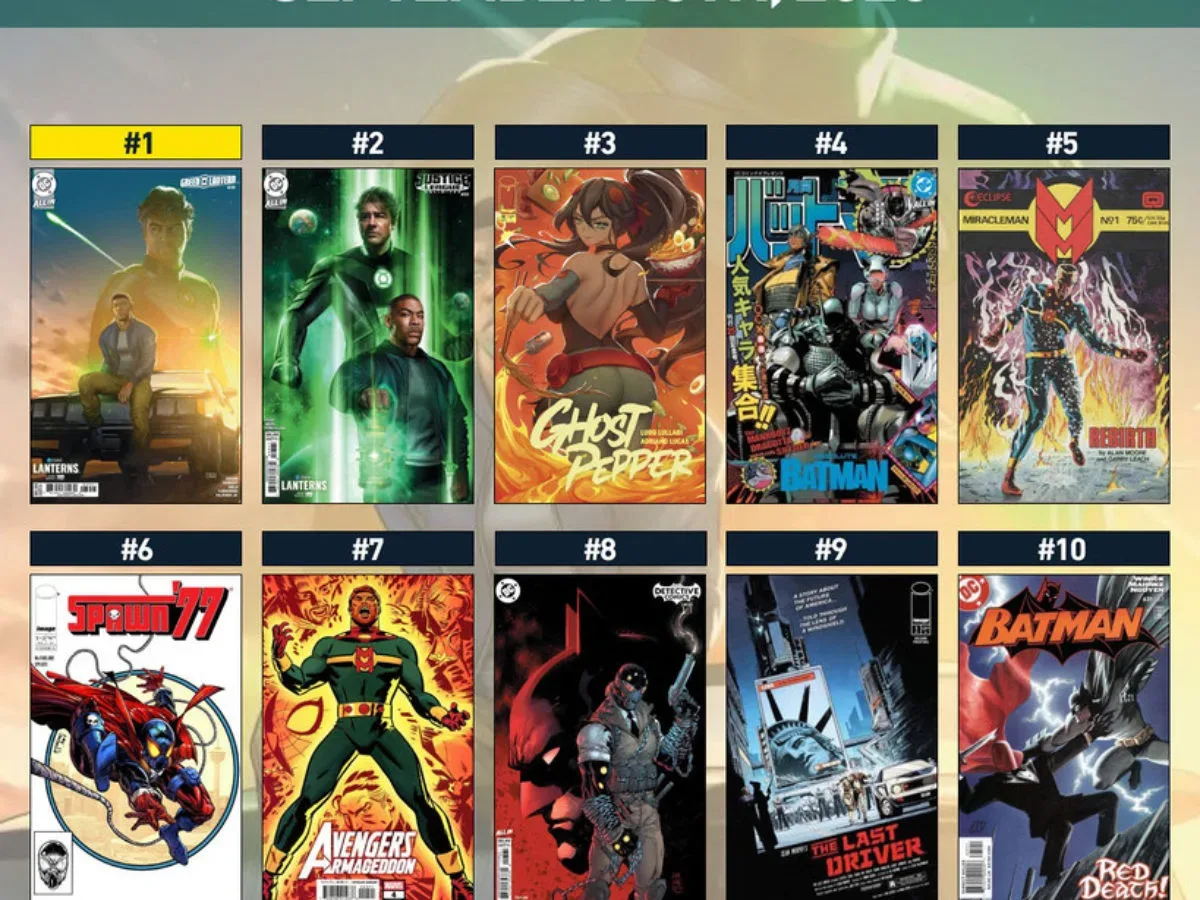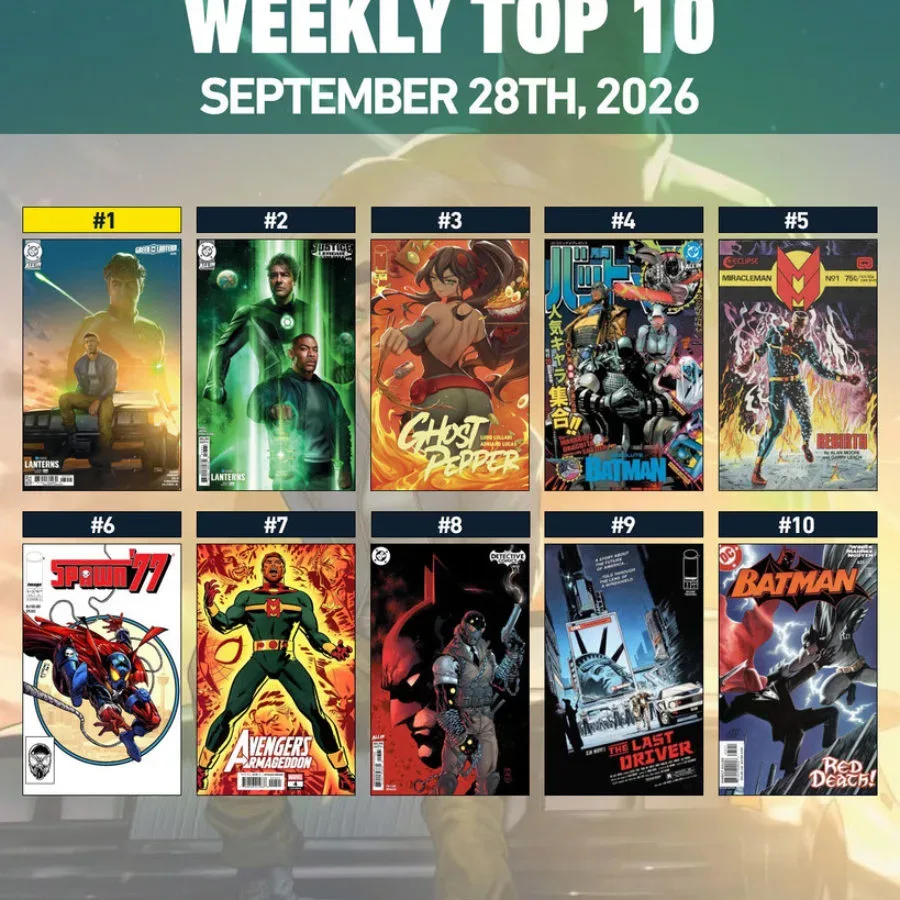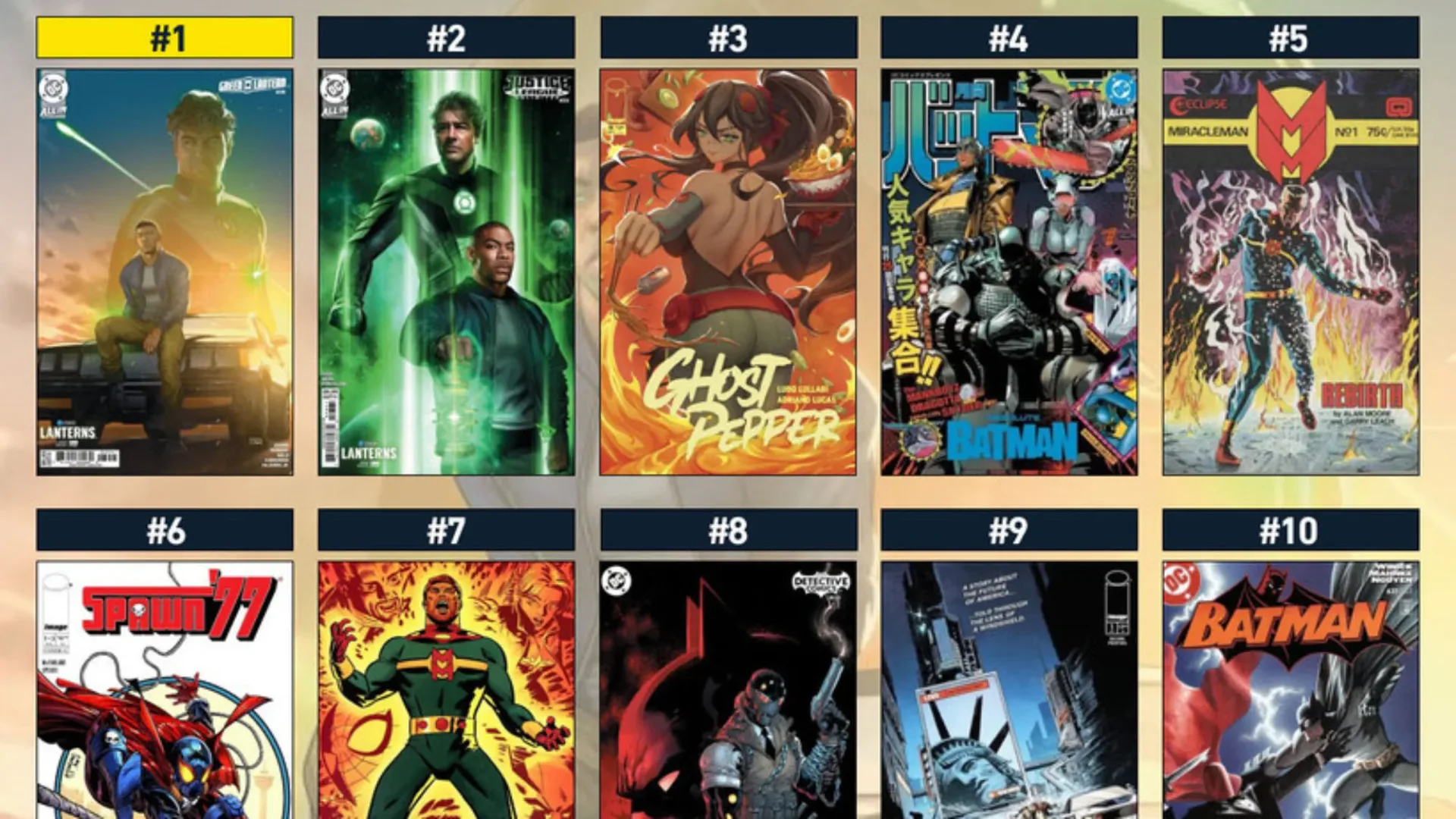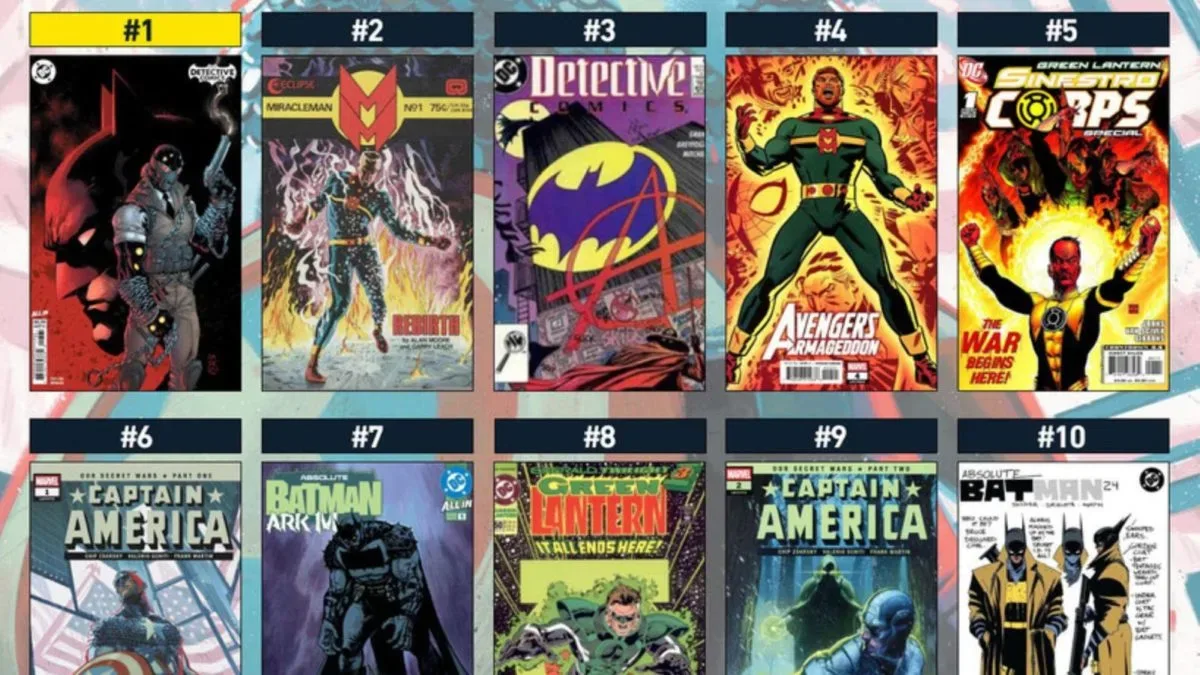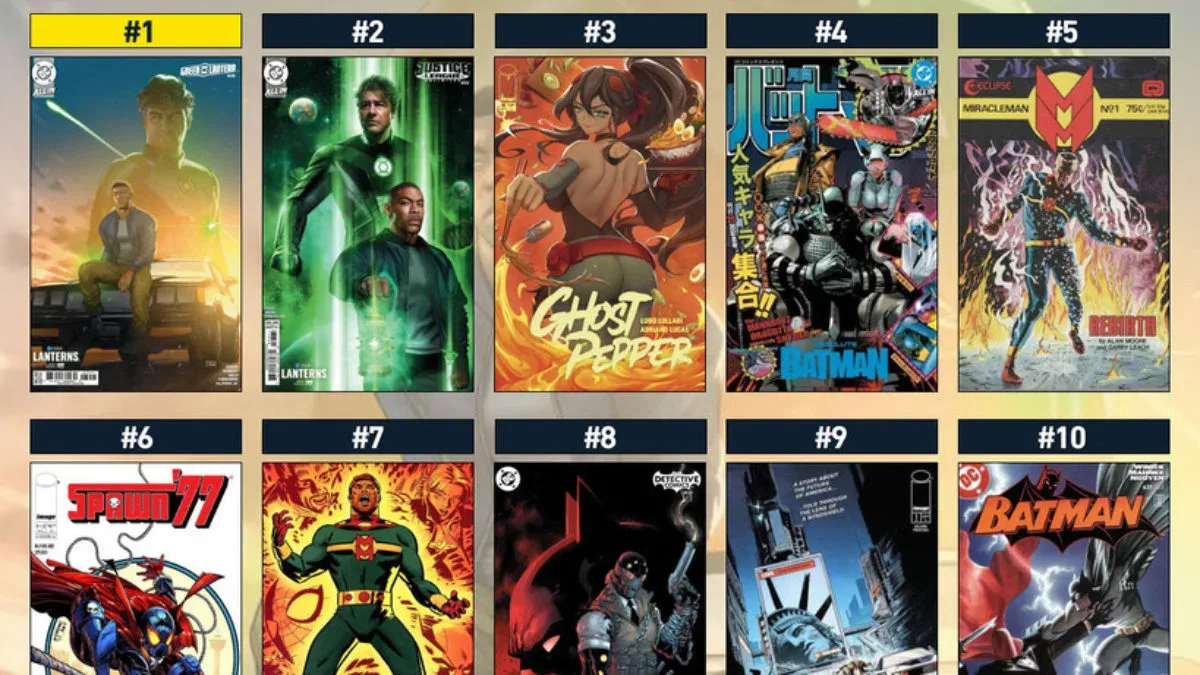
The comic aftermarket’s latest top-ten snapshot has no single driving force. Instead, it is a particularly clear example of how several kinds of attention can converge at once: a television mystery approaching its season finale, a major character’s return to Marvel continuity, a new villain with a fan-created origin, and the familiar scarcity mechanics of retailer incentive variants.
The ranking reflects a weighted combination of online sales volume and price movement for the week ending September 27, 2026. That distinction matters. A “hot” book is not automatically a rare book, a historically important book, or a sensible purchase at any given price. It means buyers are actively concentrating on it right now, often for reasons that can change quickly.
For collectors, the useful lesson is less “buy the list” than “understand the catalyst.” The books here are being moved by very different catalysts, and that changes what a reported sale actually tells us.
Lanterns puts Green Lantern covers in the spotlight
Green Lantern #39, featuring a Taurin Clarke cover, is one of two entries benefiting from the television series Lanterns as its first season nears its end. Covers connected to the show’s versions of Hal Jordan and John Stewart, played by Kyle Chandler and Aaron Pierre, have found an audience amid growing interest in the series’ central mystery. A raw near-mint copy reached a reported high sale of $25, with a current raw near-mint fair-market-value estimate of $20.
The other is Justice League Unlimited #23 with a Dave Wilkins cover. It has a direct spoiler-related connection to recent developments in Lanterns: the show’s investigation has shifted toward the circumstances surrounding Hal Jordan’s death, including a secret portal to Antaan, a fear-corrupted yellow world where Sinestro was stranded. That narrative linkage is helping propel a cover with the show’s leads. Its reported high sale is $22 for a raw near-mint copy, while the current raw near-mint estimate is $17.
There are two separate ideas at work here. A media tie-in cover is a comic cover using the likenesses, costumes, or imagery associated with an adaptation. A spoiler-driven demand bump occurs when a plot reveal encourages people to seek related material before the next episode or while discussion is most intense. Neither necessarily depends on a character’s first appearance or on a low print run. The desire can be immediate and broad, but it can also cool once the season concludes and the next big conversation takes over.
That is why condition language should be read carefully. Raw means an ungraded comic; NM, or near mint, is a condition descriptor rather than a guarantee that every copy is equally sharp. A $25 high sale records one transaction at the top end of the observed activity. It should not be confused with a universal price floor.
Ghost Pepper #15 combines scarcity with story developments
The strongest raw sale among the newer entries belongs to Ghost Pepper #15, specifically Rachta Lin’s 1:25 incentive variant. A raw near-mint copy reportedly sold as high as $100, compared with a current raw near-mint fair-market-value estimate of $53.
A 1:25 incentive variant is generally allocated to retailers based on their order quantity: one qualifying variant for every 25 copies ordered under the relevant program. That does not establish an exact total number in circulation, but it does help explain why these editions can be more difficult to locate than the regular cover. Scarcity alone is not the whole story, however. Issue #15 also includes the origin of the Eclipse Makers and introduces a new titan, while Lin’s Loloï-and-food imagery has become a notable visual hook.
This is a useful example of how a variant can gain traction through several overlapping signals—an eye-catching cover, limited allocation, and story material that buyers may regard as meaningful. Still, a 1:25 label is not a promise of lasting value. Retailer ordering, the number of copies retained in clean condition, and the durability of interest in the issue’s story elements all remain relevant.
Open-order Absolute Batman proves scarcity is not the only game
Absolute Batman #25 offers the counterpoint. Clay Mann’s foil cover is an open-order edition, meaning retailers could order it without a stated incentive ratio. It is not being chased because it is a 1:25 or 1:50 retailer reward. Interest instead appears to be centered on its visual concept: a homage to Japanese weekly comics.
Despite an October 2026 release date, the foil has posted a raw near-mint high sale of $15 and a current estimate of $8. The final order cutoff has already passed, which may sharpen attention as buyers consider how many copies stores actually chose to bring in. But the key point is that open-order does not mean unwanted, just as a low-ratio variant does not mean universally desirable. Art, format, character popularity and timing can all matter as much as formal scarcity.
Collectors comparing this book with a retailer incentive should avoid treating the two as interchangeable. An open-order foil may be plentiful but still become hard to find in excellent shape or command demand because people simply like the design. Conversely, an incentive may be objectively less available but lack the audience needed to sustain interest.
Miracleman’s return creates a two-book collecting lane
Miracleman is responsible for the list’s most obvious modern-continuity story. The character—previously known as Marvelman—returns in Avengers: Armageddon #4 and is slated to be the fifth member of the post-event Avengers lineup. That event has revived attention around both the current key issue and the character’s older comics.
Miracleman #1, the Garry Leach regular cover published by Eclipse in August 1985, has reached a reported high of $128 in graded 9.6 condition. Its current raw very-fine estimate is $13. The enormous-looking gap is not an apples-to-apples comparison: graded 9.6 denotes a comic assessed and encapsulated by a third-party grading service, while raw VF refers to an ungraded very-fine copy. Condition, grading, presentation and buyer confidence can each materially alter a comic’s price.
Meanwhile, Michael Cho’s spoiler variant for Avengers: Armageddon #4 is the only variant cover identified here as showing Miracleman in the Marvel universe. A raw near-mint copy has a reported high sale of $25 and a current estimate of $16. The pairing illustrates two different collector instincts: some buyers want an earlier character landmark, while others want the newly relevant issue that visually signals the crossover.
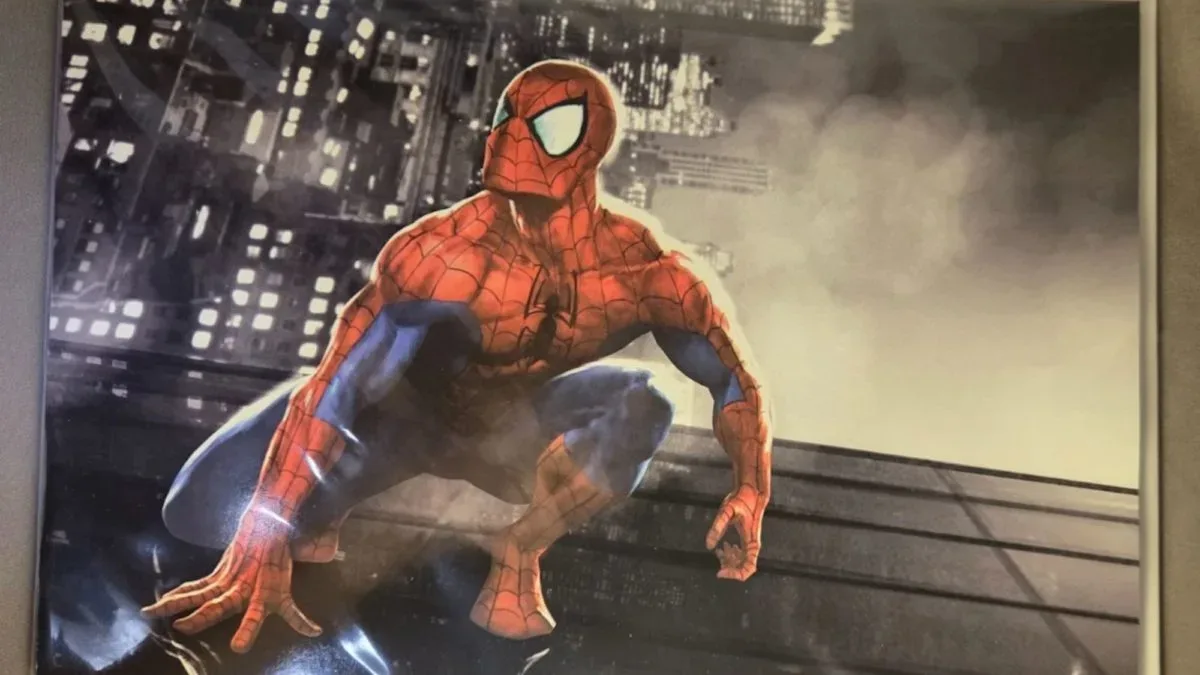
Marvel acquired the character in 2009, reprinted stories in 2010, and teased him in 2021’s Timeless #1, but the current return is what has apparently converted that long-running possibility into immediate market activity. For a related example of how cover variation can drive attention even around a familiar Marvel property, see this look at Amazing Spider-Man #1000 variants.
Spawn ’77, Rhetoric and The Last Driver show three paths to heat
Spawn 77 #1 appears through Todd McFarlane’s 1:50 incentive variant. A Spider-Man #300 homage had already helped put the title on collectors’ radars, and the red-letter Whatnot variant initially drew substantial attention. The 1:50 has subsequently become a target for people trying to assemble the various homage covers. It has a reported raw near-mint high sale of $60 and a current estimate of $42.
That is a case where “completist” behavior can be a meaningful force. A buyer who wants one homage may be casual; a buyer who wants every connected homage cover is participating in a more demanding chase. Demand may be focused on the set relationship rather than solely on the content of one issue.
Detective Comics #1113, with Jim Lee’s Building Bad cover, has a different proposition. It is the only cover in the issue’s lineup said to feature Rhetoric, a new Batman villain developed through DC’s Building Bad sweepstakes. Contest winner Sharif Robbins-Brinson worked with DC on the character’s creation. Reported activity includes a raw near-mint high sale of $21 and a current estimate of $12.
A first appearance or debut can draw attention because it provides a clean reference point in a character’s history. In Rhetoric’s case, the participatory route to the character’s creation gives the issue an additional human angle. That does not predict the villain’s long-term importance, but it helps distinguish this cover from a standard new-character entry.
The Last Driver #1, Sean Murphy’s second printing, demonstrates another familiar market pattern: momentum moving from an early promotional edition into later printings. An ashcan edition attracted attention, the first issue’s covers sold well, and now the second print has recorded a $18 raw near-mint high sale with a $13 current estimate. An ashcan is commonly a small-format promotional or preview comic, often used to introduce a project ahead of a wider release. Here, early demand appears to have carried into subsequent editions, though a third printing has not been confirmed.
Dynamic Duo speculation remains speculation
Batman #635, Matt Wagner’s direct edition from December 2004, is the list’s clearest reminder to separate confirmed information from rumor. The animated film Dynamic Duo is slated for June 2028 and is expected to focus on Dick Grayson and Jason Todd’s early friendship against the Red Hood gang. The comic has posted a high sale of $345 for a graded 9.8 copy and a current raw near-mint estimate of $93.
However, reported casting claims involving Mason Thames as Dick and Logan Kim as Jason have not been officially announced. Those claims should therefore be treated as unverified, not as a reason to assume any particular comic connection will pay off. Two years is also a long time in a market whose weekly list can be transformed by a single episode, cover reveal or character appearance.
How to read a weekly hot-comics list without getting burned
The practical takeaway is to identify the kind of interest before assigning too much meaning to the price.
- Adaptation heat: Green Lantern #39 and Justice League Unlimited #23 are tied to the immediate conversation around Lanterns.
- Allocation scarcity: Ghost Pepper #15 and Spawn 77 #1 use incentive ratios that can reduce supply relative to regular covers.
- Cover-art demand: Absolute Batman #25 shows that a popular design can create demand even for an open-order release.
- Continuity and character relevance: Miracleman #1 and Avengers: Armageddon #4 are benefiting from Miracleman’s active Marvel return.
- Debut, participation and print momentum: Detective Comics #1113 and The Last Driver #1 have distinct hooks beyond standard superhero speculation.
- Future-media speculation: Batman #635 is exposed to the uncertainty that comes with a film still years away.
Most importantly, check like against like. Compare raw copies with raw copies of similar condition, and graded copies with the same grade where possible. A high sale is a data point; fair-market-value estimates summarize recent activity; neither is a promise about the next transaction. In a week led by Lanterns, Miracleman, Ghost Pepper and Batman, the real through-line is not that every book has the same upside. It is that collectors are responding to different stories at the same time—and the reason behind the chase is as important as the number attached to it.