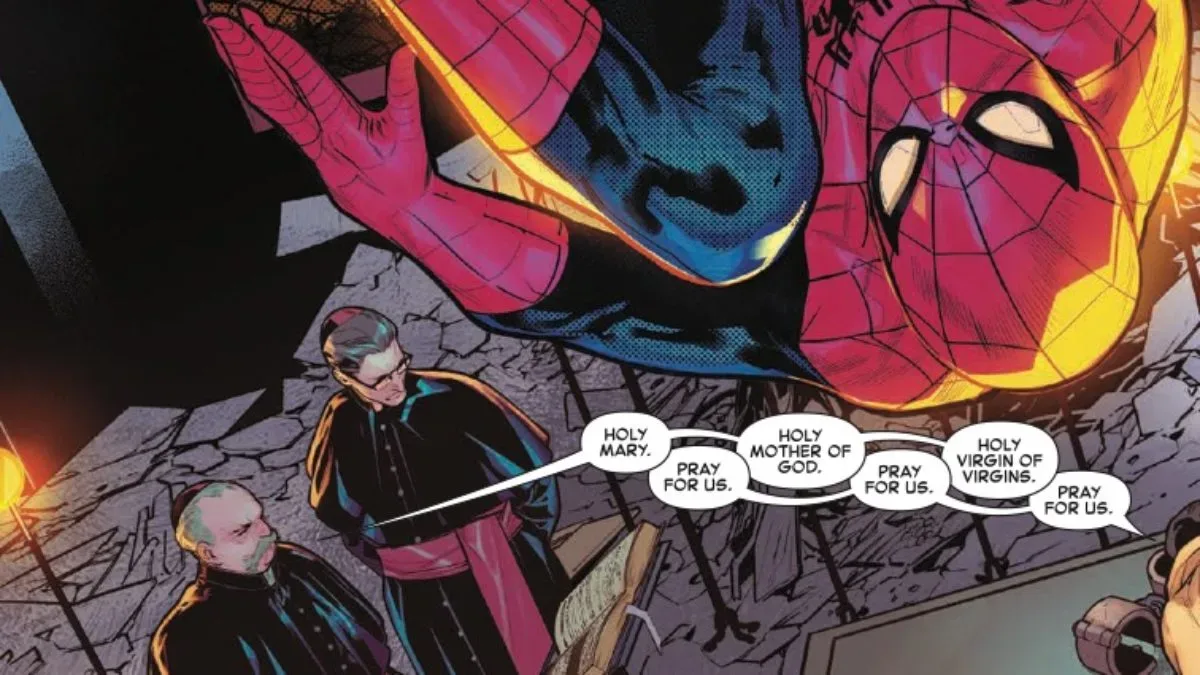
Spider-Man is headed into a mission that the Avengers apparently do not approve of in Infernal Hulk vs. Spider-Man #1, a 32-page Marvel comic scheduled for November 4, 2026. The premise positions Peter Parker between an immediate rescue and a much larger emergency: Infernal Hulk has corrupted the Fantastic Four and taken control of the Baxter Building, New York is under siege, and the Richards children have been taken.
That is already an intimidating amount for a one-shot-style team-up title to carry, but the solicitation adds a second objective. Spider-Man’s unauthorized attempt to reach the children is also meant to obtain a weapon the Avengers need to stop Infernal Hulk. The stakes extend beyond the immediate fight; the issue is presented as a penultimate step toward an “Age of Monsters” and the arrival of Hulk’s Infinite Avengers.
Written by Phillip Kennedy Johnson with art by Javier Pina and a cover by Nic Klein, the comic is positioned within the ongoing Hulk War storyline. Its setup makes the familiar Hulk-versus-Spider-Man billing a little misleading in an interesting way. The stated conflict is not simply a superhero grudge match. Spider-Man appears to be operating inside a citywide disaster, against orders, while trying to save hostages and locate something that could change the wider war.
A rescue mission at the center of a Hulk War chapter
The Baxter Building’s fall is the story’s clearest image of escalation. As the Fantastic Four’s headquarters, it is normally a place associated with the Richards family and their scientific work. Here, the building is described as corrupted and under Infernal Hulk’s control. With the Fantastic Four also said to have fallen, Spider-Man’s route to the Richards children is unlikely to be a straightforward extraction.
The solicitation calls Peter’s plan a “suicide mission,” which should be read as high-stakes promotional language rather than a detailed account of what occurs on the page. Still, it establishes the kind of pressure the issue intends to apply: he is entering territory controlled by a threat powerful enough to overwhelm both the Fantastic Four and New York’s defenders.
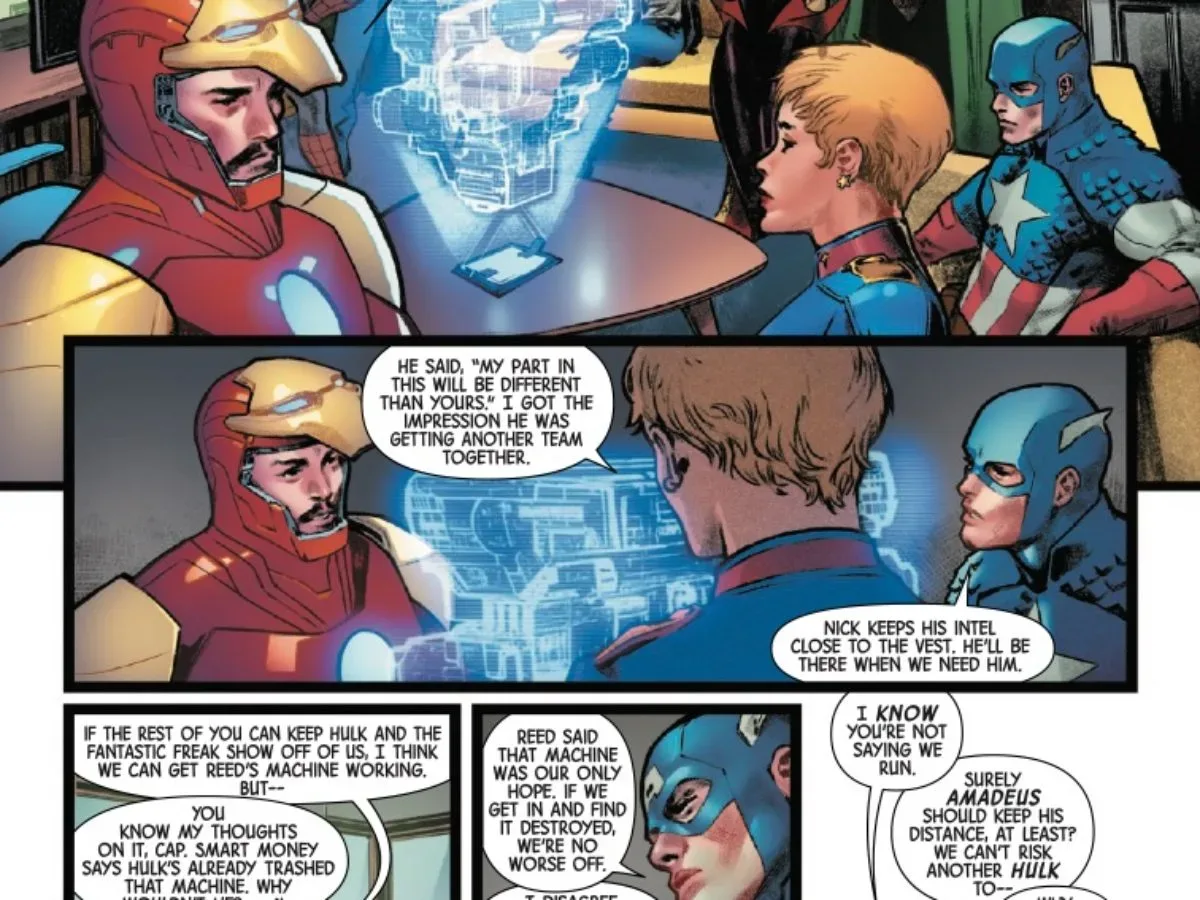
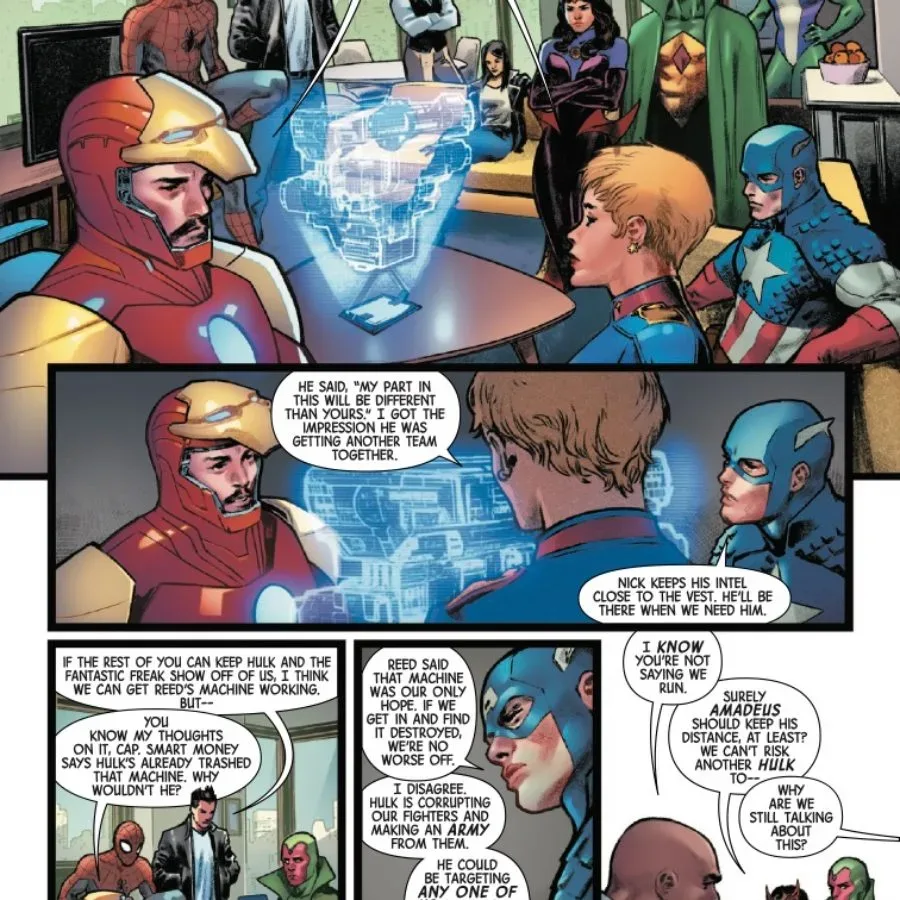
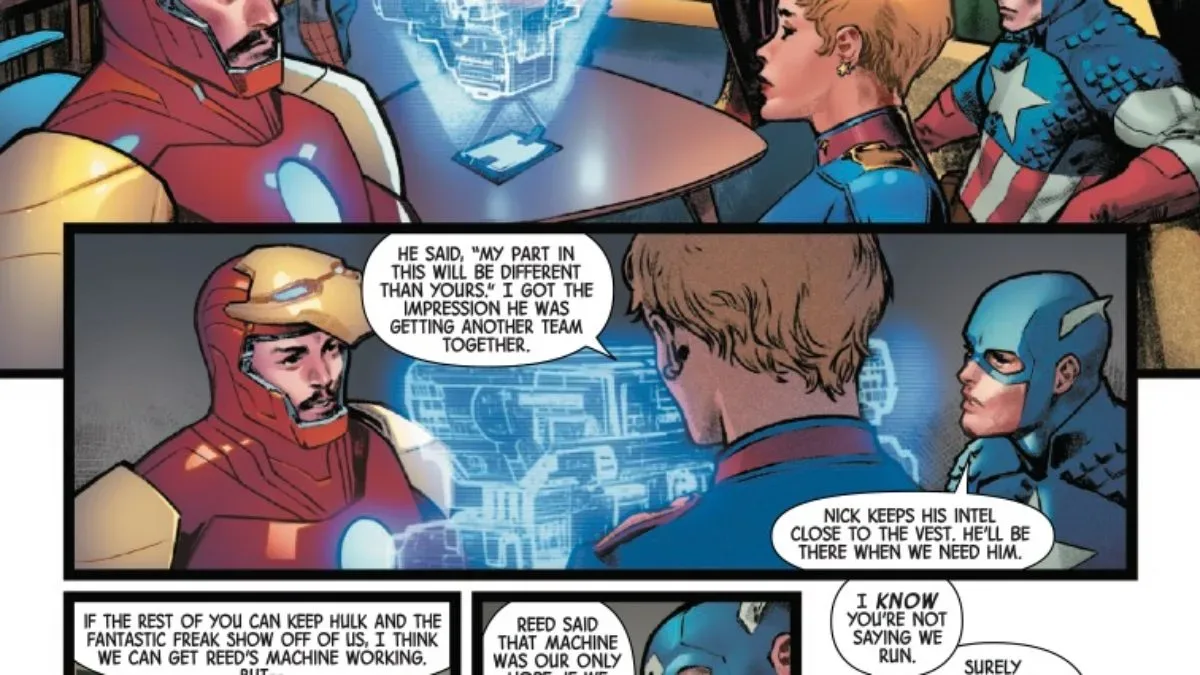
Spider-Man disobeying Avengers orders supplies the story with a potentially meaningful emotional fault line. The evidence available does not explain which Avenger issued those orders, why the team objects, or whether Peter has a workable plan. What it does establish is a clash between coordinated crisis management and the urgency of saving children in immediate danger. That gives the conflict a human-scale focus amid language about city sieges and future monster eras.
It also gives Peter a role that is different from merely being another heavy hitter on the battlefield. Spider-Man’s objective is apparently twofold:
- Reach and rescue the Richards children.
- Retrieve or secure a weapon that may let the Avengers stop Infernal Hulk.
Those goals may complement each other, but they can also create complications. A rescue requires speed and care; acquiring a weapon could demand time, access, or knowledge that the enemy has made difficult to obtain. The issue’s tension should come from how Spider-Man tries to pursue both while moving through a corrupted Baxter Building.
What “penultimate” means for this issue
Penultimate means second-to-last. In this context, the word signals that Infernal Hulk vs. Spider-Man #1 is not being framed as an isolated detour. It is a late-stage chapter in the Hulk War plot, designed to move the event toward its next and presumably final major beat.
That makes the promised weapon particularly important. The solicitation does not name it or explain how it works, so readers should not assume it will offer a complete solution by the issue’s end. Its stated function is to give the Avengers what they need to stop Infernal Hulk’s corruption and prevent the Age of Monsters. In crossover storytelling, that kind of object or piece of information often serves as a turning point rather than an instant victory.
The broader language around “Infinite Avengers” likewise suggests that the threat is not contained to Hulk alone. However, the available details do not define the term or identify who may be involved. It is best understood as an unresolved element of the Hulk War narrative, not a list of confirmed characters or a fully explained faction.
Readers coming to the comic primarily for Spider-Man should therefore expect an issue rooted in a larger continuity. The solicitation provides the essential setup—the Fantastic Four and Baxter Building have fallen, the Richards children are missing, and the Avengers require a way to counter Infernal Hulk—but it leaves the preceding developments off-page. The story’s “#1” designation identifies this specific installment, while the penultimate-event positioning suggests that its consequences are meant to carry forward.
Why the Richards children raise the stakes
The danger facing the Richards children gives the book a direct emotional engine. New York being under siege is a massive premise; children trapped in the hands of an enemy turn that broad catastrophe into an immediate responsibility. Spider-Man’s decision to disregard orders is built around that urgency.
The setup also naturally connects Spider-Man to the Fantastic Four without requiring the solicitation to establish a separate personal rivalry. Peter’s mission is tied to a family in crisis and to the loss of their home base. If Infernal Hulk has corrupted the building itself, then the rescue target and the potential weapon may be intertwined with the same location.
There is a practical story advantage to concentrating so much on the Baxter Building. Rather than spreading the action across every front in a siege of New York, the comic has a defined destination and a clear pair of objectives. Readers know what Spider-Man is going in to do, even if the methods, obstacles and ultimate cost have not been revealed.
There is also room for the Avengers’ role to matter without turning the issue into a conventional team battle. They need the weapon, and Spider-Man’s decision breaks with their orders. That means the team’s tactical concerns and Peter’s rescue imperative can pull in different directions while still aiming at the same ultimate goal: ending Infernal Hulk’s rampage.
Creative team and release details
Infernal Hulk vs. Spider-Man #1 is credited to writer Phillip Kennedy Johnson and artist Javier Pina. Nic Klein provides the main cover. The comic is rated T+, has a listed U.S. price of $4.99, and is scheduled to be available on Wednesday, November 4, 2026.
Four additional covers are listed: a Clayton Crain 1:25 variant, a Skottie Young variant, a Peach Momoko Momo-Tone variant, and a Paco Medina variant. The listed U.S. price for each is $4.99, while the solicitation lists $6.25 in Canada.
The 1:25 designation is a retailer-incentive ratio, meaning retailers generally order a specified quantity of the standard edition to qualify to purchase one copy of that variant. It does not describe a story difference, and the supplied information does not indicate that any of the variants contain exclusive interior material. Cover preference, retailer allocation and local availability may therefore differ from shop to shop.
For Marvel readers tracking the Fantastic Four’s place in current events, the group’s reported fall gives this issue extra context. Another recent setup involving the team can be found in Iron Man #11’s Fantastic Four intervention setup, though Infernal Hulk vs. Spider-Man #1 has its own stated crisis and objectives.
What has—and has not—been revealed
The solicitation provides a strong outline but intentionally withholds the mechanics. It confirms Infernal Hulk’s corruption has reached the Fantastic Four and Baxter Building, the Richards children have been taken, Spider-Man will act against Avengers orders, and a weapon sought by the Avengers is central to the mission.
It does not confirm the exact nature of Infernal Hulk’s corruption, the children’s condition, the identity or capabilities of the weapon, the reason the Avengers oppose Spider-Man’s plan, or the outcome of the rescue. It also does not say whether Spider-Man will fight Infernal Hulk directly. Those gaps are not contradictions; they are the core mysteries the issue is selling.
For readers following Hulk War, the appeal is clear: this chapter promises to turn an enormous event premise into a focused infiltration-and-rescue scenario, with Spider-Man carrying the responsibility. For Spider-Man and Fantastic Four fans, it places Peter in a dangerous situation tied to the Richards family and their compromised headquarters. And for those waiting to see where the event is headed, the “penultimate” label makes the mission’s promised weapon the detail worth watching most closely.