Spoilers for Gangs of Gotham #1 follow.
Gotham’s newest conflict is not framed as another ordinary clash between Batman and one costumed adversary. Gangs of Gotham #1, from Christopher Cantwell and Mike Henderson, turns its attention to the city’s lower-level criminal factions in the aftermath of Batman: Bad Seeds. At the center is Lonnie Machin, better known as Anarky, who is forced into an extraordinarily difficult job: bring together 100 street gangs outside a larger power structure, or die trying.
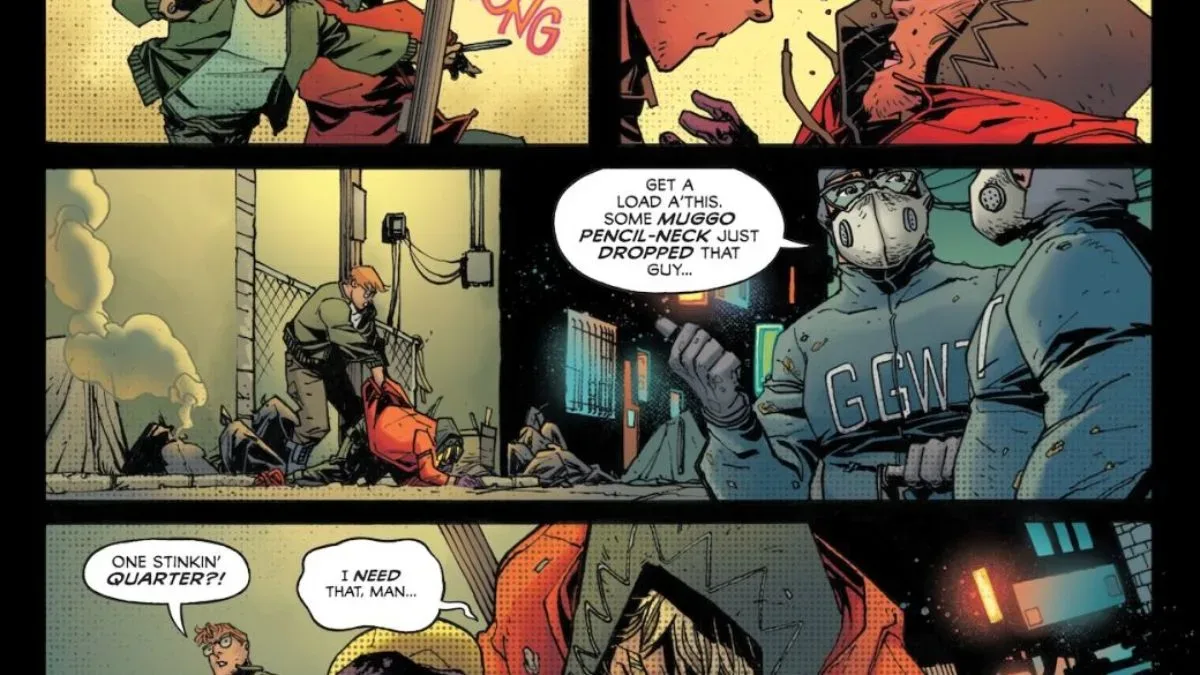
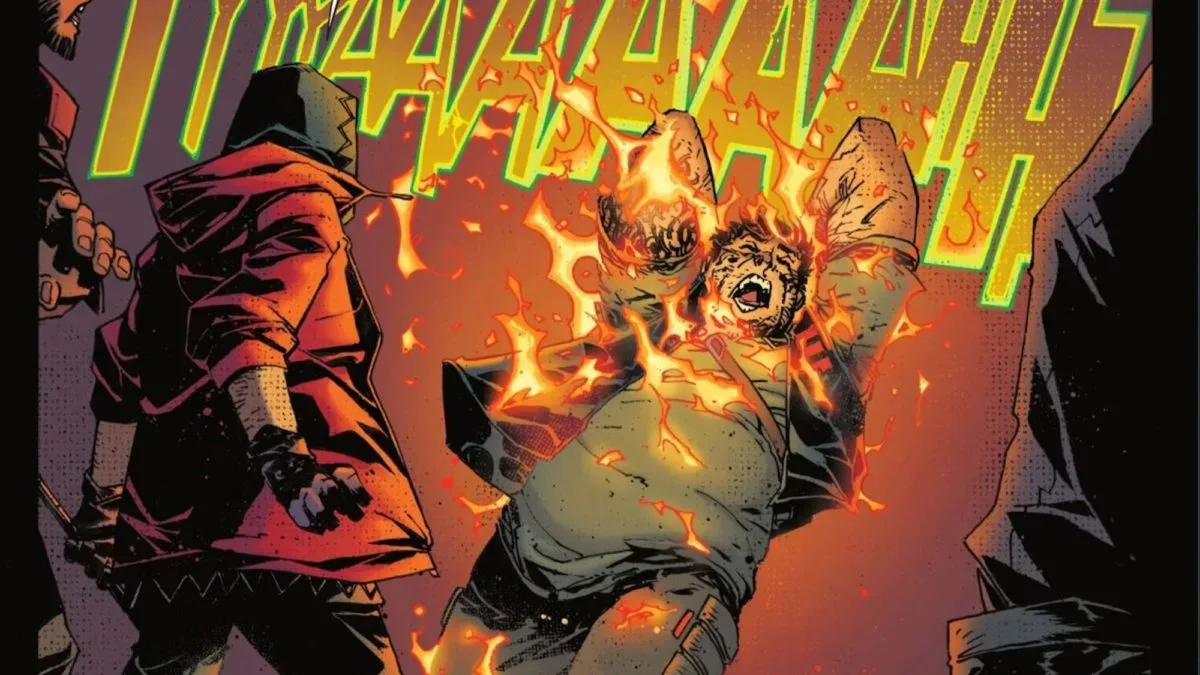
That premise gives the new series a clearly defined street-level focus. Rather than treating Gotham crime as a single organized machine, the issue’s setup emphasizes an unruly collection of crews, competing interests and local power struggles. Anarky’s opening task takes him to Gotham’s East End, described as a particularly unstable area populated by some of the city’s hardest-to-control figures.
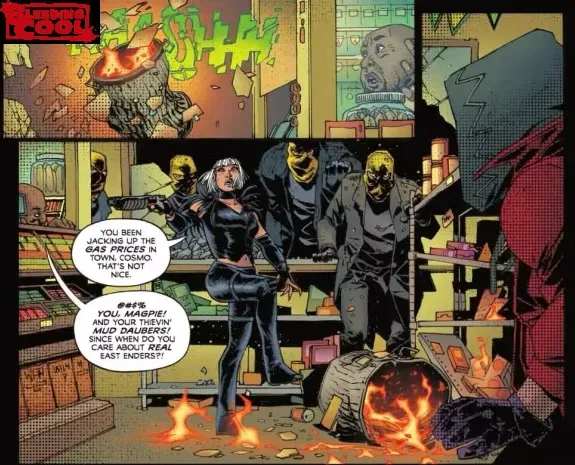
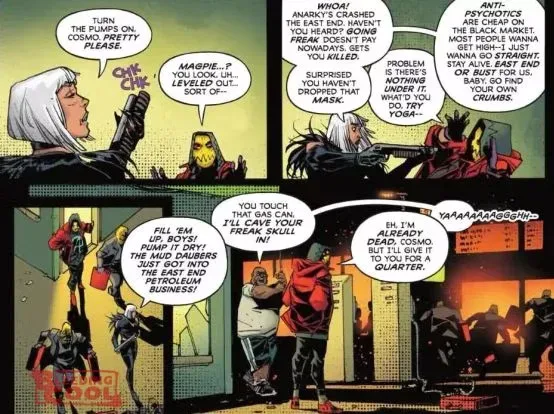
The issue also returns Magpie to Gotham. Her anger over gasoline prices informs a new criminal push, adding a deliberately everyday spark to an otherwise heightened superhero setting. Alongside that, Anarky is pressured toward the orbit of a biker-gang crew, making the first issue feel less like a recruitment drive and more like a survival test.
Anarky’s mission is bigger than a turf dispute
The solicitation establishes the core ultimatum: Anarky must unify 100 low-level gangs that are not already controlled by the Torus. Success earns Lonnie a place at the table; failure means “lights out” for him. That is a useful distinction from simply defeating a rival gang. He is being tasked with coalition-building among groups defined by their independence.
In crime-fiction terms, a power vacuum is what emerges when an existing authority falls away or cannot enforce its control. The setup for Gangs of Gotham appears interested in the opposite problem as well: what happens when a would-be authority tries to consolidate people who have remained outside its system. A hundred gangs is an intentionally unwieldy number. It suggests the assignment cannot be solved merely by winning one fight in the East End.
Anarky is an apt figure for that kind of pressure. The character’s name and visual identity carry a strong association with disorder and anti-authority ideas, while the ultimatum makes him an instrument of a hierarchy. The tension is immediate: Lonnie is asked to organize the unorganized on someone else’s terms. Whether he sees that as an opportunity, a trap, or both is the dramatic question built into the series’ first move.
There is a naming wrinkle worth keeping clear. The series description identifies the powerful faction as the Torus, while the issue discussion refers to Anarky acting at the behest of the Minotaur. The supplied material does not establish whether those names refer to the same force, an individual within it, or separate elements of the gang conflict. Readers should not assume a relationship beyond Anarky facing pressure from a larger criminal power.
A deliberately strange opening image for Lonnie Machin
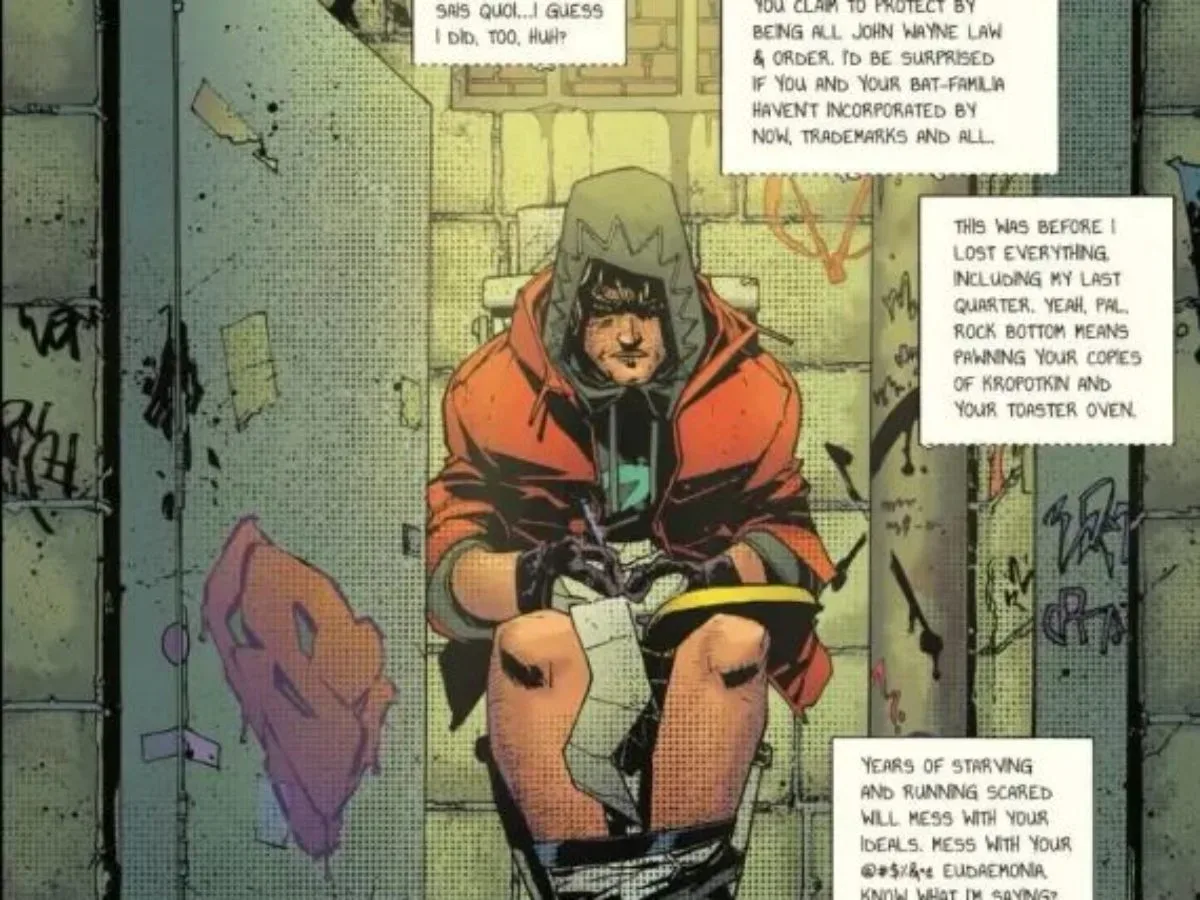
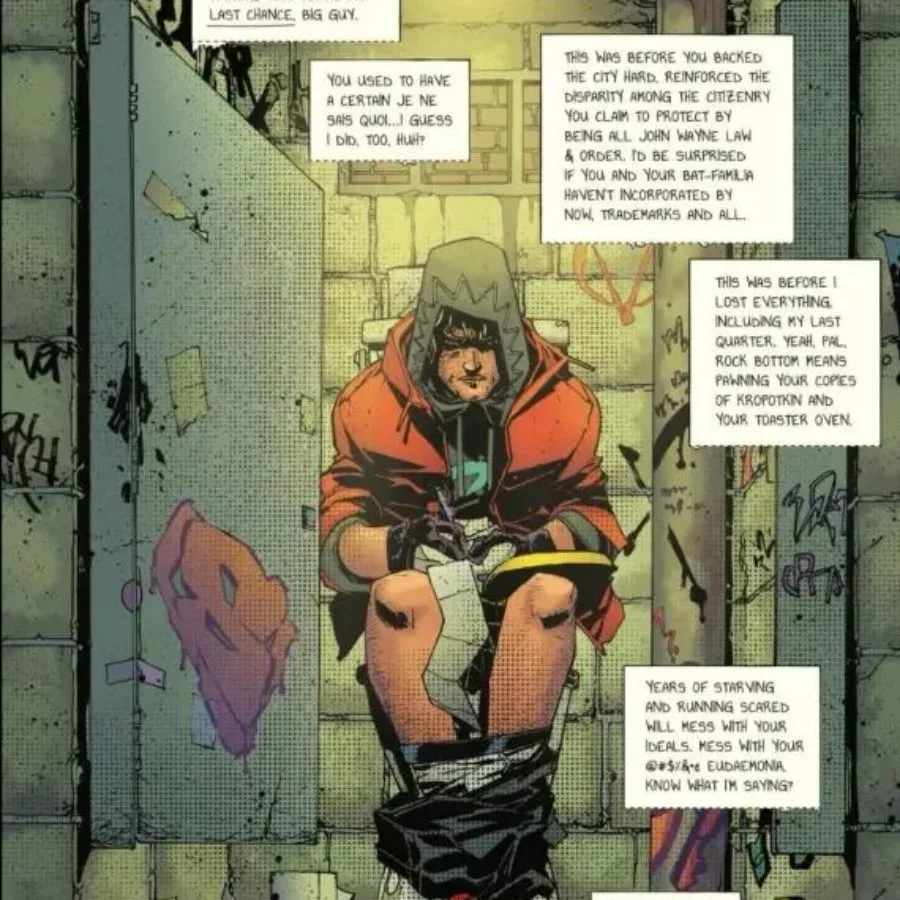
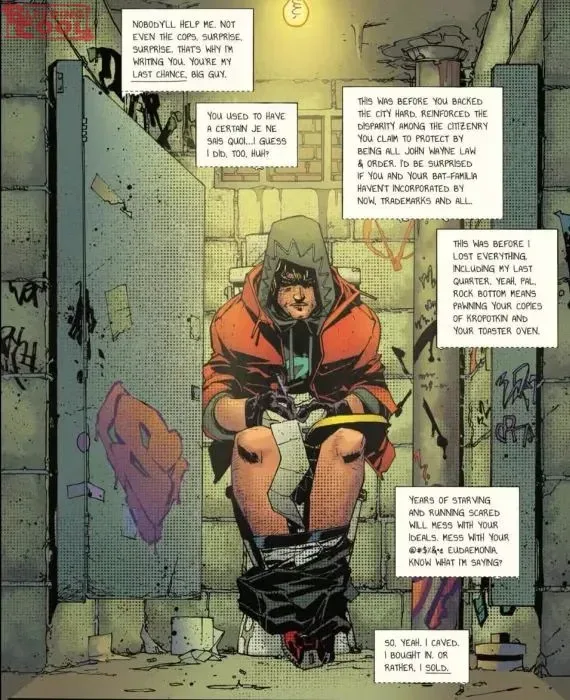
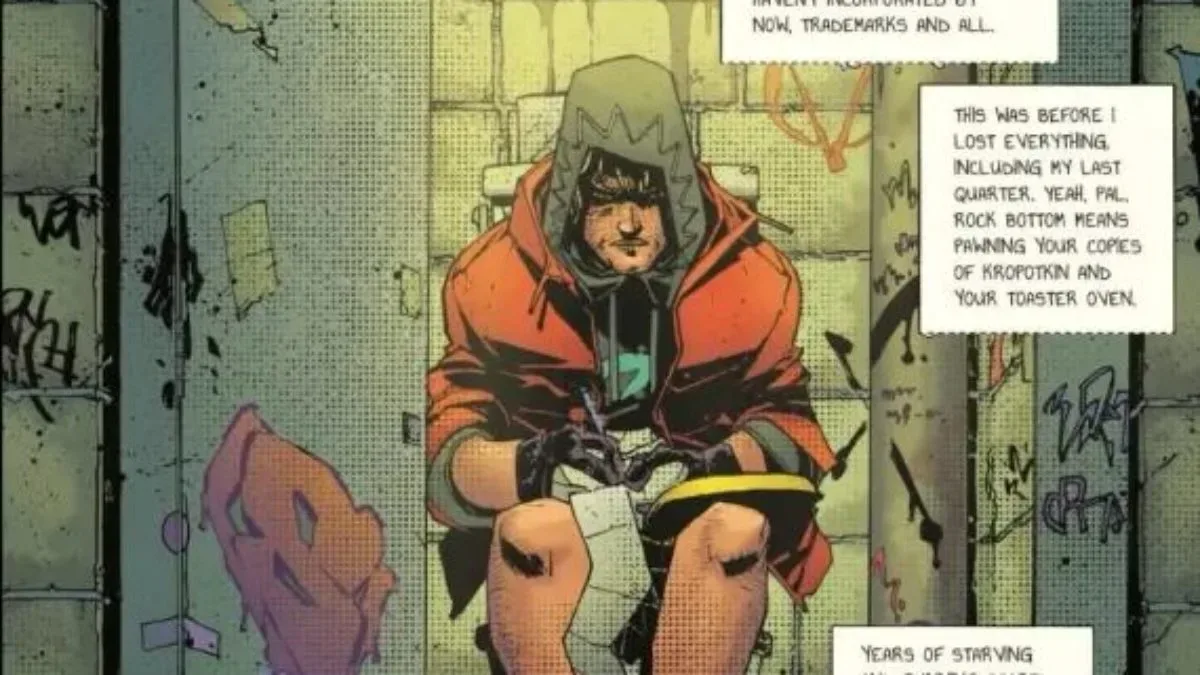
Gangs of Gotham #1 introduces Anarky with an intentionally undignified image: he is shown seated on a toilet. It is a small but revealing choice for a book otherwise selling high-stakes gang politics and street action. Comic-book characters often enter a scene through controlled, iconic poses. This entrance instead cuts through the pageantry and presents Lonnie in a private, awkward moment.
That contrast may be the point. Anarky is still the figure who must confront an enormous criminal mandate, but he is not introduced as an untouchable crime lord. The issue places absurdity next to menace before moving him toward Gotham’s biker-gang world. The resulting tone appears to allow room for the bizarre without abandoning the danger of the premise.
That balance matters for a Gotham book focused on gangs rather than one singular supervillain scheme. Street-level stories can become grimly uniform when every scene has the same threat level and visual register. A joltingly comic image can establish that a series has a personality of its own—particularly when its protagonist is someone forced to navigate a city full of people who are likely to question, exploit or kill him.
Magpie’s long, complicated DC history
Magpie’s return brings a very different kind of Gotham criminal into the story. Created by John Byrne for The Man of Steel in 1986, she began as a jewel thief with a precise signature: she targeted jewels named for birds and left booby-trapped replicas behind. Her early place in DC history is notable because she was the first villain defeated by Superman and Batman working together.
Her subsequent continuity has been anything but straightforward. Magpie was murdered by Tally Man, later returned as a Black Lantern, and was rebooted in the New 52 era. That version was associated with the Secret Society of Super Villains and later the Suicide Squad. Such shifts are common in long-running shared-universe superhero comics, where characters can be altered by deaths, revivals, relaunches and changes in the broader fictional timeline.
For this story, the key point is not to untangle every past incarnation. Magpie arrives in Gotham with an immediate motivation tied to gasoline costs and an intention to commit crimes. It anchors a fantastical thief in a recognizable economic irritation, then lets the book turn that irritation into chaos. The issue’s treatment is plainly heightened rather than a report on real-world policy; gasoline prices become a character-level provocation and a trigger for unrest inside a fictional city.
There is an important difference between that device and a claim that the comic is offering a direct allegory for any one current event. The material connects Magpie’s actions with contemporary anxieties and suggests an echo of the current American political environment, but it does not provide a definitive statement from the creative team about a specific real-world target. The safest reading is that Gangs of Gotham uses a topical frustration to give its criminal plot extra volatility.
Why the aftermath of Bad Seeds matters
The book is explicitly positioned as spinning out of Batman: Bad Seeds and Batman. “Spinning out” generally means a new series takes consequences, characters or conflicts from an existing storyline and develops them into a separate narrative. Here, Gotham is described as cleaning up after Bad Seeds, which gives the gang war a post-crisis context rather than presenting it as an isolated crime wave.
That approach can make Gotham itself the connective tissue. Readers do not need a promise that every familiar Batman figure will appear for the premise to feel attached to the wider line: the city’s instability is the inheritance. The immediate stakes are concentrated around Anarky, the Torus and the East End, while Magpie supplies another destabilizing force with her own agenda.
For readers tracking comic releases around November 4, 2026, this day’s wider release roundup offers a separate look at what is arriving in games. In comics, Gangs of Gotham #1 is a $3.99 launch issue, dated November 4, 2026.
What the first issue establishes
- Lead character: Lonnie Machin/Anarky is the focal point of the series’ first conflict.
- The assignment: He must unite 100 unaffiliated low-level Gotham gangs or face death.
- The first destination: Gotham’s East End, portrayed as a volatile free-for-all.
- Returning player: Magpie is back in Gotham, with a crime spree tied to anger over gasoline prices.
- Creative team: Christopher Cantwell writes and Mike Henderson provides the art.
- Continuity position: The story follows the events of Batman: Bad Seeds and connects to Batman.
The strongest hook is the contradiction embedded in Anarky’s job. He is compelled to construct order among disparate gangs, but the mission itself comes from coercion. That makes every possible victory unstable: a unified alliance could secure his survival, yet it could also deepen the control of the people who issued the ultimatum. With Magpie’s return adding another unpredictable variable, Gangs of Gotham #1 starts its saga by making Gotham’s criminal ecosystem the main battlefield.