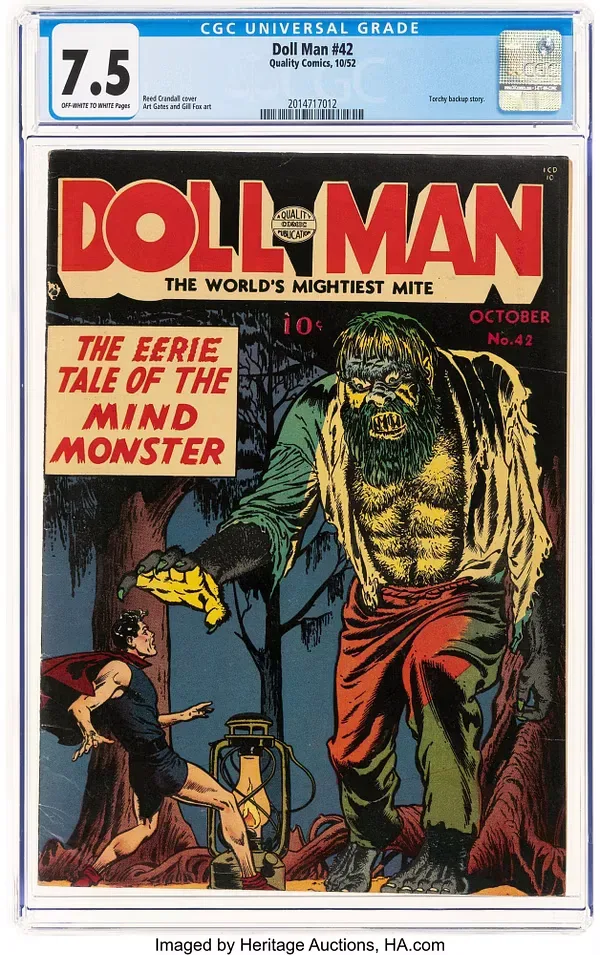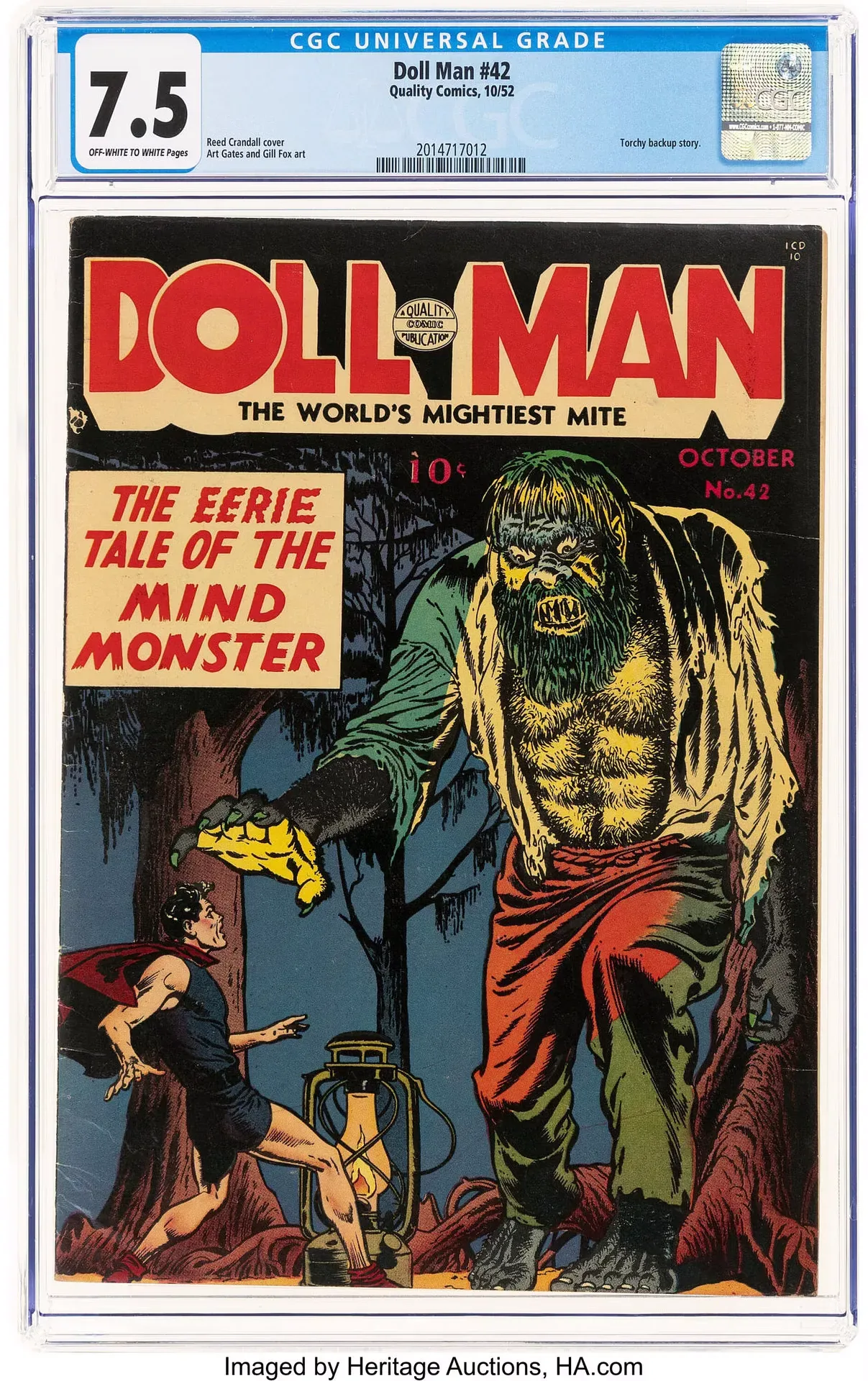
A 1952 issue of Doll Man is preparing to make an unusual case for itself at auction: not merely as a high-grade Golden Age comic, but as a compact piece of pop-culture feedback. Doll Man #42, published by Quality Comics, contains “The Mind-Monster!,” a story about a fictional villain who becomes real after mass attention turns him from a writer’s invention into a public obsession.
That premise begins with Sherlock Holmes, moves through newspapers and television, and ends at a typewriter with more authority than anyone should sensibly give a typewriter. It also bears a notable resemblance to an earlier Captain America story in which a writer’s radio character takes physical form. For readers interested in how comic-book ideas travel—between literary fandom, mass media, and superhero storytelling—the issue has considerably more going on than its title character’s tiny stature might suggest.
A fictional address becomes the doorway to danger
“The Mind-Monster!” opens in London, where two American tourists ask a policeman for directions to Sherlock Holmes’s residence. They incorrectly give the address as “22 Baker Street,” but their error is less important than the belief behind it: they assume Holmes has, or had, an actual home to visit.
Novelist Hubert Perrin sees opportunity in that conviction. If the public can treat Arthur Conan Doyle’s detective as though he were real, Perrin reasons, perhaps readers can be encouraged to do the same with his own creation, the villain Kain. He selects a vacant house at 313 Bleak Street as Kain’s supposed home and builds the character’s public identity around it.
The gambit works. Kain becomes popular enough that a crowd gathers outside the property, accompanied by a television crew expecting the imaginary villain to appear. Then the story makes its decisive genre turn: Kain materializes. Rather than simply creating an effective publicity stunt, Perrin has seemingly supplied a location, a narrative, and a huge audience with enough concentrated attention to bring his monster into the world.
Doll Man’s explanation is appropriately comic-book directness: the television viewers’ focused brain waves may have made Kain real. It is an idea sitting at the intersection of horror and media anxiety. A figure created for entertainment escapes the frame, while the apparatus designed to show him to viewers becomes one of his first targets. Kain smashes the television equipment under instructions from Perrin’s typewriter, making the writer’s creative tool both the origin point and the immediate instrument of destruction.
Why Sherlock Holmes matters to the issue
The Holmes reference was more than a random shorthand for a beloved fictional character. During the 1951 Festival of Britain, an exhibit at Abbey House on Baker Street reconstructed Holmes and Dr. Watson’s sitting room. A local public libraries committee produced an exhibition catalogue for it. By May 1952, plans were being made for the display to appear in New York City, including an actor portraying Holmes.
This context makes the opening of Doll Man #42 especially pointed. The story uses a real-world phenomenon—the public’s readiness to visit, visualize, and materially reconstruct the world of Sherlock Holmes—to fuel an impossible escalation. Perrin does not merely write Kain. He gives him an address, lets the public and press reinforce the illusion, and watches imagined identity harden into physical reality.
In that sense, the story is about collective belief, meaning the shared attention of a crowd rather than the conviction of one individual. The readers, spectators, tourists, reporters, and television audience each play a role in treating fiction as something that should have a place in the real world. Kain’s arrival is the horror-comic version of that process taken literally.
It is also a remarkably early example of a concern that remains familiar in modern pop culture: what happens when an invented character becomes larger than the creator’s ability to manage it? The comic’s answer is not subtle. The author begins testing what his now-real villain can do, chaos follows, and Doll Man has to confront the repercussions. But the central idea is sharp. Attention gives a character power, and publicity can turn into a liability when the subject of the publicity starts acting for itself.
A strong parallel with Captain America Comics #52
The route from Holmes to Kain was not without precedent in comics. Captain America Comics #52, cover-dated January 1946, featured “The Case of the Telepathic Typewriter!” In it, a radio writer creates a character called Am, described as becoming “as real as Sherlock Holmes” to the program’s listeners.
That story gives the idea a distinctly science-fiction-horror mechanism. During a broadcast, millions of listeners focus on Am and he emerges from behind the studio curtains as a real being. The writer then discovers that his typewriter can command the creature because it was the machine used to create Am’s scripts.
Captain America cannot defeat Am through ordinary physical force. The solution comes when a reporter types “AM DIES!” on the typewriter, ending the threat at the point where it began: language placed on the page.
Doll Man #42 follows a closely comparable track. Its author creates a popular fictional menace; widespread media attention helps make the menace tangible; a typewriter continues to exert control; and the outcome echoes the earlier Captain America tale. The available evidence supports a reading of the 1946 story as an apparent influence, rather than proving a formally documented line of inspiration. Still, the overlap is difficult to miss: both tales turn authorship into a dangerous practical power and make mass audiences an active ingredient in a monster’s creation.
The connection also places the Quality issue in a wider superhero-comics conversation. Captain America’s earlier encounter frames a familiar hero against an enemy produced by broadcasting and collective imagination. Doll Man adapts that kind of threat for its own hero, whose abilities are themselves associated with willpower. That makes Doll Man’s theory about focused mental energy more than a convenient explanation; it fits the conceptual territory of the series.
For readers following Captain America material beyond this historical issue, the character’s current footprint remains much broader; Joking Joystick has also covered Marvel-related video-game sales news. Here, though, the interest is firmly in a 1946 story’s possible afterlife inside a very different 1952 comic.
The creators and the cover
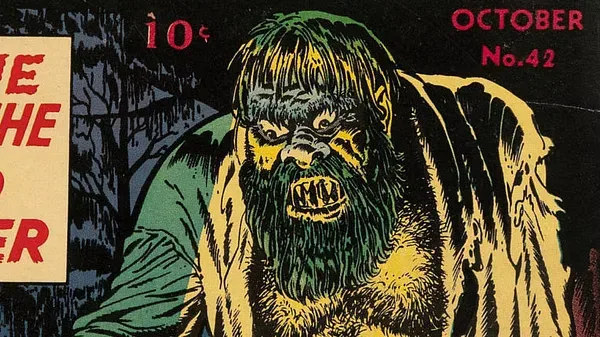
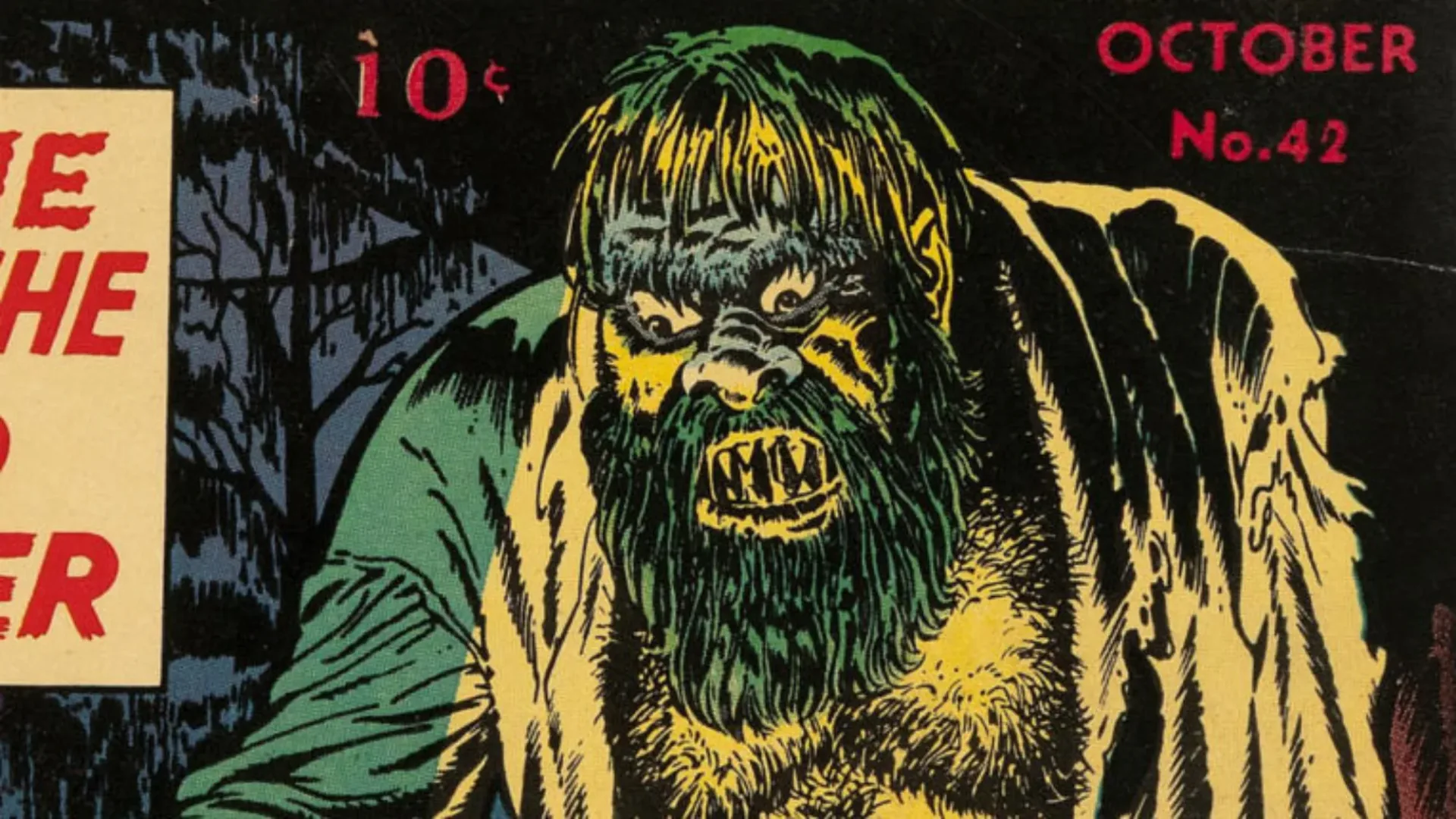
Credits listed by the Grand Comics Database attribute the interior art of “The Mind-Monster!” to Art Gates and the script to Bill Woolfolk. The cover is credited to Reed Crandall. Crandall’s image places the Mind-Monster near the rural home Perrin purchases for Kain, giving the issue’s key threat a prominent visual role before the reader reaches the story itself.
The issue is also being presented as a Pre-Code horror collectible. That label refers to American comics published before the Comics Code’s restrictions reshaped much of the industry’s content. In practical terms, it helps describe why a superhero title can host such an odd fusion of fantastical menace, psychological speculation, and a monster unleashed by its creator. “The Mind-Monster!” is not simply a standard costumed-hero battle: its danger comes from authorship, celebrity, audience participation, and a villain who exists because people have invested enough belief in him.
What the CGC 7.5 grade communicates
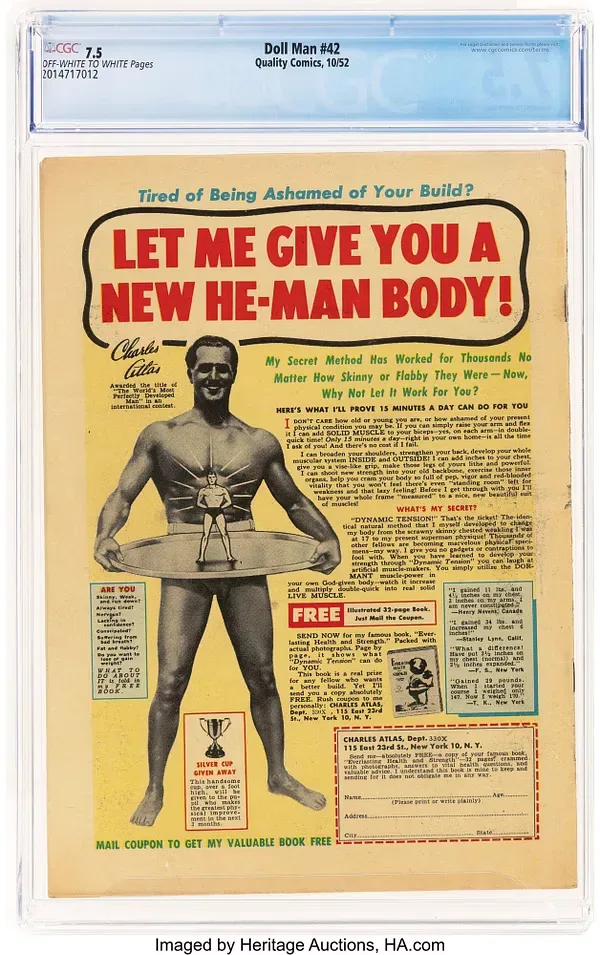
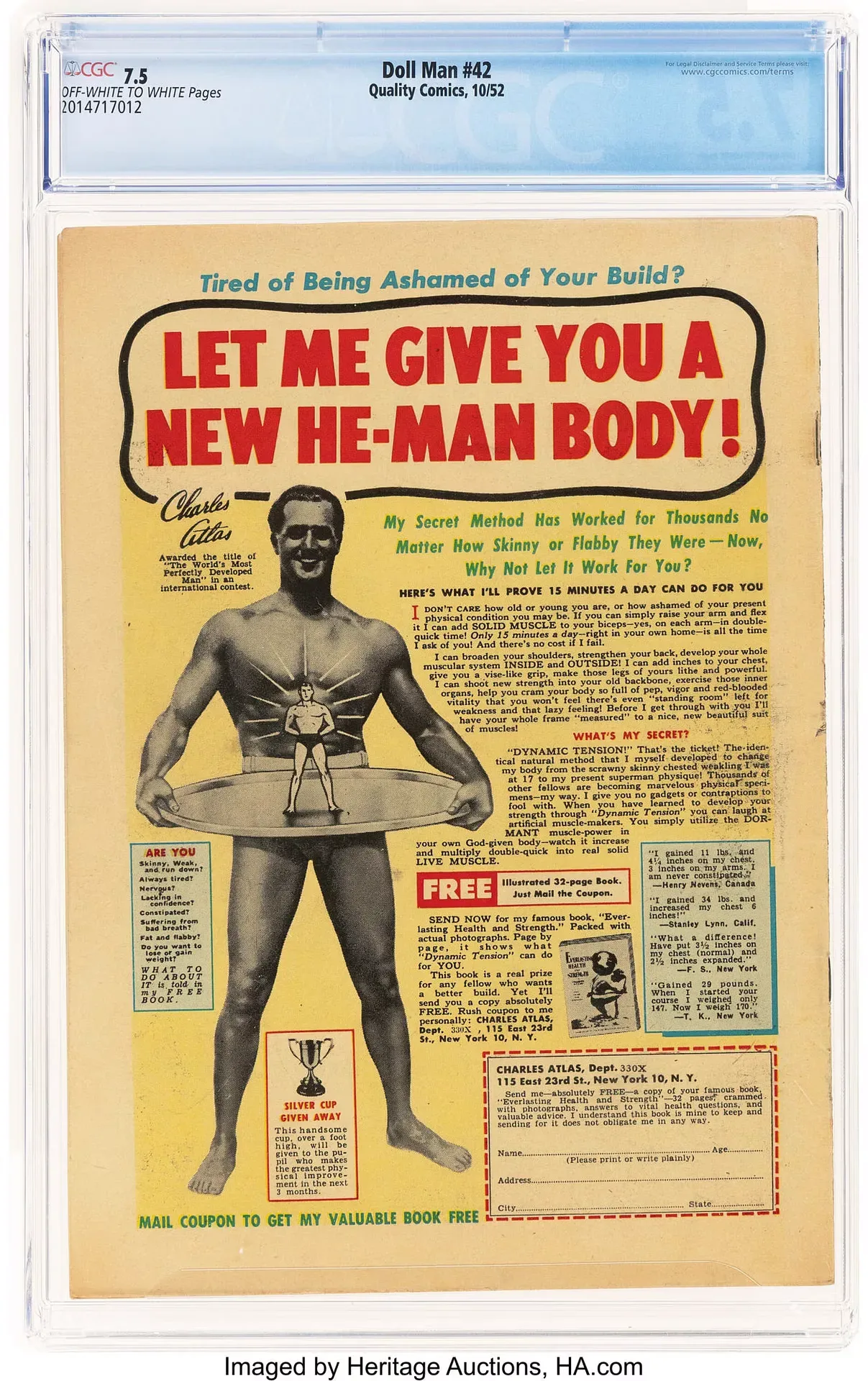
The copy offered is graded CGC VF- 7.5 with off-white to white pages. CGC is a third-party grading service that assigns a numerical assessment to a comic’s condition and encapsulates the book. “VF-” is the accompanying descriptive grade for 7.5, while the page-quality notation addresses the paper’s color and preservation rather than the comic’s overall numerical grade.
Only three copies are recorded at grades higher than this 7.5. That does not establish a value by itself—auction results depend on bidding, demand, provenance where applicable, presentation, and the broader market—but it is meaningful context for a collector assessing condition relative to other graded examples. The book’s appeal is therefore layered: a comparatively high-graded copy, a Crandall cover, and an interior story with clear thematic links to Holmes fandom and an earlier Captain America plot.
The Doll Man #42 CGC VF- 7.5 is listed in the Golden Age Century Comics Showcase Auction VI #40378 on November 5, 2026. For prospective bidders, the practical takeaway is to distinguish the attributes being highlighted: the 7.5 grade and page quality describe this individual copy’s assessed physical state, while the story’s unusual premise and credited creators explain its historical and artistic interest. Neither point needs the other to matter, but together they make this a notably curious entry from Quality Comics’ 1952 catalogue.
A monster powered by publicity
The enduring charm of “The Mind-Monster!” is how neatly it converts a real cultural observation into pulp peril. Sherlock Holmes inspired people to search for a fictional home. A reconstruction of Holmes and Watson’s rooms gave that imagined setting physical form for exhibition visitors. Comic-book writers then pushed the principle a step further: if audiences believe in a character strongly enough, perhaps the character can demand a place in reality.
In Doll Man #42, that question has a darkly playful answer. Give the villain an address. Put cameras at the door. Invite the whole country to watch. Then hope the typewriter is still on your side.