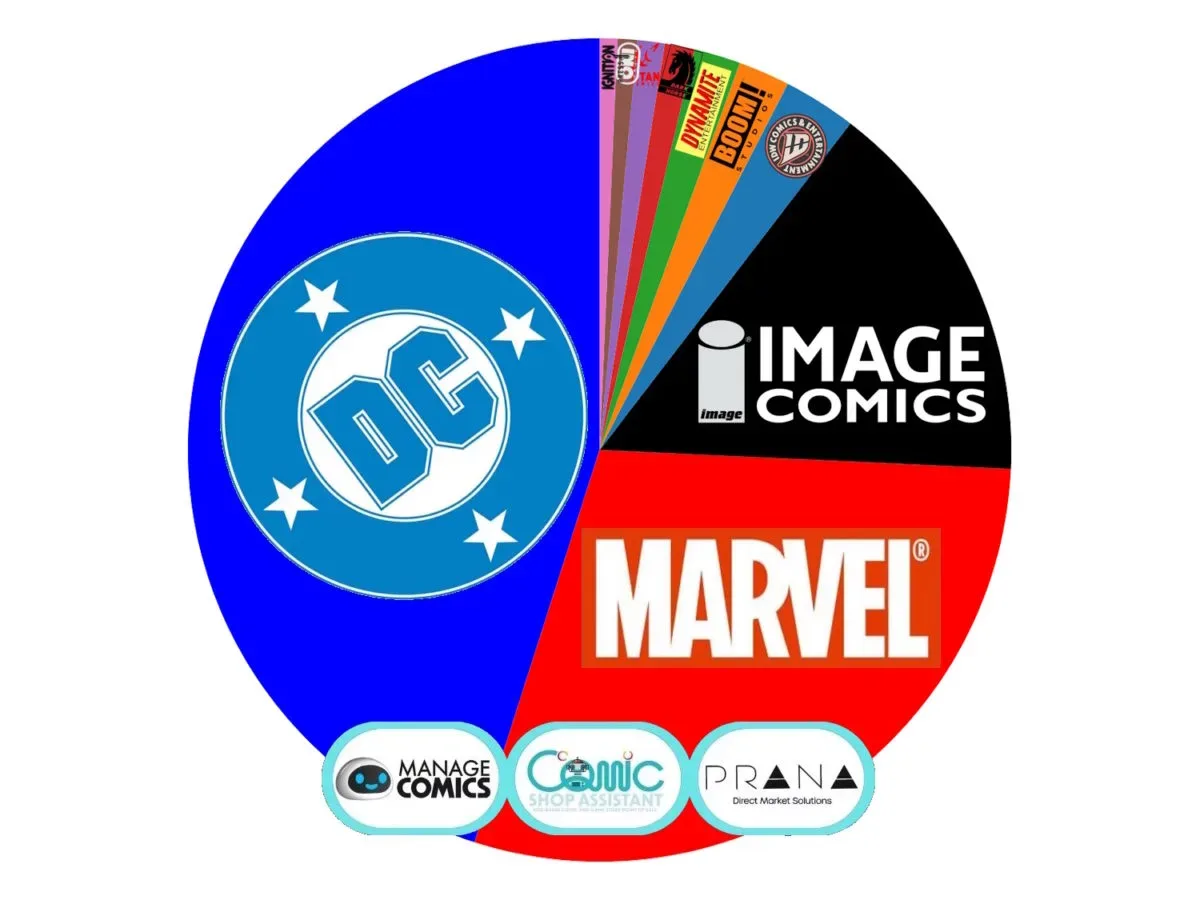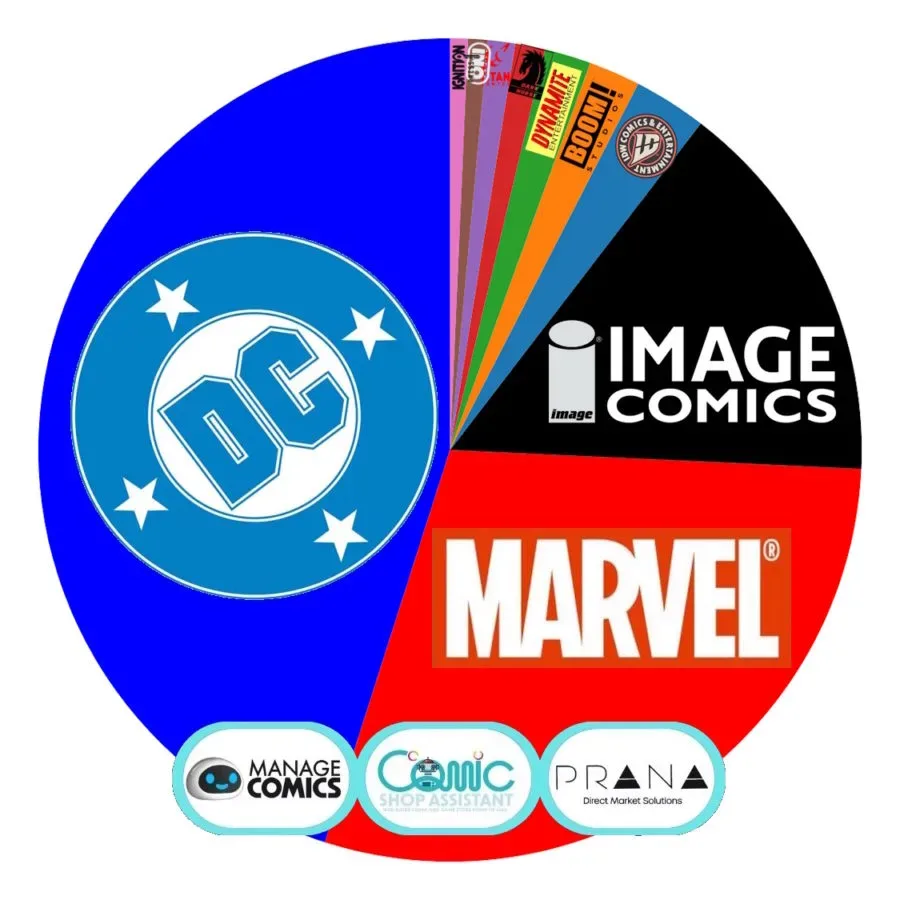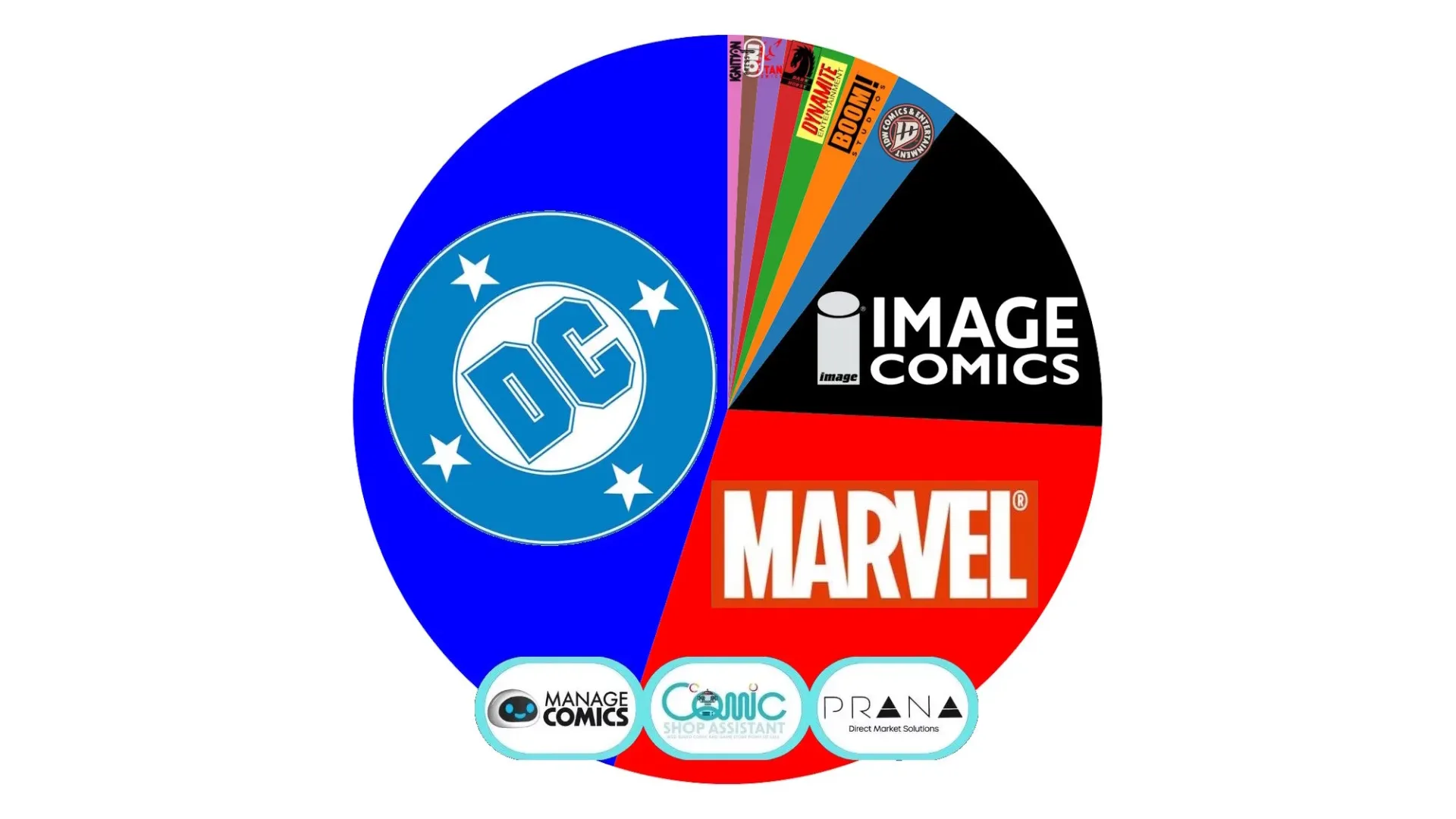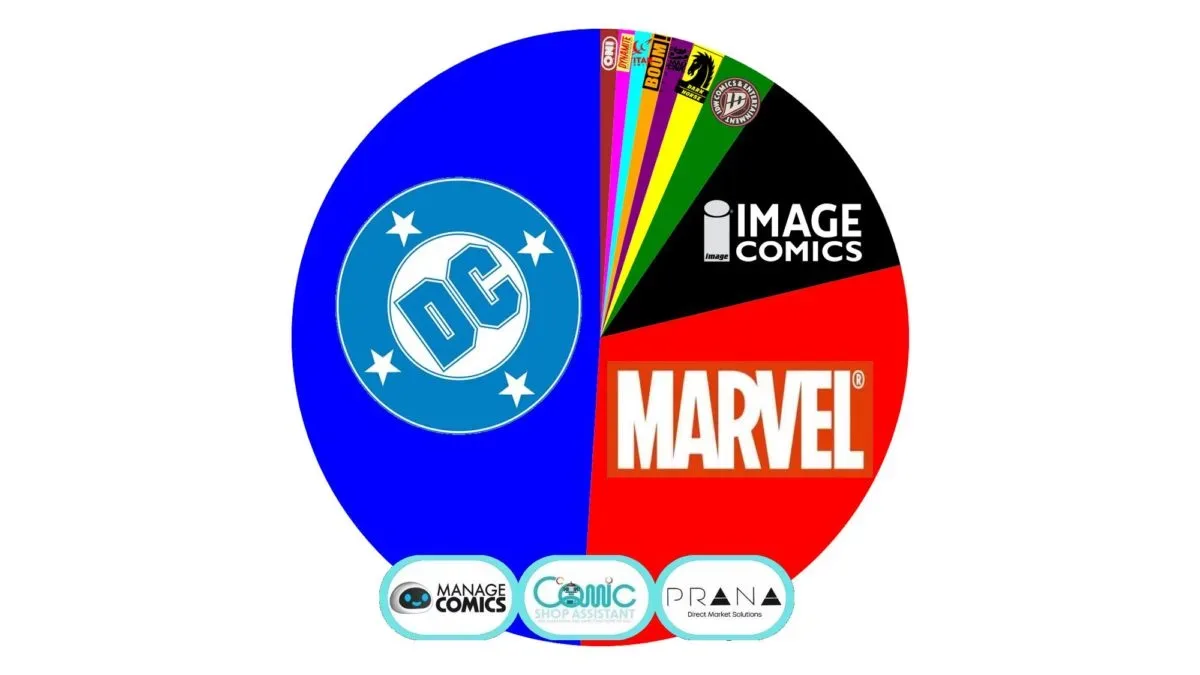
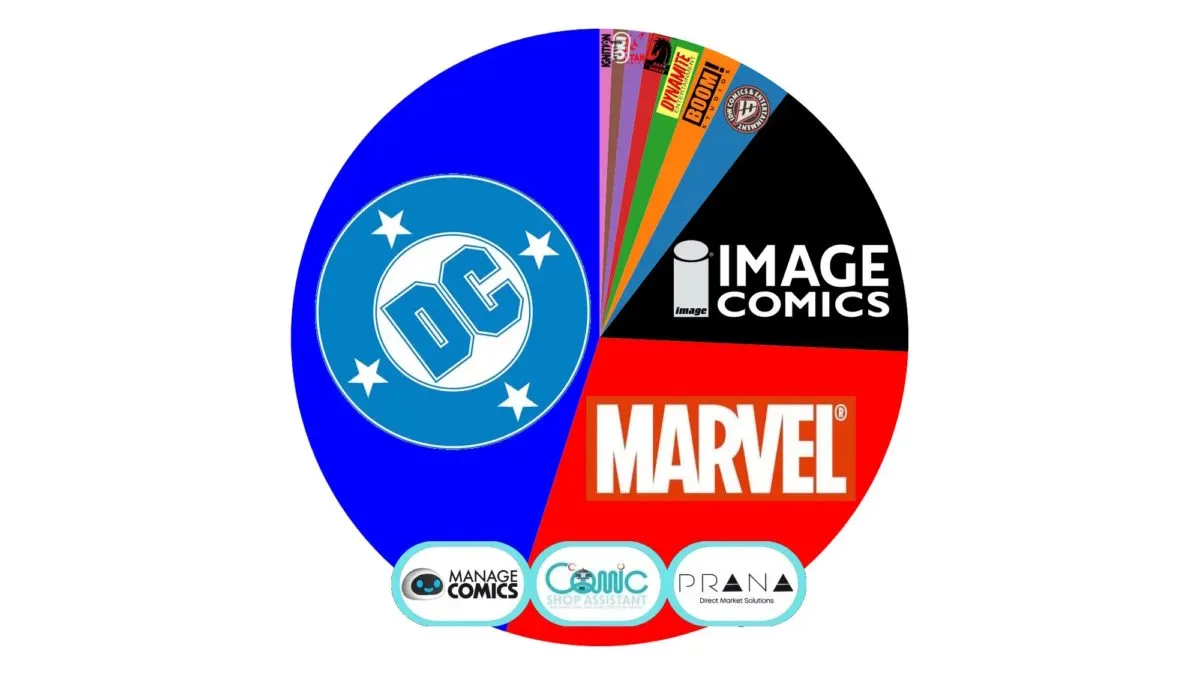
DC had an enormous September in the comic-shop market measured here, taking 44.35% of sales in a point-of-sale sample spanning more than 600 stores. Marvel followed at 28.70%, while Image held third at 15.06%. The headline result is just as clear on the individual-title chart: Absolute Batman #24 was the month’s leading book, and DC placed nine titles in the top ten.
This is a powerful monthly snapshot, but it is important to read it as exactly that: a snapshot of sales recorded by participating specialty stores, not a complete accounting of every comic sale everywhere. The dataset covers more than 600 shops using two retail systems, drawn from an estimated direct-market universe of roughly 1,800 to 2,000 ordering stores. That is a meaningful sample, and it offers a useful view of what moved through participating comic shops, while still leaving room for results elsewhere in the market to differ.
The September publisher split
DC’s 44.35% share placed it well ahead of Marvel’s 28.70%, a gap of 15.65 percentage points. Image’s 15.06% result gave it a substantial third-place position, although it remained 13.64 points behind Marvel and 29.29 points behind DC.
- DC: 44.35%
- Marvel: 28.70%
- Image: 15.06%
- IDW: 2.82%
- BOOM! Entertainment: 1.99%
- Dynamite: 1.79%
- Dark Horse: 1.16%
- Titan Comics: 1.05%
- Oni Press: 0.76%
- Ignition Press: 0.68%
Market share describes the portion of the sales measured by the reporting stores that belongs to each publisher. It is not the same thing as declaring every individual DC comic outsold every competitor. A publisher can build a large monthly share through a combination of blockbuster releases, ongoing series, relaunches, specials, back-catalogue-style entries, and a broad overall slate. September’s top 400 demonstrates precisely that kind of range: DC had a commanding group of headline books while also appearing throughout the list with Batman, Superman, Wonder Woman, Green Lantern, Flash, Harley Quinn, Nightwing and more.
Marvel’s second-place finish likewise includes a wide mix of books, from Daredevil and Avengers Armageddon to Spider-Man, Wolverine, Fantastic Four, Captain America and several X-Men-related releases. Image’s third-place showing was supported by an equally varied catalogue containing Spawn titles, Transformers, G.I. Joe, Void Rivals, Rook: Exodus, Universal Monsters: Blood of the Wolf Man and newer series such as Terminal and Last Driver.
Absolute Batman #24 sets the pace
Absolute Batman #24 ranked first among the top 400 sellers and serves as the chart’s 100.00% reference point. Batman #13 followed with an indexed 78.43%, while DNX #1 from Marvel was listed at 71.69%. Absolute Cassandra Cain: The Shadows Hand #1 was close behind at 70.17%.
The listed percentages should be understood as a relative index within this ranking, with the leading title set to 100, rather than a disclosed number of copies sold. The data provides comparative scale, not unit totals. That distinction matters: it tells readers how titles performed against the top-ranked comic in this sample, but not the precise size of the sales gap in copies or dollars.
September’s top ten
- Absolute Batman #24 — DC — 100.00%
- Batman #13 — DC — 78.43%
- DNX #1 — Marvel — 71.69%
- Absolute Cassandra Cain: The Shadows Hand #1 — DC — 70.17%
- Absolute Green Arrow #5 — DC — 66.32%
- Absolute Superman #23 — DC — 53.28%
- Teen Titans #1 — DC — 43.38%
- Legion of Super-Heroes #1 — DC — 41.90%
- Doom Patrol #1 — DC — 41.61%
- Absolute Wonder Woman #24 — DC — 41.15%
The most striking pattern is not simply that Absolute Batman won the month. It is that DC populated the rest of the top ten with a combination of continuing Absolute books and prominent first issues. Absolute Green Arrow #5, Absolute Superman #23 and Absolute Wonder Woman #24 demonstrate strong placement for continuing books, while Teen Titans #1, Legion of Super-Heroes #1 and Doom Patrol #1 show launch issues entering at a high level.
That blend is commercially significant because a #1 often attracts attention as a perceived entry point, while a high-numbered issue ranking prominently signals continued demand from readers and shops. The top ten supplied here does not tell us why any reader bought a particular issue, and it cannot establish a causal relationship between issue numbering and demand. It does, however, show that September’s DC strength was distributed across both fresh starting points and continuing series rather than resting on one single release.
Marvel’s DNX #1 breaks DC’s top-ten run
DNX #1 was the only non-DC title in September’s top ten, finishing third. Its 71.69% index put it ahead of Absolute Cassandra Cain: The Shadows Hand #1 at 70.17%, though below Batman #13 at 78.43%. That makes it the month’s central Marvel breakout in a field otherwise dominated by DC.
Beyond DNX, Marvel remained highly visible immediately outside the top ten. Daredevil #6 placed 11th and Avengers Armageddon #4 came 12th. Daredevil #7 was 14th, Muppets Take the Marvel Universe #1 ranked 16th, and Infernal Hulk Vs Wolverine #1 reached 20th. Further down the chart, major Marvel characters and teams continued to appear, including Captain America, Punisher, Deadpool, X-Men, Fantastic Four, Spider-Man, Wolverine, Venom, Thor and Doctor Strange.
That is a useful corrective to an overly simple reading of the market-share result. DC’s September was dominant, but Marvel was not absent from the conversation; it held more than a quarter of the sampled market and placed numerous releases in the top 400. The difference is concentration at the very peak. DC secured nearly the entire top-ten shelf, and that kind of concentration can have an outsized effect on the story told by a monthly chart.
Image holds a substantial third place
Image’s 15.06% share made it the only publisher besides DC and Marvel above 3% in the supplied market-share breakdown. Its highest title on the top 400 was Spawn 77 #1 in 13th place. Transformers #36 followed at 17th, with Exquisite Corpses: Fox Mask Killer #1 at 33rd and G.I. Joe #26 at 54th.
The list also contains Image releases including Terminal #3, Rook: Exodus #11, Last Driver #2, Odin #4, Dorc #8, Crowbound #1, Mask #4, Void Rivals #34, Creepshow Vol. 05 #1, Chachu #2 and Rom Special #1. The result is a broad showing rather than a one-book spike, even though no Image issue reached the top ten.
Other publishers also found meaningful positions in a chart led by the three biggest shares. IDW’s Sonic the Hedgehog x Godzilla #2 ranked 80th, while Teenage Mutant Ninja Turtles #22 followed at 85th. BOOM! Entertainment placed Hellraiser Resurrections — New Wounds #1 at 74th. Dynamite’s Ben 10 #5 came in at 34th. Dark Horse’s Six of Us #1 reached 90th. These placements do not erase the scale of DC, Marvel and Image’s shares, but they show that the top 400 contains space for licensed books, genre comics, creator-driven series, specials and releases from a wide group of publishers.
What point-of-sale data can—and cannot—show
Point-of-sale data, often shortened to POS data, is information captured when a purchase is rung up at a retailer. In this case, it reflects sales activity at participating comic shops during a Monday-to-Sunday reporting week. That is different from an orders chart, which would track how many copies shops ordered from distribution channels. It is also different from a universal retail census, because not every shop in the direct market contributes to this particular dataset.
For readers, this distinction is practical. Sales data can be especially valuable for seeing what appears to be moving at the register in participating stores. But no single sample should be used to make sweeping claims about all readers, all regions, digital sales, bookstore sales, or the complete global comics business. The supplied data itself notes that a more comprehensive direct-market orders picture would require wider distribution and publisher participation.
The chart also includes different kinds of issues side by side: new #1s, late-run ongoing issues, annuals, specials, facsimiles and books with much older numbering. A monthly rank is therefore not a score for artistic quality, a measure of a series’ full lifetime readership, or an automatic forecast of its next issue. It is a record of comparative performance for the reported sales window.
Why the DC result is bigger than one Batman book
Batman is unquestionably central to September’s outcome. Absolute Batman #24 led the whole ranking; Batman #13 was second; Detective Comics #1113 ranked 15th; and the list included Batman Bad Seeds: Gotham Central #1, Batman/Superman: World’s Finest #55, Batman & Robin: Year One — Dynamic Duos #2, Batman #251, multiple DC Start Here Batman editions and many more Bat-family entries.
Yet the data supports a wider conclusion than “Batman sold.” DC’s top-ten control also included Cassandra Cain, Green Arrow, Superman, Teen Titans, Legion of Super-Heroes, Doom Patrol and Wonder Woman. Further into the top 400 are Superman, Supergirl, Justice League Unlimited, Green Lantern, Green Lantern Corps, Flash, Aquaman, Zatanna, Firestorm, JSA, New Titans, Harley Quinn and others. September’s lead came from an extensive superhero line with Batman at its loudest point, not from a lone caped-crusader victory lap.
For comic shops, this kind of distribution may matter as much as the overall share. A market-leading title can create attention, but multiple high-charting lines give a retailer more opportunities to meet different reader interests within the same publisher’s slate. For readers looking at the list as a discovery tool, the chart highlights several clear starting points—such as Teen Titans #1, Legion of Super-Heroes #1 and Doom Patrol #1—while also pointing to long-running series that remained prominent during the month.
Anyone tracking crossover appeal may also want to look at the broad field of character and franchise books that surfaced beneath the leaders. September’s top 400 included Transformers, G.I. Joe, Sonic the Hedgehog x Godzilla, Teenage Mutant Ninja Turtles, Star Trek, Star Wars, Conan, Power Rangers, Hellboy, Archie, Gargoyles and more. For another comics-related curiosity from a galaxy far, far away, see this look at a William Shatner and Bea Arthur Star Wars comics story.
September’s measured comic-shop market ultimately belongs to DC: a 44.35% publisher share, a first-place Absolute Batman issue, and nine of the ten biggest individual sellers. Marvel’s DNX #1 proved the top tier was not entirely a DC-only space, while Image’s 15.06% share and diverse chart presence underscored its position as the clear third publisher in the sample. The broader lesson is one of scale and breadth: DC had both the month’s most successful single issue and enough strong books across its line to turn that advantage into a decisive publisher-level lead.