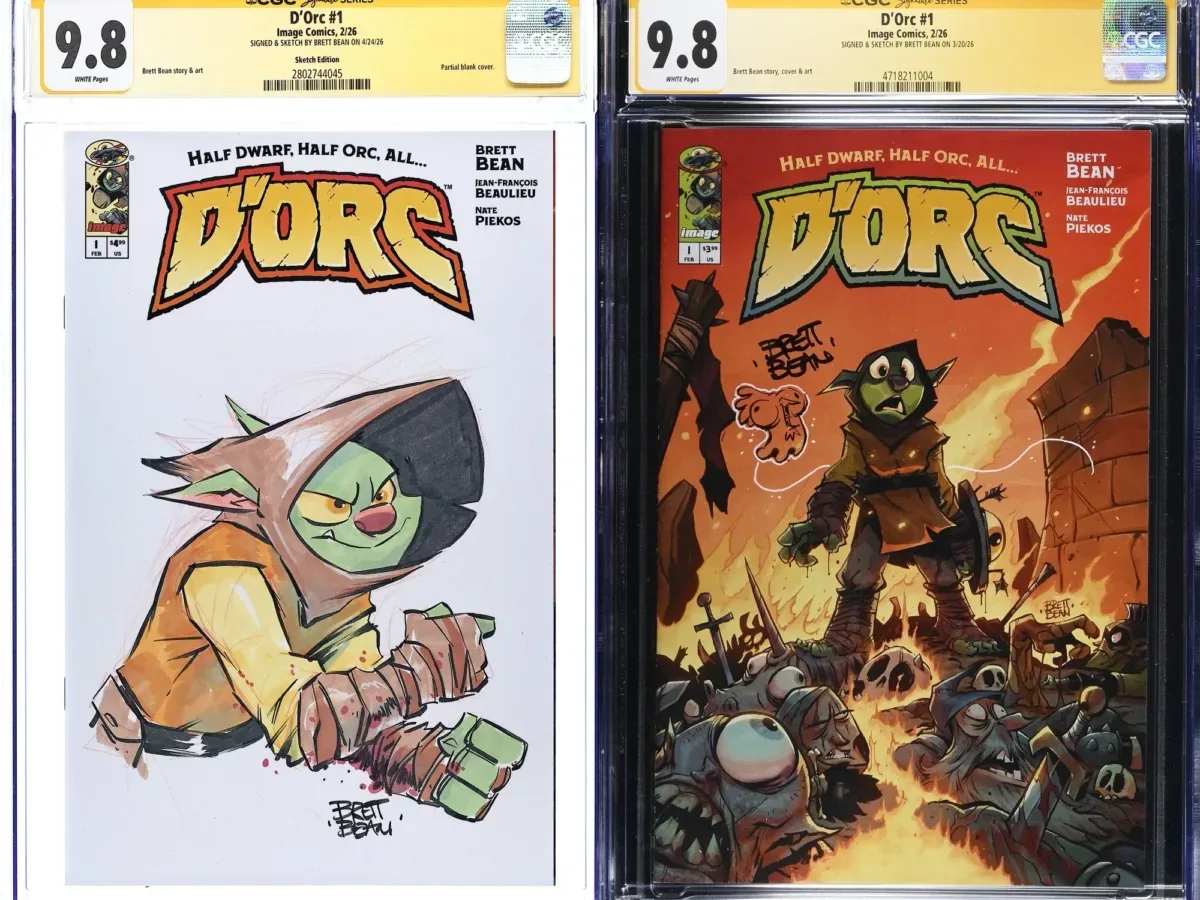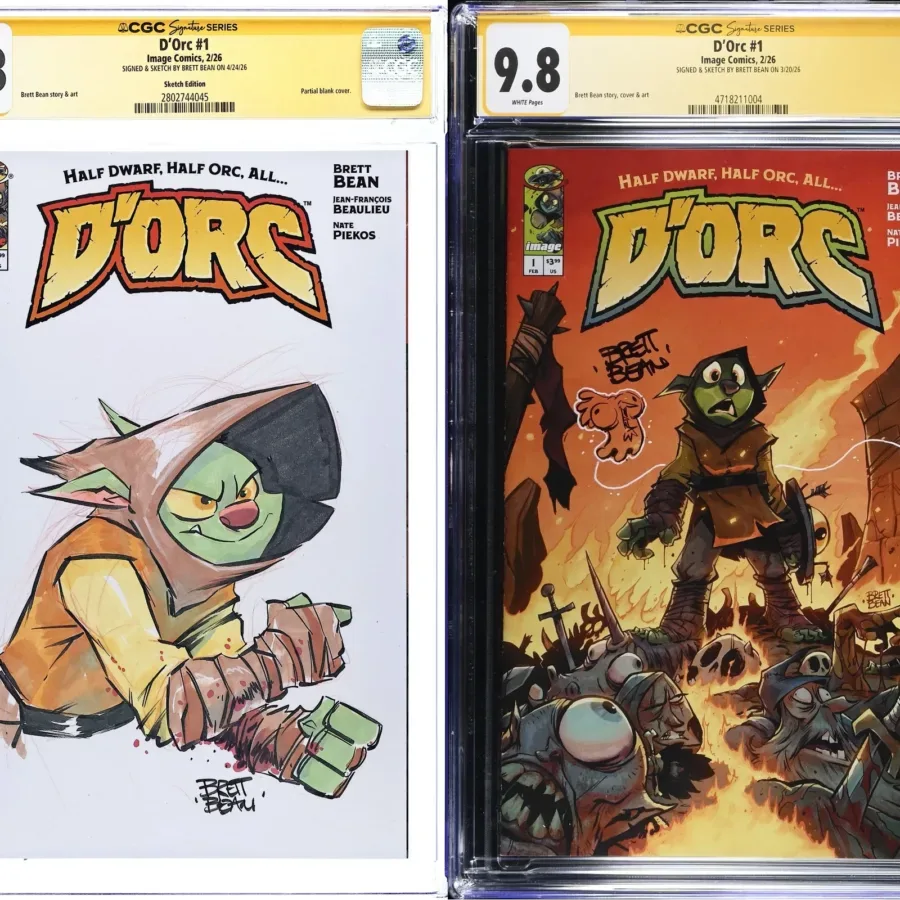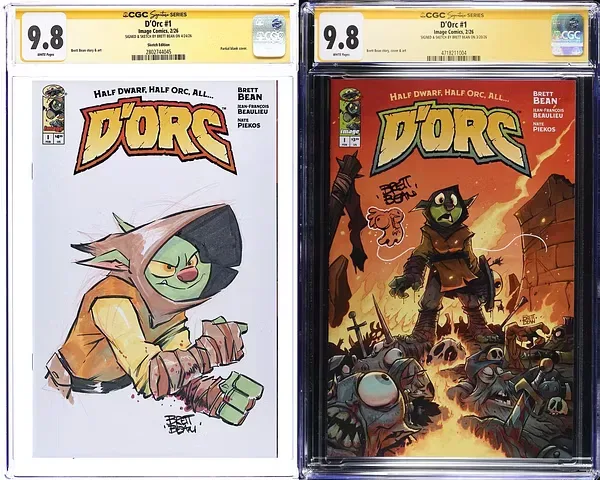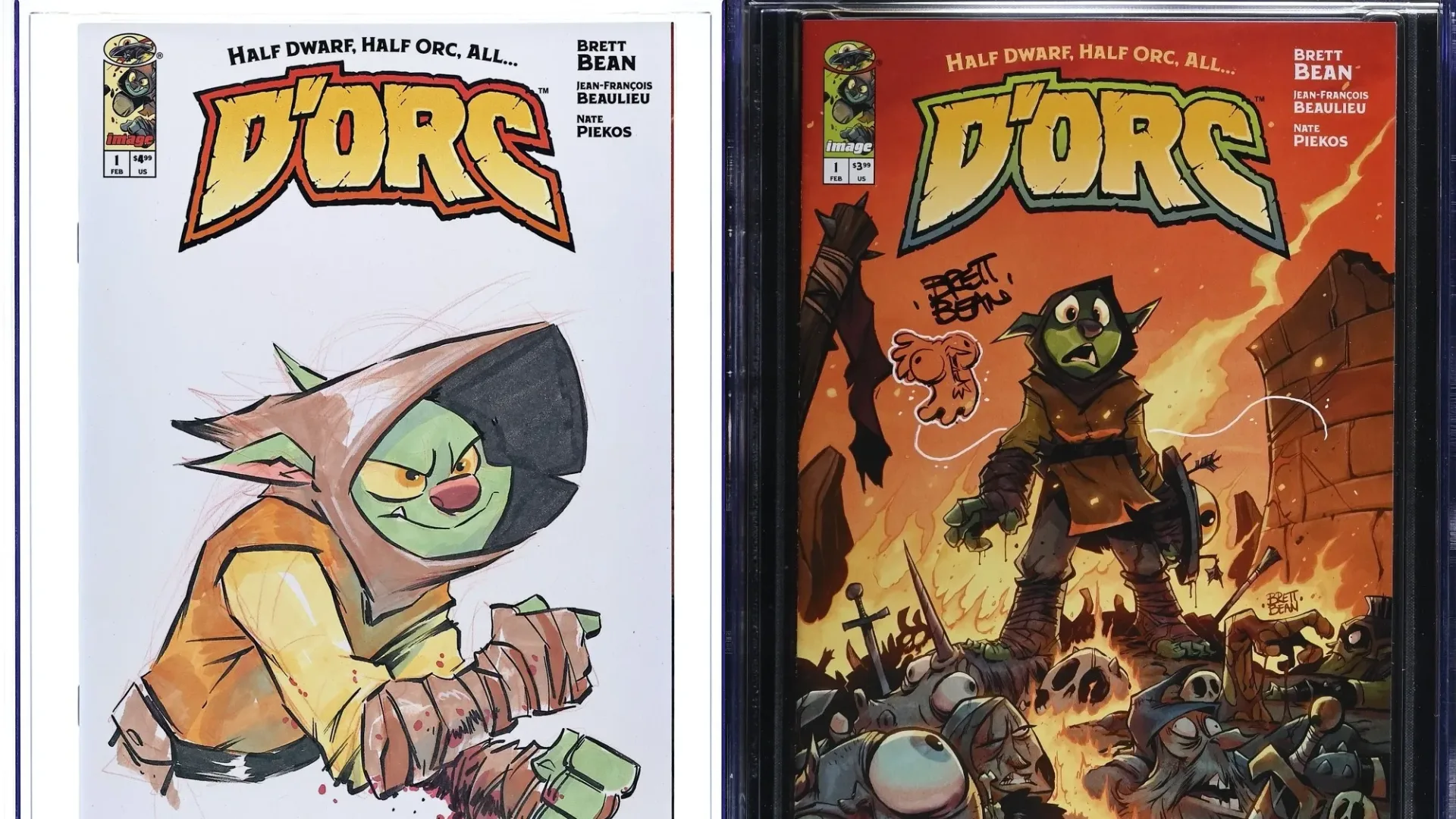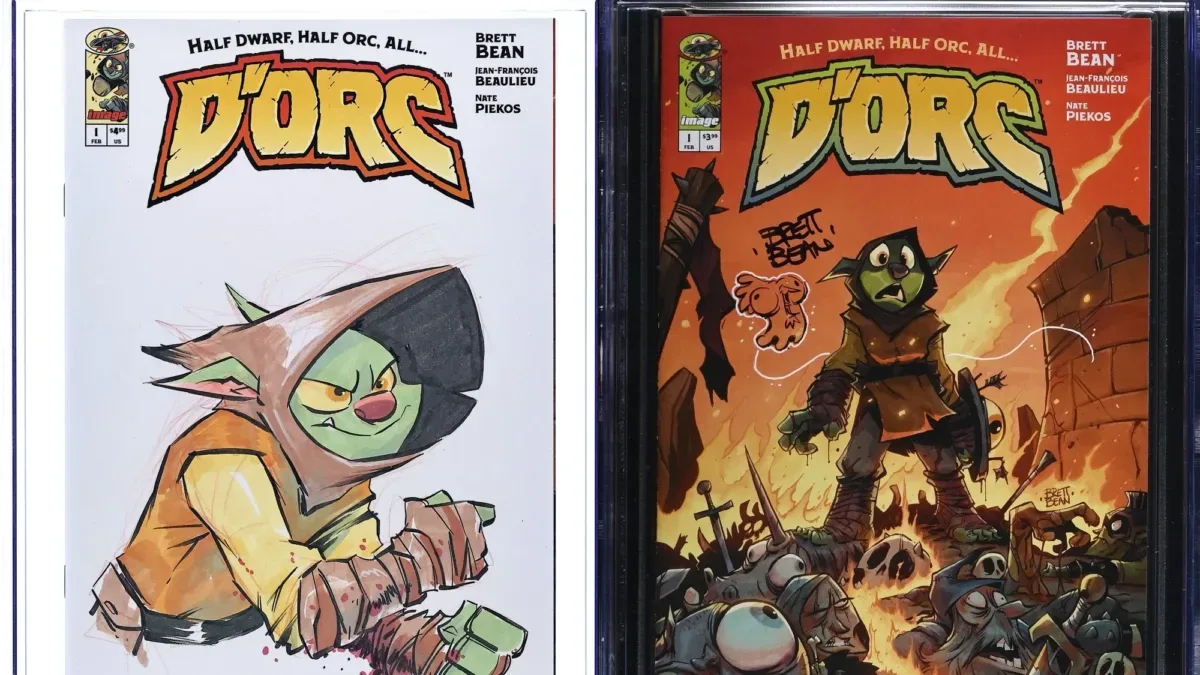
D’Orc #1 has become a fast-moving comic-market story after Sony Pictures secured the live-action film rights to Brett Bean’s Image Comics series. Reported eBay transactions showed immediate attention across several versions of the debut issue, from raw first-print copies to professionally graded books, signed editions, foil variants and a one-of-a-kind sketch-cover piece. The standout sale was a first-print blank cover graded CGC 9.8 with an original Brett Bean sketch, which sold for $1,320.
The rush is notable not simply because a comic tied to a possible film has gained value, but because buyers have separated versions of the same issue rather sharply. A plain raw first print reportedly sold for $300, while an unsigned CGC 9.8 first print reached $350. Signed, sketched and scarce variants climbed beyond that level. Those gaps are an important reminder that “D’Orc #1” is not one uniform collectible: printing, cover type, signature, original art and grading all materially affect what a buyer may be purchasing.
What changed for D’Orc #1?
The market movement followed the report that Sony Pictures obtained the live-action rights, with Bean attached to adapt the screenplay. That association can put a newer comic on the radar of readers, collectors and speculative buyers at once. It does not establish a film’s release date, cast, production timetable or eventual audience. It does, however, create a fresh reason for people to seek the first issue while attention is concentrated.
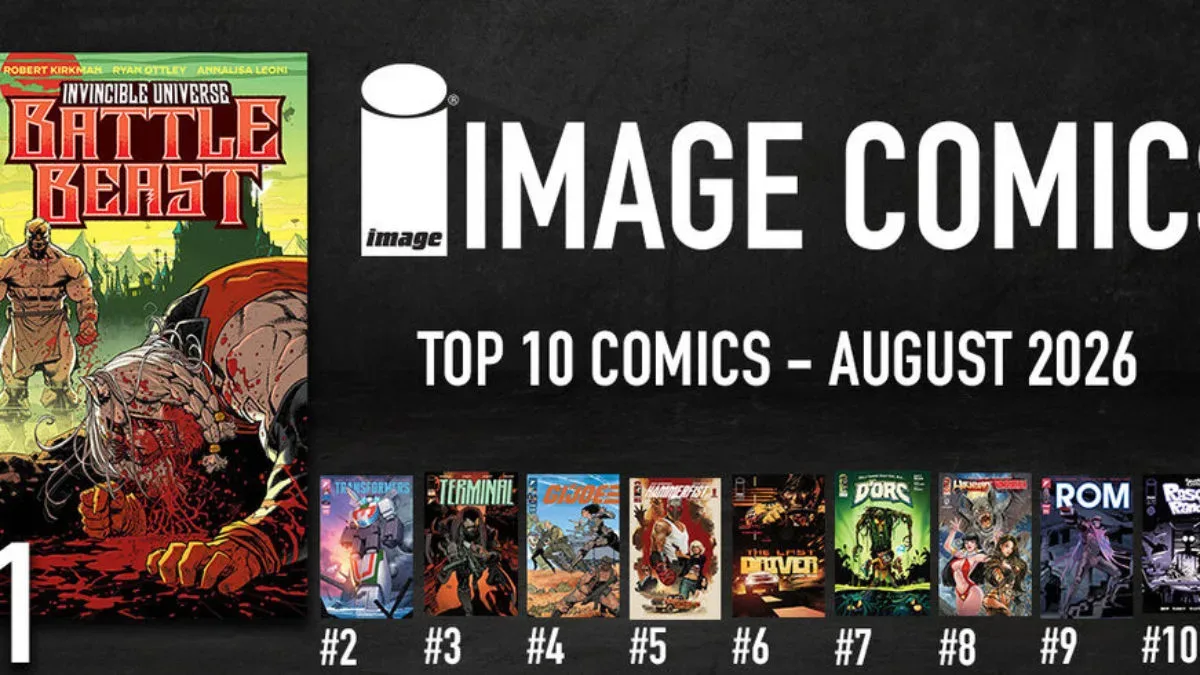
D’Orc already had an unusually visible publishing detail behind it: its first issue sold out before reaching comic shops, and issue #1 has subsequently reached an eighth printing. That does not make every printing equally scarce, nor does it determine a lasting price. But it explains why identifying a particular copy precisely matters. A buyer looking for a first printing, for example, is shopping for something different from a later-print reader copy, even though both are D’Orc #1.
Film and television developments can create rapid, uneven demand for source comics. The broader entertainment value of game and genre adaptations has also remained a major industry story; for another example of how franchise screen success can become part of the conversation, see the reported Resident Evil franchise box-office milestone. The key distinction here is that D’Orc’s current comic sales reflect early market reaction to rights news, not evidence of how a finished film will perform.
The reported first-print sales
The highest reported result came from the CGC 9.8 blank-cover first printing with an original Bean sketch: $1,320. That is an especially specialized object. It combines a high grade, a blank cover intended for commissioned artwork, and a unique drawing by the series creator. It should not be treated as a benchmark for an ordinary copy pulled from a long box.
Other reported first-print results provide a clearer look at the tiers buyers were valuing:
- A first-print copy signed and sketched by Bean, graded CGC 9.8, sold for $700.
- A signed first-print CGC 9.8 sold for $500.
- An unsigned first-print CGC 9.8 sold for $350.
- A raw first-print copy described as being in decent condition sold for $300.
- A first-print 1:25 edition, signed and graded CGC 9.8, sold for $680.
CGC is a third-party comic-grading company, and 9.8 is a very high numerical grade on its 10-point scale. “Slabbed” is collector shorthand for a comic encapsulated in the company’s hard plastic holder after grading. In a quick-moving market, a graded sale can appear more readily comparable than a raw one because it has a stated grade. Yet the distinction should not be overstated: signatures, sketch work, a limited-ratio cover and the particular buyer interest in a listing can still produce very different results between two books with the same numeric grade.
The 1:25 label is also relevant. It refers to an incentive variant generally connected to retailers ordering a specified quantity of regular copies. The reported $680 result therefore concerns a variant edition rather than a standard first-print cover. It is not direct proof that every first-print D’Orc #1 is approaching that price.
Later printings are moving too, but at different levels
Interest was not limited to the initial printing. Second- and third-print editions reportedly moved as well, though the available figures demonstrate a much broader spread and, in many cases, lower entry points than premium first-print copies.
For the second printing, reported sales included a signed raw copy at $25, a signed slabbed copy at $140, and a slabbed foil edition at $135. A black-and-white second print reportedly sold for $55 raw and $115 slabbed, while a Brett Bean store exclusive changed hands for $45.
Third-print results were more varied still. A slabbed third print reportedly sold for $50, and a slabbed foil third print reached $150. The Akira-homage edition sold for $30, while a signed copy sold for $35. At the other end, raw third-print copies were reported under $4.
That contrast is perhaps the most practical part of the whole story. The words “later printing” do not describe one market value. A foil cover, homage design, signature or high-grade slab can create a separate collecting lane, while a standard raw later printing may remain comparatively inexpensive. Readers who only want the opening chapter may find that distinction useful; collectors chasing particular variants need to be much more exact about which edition is actually being offered.
Why the $1,320 sale needs context
A record sale can be real and still be a poor shorthand for the whole market. The $1,320 D’Orc #1 was not merely a first print. It was a blank cover with original art, and original art makes the copy individually distinct. Even another blank CGC 9.8 may not command the same amount, because Bean’s sketch, placement, subject matter and buyer competition cannot be standardized.
The same caution applies to signed copies. A signature is an added collectible attribute, but the reported sale range indicates that it is only one component. A signed CGC 9.8 at $500 and a signed-and-sketched CGC 9.8 at $700 illustrate how original drawing can create a further premium. Meanwhile, the $350 unsigned CGC 9.8 shows that certification and condition themselves were attracting demand.
Raw copies require a different comparison standard. A $300 raw first print cannot be assumed to be equivalent to a $350 graded 9.8. “Raw” means ungraded; its stated condition comes from the seller rather than a third-party numeric grade. Buyers assessing raw books should pay close attention to edition identification and condition descriptions rather than assuming a single recent transaction establishes a fixed going rate.
A collector’s checklist for D’Orc #1 listings
With several printings and variations now circulating, the simplest protection against confusion is to identify the exact object before treating any sale as comparable. The reported transactions suggest a few especially important checks:
- Confirm the printing. First, second and third printings have all appeared in reported sales, and D’Orc #1 has reached an eighth printing overall. A listing title alone may not give enough detail.
- Separate the cover types. Standard copies, blank covers, foil editions, black-and-white versions, store exclusives, homage covers and incentive variants should not be casually grouped together.
- Note whether the book is raw or graded. A CGC slab provides a stated grade; a raw listing does not carry that third-party assessment.
- Identify signatures and sketches precisely. A signature is not the same as a signed book with an original drawing, and a unique sketch cover is not interchangeable with a printed variant.
- Use completed sales as snapshots, not guarantees. The reported results arrived soon after the rights news, when attention and competition may be unusually intense.
The comic at the center of the surge
D’Orc follows its half-dwarf, half-orc title character, who is tied to a prophecy in the Book of Certain Doom that says he will end the world. He is armed with a magical and highly violent shield, accompanied by a chicken with its head cut off, and caught in Sunderaine’s ongoing conflict between Light and Dark.
The premise places him amid elves, orcs, wizards, dragons and a long list of hostile fantasy beings, including witches, Timelords, Ice Giants and a three-headed dog. That deliberately crowded, comic fantasy setup is the material Bean is attached to adapt for the live-action project.
For now, the clearest measurable effect of the film-rights news is the burst of reported secondary-market sales. The figures span under-$4 raw third prints at one end and a $1,320 unique-art CGC 9.8 at the other. That is a wide range, but it is also a useful map of what the market is rewarding: not merely the title, but the exact edition, its condition, its certification and any direct connection to Bean’s artwork.
Shop the products
Check current price, model and availability at the retailer.