Rob Gronkowski traded the familiar territory of sports for Latverian armor at NY Comic Con 2026, appearing on the Javits Center floor dressed as Doctor Doom. The appearance was part of an eBay Live collaboration hosted by PCBHobby and connected to Avengers: Doomsday, the Marvel film scheduled for December 18, 2026.
The event was also the second edition of Gronk Geeks Out, a livestreaming initiative pairing Gronkowski with eBay Live for fan-facing content. On its face, it is a convention-costume stunt built around one of Marvel’s largest villains. For the trading-card hobby, though, it is also a clean example of how sports personalities, entertainment releases, livestream commerce and character collecting can meet around the same table.
That does not automatically turn every Doctor Doom card into a must-buy. It does show why a character’s moment in the wider culture can matter to collectors: a major movie campaign can bring new eyes to existing cards, while a recognizable athlete can make a comics-centered activation legible to people who usually enter the hobby through football, basketball or baseball products.
A sports star walks into Marvel’s villain era
Gronkowski’s choice of Doctor Doom is particularly useful for a crossover event because Doom is a character with immediate visual identity: the mask, hood and armor communicate the role before anybody has to explain the deep continuity. It also ties directly to the upcoming film, in which Robert Downey Jr. is set to play Doctor Doom after previously portraying Iron Man.
Marvel’s multiverse storytelling is the connective tissue offered for that casting change. Put simply, a multiverse framework concerns alternate realities rather than one uninterrupted setting and timeline. That concept has been central to several recent Marvel stories and gives the franchise a way to present Downey as Victor von Doom rather than Tony Stark.
For collectors, that distinction matters more than it may seem. A card can depict Doctor Doom as a comic character, a film-adjacent character, a vintage interpretation or a modern premium parallel. They may share a character name, but they are not automatically the same collecting proposition. The specific set, card treatment, serial numbering, condition and buyer audience remain important.
The convention setting makes the overlap more visible. Comic conventions bring together cosplay, film anticipation, comics fandom and dealer-floor buying. A live e-commerce broadcast adds another layer by turning the event into material that can reach people who were not physically in the hall. Gronkowski’s involvement supplies a sports-hobby bridge without changing the basic appeal: Doctor Doom has long been a recognizable Marvel character in his own right.
Why Doctor Doom cards are drawing attention
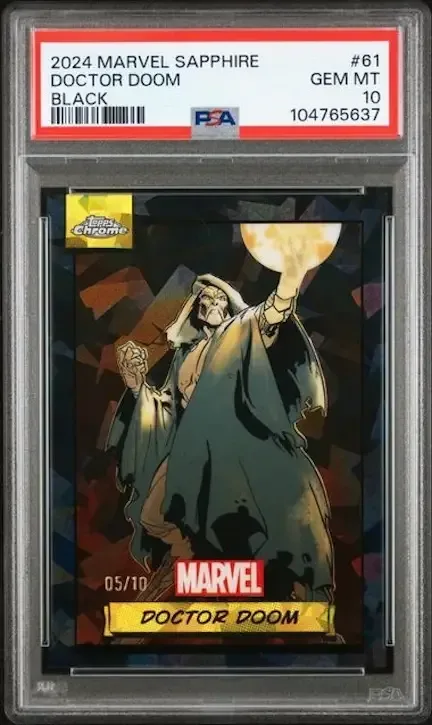
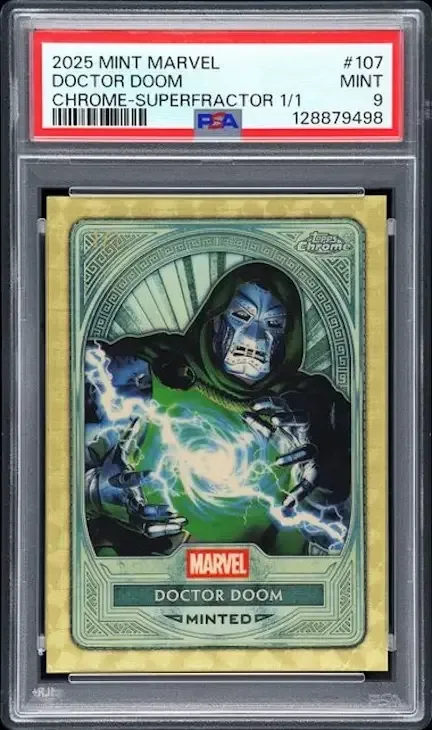
Two reported 2026 sales illustrate the high-end ceiling attached to scarce, graded Doom cards. A 2025 Topps Chrome Marvel Mint Superfractor Doctor Doom graded PSA 9 sold for $30,300 on September 25. Separately, a 2024 Topps Chrome Marvel Sapphire Doctor Doom Black Refractor numbered to 10 and graded PSA 10 sold for $25,350 on September 19.
Related coverage includes Rob Gronkowski Brings Dr. Doom to NY Comic Con in eBay Live Crossover Push for Avengers: Doomsday.
Those descriptions contain several terms worth unpacking. A Superfractor is a highly scarce parallel-card treatment; scarcity is a major part of why these cards command attention. A Black Refractor /10 means the card is part of a variant limited to 10 copies. That printed limitation is not the whole story—condition and demand still decide what buyers will pay—but it establishes a known maximum supply for that version.
PSA 9 and PSA 10 refer to graded condition assessments from PSA. Grading is a third-party opinion on a card’s state of preservation, generally examining elements such as centering, corners, edges and surface. The numerical grade is attached to that individual copy, not to every card with the same player or character. A PSA 10 Black Refractor and an ungraded Black Refractor are therefore not interchangeable in a sales comparison.
The sales are notable because they demonstrate interest in premium Doctor Doom material before the film’s December release. But they are not a price guide for all Doom cards, all Topps Chrome cards, or even all cards from the same releases. One sale records what a buyer paid for a particular card at a particular point in time. It is evidence of demand, not a guarantee of a future result.
That distinction is especially important during movie-driven attention cycles. Publicity can make a character more visible, yet visibility alone does not erase differences in print run, grading, set design, availability or collector preference. A character’s biggest sale can be a useful data point; it should not be mistaken for the value of a binder card, a base card or another parallel with a different level of rarity.
Topps, Marvel and the appeal of the crossover collector
Topps’ Marvel output sits at the center of this moment. Products such as Topps Chrome Marvel and Topps Chrome Marvel Sapphire frame comic-book characters through the language many modern card collectors already recognize: chromium-style finishes, parallel colors, low-numbered variants and graded examples. The result is a natural point of entry for someone who understands sports-card parallels but is newly interested in Marvel.
That is the practical value of an activation like Gronk Geeks Out. It need not persuade a committed Marvel reader that Doom is important. Instead, it can introduce the product category to people who know Gronkowski from sports and understand why a numbered or premium-finish card might matter. Conversely, it puts a sports-world figure into the orbit of collectors who may primarily care about comics, movies and character art.
Crossovers are already a broad part of collector culture. The shared language is less about any one franchise than about familiar habits: searching for favorite characters, identifying rarer versions, comparing condition, and deciding whether an item belongs in a personal collection rather than treating it solely as a financial vehicle. Readers looking at other franchise mash-ups can also see how character worlds get remixed in Sonic the Hedgehog x Godzilla #3.
A sensible way to approach the Doom moment
With a film campaign, a convention appearance and high-profile sales all in view, it is easy to collapse every discussion into a single question: what is the next card worth? A more useful approach starts by separating collecting goals.
- Character collectors may prioritize an image, costume era, artist, card design or affordable set rather than serial numbering.
- Set collectors may focus on completing a particular Topps Chrome or Sapphire release, where Doctor Doom is one piece of a broader checklist.
- Parallel collectors may care most about the rarity hierarchy and numbered variations.
- Condition-focused collectors may place added weight on third-party grading and the distinction between PSA 9 and PSA 10 examples.
Each approach can be valid, but they lead to different decisions. The reported $30,300 Superfractor sale and $25,350 Black Refractor sale are relevant benchmarks for rare, graded cards—not instructions to chase any Doctor Doom item at any price. Collectors should identify the exact card they are considering, note its edition and condition, and avoid treating film publicity as proof of permanent price movement.
There is also room for the fun of it. Doctor Doom’s appeal rests on more than scarcity: the character combines intellect, technology and mystic arts, giving Marvel a villain whose presence can be read in several ways. The looming film gives that character a new spotlight, while Gronkowski’s convention costume gives the promotional push an intentionally unexpected human face—or, more accurately, a very recognizable mask.
The watchlist ahead of December 18
The supplied viewing roadmap for Avengers: Doomsday stretches from X-Men and X2 through major Avengers films, multiverse-focused entries and more recent releases. Its common threads are legacy mutants, the Avengers, the Time Variance Authority, alternate realities, Wakanda and Talokan, the Ten Rings, an active anti-hero team, and the Fantastic Four’s connection to Doom.
Key titles on that path include Captain America: The First Avenger, The Avengers, Avengers: Infinity War, Avengers: Endgame, both seasons of Loki, Shang-Chi and the Legend of the Ten Rings, Spider-Man: No Way Home, Doctor Strange in the Multiverse of Madness, Black Panther: Wakanda Forever, Captain America: Brave New World, Deadpool & Wolverine, Thunderbolts, and The Fantastic Four: First Steps.
For the card market, the important near-term fact is not a prediction about where values go next. It is that Doctor Doom now has several sources of attention converging at once: Marvel’s forthcoming release, a sports-celebrity convention appearance, livestream promotion, and documented demand for scarce Topps cards. That convergence makes Doom a character to watch—and gives collectors a reason to look carefully at the card in front of them, not merely the hype around it.