Spider-Man’s latest box-office run is coinciding with a sharp burst of attention for vintage Marvel trading cards. Spider-Man: Brand New Day, released in theaters July 31, has reportedly passed $936.77 million domestically and $2.45 billion worldwide. Those totals place it above every prior Spider-Man film at the domestic box office, while the worldwide result is reported as the third-largest ever behind Avatar and Avengers: Endgame.
For card collectors, the more immediate story is not simply that Spider-Man is having a major movie moment. It is that a small group of older, graded cards has produced notable public sale results in September. Four PSA 10 examples spanning 1990 to 1995 reached reported all-time highs or near-highs, with gains ranging from roughly 100% to more than 300% over the supplied comparison periods.
That does not mean every Spider-Man card has suddenly become a four-figure collectible, or that a recent sale guarantees the next one will match it. Each card has its own supply, grade population, visual appeal and history of recorded transactions. Still, the recent sales offer a clear snapshot of where demand has concentrated: recognizable character art, premium foil treatments, older Marvel issues, and copies preserved well enough to earn PSA’s top numerical grade.
The broad Marvel conversation has also remained active beyond the film itself, including the character’s street-level corner of the universe; Kingpin’s changing role in Daredevil: Born Again is another reminder that collector interest often follows attention across interconnected Marvel properties. The reported Spider-Man card results, however, are tied to specific cards and specific transactions—not a universal benchmark for the entire category.
Why the movie moment matters to the card market
Entertainment success can bring new eyes to a character’s older merchandise. A theatrical hit gives longtime fans a fresh reason to revisit the character, while newer buyers may begin searching for tangible items that predate the current movie cycle. Trading cards are a natural destination because they can combine character recognition, art and condition-sensitive scarcity in a compact collectible.
PSA 10 is central to all four sales discussed here. PSA is a grading company that assigns numerical condition grades to cards; a 10 is its top grade. The grade is not merely a label of whether a card looks clean in a binder. In markets like these, it creates a narrower version of the collectible: not simply a particular Spider-Man card, but that card in a professionally authenticated, top-graded example.
The supplied numbers also use PSA 10 population, commonly shortened to “pop,” as a measure of how many examples PSA has graded at that level. A population of 21, for example, means only 21 copies are recorded in PSA 10 in the cited data. It does not establish the total number of cards printed, nor does it guarantee that all 21 are available to buy. But it helps explain why a card can command attention when demand arrives.
Another key term is public sale. These are transactions with a recorded, publicly visible price. Public sales make it possible to compare observed results over time, but they are still only the sales that can be tracked. A low number of public transactions can make a market harder to read: one enthusiastic buyer, one unusually attractive card, or a temporarily thin supply can have an outsized effect on the latest apparent value.
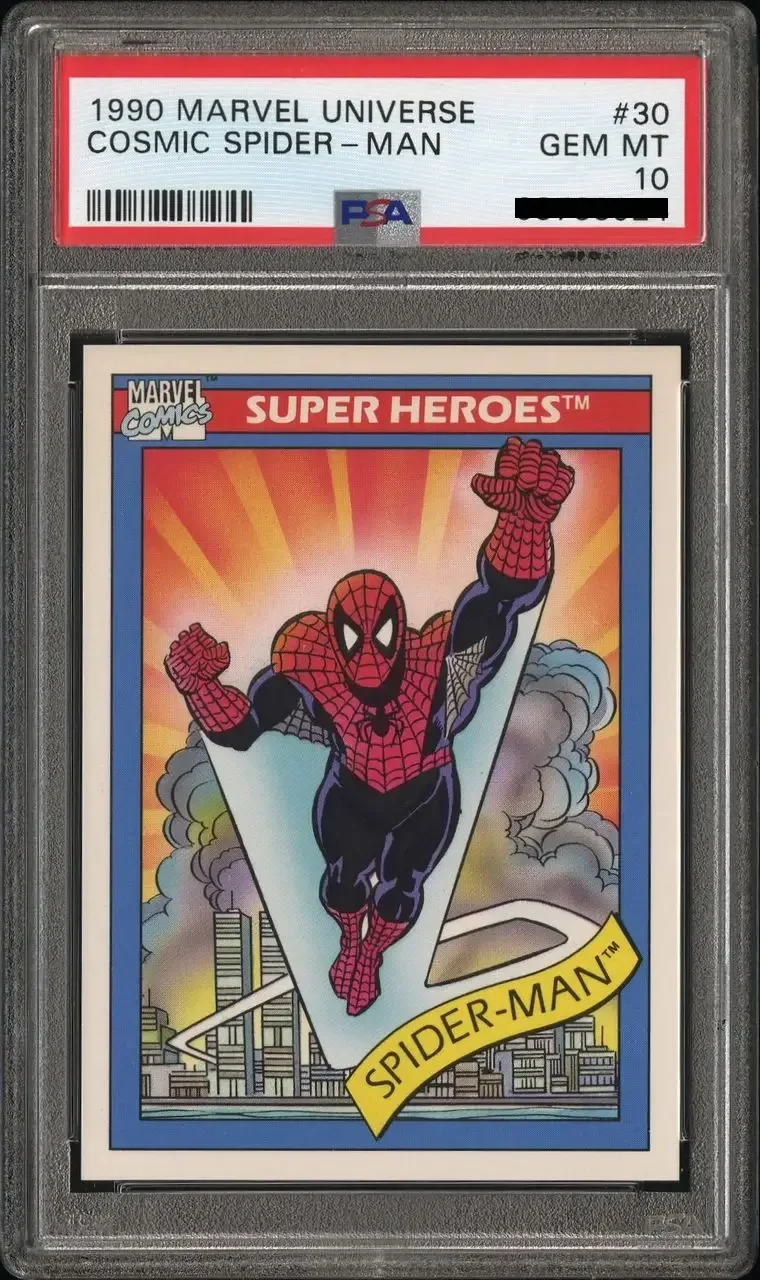
1990 Marvel Universe Cosmic Spider-Man #30: a recognizable early Marvel card
The 1990 Marvel Universe Cosmic Spider-Man #30 is the most frequently traded card among the four examples. Its PSA 10 population is 161, and it has logged 140 public sales in total. Those figures give it a deeper visible sales history than the other cards in this group, which matters when collectors try to distinguish a sustained trend from a lone outlier.
A PSA 10 copy sold for $2,250 on September 15 through an eBay fixed-price listing. That was the card’s highest reported public sale since April 2021 and its second-highest reported public sale overall. The result was said to represent a $1,696 increase, or 306%, across the preceding six months.
Its population of 161 is notably larger than the populations cited for the 1995 Marvel Annual, 1995 Marvel Metal Gold Blaster and 1992 Marvel Masterpieces cards. Yet the result illustrates that top-end demand is not determined by low grade population alone. Recognition has a role, too. The Cosmic Spider-Man card is presented as one of the character’s most familiar card images, giving collectors a well-established visual rather than a niche variation that requires deep set knowledge to identify.
For anyone monitoring comparable listings, the practical distinction is important: 161 PSA 10 examples is not the same thing as 161 cards for sale. But it does mean prospective buyers may have more historical transactions to study than they would for an issue with only 11 total recorded sales. That additional history can provide context, even though it does not remove the volatility inherent in collectible-card markets.
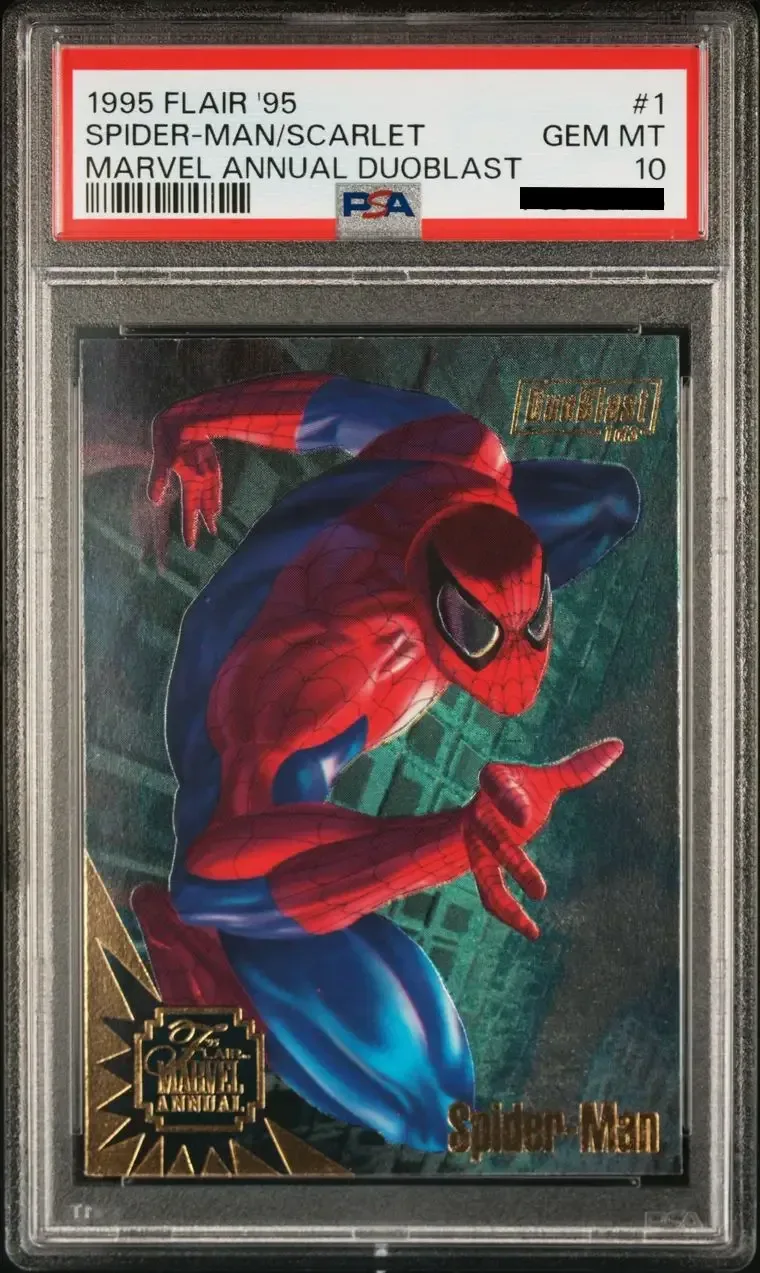
1995 Marvel Annual Spider-Man & Scarlet Spider #1: low PSA 10 population, limited sales
The 1995 Marvel Annual Spider-Man & Scarlet Spider #1 takes a different route to collector attention. It has the smallest PSA 10 population of the four at 21. The card also has foil accents, a design feature that supplies visual shine but may make top-condition copies more difficult to achieve. Foil surfaces can draw the eye, yet their reflective finish can also make condition a central part of how collectors assess an example.
A PSA 10 copy sold for $499.95 on September 10, a reported all-time public high for the card. The sale was a $250 increase, or 99.99%, over the prior year. The number of total public sales is only 11, however, making this a particularly small data set.
That combination—low PSA 10 population and a thin sales record—is worth reading carefully. Scarcity can be meaningful, especially when the card has a distinctive foil presentation and two Spider-Man-related characters on it. At the same time, a market with 11 observed sales offers less evidence about its usual trading range than a card with dozens or hundreds of recorded results. The September price is significant as a new peak, but it should be understood as one documented transaction rather than an automatic, fixed value for all PSA 10 copies.
1995 Marvel Metal Gold Blaster #12: the highest recent result
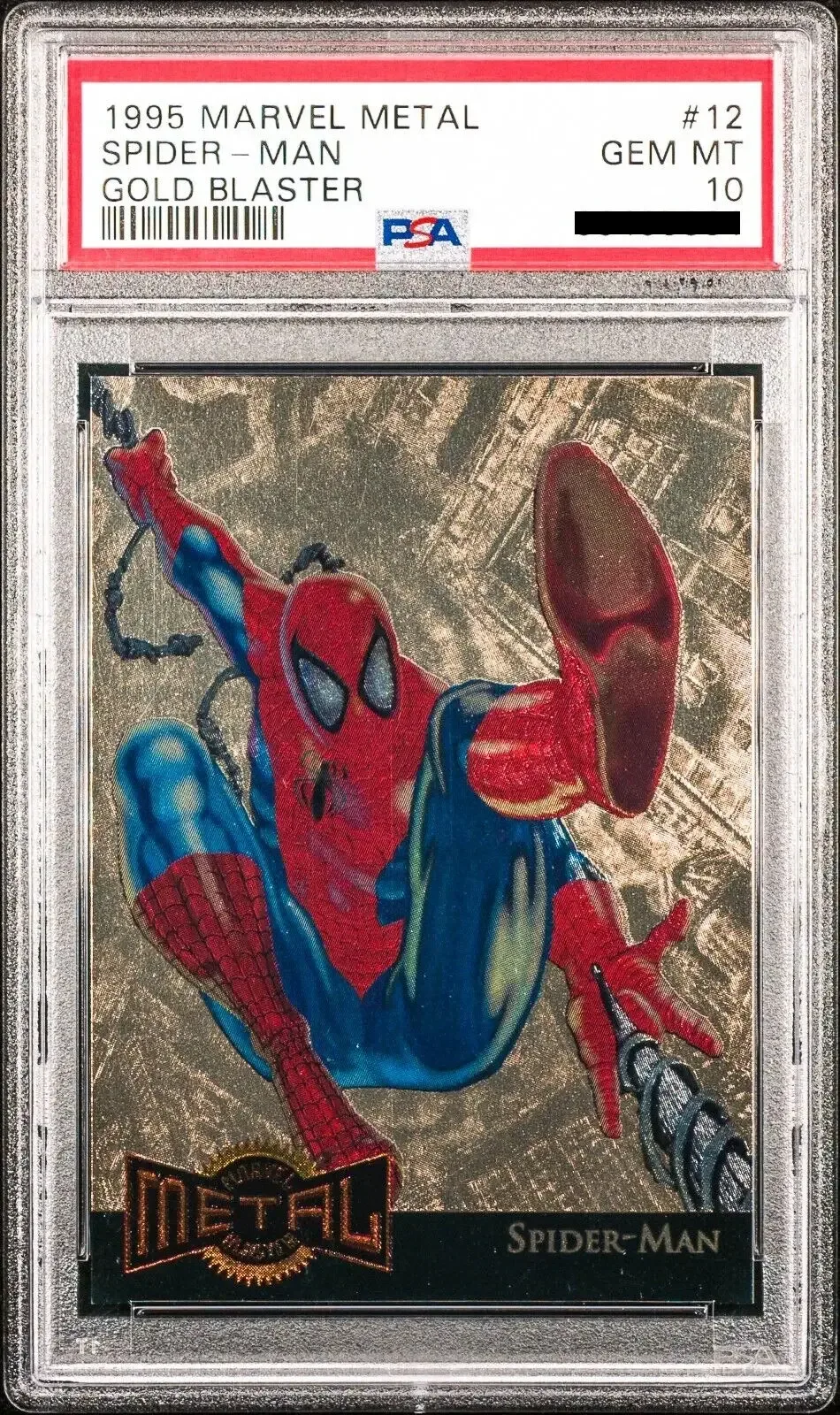
The largest reported sale in the group belongs to 1995 Marvel Metal Gold Blaster #12. A PSA 10 Spider-Man copy sold for $3,999 on September 22 through an eBay best-offer transaction. It was a reported all-time high and followed three separate record-setting sales for the card within the prior month.
The Gold Blaster is a parallel, meaning a version of a card differentiated from another release by its particular treatment or design. Here, that distinction is the gold foil framing around the character. Parallels matter because collectors may pursue them separately from standard versions, especially where the alternate treatment substantially changes the card’s look.
There are 91 PSA 10 copies of the Gold Blaster #12 cited in the available data. The $3,999 result represented an increase of $2,969, or 288%, over six months. Repeated records in a short window can indicate that sellers and buyers are actively revising expectations upward. It can also make the next sale especially consequential, since each new transaction becomes fresh evidence in a rapidly changing and relatively specialized market.
The card’s appeal is therefore easy to separate into concrete components: Spider-Man is the subject, the 1995 Marvel Metal issue has a collector following, Gold Blaster is a visually distinct parallel, and PSA 10 availability is limited relative to the broader universe of raw cards. None of those components alone dictates a price. Together, they help explain why this example has become the headline sale among the four.
1992 Marvel Masterpieces #87: long-running set, fresh record
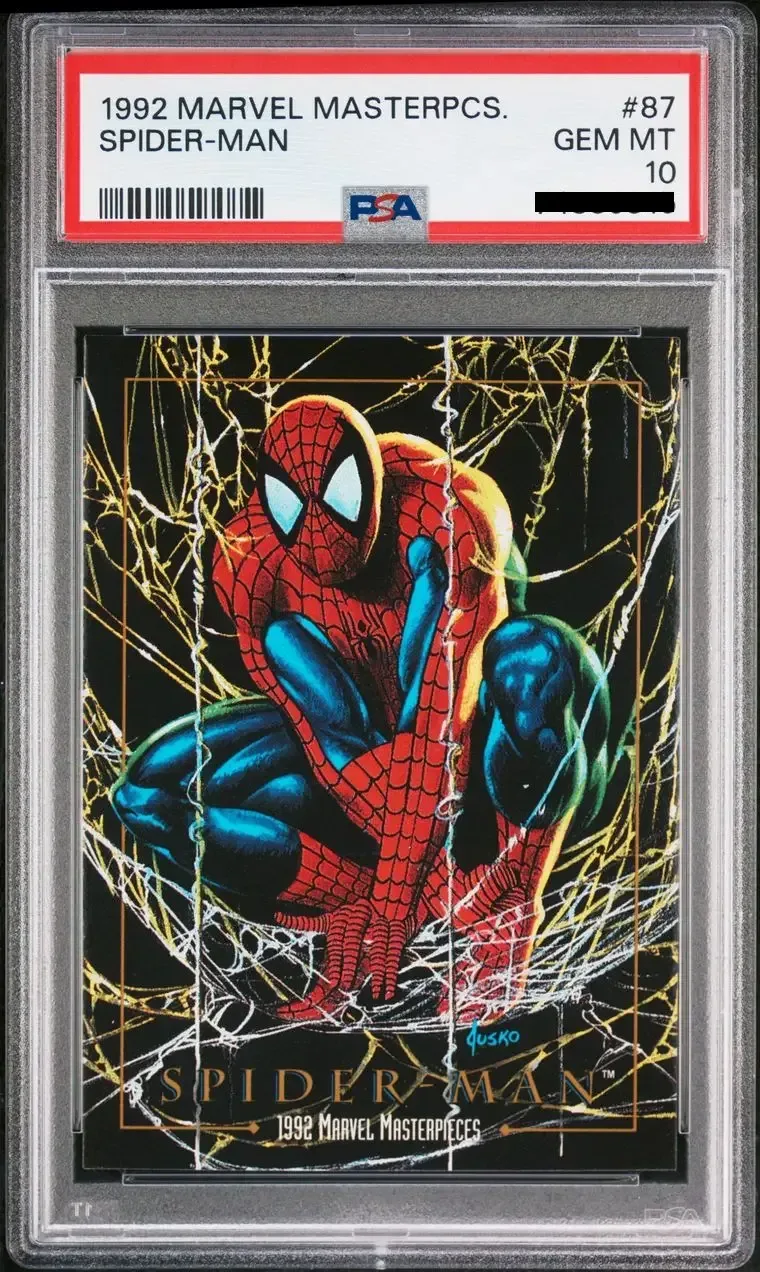
Spider-Man’s 1992 Marvel Masterpieces #87 also registered a new reported high. A PSA 10 sold for $3,795 on September 9 via eBay. That marked a $2,100 gain, or 175%, over the preceding six months.
Marvel Masterpieces began in 1992 and is described as one of the longest-running Marvel card lines. The #87 Spider-Man has a PSA 10 population of 82, the third-highest total among the four highlighted cards. It also has the second-most public sales in the group, though no exact total was provided.
This card’s result reinforces a useful collecting point: set identity can matter alongside rarity. A buyer may be drawn to Spider-Man first, but the card also belongs to a recognizable Marvel Masterpieces lineage. That gives it a place within both a character collection and a set-focused collection. Such overlap does not ensure demand, but it expands the reasons a collector could decide that a high-grade copy belongs in their collection.
How to interpret the four sales without overreading them
The September results are substantial: $2,250 for 1990 Marvel Universe Cosmic Spider-Man #30, $499.95 for 1995 Marvel Annual Spider-Man & Scarlet Spider #1, $3,999 for 1995 Marvel Metal Gold Blaster #12, and $3,795 for 1992 Marvel Masterpieces #87, all in PSA 10. They also arrived while Brand New Day was drawing extraordinary box-office attention. The timing supports the view that renewed Spider-Man enthusiasm is helping lift interest in cards.
But collectors evaluating similar cards should keep the distinctions between the four markets in view. The 1990 Cosmic card has the largest PSA 10 population and the greatest number of recorded public sales. The Annual Spider-Man & Scarlet Spider card has the lowest PSA 10 population but only 11 recorded sales. The Gold Blaster has a premium parallel treatment and saw multiple record results in a month. The Marvel Masterpieces issue combines a fresh top sale with a connection to a long-running set.
- Check the exact card version: Standard issues, foil cards and parallels are not interchangeable.
- Check the grade: These headline figures are for PSA 10 examples, not ungraded copies or cards in lower grades.
- Check sale depth: A card with few public sales may have less predictable pricing, even if the latest result is impressive.
- Check the date and sales format: Fixed-price, best-offer and other eBay transactions can each reflect different seller and buyer behavior.
- Separate a peak from a guarantee: An all-time high documents what one buyer paid at one time; it does not promise a repeat result.
For now, the clearest evidence is concentrated in these high-grade vintage Marvel examples. Spider-Man’s screen success has created a high-visibility moment, and collectors have responded with record public transactions across several distinct card lines. Whether that momentum spreads more widely through Marvel cards—or holds at the same level once the immediate movie spotlight cools—will depend on the next sales, not on a single headline result.