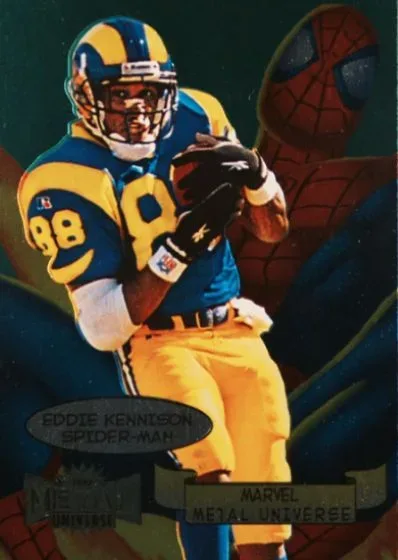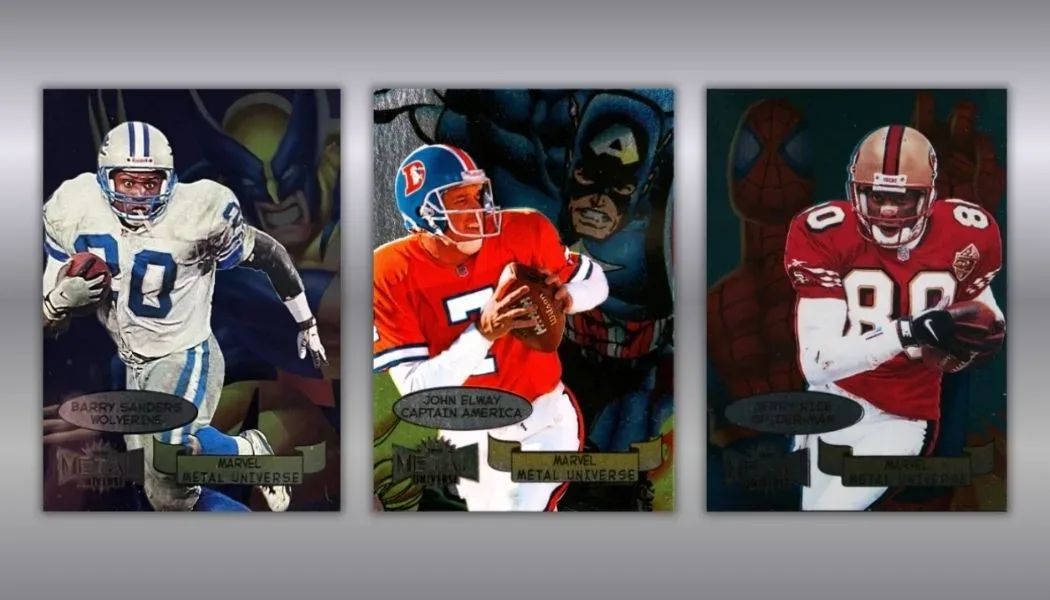
There is a particular kind of late-1990s trading card design that refuses to enter a room quietly. It shines, it catches every fingerprint within a five-mile radius, and it frequently makes a collector tilt it beneath a lamp like they are decoding an alien transmission. The 1997 Metal Universe Football Marvel Metal inserts are exactly that kind of card.
The 20-card insert set has drawn substantially stronger secondary-market attention in 2026. Public raw-card sales ranges from January through August point to broad movement across the checklist, not merely a spike around one marquee Hall of Famer. Barry Sanders, Jerry Rice, John Elway and Marshall Faulk are the headliners, naturally, but numerous cards featuring players with less enduring hobby followings also rose from low-dollar sales early in the year to noticeably higher August ranges.
That combination is what makes the development interesting. This is not just football nostalgia, or just superhero collecting, or just the familiar premium placed on difficult high-grade foil. Marvel Metal sits at the intersection of all three. It is an artifact of an aggressively stylish card era, pairing NFL players with comic-book icons and putting the whole arrangement on a full-bleed foil surface that is visually loud and condition-sensitive.
For collectors following the wider superhero side of the hobby, it is also another reminder that Marvel’s reach goes well beyond dedicated comic cards. The characters remain cultural fixtures in other formats too, including current conversations around Spider-Man and Hulk’s planned big-screen connection. On these 1997 cards, their job was to lend comic-book force to football stars.
A product born from the SkyBox-Marvel connection
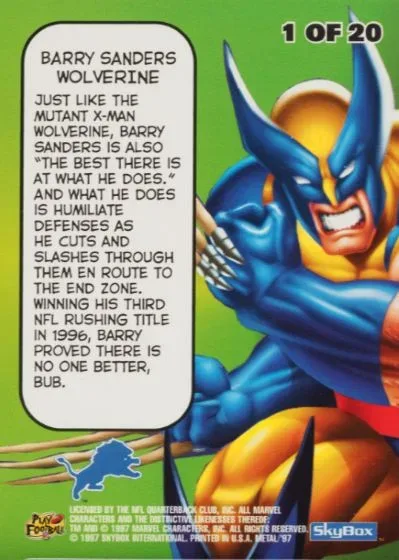
Marvel Entertainment acquired SkyBox for $150 million in 1995, and the relationship was very apparent by the time Metal Universe Football arrived in 1997. Marvel illustrators helped establish the striking etched-foil identity of the main set. Marvel Metal took the concept a step further: each insert places an NFL player alongside a recognizable Marvel character, with a comic-inspired comparison of the athlete and hero printed on the reverse.
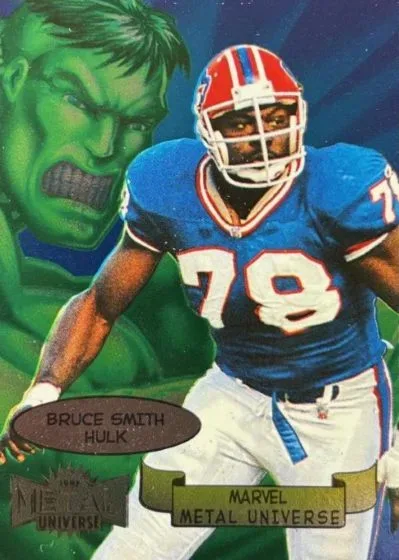
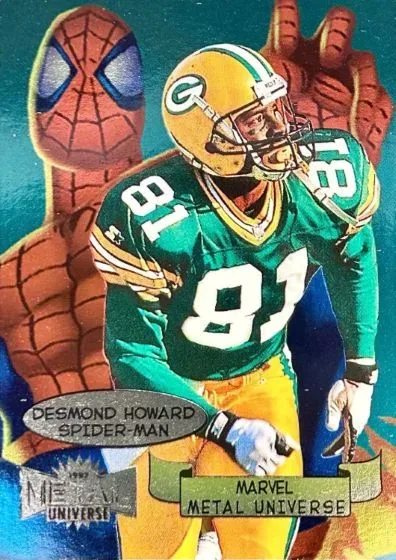
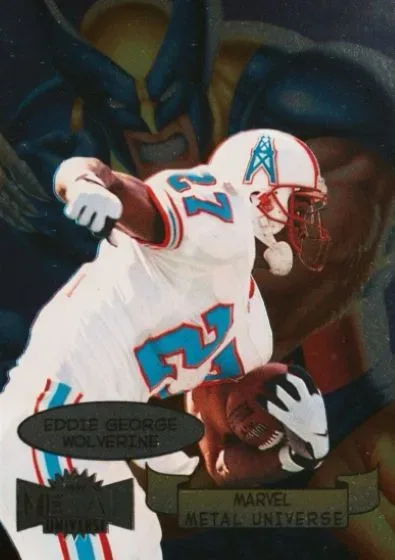
The four character assignments are not evenly split. Spider-Man appears on seven cards, Wolverine on five, Captain America on four and Hulk on four. The result is a checklist with an unmistakable visual rhythm: stars from the gridiron paired with heroes whose powers, toughness, agility or leadership could be used as the hook for the back-of-card copy.
Marvel Metal was not presented as an impossible pack pull at release. The inserts landed at roughly one per six packs, or about four per hobby box. That relative accessibility is part of the set’s appeal today. A collector can still chase all 20 without treating every card as a once-in-a-lifetime find. But availability and condition are very different questions.
Why clean copies are a much tougher pull
The foil covers the card from edge to edge. That makes Marvel Metal inserts look fantastic when well preserved, but it also leaves them exposed to the flaws collectors know too well: edge wear, corner issues, surface scratching and other blemishes that can stand out under reflected light. A raw copy can be visually satisfying and may be the practical route for a binder or display collection. A truly pristine copy, however, is an entirely different proposition.
Related coverage includes 1997 Metal Universe Football Marvel Metal Inserts Surge as 1990s Card Demand Climbs.
That divide helps explain the exceptional result for a PSA 10 Barry Sanders with Wolverine. One such copy sold for $5,000 on August 30. It should not be used as a shortcut for valuing every Sanders card, let alone every raw example in the set; grade, eye appeal and sale setting matter enormously. Still, the sale illustrates why condition has become central to the conversation around an insert that was never designed to be handled gently by the passage of time.
The raw ranges below exclude outliers, and each is a snapshot of public sales activity rather than a fixed price guide. Some values had edged down somewhat from August peaks by early September. Raw cards can vary sharply based on centering, scratches, foil wear and the quality of listing photos, so collectors should treat the figures as broad market reference points, not guarantees.
2026 public-sales movement across the full checklist
The strongest August raw ranges belong to the biggest names. Jerry Rice with Spider-Man reached $275 to $350, while Barry Sanders with Wolverine landed at $200 to $250. John Elway with Captain America rose to $115 to $200, and Marshall Faulk with Wolverine reached $60 to $80. Those are dramatic changes compared with January’s comparatively modest levels.
- Barry Sanders / Wolverine: January $30-$50; April $35-$50; August $200-$250.
- Bruce Smith / Hulk: January $5-$10; April $5-$10; August $40-$90.
- Desmond Howard / Spider-Man: January $3-$6; April $5-$15; August $25-$50.
- Eddie George / Wolverine: January $8-$10; April $8-$10; August $35-$75.
- Eddie Kennison / Spider-Man: January $3; April $5; August $10-$20.
- Jerry Rice / Spider-Man: January $20-$30; April $25-$40; August $275-$350.
- Joey Galloway / Spider-Man: January $2-$5; April $5; August $15-$30.
- John Elway / Captain America: January $10-$12; April $10-$20; August $115-$200.
- Karim Abdul-Jabbar / Wolverine: January $4; April $8-$10; August $15-$25.
- Kerry Collins / Captain America: January $3-$8; April $3; August $15-$30.
The middle of the checklist provides a useful example of how set-based demand can operate. Steve McNair, Kordell Stewart, Mark Brunell and Simeon Rice all showed meaningful gains despite the current market’s attention being concentrated most intensely on Hall of Fame-level names. The Marvel character pairing may be helping collectors approach the release as a cohesive 20-card project rather than simply a stack of individual player cards.
- Kevin Hardy / Hulk: January $2-$3; April $3; August $8-$25.
- Kordell Stewart / Wolverine: January $3-$5; April $8-$10; August $25-$30.
- Mark Brunell / Captain America: January $3-$6; April $3-$6; August $15-$30.
- Marshall Faulk / Wolverine: January $8-$10; April $8-$12; August $60-$80.
- Michael Westbrook / Spider-Man: January $2-$4; April $2-$5; August $20-$30.
- Simeon Rice / Hulk: January $2-$3; April $4-$5; August $10-$20.
- Steve McNair / Captain America: January $5-$8; April $5-$8; August $30-$50.
- Terry Glenn / Spider-Man: January $5-$7; April $5-$7; August $15-$20.
- Tony Brackens / Hulk: January $2-$4; April $2-$4; August $10-$20.
- Tony Martin / Spider-Man: January $3; April $3; August $8-$20.
What collectors should take from the surge
The data does not establish that every Marvel Metal card will hold an August-level range indefinitely. It does establish that this specific insert has become much more actively pursued in 2026, with gains extending throughout the 20-card lineup. The Hall of Famers make the clearest case, but the lower-priced cards matter as well: they offer evidence of a broader chase for the design, the superhero pairings and the era.
For someone building the set, the sensible approach is to separate collecting goals. A raw complete run can emphasize visual presentation and affordability, while a high-grade project demands patience and close inspection. In either case, condition deserves more than a quick glance. Full-foil cards reward careful scrutiny, especially around edges and surfaces, and protection is a practical part of preserving whatever condition remains.
Marvel Metal’s current moment makes sense because it delivers something many modern releases struggle to replicate: immediate identity. A football card with Spider-Man, Wolverine, Captain America or Hulk in the composition is not subtle, and it was never meant to be. Nearly three decades later, that unapologetic crossover aesthetic is precisely why collectors are looking again.