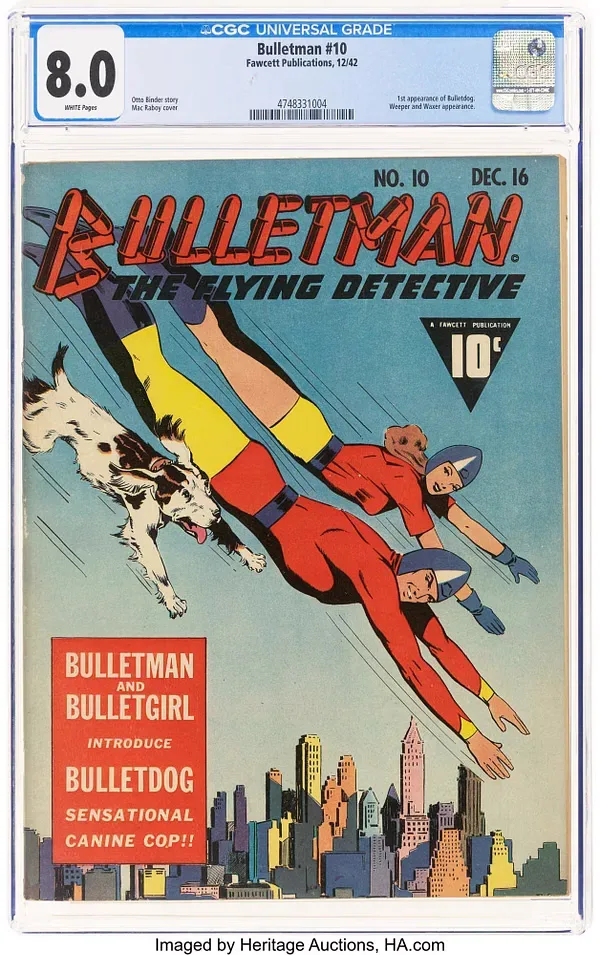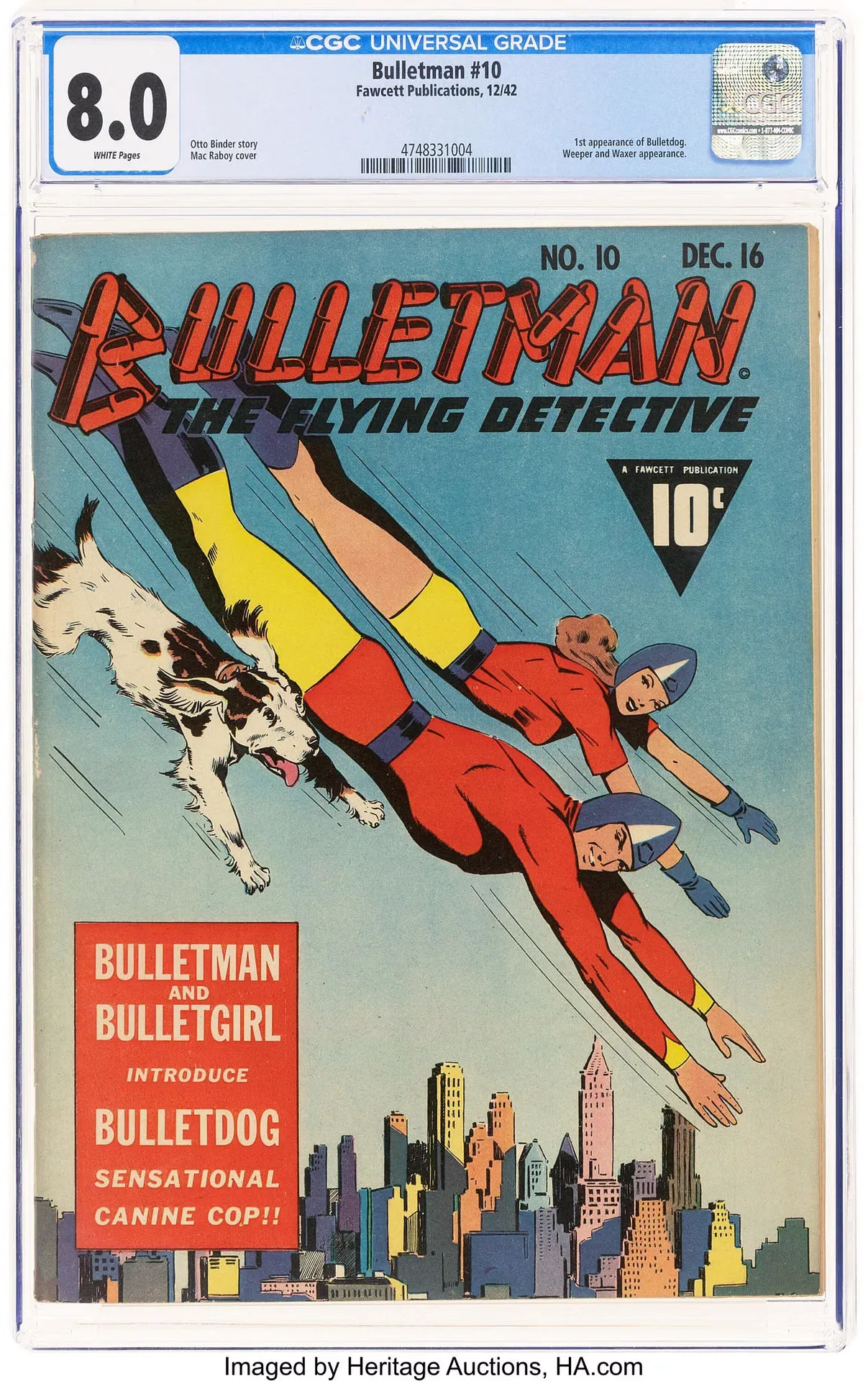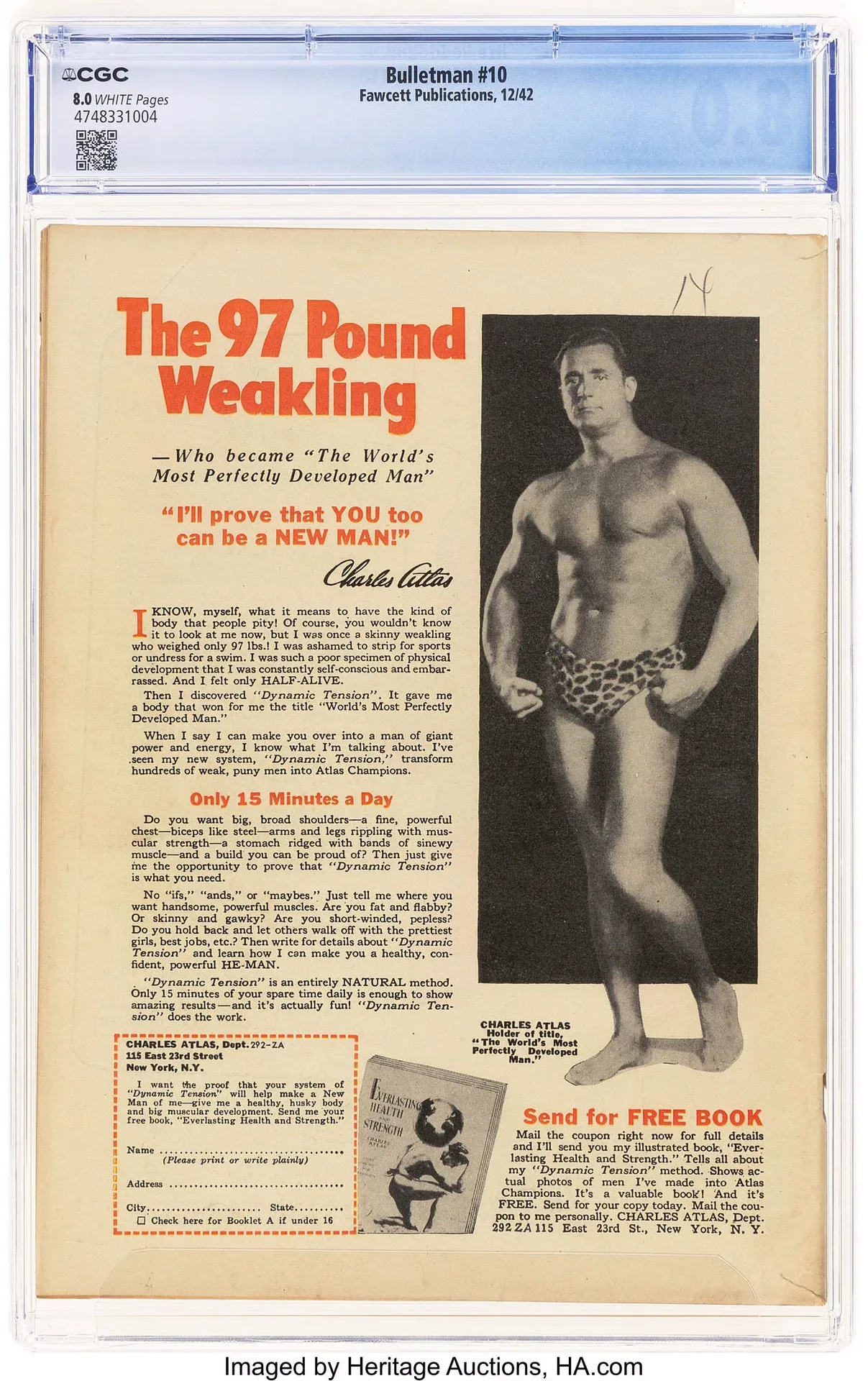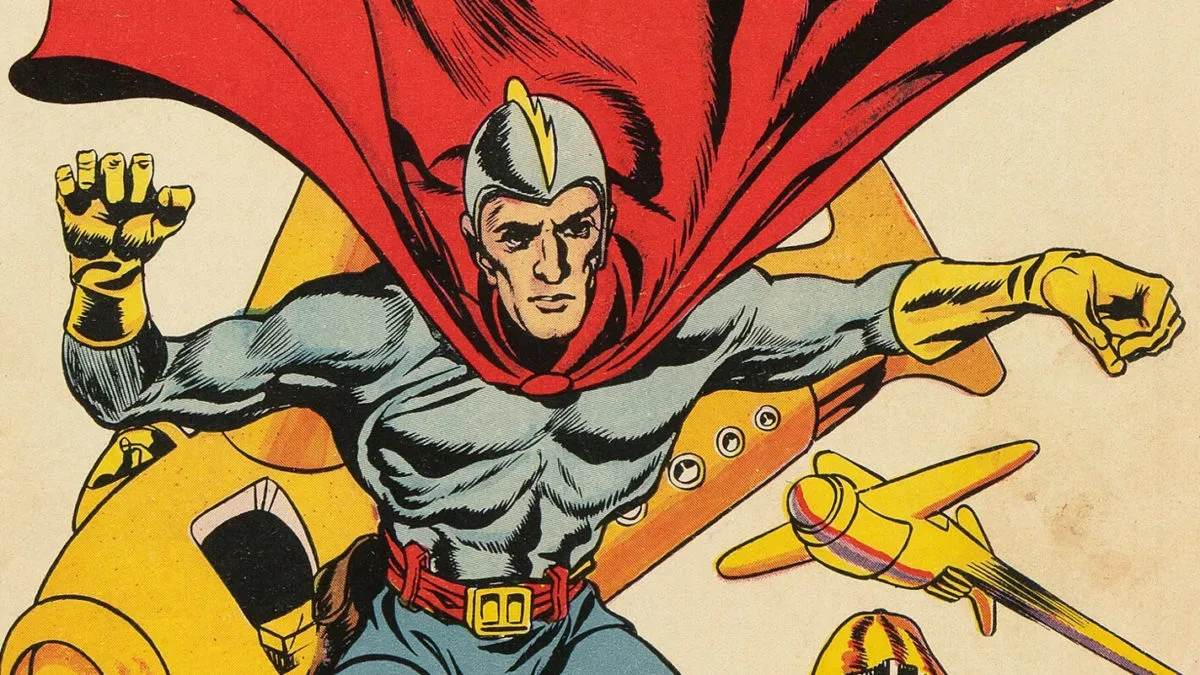
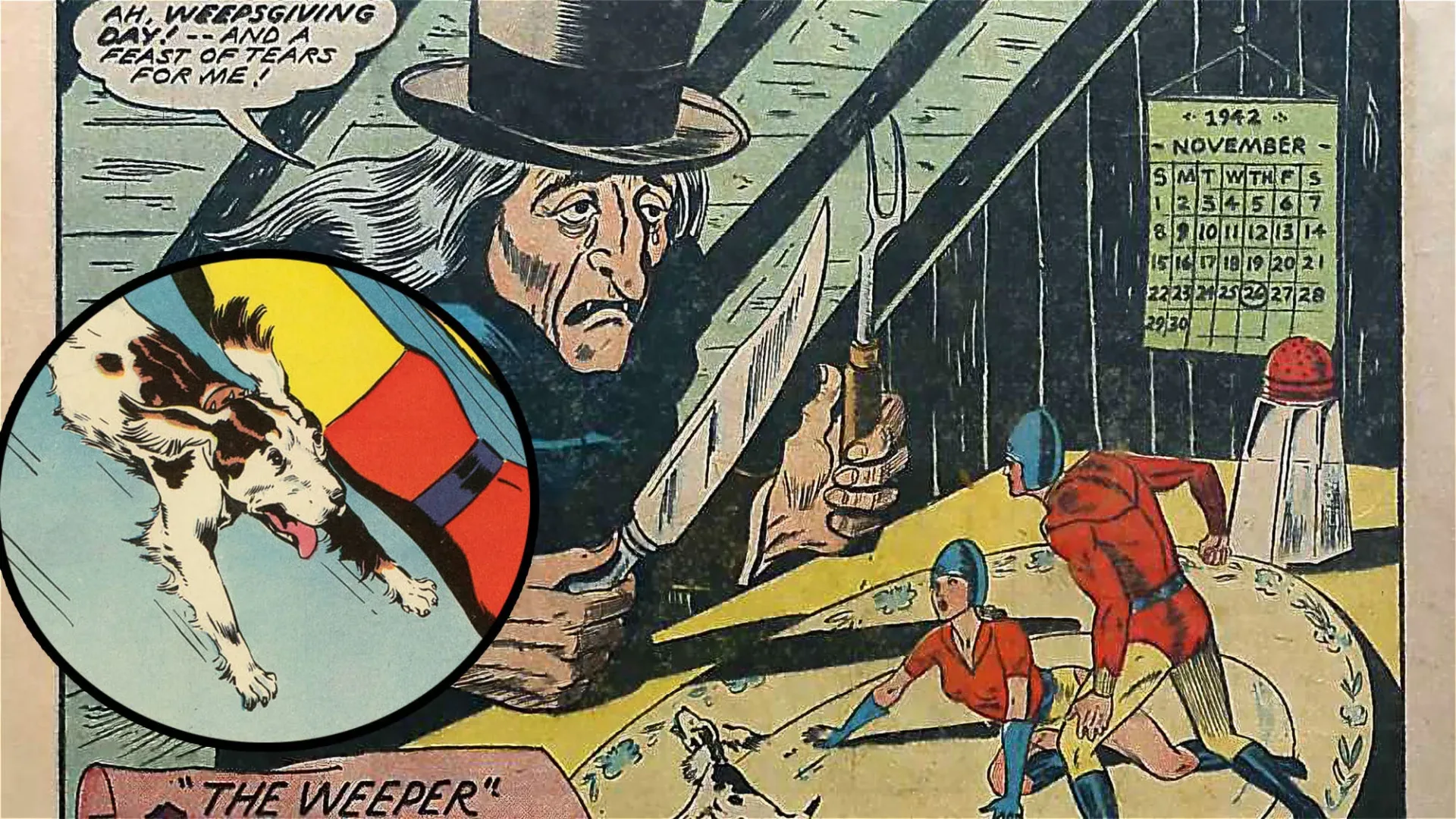
Thanksgiving is usually a poor setting for a supervillain plot, unless the villain’s entire brand is ruining a holiday dinner. That is precisely the territory of Bulletman #10, a 1942 Fawcett comic now represented by a CGC VF 8.0 copy with white pages in the December 10, 2026 Heritage Comics Auction #40379.
The issue matters for more than its seasonal premise. It supplies the crucial transformation of Bulletgirl Susan Kent’s puppy into Bulletdog, a flying canine hero equipped with an anti-gravity collar. The dog had already appeared in Bulletman #9, where he assisted Bulletman and Bulletgirl, but issue #10 is where the character receives his superhero identity and the technology that makes him part of the team.
That distinction is important for comic-book collectors. A character can debut before receiving a familiar name, costume, powers, or ongoing role. Here, issue #9 establishes the puppy’s presence and usefulness, while issue #10 establishes Bulletdog as Bulletdog. The offered comic is therefore a significant early key for a character described as arguably the first dog superhero of the Golden Age.
From a new puppy to a costumed-team regular
The story starts one issue earlier in “Case of the Canine Criminals.” Susan Kent has recently acquired a little brown puppy when Bulletman and Bulletgirl investigate a jewelry robbery carried out by dogs. The animals are being directed by a criminal through radio control, placing the story squarely in the gleefully outlandish science-fiction crime mode common to the era.
Susan’s puppy proves more than a bystander. During the case, he protects Bulletman from another dog’s attack. The plot later reveals that the puppy’s mother belongs to the radio-controlled pack, and the puppy also helps prevent the human leader of the operation from escaping. He has no superhero label at this point, but he already fills a recognizable companion role: loyal, brave, and unexpectedly effective when the adult heroes need help.
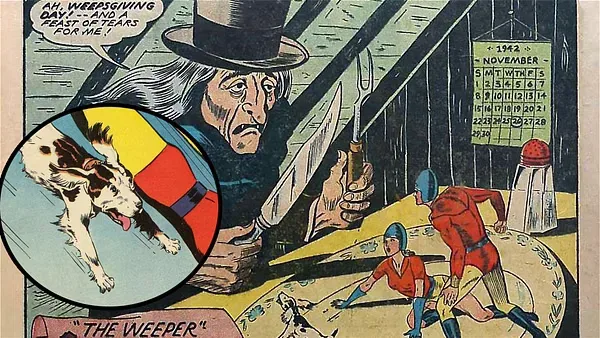
Bulletman #10 picks up the thread at the Kent household’s Thanksgiving table. There is a visual wrinkle in the transition: the black-and-white puppy depicted there does not resemble the little brown dog from the preceding issue. Yet Susan’s wish that her pet should fly alongside Bulletman and Bulletgirl makes the intended connection explicit. Continuity was not always visually airtight in early superhero comics; the character’s narrative function is what carries forward.
The issue’s antagonist, the Weeper, intends to turn Thanksgiving into a day of misery. His scheme relies on manufactured disasters and emotional manipulation. A family receives a purported War Department telegram saying that their son Edward has been killed in action, but the message is fraudulent. Elsewhere, a fake warning about a fire leads a man to disclose where he keeps his securities. Bulletman ultimately identifies the pattern: the tragedies are cover for robberies.
The premise is striking because the Weeper’s weapon is not a ray gun, monster, or elaborate disguise alone. It is misinformation tailored to provoke immediate fear and confusion. Within the adventure’s pulp logic, fake reports force people to abandon caution, reveal valuable information, or become vulnerable to theft. It gives the story a sharper criminal motive beneath its theatrical villainy.
The moment Bulletdog earns the collar
During a later confrontation, the Weeper gains the advantage over Bulletgirl. Her puppy has followed the action on foot and bites the villain’s arm, opening the moment Bulletman needs to step in. The rescue confirms that the dog’s contribution in issue #9 was not a one-off gag. Susan then proposes giving him an anti-gravity collar comparable in function to Bulletman and Bulletgirl’s helmets.
Bulletman agrees, specifically recalling the puppy’s part in stopping the dog-ring criminal in the previous issue. Susan gives her companion the name Bulletdog. This is the origin beat collectors look for: the pet is not merely retroactively called a hero, but is directly adopted into the super-team through a piece of defining equipment and a new identity.
The collar’s importance is easy to explain in superhero terms. An origin is often the event that grants a character the ability or symbolic marker separating them from an ordinary civilian. For Bulletdog, the anti-gravity device supplies the practical means to fly with his human allies, while the name makes the team relationship public to the reader. Together, they turn an adventurous household pet into a superhero character.
Bulletdog then has a final job in the Weeper case. Given the scent from the villain’s handkerchief, he tracks him to a grandfather clock. With the criminal caught, the story returns to the holiday meal, where the newest flying hero receives turkey legs. It is a tidy piece of Golden Age structure: a darkly manipulative crime is resolved with a canine feat and a domestic punchline.
A fast expansion, followed by a naming contest
Fawcett did not leave Bulletdog’s future in doubt. Issue #10 was already advertising another Bulletdog adventure and a Christmas case. Its Copyright Office entry is dated November 13, 1942, before Thanksgiving on November 26, placing the Thanksgiving-themed story’s documented copyright ahead of the holiday it uses as its setting.
The character’s naming history is also more complicated than the clean origin moment in issue #10 suggests. In the Christmas story in Bulletman #11, the dog was identified as Slug. Then Bulletman #12 invited readers to name him. The resolution appeared on page 33 of Master Comics #39, where Fawcett said it had received thousands of entries and explained the selection of Tracer.
That sequence makes the issue especially interesting as a snapshot of a character still being defined in real time. “Bulletdog” functions as the superhero designation bestowed in the Thanksgiving adventure, while the later reader-driven process settles the dog’s personal name as Tracer. For collectors and catalogers, that is a useful reminder to distinguish a heroic alias from a character’s given name, particularly in serialized comics where editorial decisions can develop across several issues.
It is also an early example of reader participation being folded into a superhero character’s identity. The thousands of submitted names point to a publisher seeking to turn a new supporting player into someone with an audience relationship beyond the page. The dog was already being positioned for repeat adventures; the contest helped formalize his place in that expanding cast.
Why condition and attribution matter for this copy
The auctioned example is graded CGC VF 8.0 with white pages. “VF,” or Very Fine, is a condition designation used in comic grading, and the 8.0 numerical grade communicates the third-party assessment in a standardized form. White pages refer to the paper’s preservation and are a notable detail for a comic published in 1942, though buyers should always treat a grade as an assessment of that specific copy rather than a guarantee that every issue has aged similarly.
The available CGC census information lists 16 Universal copies of Bulletman #10, with three at 8.0 and three graded higher. A Universal label is used for a comic without a qualifying-restoration or signature designation affecting the standard category. Census totals are useful context for the number of graded examples recorded by that service, but they are not a complete count of every surviving copy in private hands or in raw, ungraded collections.
Cover-credit attribution is another point of uncertainty. Heritage and CGC credit the Bulletdog cover to Mac Raboy. The Grand Comics Database, meanwhile, tentatively credits Jack Binder for both pencils and inks. “Tentatively” matters: it signals an attribution that has not been settled with certainty. Rather than treating either name as conclusive, prospective bidders should understand that the cover’s artistic credit remains debated.
That ambiguity does not change the underlying story significance. The issue remains the comic where Bulletgirl’s previously introduced puppy receives his anti-gravity collar and superhero identity. But it does illustrate a broader reality of Golden Age collecting: publication records, visual continuity, creator credits, and character milestones can all require careful reading across multiple issues and reference systems.
What makes Bulletman #10 a focused Golden Age key
Not every important comic is important for the same reason. Some books are sought for an unmistakable first cover appearance, others for a first appearance, an origin, a major creator credit, or scarcity in upper grades. Bulletman #10 brings several of those conversations together without making them identical.
- Early appearance: the puppy had already helped in Bulletman #9.
- Superhero origin: issue #10 gives him the anti-gravity collar and the Bulletdog identity.
- Character development: later issues continue the dog’s adventures and settle on the name Tracer through a reader contest.
- Condition context: the census records a limited number of Universal copies, including three at 8.0 and three higher.
- Attribution question: the cover has competing credits associated with Raboy and Binder.
For readers who follow comics as an evolving medium rather than only as a market, the book’s appeal is also its strange tonal balancing act. A Thanksgiving caper involving forged military-death notices and staged emergencies is grim material, yet it ends with a new canine superhero receiving turkey legs. That shift is not subtle, but it is revealing: Golden Age adventure comics could move abruptly between wartime anxiety, crime melodrama, domestic humor, and fantastic technology.
Its significance is therefore best understood as specific rather than inflated. Bulletman #10 is not simply “a comic with a dog on it.” It documents the step at which a brave puppy became a named, flying member of the Bulletman family, while preserving a character history that continued to shift over the following issues. For more recent superhero imagery taking a very different turn, see these horror-styled Marvel cover reveals.
With the CGC VF 8.0 white-pages copy headed to auction on December 10, collectors have a chance to consider that full chain of context: the prior puppy appearance, the Thanksgiving transformation, the later Tracer naming campaign, and the still-unresolved question of who created the memorable cover art.