Batman has spent decades fighting costumed criminals, solving murders, maintaining an impossible cave full of screens and somehow finding time to brood over Gotham. Yet one of the character’s most durable arguments comes down to a far smaller question: should he ever sit down?
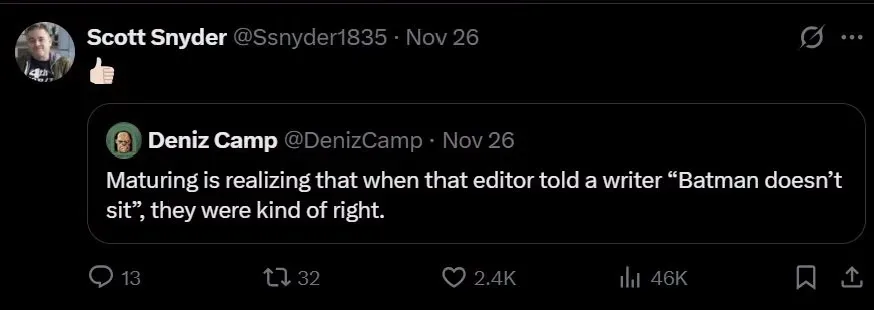
The debate has returned after Deniz Camp, attached to the upcoming Shadow of the Bat, revisited an infamous editorial note from 2013. Camp’s position was deliberately provocative but measured: the editor who insisted that Batman does not sit may have been at least partly correct. Scott Snyder, who was writing DC’s main Batman series during the earlier controversy, responded approvingly, putting new attention on a dispute that once generated memes and even a Tumblr devoted to the idea.
On its face, it is an argument about furniture. In practice, it is about character language: the visual and behavioral shorthand that tells a reader who a hero is before a word balloon explains it. Batman standing, crouching, perching or leaning forward can project vigilance and readiness. Batman seated can communicate fatigue, intimacy, control, injury, contemplation or simple practicality. The disagreement is not really whether Bruce Wayne possesses knees. It is whether a recurring visual choice changes the feeling of Batman on the page.
Where the “Batman doesn’t sit” note came from
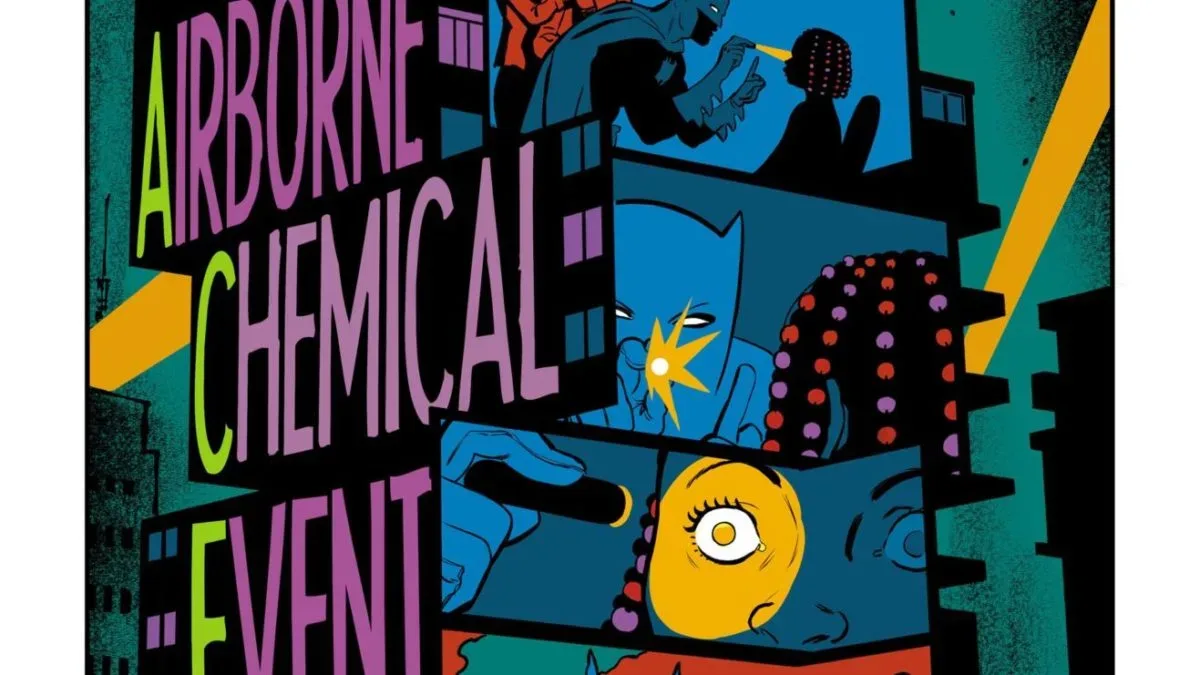
The original account was shared by writer Paul Jenkins in 2013 as he discussed leaving DC. Jenkins had been writing Batman: The Dark Knight during the New 52 era. He described a scene set on a rooftop, where Batman sat near an injured person during an intense conversation. The editorial response, as Jenkins recalled it, questioned whether the scene showed a proper understanding of Batman because the character supposedly never sits.
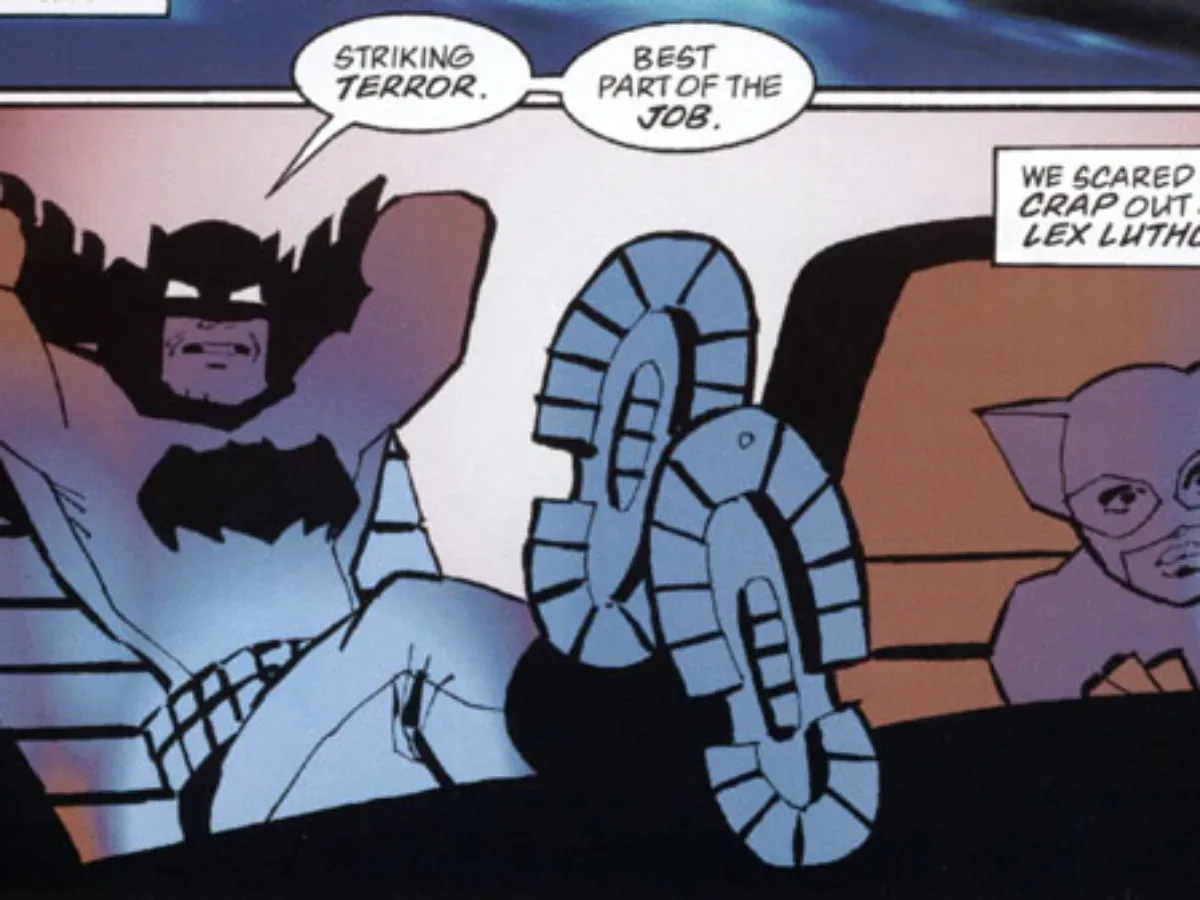
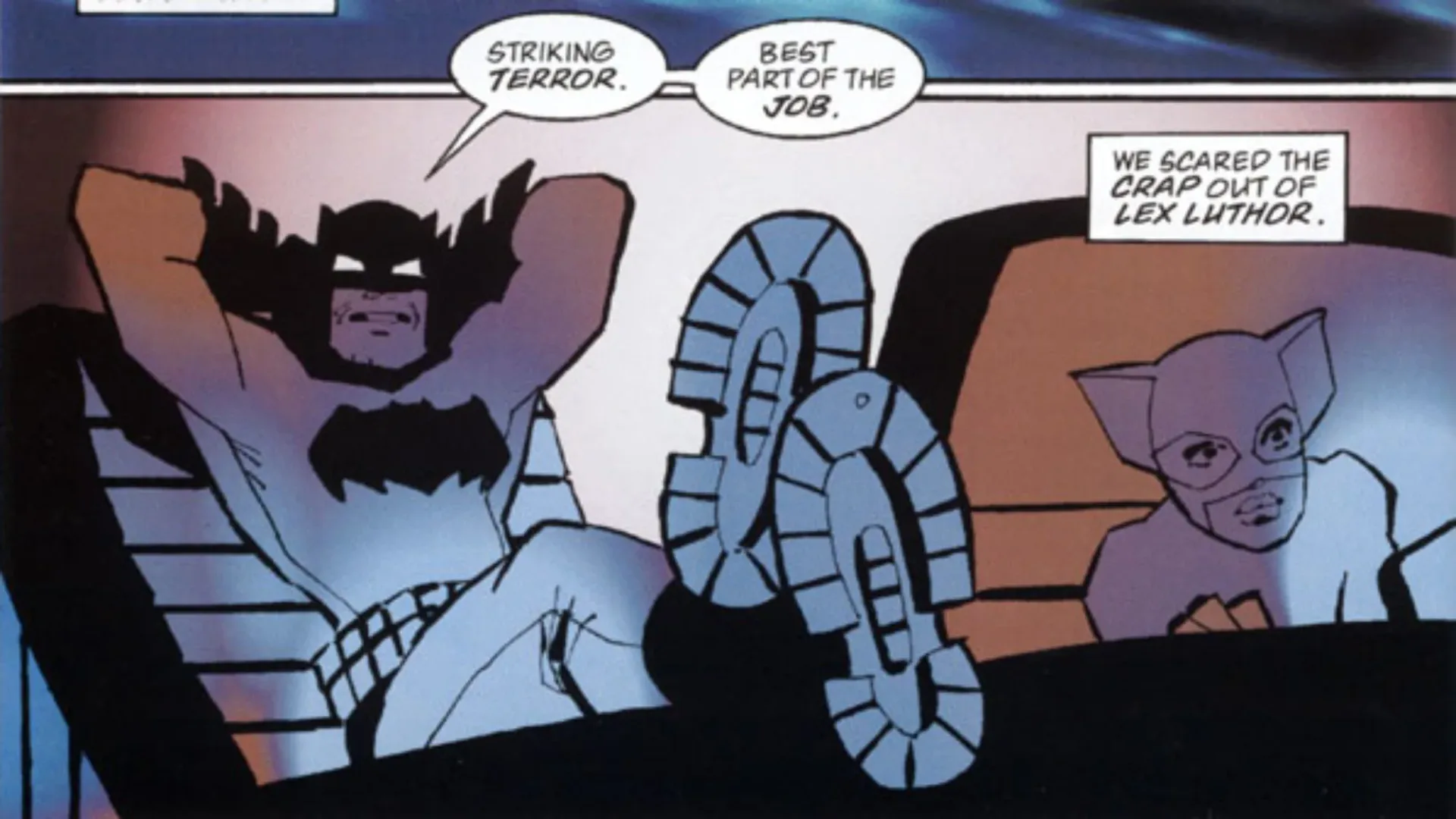
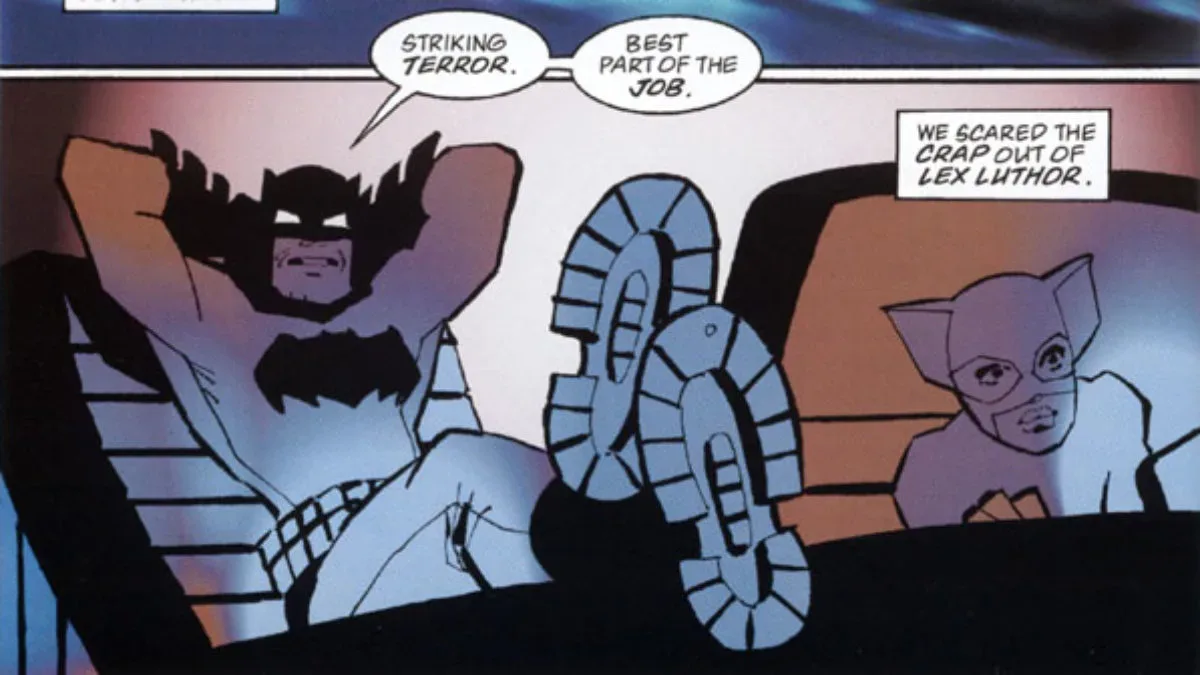
Jenkins strongly objected to the feedback. His argument had two sides. First, he challenged the factual premise, noting that Batman had appeared seated in notable comics. He pointed to work associated with Alan Moore and Brian Bolland’s The Killing Joke, as well as Frank Miller’s The Dark Knight Strikes Again. Second, he argued that editorial attention should prioritize larger storytelling concerns—such as character interaction, pacing and structure—rather than an inflexible rule about posture.
That account landed because it appears to reduce a famously expansive superhero mythology to a comically narrow instruction. “Batman doesn’t sit” is easy to repeat, easy to parody and easy to test against panels readers remember. It also carries the peculiar force of a creative note: even an apparently minor direction can affect how a writer stages a scene and how an artist composes it.
Camp and Snyder reopen the case
Camp’s recent post reframes the old note rather than simply reviving it as a joke. Saying the editor was “kind of right” does not necessarily require the literal claim to be true. Batman has plainly been depicted sitting, and Jenkins’ cited examples are central to why the statement became a punchline. The more charitable interpretation is that the note was trying—awkwardly—to protect a particular impression of the character.
Snyder’s approval matters because he was writing Batman when the original debate occurred. His response does not settle what the old note meant, nor does it turn an absolute statement into a factual rule. It does show that at least two contemporary Batman writers see value in the instinct behind it: the character’s physical bearing is part of his identity.
There is a meaningful distinction between an absolute continuity rule and a creative default. An absolute rule says Batman never sits, making any contrary panel an error. A creative default says writers and artists should think carefully before placing Batman in a relaxed seated pose, because it may weaken the intended tension or mystique. The first position is easy to disprove with existing comics. The second is an editorial preference, and preferences are where superhero characterization gets interesting.
Why posture can matter in comics
Comics are a medium of selected moments. A reader does not see every ordinary second between panels; they see poses chosen to carry information efficiently. In that setting, body position is rarely neutral.
A standing Batman can create a vertical silhouette: cape falling, shoulders squared, chin lowered. A crouched Batman keeps him compressed and predatory. A perched Batman suggests a lookout poised to move. These choices can make the hero feel as if he is always monitoring danger, even in a conversation. They are visual signals rather than hard evidence that he literally never rests.
A seated pose may send the opposite signal if it is staged casually. It can make a character appear domestic, settled or at ease. That potential mismatch is likely the strongest case for Camp’s reading of the old note. Batman’s public image depends heavily on pressure: he is often presented as alert, guarded and prepared to react. A scene that accidentally gives him the visual energy of someone waiting for a bus might undercut that construction.
But the same contrast gives a seated Batman narrative power. If a character usually appears coiled and upright, showing him sit can mark an exceptional emotional state. Sitting beside an injured person, as in Jenkins’ described scene, can emphasize proximity and concern. Sitting before Batcave monitors can indicate sustained work rather than leisure. Sitting across from an adversary can be a display of confidence. Context, panel composition and dialogue determine whether the choice reads as vulnerable, compassionate, exhausted, tactical or casual.
This is why the broad claim that Batman should never sit is less useful than a sharper question: What does the pose ask the reader to feel in this scene? That is not a loophole around character consistency. It is the work of character consistency.
The editorial lesson behind the meme
Editorial notes are often compressed. A short instruction can represent a larger concern that has not been fully explained. “Batman doesn’t sit” may have meant, “This staging makes him feel insufficiently vigilant.” It may have meant, “The scene is not projecting the version of Batman we want.” Or it may genuinely have been presented as an overly strict belief about continuity. The available account cannot resolve that intention.
What it does show is the risk of expressing a tonal concern as a literal mandate. The phrase became bigger than the scene because it sounds categorical. Once a note is worded as supposed “common knowledge,” it invites readers to look for exceptions—and Batman’s long publication history provides plenty of room for them.
For writers, artists and editors, the practical takeaway is not that every decision needs a lengthy defense. It is that precise notes travel better. If the concern is tension, say tension. If the concern is staging, identify the staging. If the concern is Batman’s intimidating presence, describe the desired effect. That gives collaborators a goal while leaving space for a scene to use stillness, injury, empathy or strategy when those elements matter.
Jenkins’ objection also identifies a legitimate hierarchy of priorities. Story flow, relationships and characterization are substantial concerns. Yet visual details need not be trivial simply because they are small. In superhero comics, repeated details become part of an icon’s grammar: a cape’s shape, a mask’s expression, a hero’s stance, the way a figure occupies a panel. The mistake is treating one bit of grammar as more important than the sentence it appears in.
Batman as an icon, not a statue
Long-running characters create an unusual tension. Readers want recognizability, but they also want scenes that feel responsive to their circumstances. Batman must look like Batman while functioning in detective stories, action stories, horror stories and intimate conversations. A rigid pose rule might preserve one surface trait while limiting the range of emotions a story can communicate.
At the same time, a character without recurring visual habits can lose clarity. That is the good-faith core of the revived argument. Batman should generally seem like a person carrying responsibility, danger and discipline. His body language should not accidentally make him seem disengaged from the room, the rooftop or the threat. That does not demand constant standing. It demands intention.
There is also a useful irony in applying the debate to Bruce Wayne rather than Batman. The civilian identity can be social, performative and at times deliberately unguarded. The costume identity is often built around control. A seated Bruce Wayne and a seated Batman may communicate entirely different things, even if both are physically the same person. The costume, setting and audience inside the scene all shape the pose’s meaning.
Batman’s Batcave is especially revealing. Jenkins noted the obvious practical counterexample of Batman using monitors while seated. No reader needs to believe Batman is literally prohibited from taking a chair while analyzing information. But a panel of him hunched, focused and surrounded by screens has a different energy from one in which he lounges. The posture does not create the character alone; the total image does.
Why the debate lasts
The renewed conversation works because both sides can identify something real. Jenkins was right to push back on a claim that a single seated scene proves ignorance of Batman, especially when established comics offer counterexamples. Camp’s reinterpretation is also persuasive as an observation about iconography: Batman’s default presentation is not relaxed, and creative teams have reason to protect that quality.
So Batman sits. Batman has sat. Batman may need to sit, whether the story calls for care, surveillance, recovery or confrontation. But the character’s usual visual promise is that he is ready to rise, move or strike at a moment’s notice. The most productive version of the old editorial note is therefore not a prohibition. It is a question for the page: if Batman is sitting here, what is that choice saying?
That kind of close reading is part of what keeps superhero comics alive as serialized visual storytelling. Even a meme-sized disagreement can expose a serious creative issue: maintaining an icon’s silhouette without mistaking the icon for a statue. For another snapshot of the current comics marketplace beyond Gotham, see the report on a Marvel-heavy week in direct-market comic sales.