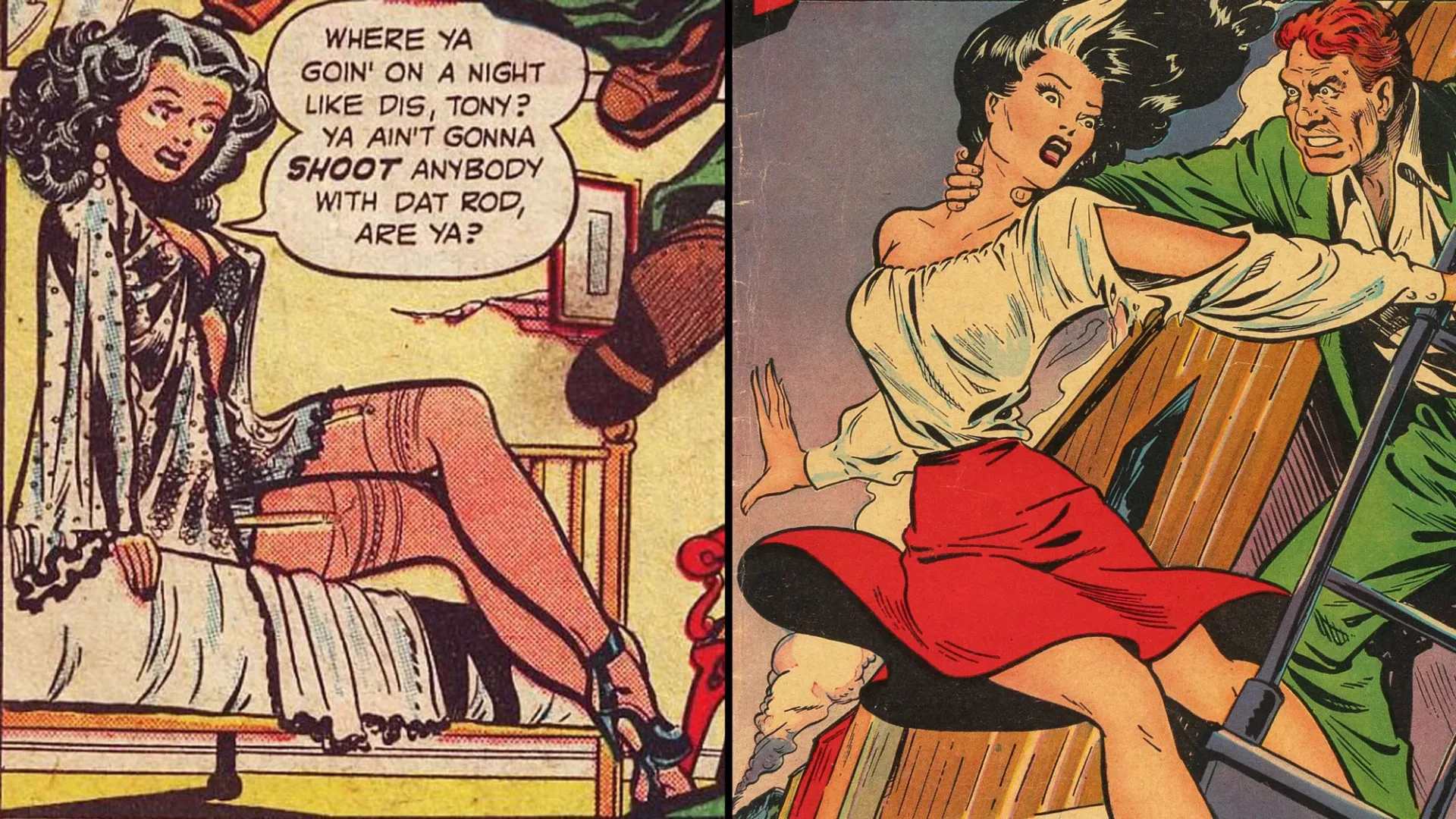
Authentic Police Cases #6 is headed to auction with the kind of layered significance that makes a Golden Age comic more than a scarce old periodical. The 1948 St. John issue combines a coveted early cover by Matt Baker, a contentious interior illustration later reproduced in Fredric Wertham’s Seduction of the Innocent, and a direct connection to the climate of public alarm that helped reshape its publisher’s line.
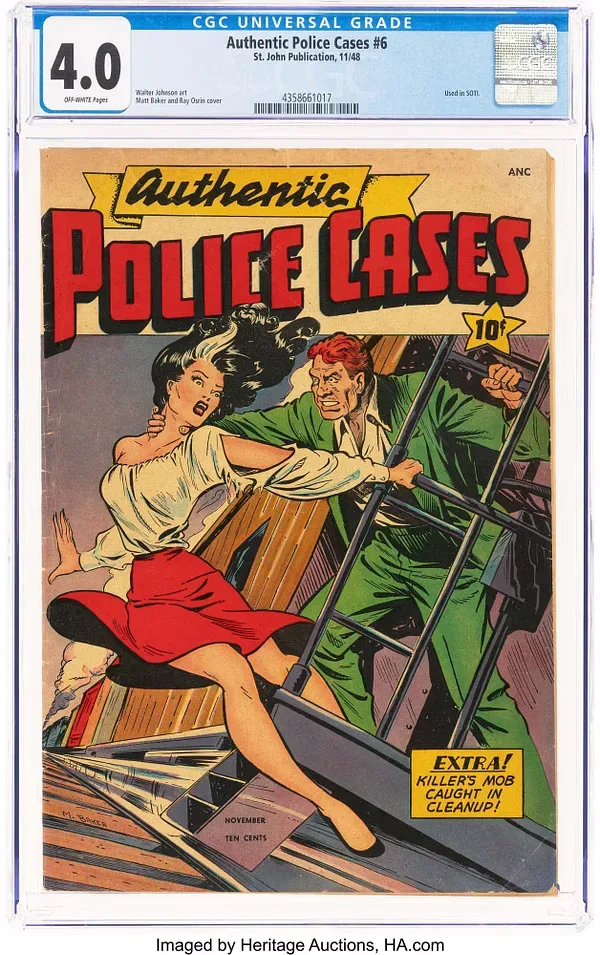
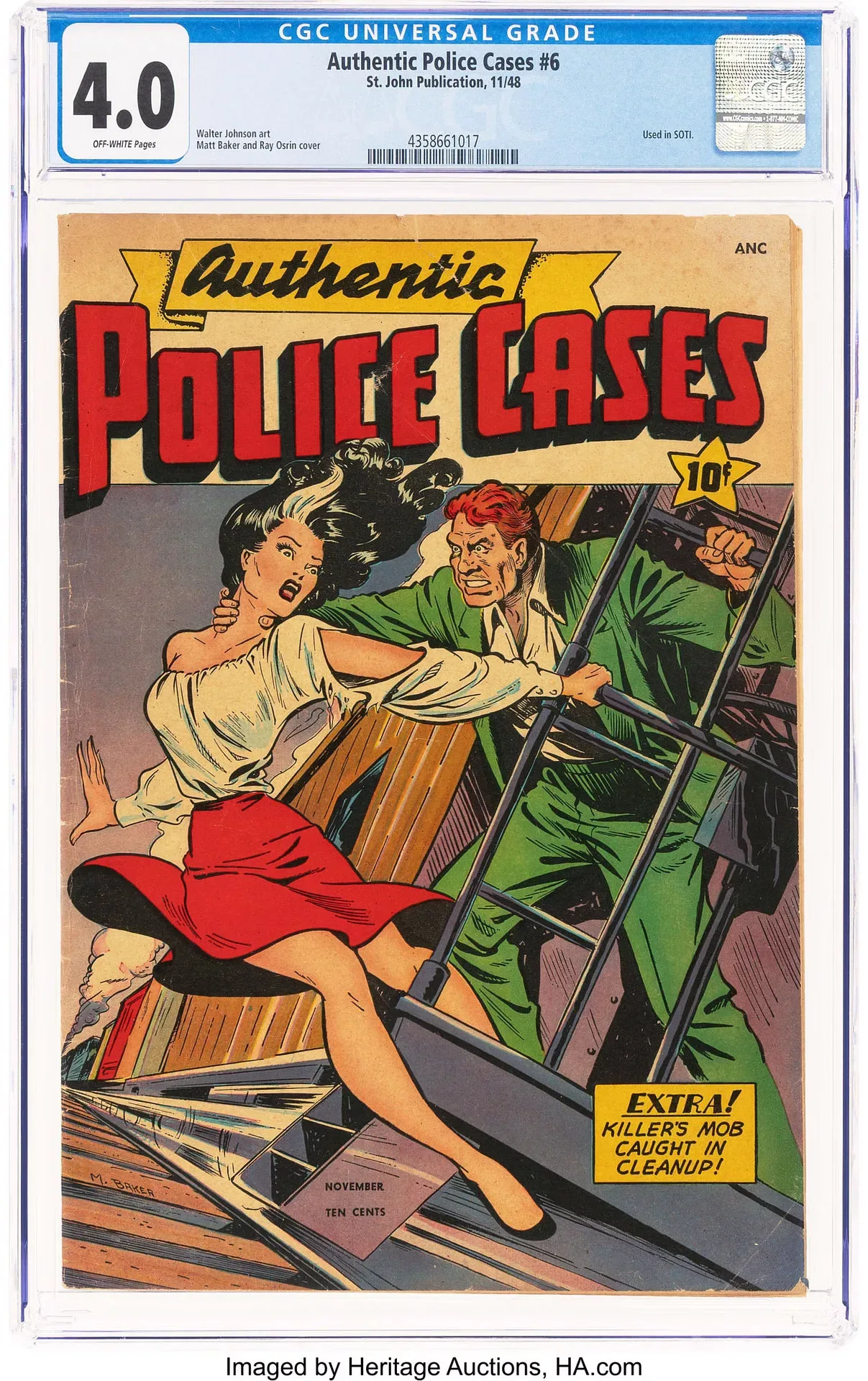
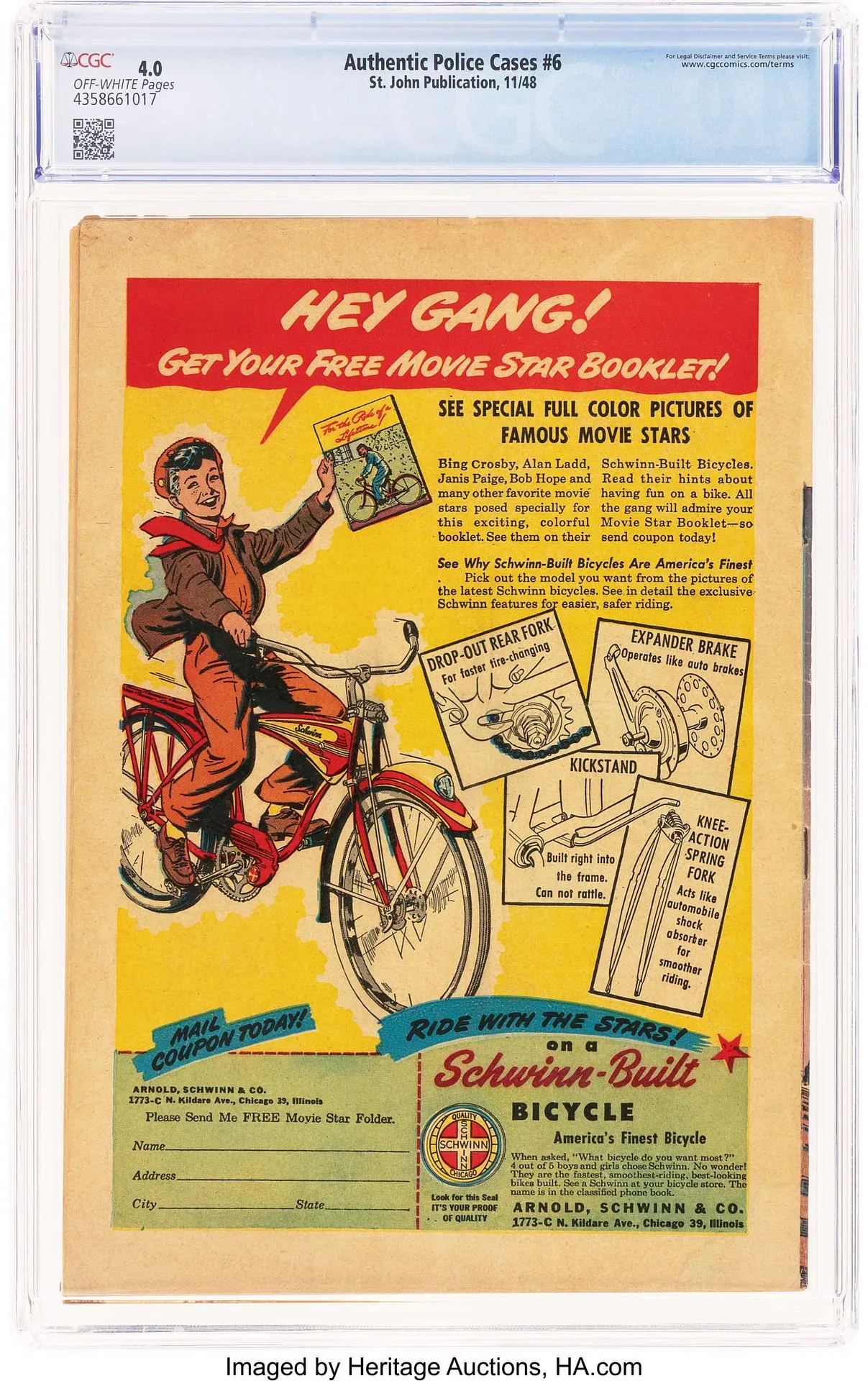
The offered copy is graded CGC VG 4.0 with off-white pages and is scheduled for the December 10, 2026 auction identified as #40379. For collectors, the attraction is not reducible to a single checklist item. The book sits at the crossroads of artist collecting, Pre-Code crime-comic history, publisher history and the long afterlife of the arguments made against comics in the late 1940s and beyond.
Why this 1948 issue matters
The cover is one of the earliest published St. John covers by Matt Baker: his fourth for the publisher. That placement is important because Baker’s subsequent association with St. John became much broader. Across the full 38-issue 1948–1955 run of Authentic Police Cases, Baker produced 28 covers.
In other words, issue #6 arrived early in a relationship that would become central to the series’ visual identity. It also appeared at a moment when crime comics were attracting damaging attention, making it an unusually useful snapshot of an artist, a publisher and a genre in transition.
“Pre-Code” here is a collecting term for American comic books published before the Comics Code Authority era. It does not mean every book in the category is alike in content or tone. It is generally a period designation, but it has also become shorthand for comics—especially crime, horror and romance books—associated with the more provocative material that sparked public criticism. Authentic Police Cases #6 is a particularly charged example because the controversy is tied to a precise page inside the issue, not merely to the broad reputation of the genre.
The Walter Johnson image in Seduction of the Innocent
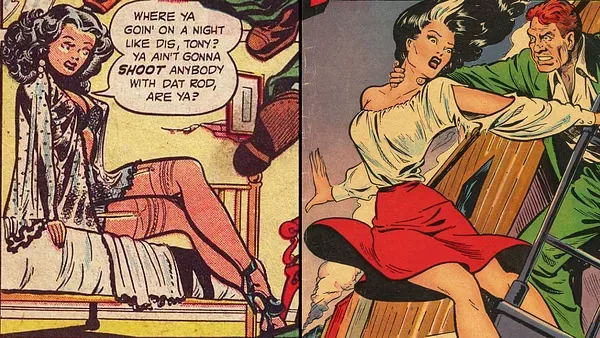
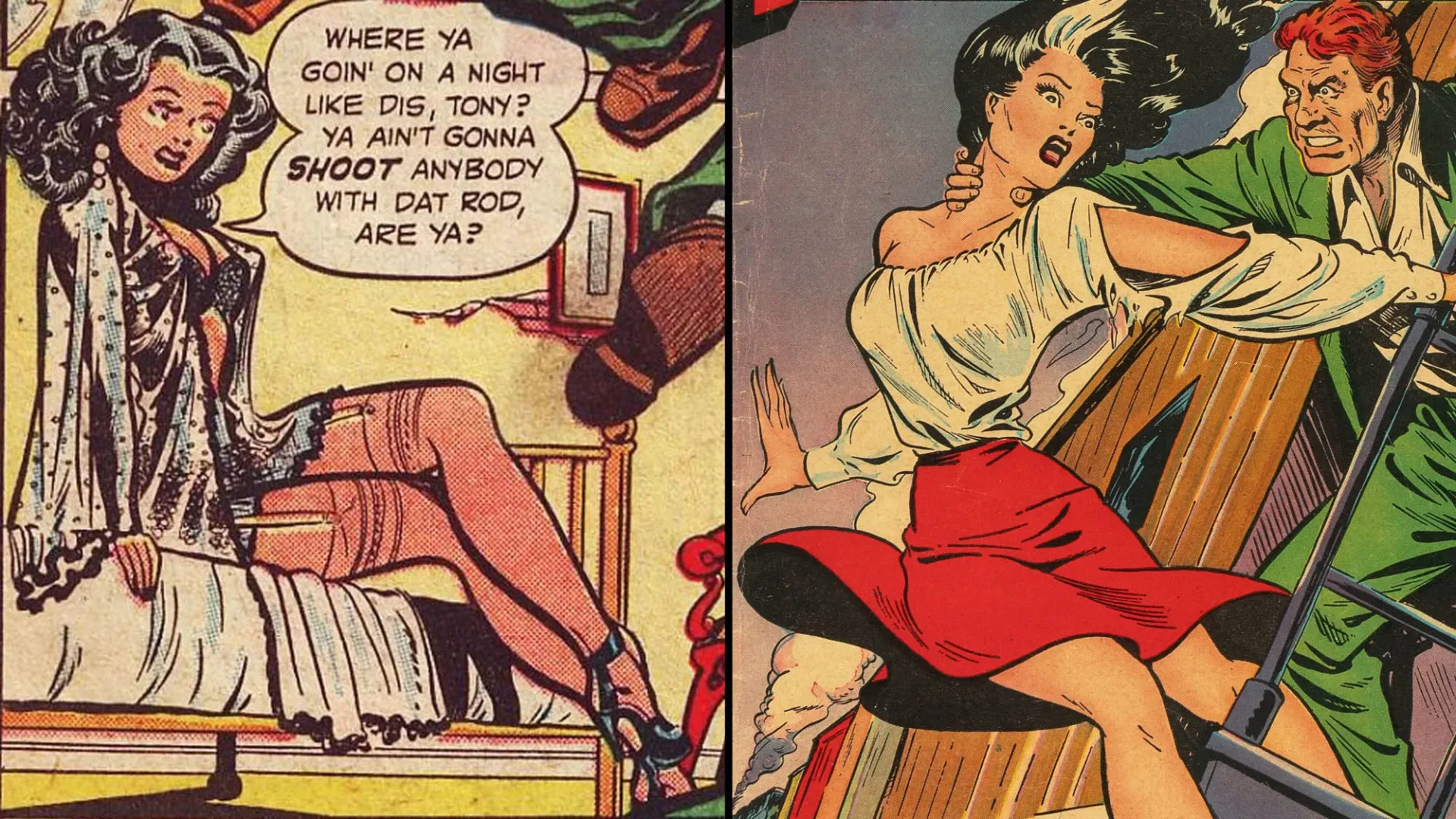
The issue contains Walter Johnson’s “Human Cat Trapped by Death Gun Slugs,” presented as an authentic crime case. Its central criminal is cat burglar Antonio Boccadora. The story’s title-page montage includes Rose, Boccadora’s girlfriend, depicted as a gun moll in lingerie. That illustration became one of the most recognizable visuals linked to the era after Wertham used it in Seduction of the Innocent.
Wertham captioned the image “An invitation to learning.” The phrase supplies little explanation on its own, leaving readers to infer the supposed lesson being criticized. That ambiguity is part of why the reproduction has endured: the image can be cited as a compact emblem of the era’s concern about what comic books might communicate to young readers.
There is a further wrinkle that makes the issue especially interesting as historical material. Rose has very little actual role in the rest of “Human Cat Trapped by Death Gun Slugs,” appearing only in a single panel beyond the title-page presentation. The prominent montage therefore gives her a visual importance that the narrative itself does not sustain. For a collector or researcher, that gap is revealing. The contentious image is not simply a neutral summary of the story; it is a selected presentation, designed to seize attention before the story gets underway.
The story’s claim to authenticity is also uncertain. Newspapers of the period did use “human cat” for burglars, but no real case involving a burglar named Antonio Boccadora has been located. That does not make the comic unimportant—if anything, it clarifies the distance that can exist between a comic’s true-crime framing and a verifiable historical record.
A more documentable case in the same comic
Another story in the issue, “Bullets Blaze the Mounties’ Trail,” offers a sharper contrast. It had originally appeared in Dynamic Comics #14 in 1946. Its underlying case is documented in an RCMP report concerning a 1932 murder: William Kurulak was sentenced to be hanged, while his brother Mike Kurulak received 15 years in prison for the murder of RCMP Corporal Ralls.
Placed together, these stories demonstrate why “authentic” should be treated cautiously as a publishing label rather than an automatic guarantee. One feature in the book has an unverified named protagonist despite its true-crime presentation; another has a documented real-world basis. That contrast adds research value to the issue and gives prospective buyers a reason to look beyond the headline image and cover.
It is also a reminder that the material inside a comic can carry as much historical weight as the exterior. Cover collecting is a legitimate focus, particularly with an artist as sought after as Baker, but this issue’s interior is inseparable from its modern identity. A buyer interested in a complete example of the period’s cultural history should care about both.
St. John’s rapid change in direction
The timing of Authentic Police Cases #6 makes it a marker of St. John’s shifting editorial and business direction. Around the period in which the comic was reaching newsstands, a Washington state reporter singled out Authentic Police Cases #5. The cited cover showed a bare-kneed girl helping a convict in a gunfight with an officer, and it was discussed in connection with a juvenile delinquent’s reading material.
St. John soon ended both Authentic Police Cases and Crime Reporter in the same month. That decision followed adverse publicity at a time of heightened scrutiny, and it affected the very titles that had recently featured Baker’s first St. John cover work.
The publisher’s next move was decisive: the following month, it launched Teen-Age Romances, its first romance comic, with a Baker cover. That pivot helped alter Baker’s career and helped St. John establish itself on a new footing. Crime Reporter did not return, but Authentic Police Cases came back to newsstands roughly 17 months later, in early 1950, after the immediate 1948 crime-comic furor had eased.
For that reason, issue #6 is not merely a desirable entry from a long run. It falls immediately beside the interruption in that run and before the publisher’s important turn toward romance comics. It can be read as evidence of the pressure that was bearing down on crime books, rather than as a detached collectible from a settled publishing program.
Baker’s later body of work is one reason those publishing decisions remain relevant to collectors. His presence connects the short-lived early St. John crime material to a much more consequential romance-comic chapter. Readers interested in the long relationship between comics characters and games can also see another corner of that wider pop-culture overlap in the Commodore 64 and Plus/4 conversion of the 1986 Batman isometric adventure, though the collecting logic around a 1948 crime comic is very different from preserving software.
What the CGC census does—and does not—say
The CGC census lists 39 Universal-label entries for Authentic Police Cases #6. Five are graded 4.0, while 21 are graded higher. “Universal” is CGC’s standard label for a comic without a qualifying restoration or other designation reflected by another label category. “VG 4.0” is the numerical grade assigned to this auction copy; the off-white page designation describes the paper rather than changing the 4.0 grade itself.
Census data is useful, but it should not be mistaken for a complete population count. It records books submitted for certification, not every surviving copy. It is most useful as a snapshot of graded examples and their distribution. In this case, the data establishes that certified copies exist above 4.0, while also showing that the offered grade is represented by only five Universal-label entries in the census cited for the issue.
Condition remains consequential, but this is a book where demand can be driven by several overlapping considerations: Baker’s cover, the Wertham-linked interior montage, the specific Pre-Code crime context, and the issue’s place in St. John history. Those factors do not make a 4.0 equivalent to a higher-grade copy; they explain why a mid-grade copy can still draw attention.
Practical takeaways for comic collectors
- Identify the issue precisely. The collectibility here is tied to Authentic Police Cases #6, not simply to the title or to any generic St. John crime comic.
- Separate cover, contents and provenance. Baker’s cover and Johnson’s interior image are distinct reasons for interest. A prospective buyer should understand both.
- Read “authentic” critically. The issue itself contains a contrast between an unverified purported crime case and a story connected to documented events.
- Use census numbers appropriately. Certified-population data can inform rarity discussions, but it does not count all surviving copies or dictate value on its own.
- Consider context alongside grade. The 4.0 grade and off-white pages matter, but so does the issue’s unusually direct place in debates over crime comics and juvenile reading.
The December offering is therefore a chance to acquire a comic with several durable collecting narratives embedded in a single object. It is an early landmark in Baker’s St. John work, a surviving artifact from a publishing retreat and relaunch, and a book whose interior art became part of one of the best-known anti-comics arguments of the twentieth century.