Amazing Spider-Man #1000 will mark a major numerical milestone for Marvel’s long-running wall-crawler series when it goes on sale September 30, 2026. The 104-page, Rated T anthology carries a $9.99 US cover price and brings a broad group of writers and artists into the celebration, with Joe Kelly, Noah Hawley, Pepe Larraz and Patrick Gleason listed among its creators. The main cover is by John Romita Jr.
Milestone comics can sometimes be built entirely around spectacle: a large guest cast, a line-wide threat, a commemorative format, or an excuse to revisit famous eras. The material outlined for Amazing Spider-Man #1000 takes a more intimate route alongside its supervillain promise. Spider-Man is set to face a new foe called Ravage, described as his most frightening new villain in decades, while Peter Parker’s family faces an emergency involving Aunt May.
That pairing matters. Spider-Man stories work best when the costume-level danger and Peter’s personal life pull in opposite directions. A new adversary may provide the big, forward-looking superhero conflict expected of an anniversary issue. Aunt May’s situation, and the appearance of newly discovered Parker cousin Cormac Crane, bring the milestone back to the human stakes that have always made Peter’s responsibilities feel costly.
A landmark issue with a deliberately wide creative scope
The defining feature of issue #1000 is its anthology structure. An anthology comic contains multiple stories or segments, often made by different creative teams, rather than one uninterrupted chapter by a single writer and artist. For a legacy number such as 1000, that format creates room for several approaches to the same character: a present-day plot can stand alongside a short character study, a tribute from a returning creator, or a self-contained story with a distinctive visual style.
The announced lineup reflects that ambition. Noah Hawley is making his comic-book debut in the issue. Frank Miller and Peach Momoko are collaborating for the first time, while Stuart Immonen and Brian Michael Bendis are returning to Spider-Man together. Those names alone do not reveal how many pages each contributor will handle or how their material will connect, so readers should not assume that every announced talent is involved in the Ravage plot. What is clear is that the issue is designed to honor the breadth of The Amazing Spider-Man through multiple creative voices.
For readers who follow comics primarily through individual runs, an anthology can feel different from a standard monthly issue. It may offer less of a single sustained narrative than a normal installment, but that is also the appeal of a celebratory special: each team can concentrate on one idea, relationship, mood or image. The format makes the issue potentially welcoming to curious readers who want a substantial Spider-Man package without needing to begin at the first page of an ongoing arc.
It also places extra pressure on editorial coordination. A big anniversary comic must feel substantial without becoming a collection of disconnected victory laps. The central ingredients announced here—Ravage, Aunt May and Cormac Crane—give the book a possible emotional spine, even as additional creators contribute their own perspectives on Peter Parker.
Ravage is the new unknown in a story built around familiar stakes
Ravage is the headline mystery. The character is being positioned as a formidable new threat, but the available details do not establish an origin, powers, costume, motives or connection to Peter Parker. That lack of definition is useful in a preview context: Spider-Man’s rogue gallery is crowded with villains whose identities and tactics are immediately recognizable, while a new villain has to earn attention through uncertainty as well as danger.
The title “Ravage” suggests destruction, but that is interpretation rather than confirmation of the character’s abilities or goals. Readers looking for concrete answers will need to wait for the comic itself. The most reliable expectation is simply that Ravage is intended to be a major adversarial presence, not merely a background guest in the anniversary lineup.
New villains in a legacy title face a particular challenge. They must give Peter a problem that feels unlike his established battles, but still belong in Spider-Man’s world. An effective debut does not necessarily require a larger power scale than previous enemies. It needs a pressure point: something that tests Peter’s values, his resourcefulness, his relationships or the fragile balance between Peter Parker and Spider-Man. The issue’s family plot indicates that personal vulnerability may be as important as physical peril.
Aunt May and Cormac Crane put family at the center
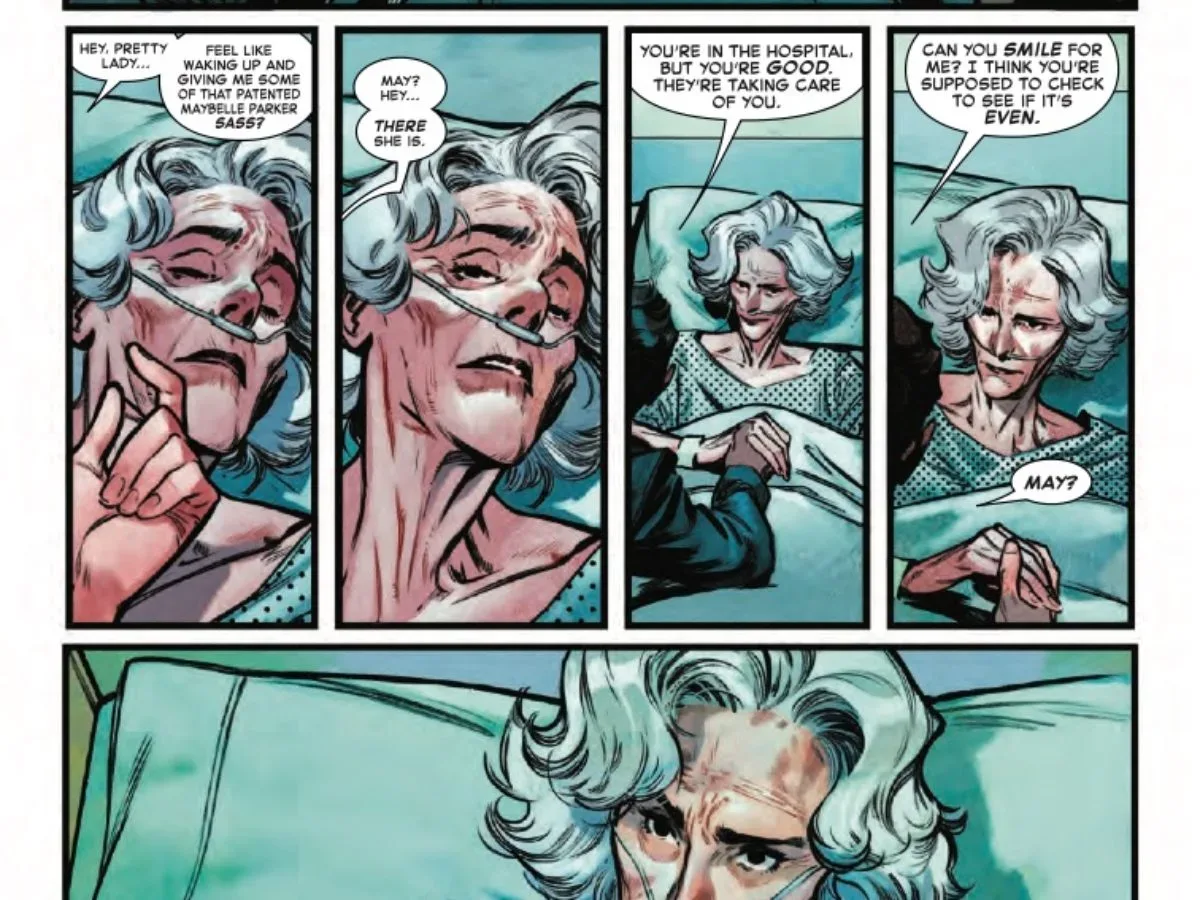
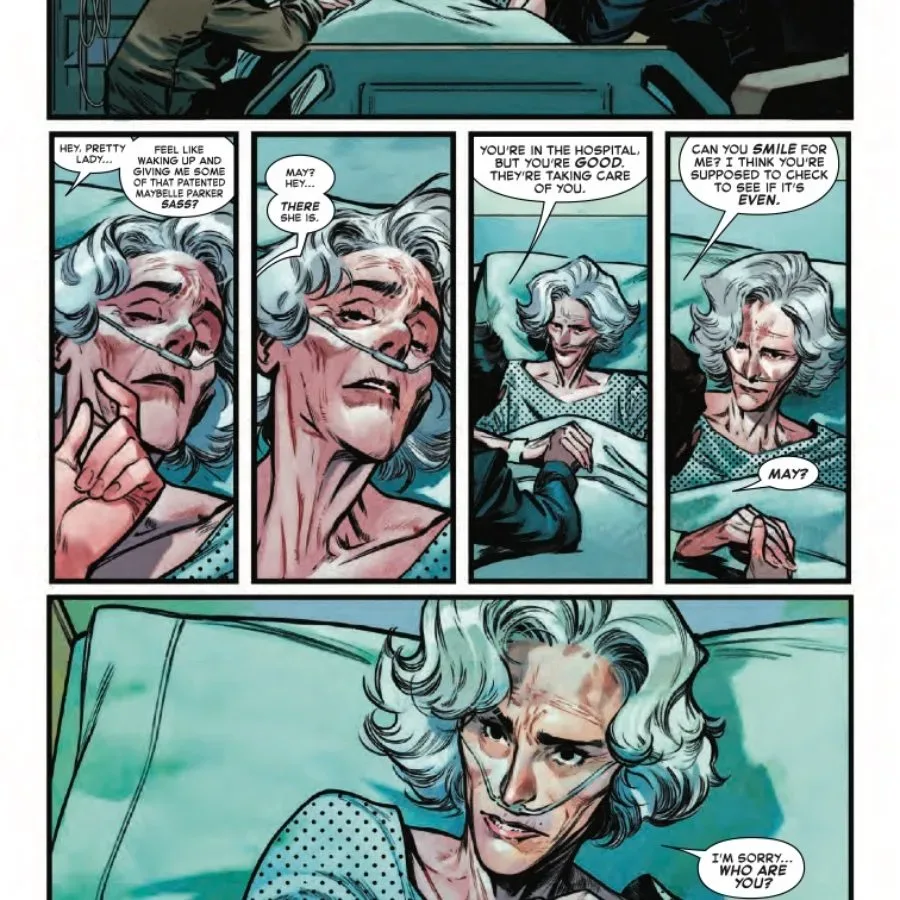
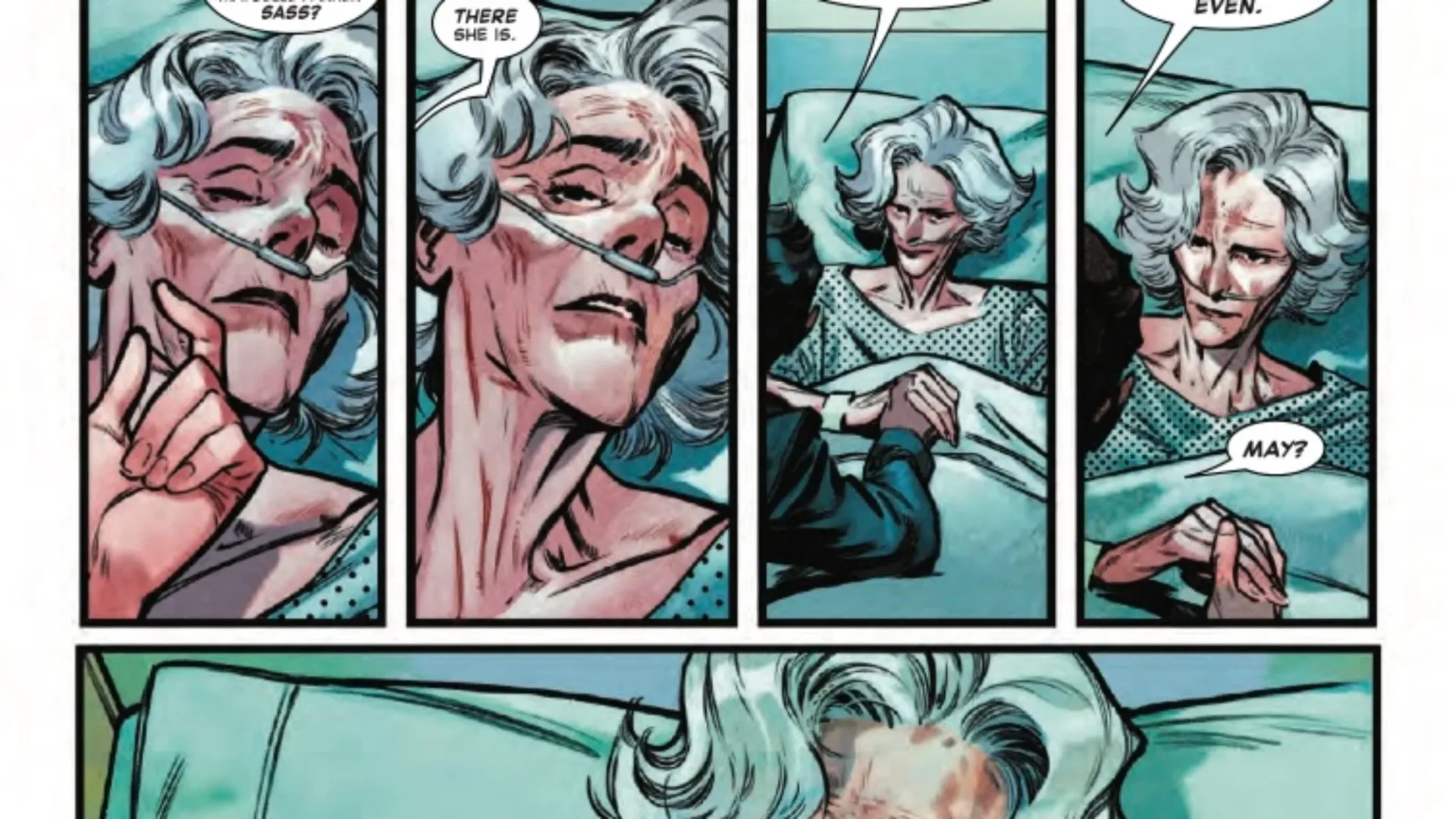
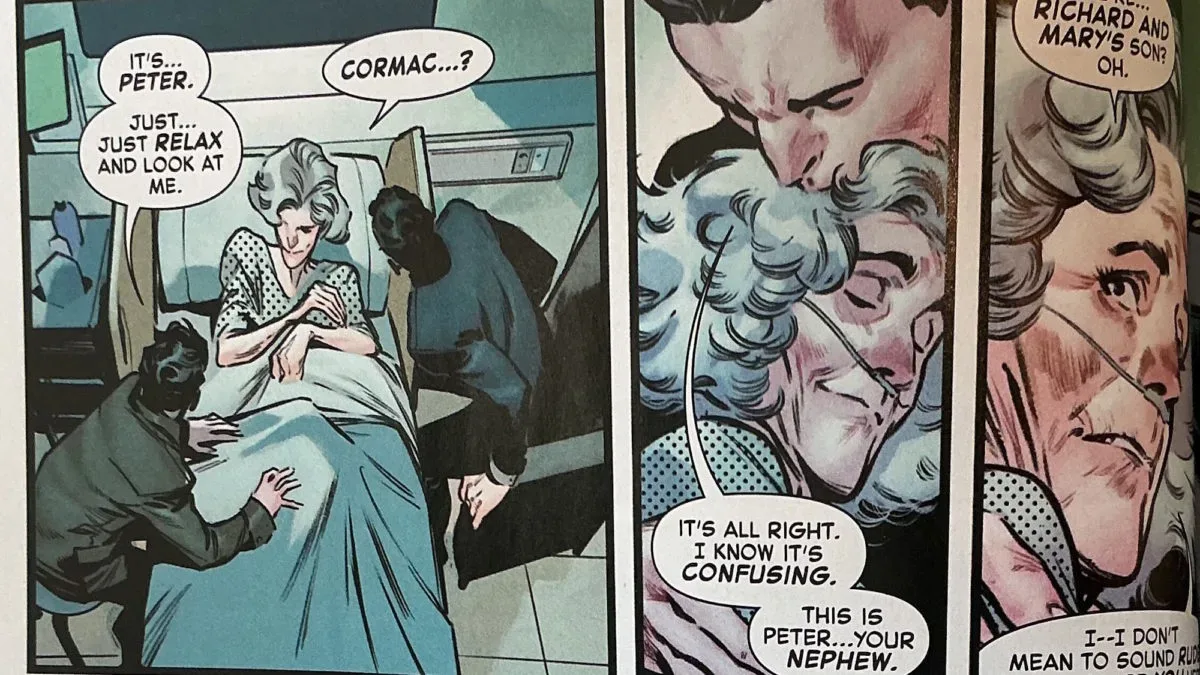
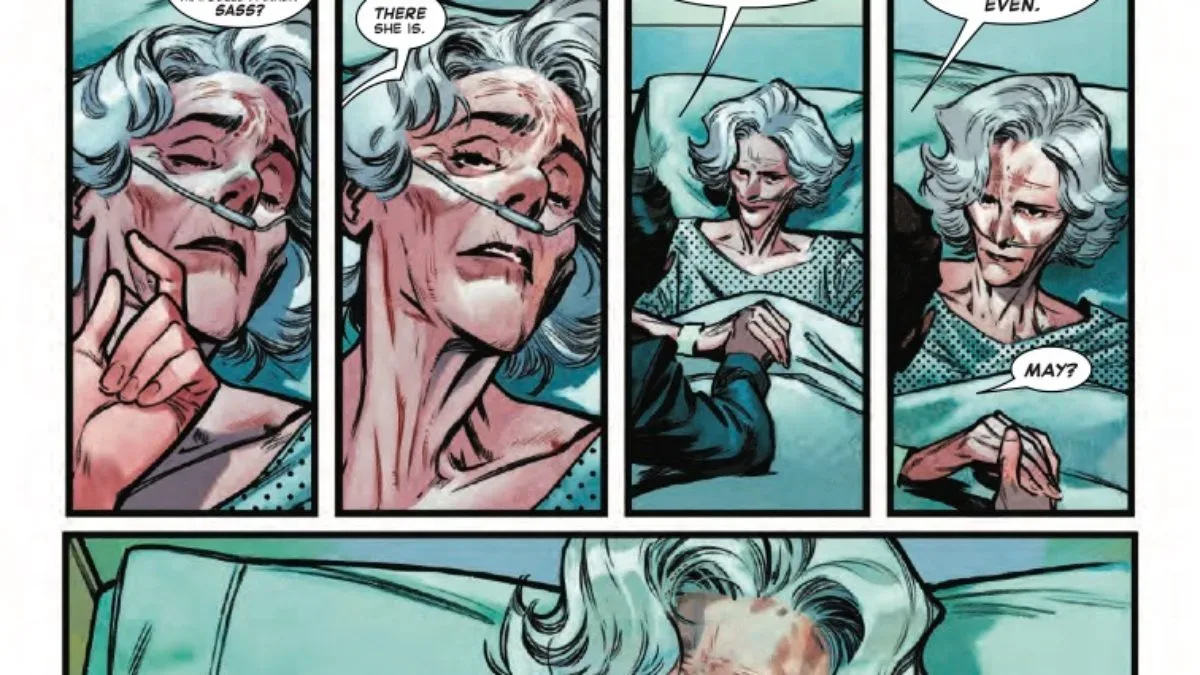
The preview material places Aunt May in a medical crisis after confusion and difficulty with speech, leading to a hospital scene. Cormac Crane, identified as a newly discovered Parker cousin, is involved in the situation and seeks specialist help. These are story details about fictional characters, not a diagnosis or substitute for medical guidance, but they immediately establish the sort of problem Spider-Man cannot simply punch or web away.
That distinction is fundamental to the character. Peter can respond to a robbery, an attack or a super-powered disaster by becoming Spider-Man. Family emergencies do not grant him that same clarity. They demand presence, patience and difficult choices—especially when a masked hero’s obligations arrive at the same time. Putting Aunt May in jeopardy therefore gives the issue stakes that are personal without needing to disclose Ravage’s full plan in advance.
Cormac’s introduction is equally notable. A newly discovered relative is more than another supporting player; he has the potential to complicate how the Parker family sees itself. At this stage, there is no confirmed evidence that Cormac is an antagonist, a secret ally, or connected to Ravage. His role should be treated as an open question. The available setup establishes him as a family member entering the story during an acute crisis, which is enough to make him narratively significant.
For a thousandth issue, this emphasis on May also connects the milestone to a core feature of Spider-Man storytelling: the hero’s life is never only about the mask. However extraordinary the villain, Peter’s responsibility is measured by the people who rely on him when he is not swinging through the city.
What the anniversary format means for readers and collectors
The standard edition of Amazing Spider-Man #1000 is listed at 104 pages for $9.99 US, with a $12.50 Canadian price. That page count sets it apart from a typical single-issue chapter and helps explain its anthology approach. The book is also supported by a large range of cover editions, including designs credited to Pepe Larraz, Mark Bagley, Alex Ross, Patrick Gleason, Erik Larsen, Stuart Immonen, Steve Ditko, Humberto Ramos, Marcos Martin, Todd Nauck, Ryan Stegman, Skottie Young and others.
A variant cover is an alternate exterior cover for the same comic issue. It is important to separate the cover from the interior: buying a different cover edition does not automatically mean receiving a different story, and the supplied listing does not indicate exclusive interior content for any of these editions. A virgin variant, such as the listed Lee Bermejo and J. Scott Campbell editions, generally refers to cover art presented without the usual logo and trade dressing. A wraparound cover extends the artwork across the front and back, while a connecting cover is designed to align visually with companion images.
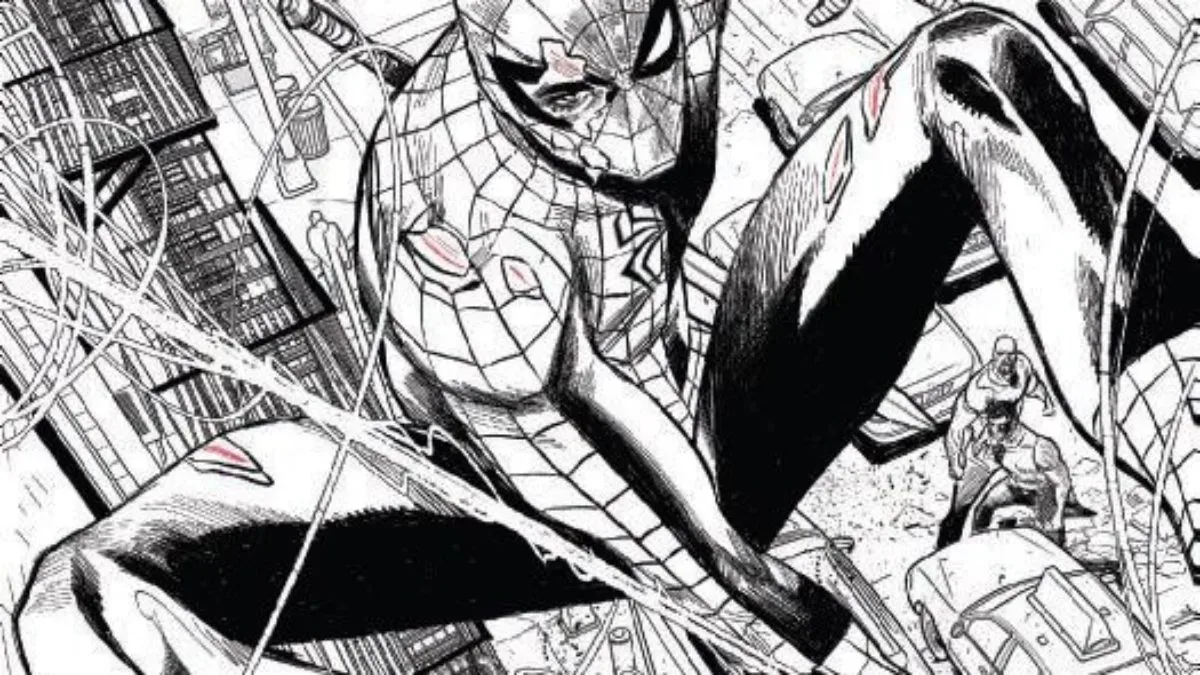
The listed selection includes a four-part connecting legacy cover by Todd Nauck, a Marvel Animation Spider-Man 1967 wraparound variant, a foil variant by Ed McGuinness, a black-and-white Steve Ditko variant, a Ravage cover by Ryan Stegman, and a Peach Momoko and Frank Miller variant. There are also second-printing variants credited to John Romita Jr. and Pepe Larraz in the provided catalog information.
For buyers, the practical question is simple: decide whether the priority is reading, a preferred artist, or completing a specific visual set. The regular edition is the clearest route for someone who wants the story itself. A favorite cover artist or a format such as the connecting set may make a variant more appealing, but the sheer number of options means collectors may want to check which editions their local shop plans to carry rather than assume every cover will be readily available.
Those following Aunt May’s current place in Marvel stories may also be interested in a separate Avengers preview featuring Spider-Man, Aunt May and Mephisto. It is a reminder that May’s presence can resonate well beyond Peter’s solo title, even as Amazing Spider-Man #1000 makes her situation central to its own anniversary narrative.
What remains unknown before release
The announcement makes the scale of the project clear, but it wisely leaves several major questions unanswered. Ravage’s identity and threat are still under wraps. Cormac Crane’s broader significance has not been confirmed. The exact division of stories among the all-star creative teams has not been detailed, and further art and talent reveals are anticipated in September.
That leaves Amazing Spider-Man #1000 with a balanced promise: a landmark-sized tribute to the title’s history, a fresh villain intended to push it forward, and an emotionally immediate crisis rooted in Peter Parker’s family. Whether each anthology segment lands will be for readers to judge after release. Before then, the issue’s strongest hook is not just its four-digit number. It is the prospect of Spider-Man confronting a threat he cannot solve merely by being Spider-Man.