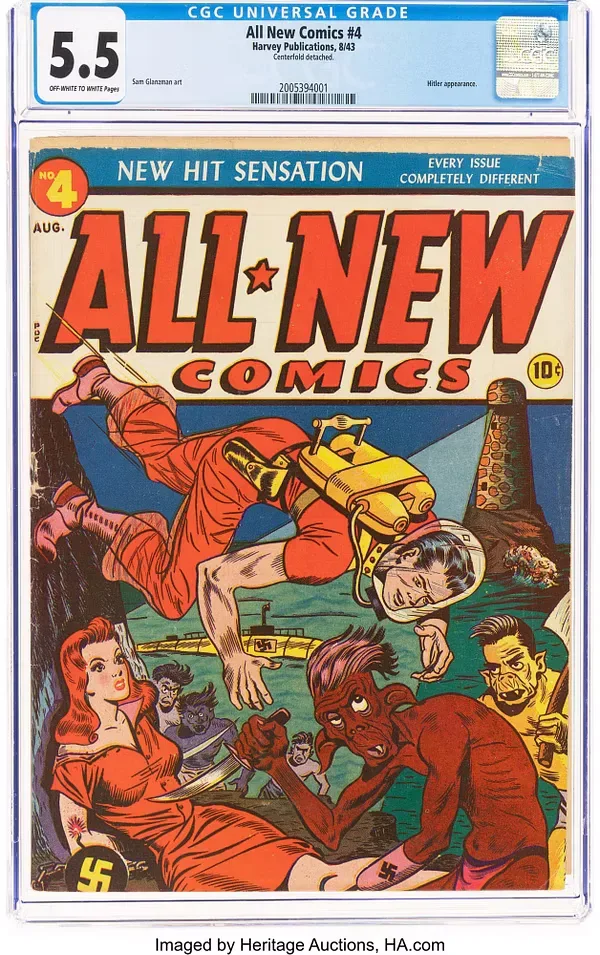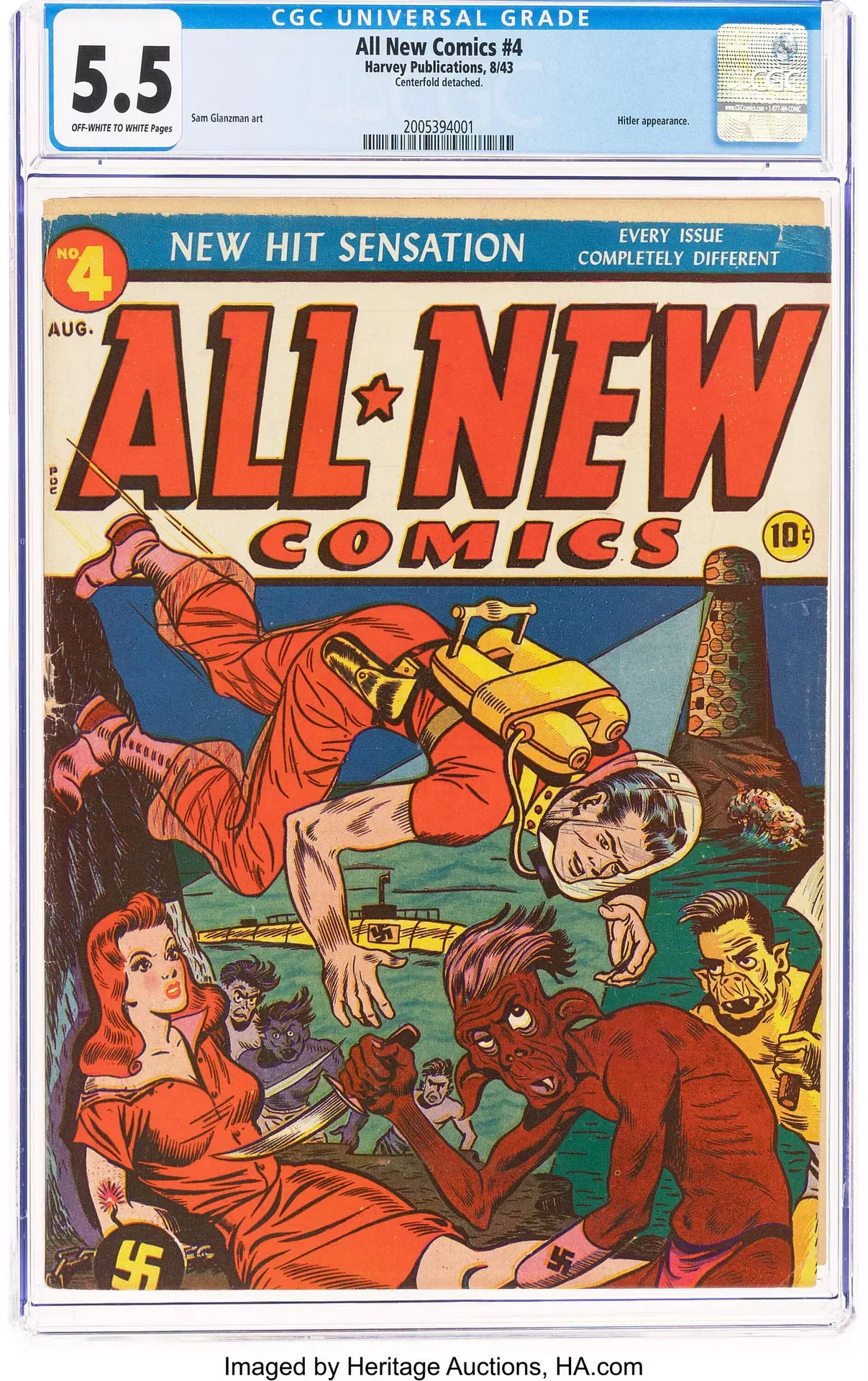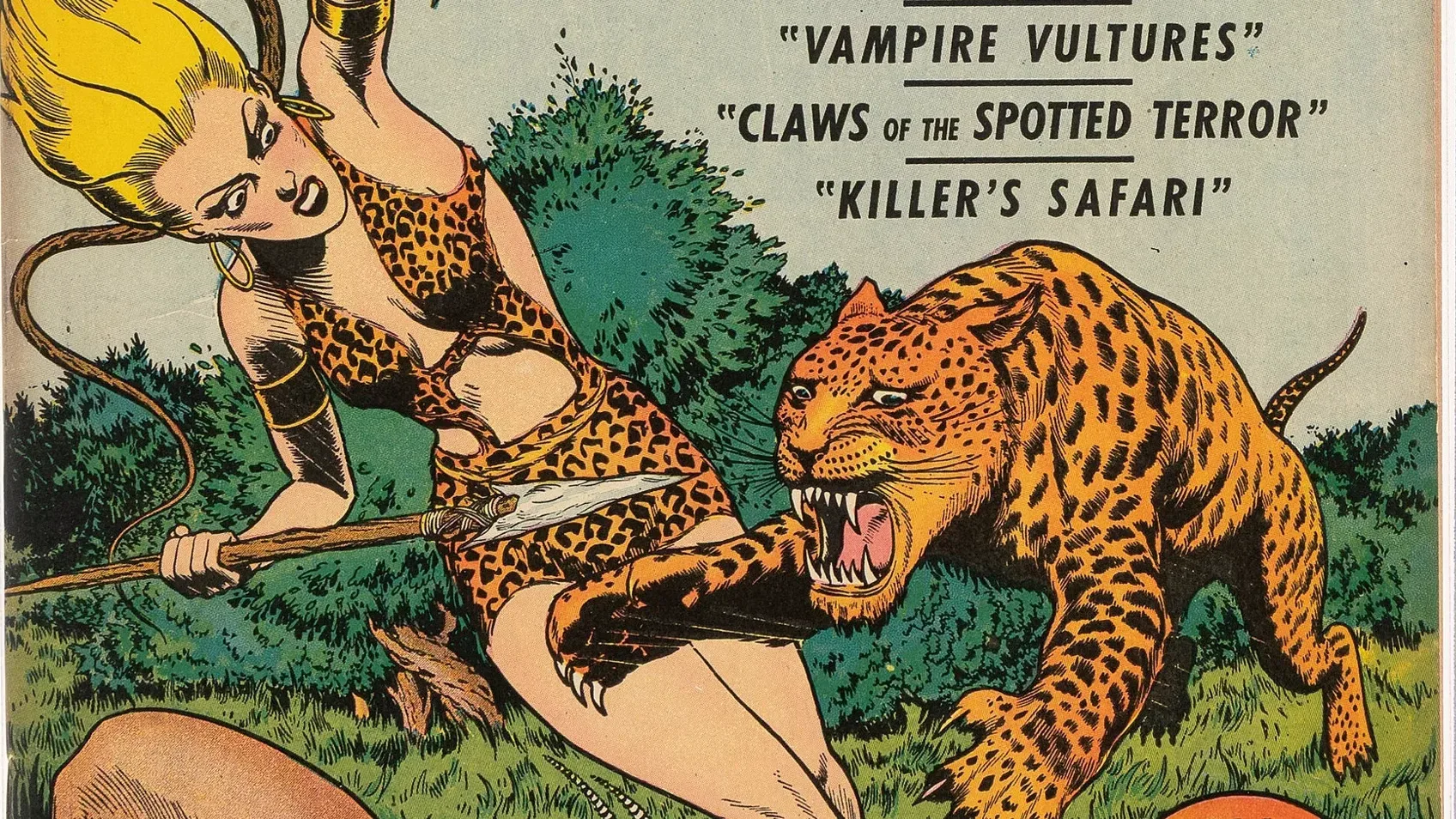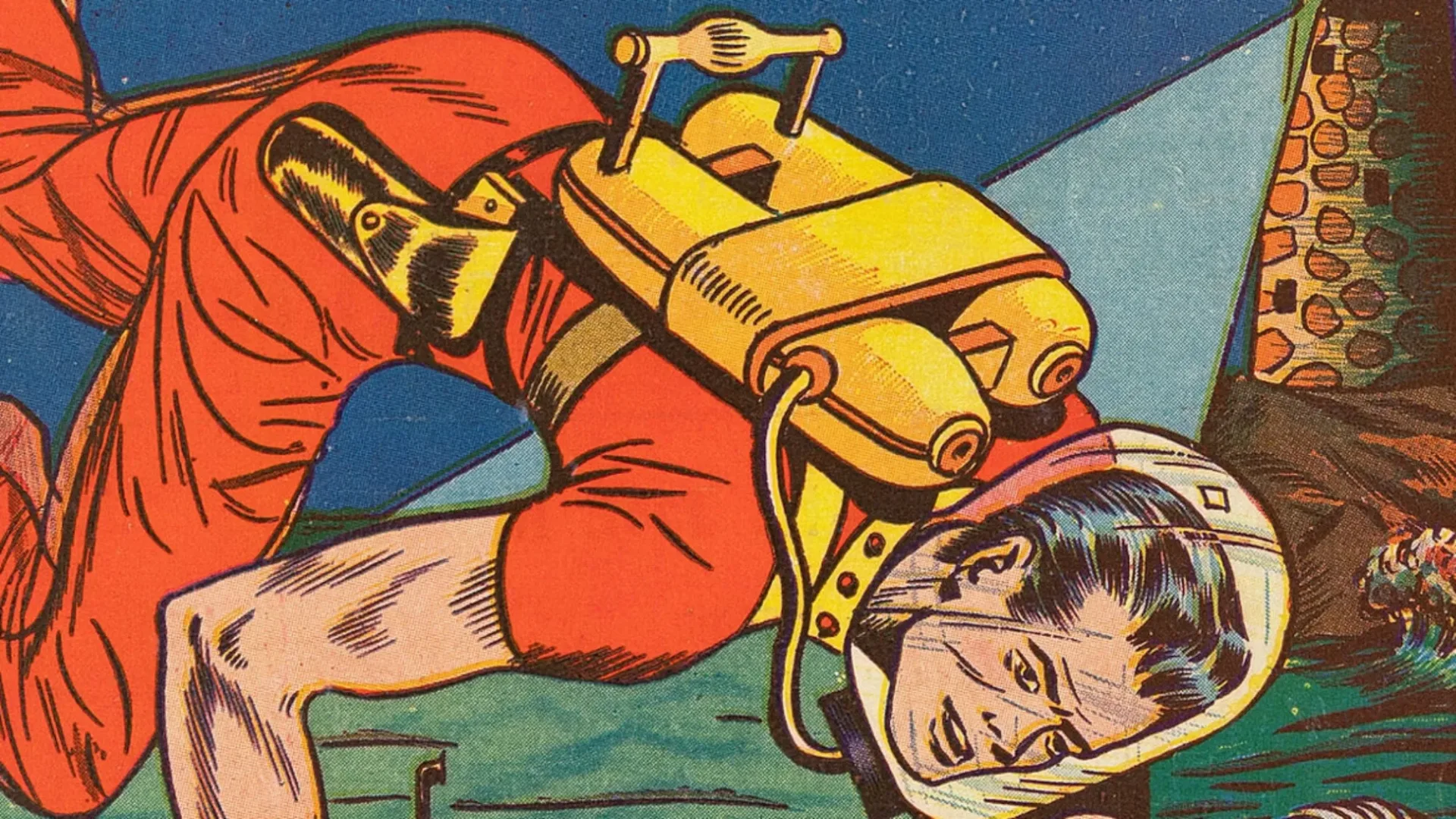
Golden Age comics can preserve the temperature of the moment that produced them. All-New Comics #4, published by Harvey in 1943, is a particularly direct example: its science-fiction adventure, “Poison in the Universe,” transforms a real dispute over strategic materials into an interplanetary conflict. It is space opera with barely disguised geopolitical stakes, built around a frighteningly simple idea: a peaceful society supplies metal to a foreign power, only to find that its customer has turned that material into weapons.
The issue is notable not just as an early Harvey comic, but as a piece of wartime popular culture that processes anxiety through genre fiction. Its alien planets and invented mineral give the narrative a speculative surface, yet the logic beneath them is rooted in the period’s arguments over trade, military preparedness and the danger of empowering expansionist dictatorships.
“Poison in the Universe” and the material cost of complacency
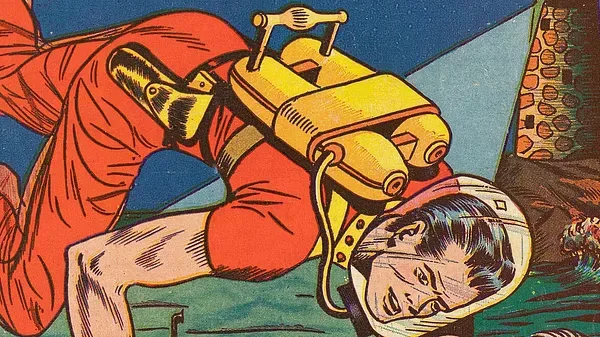
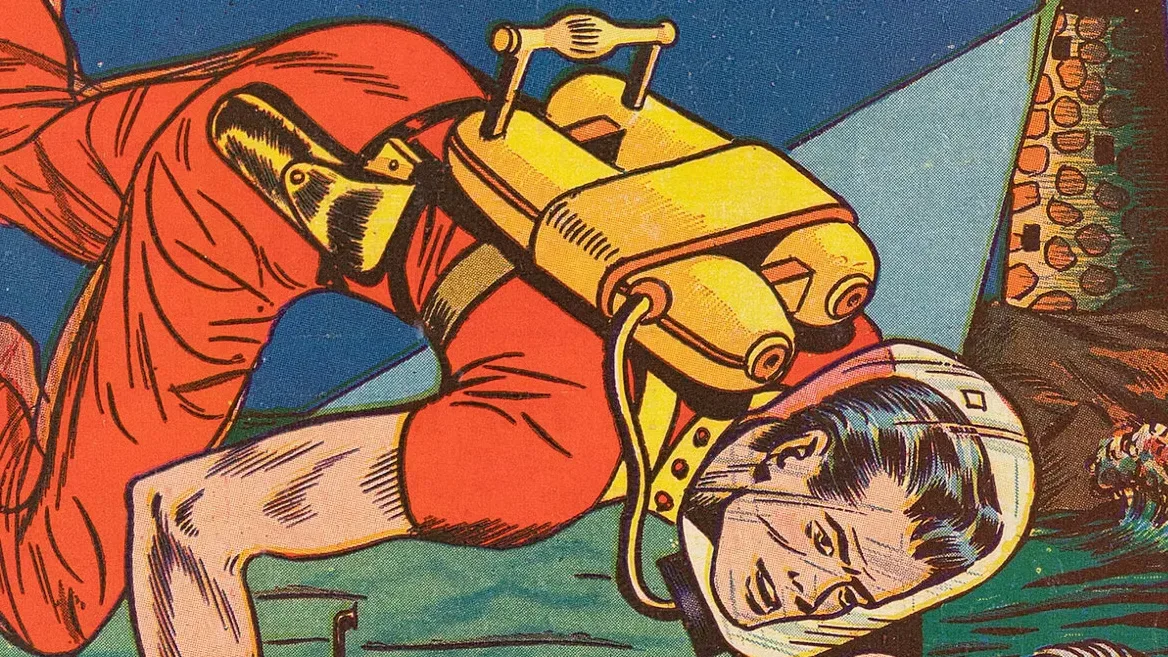
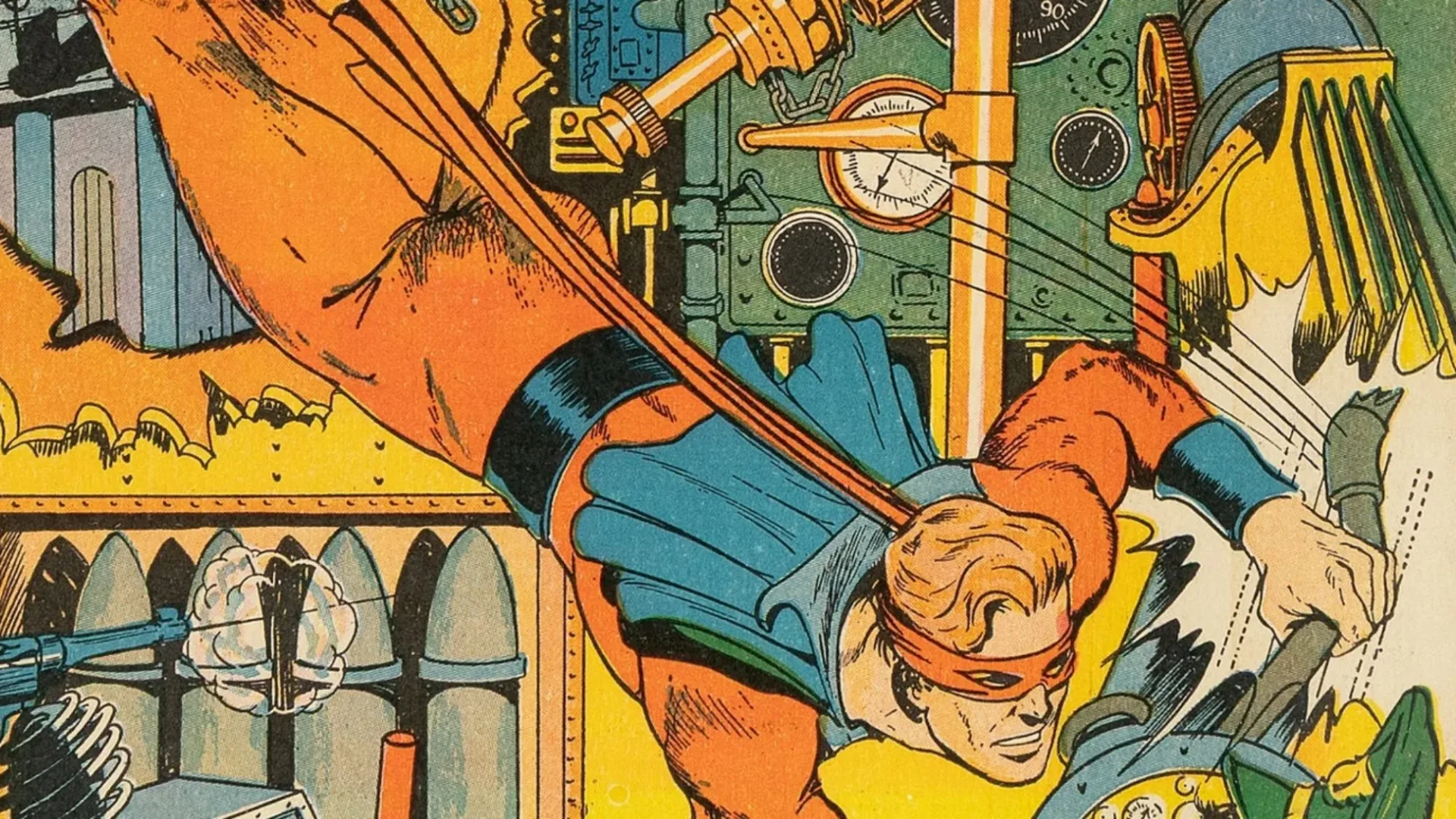
Drawn by Sam Glanzman, “Poison in the Universe” takes place between the worlds of Ammer and Jaan. Ammer is the peaceful supplier; Jaan purchases a metal called iraen, needed to make spacecraft. The relationship appears commercial rather than openly hostile at first. But Jaan duplicates Ammer’s ships, constructs a fleet with Ammer’s own exported metal, and ultimately deploys that force for war.
That setup is an allegory: a fictional narrative designed to point beyond its literal setting. The names Ammer, Jaan and iraen evoke the historical players and materials behind the story, but the most meaningful connection is the trade relationship itself. The premise parallels the United States’ role as a supplier of vital raw materials to Japan before the United States entered World War II.
In 1939, Japan relied on the United States for roughly 90% of its scrap metal and copper. These were not abstract commodities. Scrap metal could be processed and reused in industrial production, while copper had broad military and industrial value. A country building up its armed forces needed access to materials as surely as it needed factories and personnel. “Poison in the Universe” turns that dependency into a moral warning: selling strategic inputs to an aggressive power can mean helping to manufacture the threat that later arrives at one’s doorstep.
The story adds another explicit ideological note. Jaan’s dictator is influenced by Hitler’s radio broadcasts, linking its looming attack to Nazi fascism as well as Japanese militarism. For readers in 1943, this was not distant symbolism. The United States was already fully involved in a global war, and a comic-book adventure could frame the politics of the preceding years as a lesson in the price of delayed action.
The real trade dispute behind the imaginary metal
The background to the story reaches back to Japanese expansion in Asia. After Japan invaded Manchuria and after the Second Sino-Japanese War began in 1937, the United States continued to be a major supplier of key raw materials to Japan. That arrangement increasingly became a point of moral and political conflict, especially for people focused on the war’s consequences in China.
In early 1939, Chinese American workers at the ports of Portland and Astoria protested shipments of scrap iron and steel bound for Japan. Their actions make clear that the issue was not merely an argument among national leaders. Workers and communities understood that industrial exports could carry real human consequences abroad. Their protests opposed a trade flow that continued despite the expanding conflict in Asia.
Congressional isolationism complicated attempts to disrupt U.S.-Japan trade. In this context, isolationism refers to the political view that the United States should avoid deeper involvement in foreign conflicts and commitments. It did not necessarily mean indifference to events overseas, but it did help limit willingness to alter trade relations with Japan. The result, as represented by the comic’s later wartime perspective, was a dangerous interval in which commercial exchange remained possible even as the strategic implications were increasingly apparent.
President Franklin D. Roosevelt eventually received authority to control defense-related exports. On September 26, 1940, the White House announced export restrictions covering every grade of iron and steel scrap, effective October 16. Licenses would be limited to destinations in the Western Hemisphere and Great Britain, stopping exports of those materials to Japan.
“Poison in the Universe” views that delay in blunt dramatic terms. Its enemy does not merely buy metal and become stronger in the abstract; it uses the supplier’s resources to build the very vessels used in an attack. That is how the story gives a complex policy dispute a clean comic-book shape. The question is no longer whether trade rules are diplomatically awkward. It is whether a society recognizes a threat before it has armed it.
Why science fiction was a useful vehicle
Science fiction allowed creators to discuss contemporary fears at one remove. Rather than staging the argument between real governments, “Poison in the Universe” substitutes planets, spacecraft and a fictional resource. This makes the idea immediate and legible: readers can understand the betrayal in a single plot turn, without requiring a detailed knowledge of export policy or international diplomacy.
It also demonstrates that wartime science fiction was not necessarily an escape from reality. Here, the speculative elements are tools for reframing reality. Iraen is not valuable because the comic explains a fully developed alien economy; it matters because it stands in for the strategic materials at the center of a historical trade debate. Jaan’s copied spacecraft similarly compress industrial and military buildup into an easily understood visual threat.
For collectors and comics readers, that makes the issue more than a vintage curiosity. The historical significance lies in the connection between narrative premise and its 1943 audience. Its fiction is specific enough to reveal the arguments and fears circulating around it.
Bob Powell’s Berlin story reflects a different wartime front
All-New Comics #4 also includes Bob Powell’s “Bombs Over Berlin,” another story firmly tied to the politics of World War II. Its plot revolves around a suicide mission intended to kill Adolf Hitler, Heinrich Himmler and Hermann Göring by destroying Berlin’s Sportpalast at the right moment.
The Sportpalast was a potent setting for such a story because it had become associated with Nazi Germany through major speeches. Joseph Goebbels delivered his notorious “Total War” speech there on February 18, 1943. The venue’s symbolic stature helps explain why it could serve as the focal point for a wartime comic narrative about striking at Nazi leadership. The premise is severe, and it reflects the propagandistic and openly anti-Nazi tenor common to American war-era entertainment rather than a detached adventure fantasy.
Together, the Glanzman and Powell features make the issue unusually concentrated as a historical artifact. One story imagines the consequences of furnishing resources to a militarist regime; the other dramatizes a direct attempt to destroy the leadership and symbols of Nazi power. They approach the war differently, but both use comic-book storytelling to make the conflict feel personal, urgent and morally unambiguous.
What the reported CGC census says—and does not say
All-New Comics #4 is also scarce in certified form. There are 16 copies in CGC’s Universal category, including three graded 5.5 and one graded higher. A Universal label identifies a comic without restoration noted by the grading service; it is distinct from other label categories that may flag restoration, signatures or other qualifications.
That number is useful context, but it should be read carefully. A grading census records copies submitted to that particular service and category, not every surviving copy in existence. It is evidence of certified scarcity, not a complete population count. Condition details matter, too: page quality, structural flaws and completeness can affect an individual book’s appeal even when the numerical grade is the same.
An All-New Comics #4 graded CGC FN- 5.5, with off-white to white pages and a detached centerfold, is scheduled for the Golden Age Century Comics Showcase Auction VI #40378 on November 5, 2026. “FN-” denotes Fine Minus, while the detached centerfold is a specific physical defect that prospective bidders should weigh alongside the grade and page designation. The issue’s value proposition is therefore not reducible to a single census figure: it combines age, surviving certified population, condition particulars, and the historical specificity of its stories.
For anyone examining wartime comics as cultural records, All-New Comics #4 offers an unusually clear case study. Its science-fiction feature makes a policy argument out of metal, machinery and invasion; its Berlin story brings the anti-Nazi war effort into the same package. Readers interested in how comics continue to carry big political and cultural ideas through genre storytelling can also see a very different modern corner of the medium in this look at Daredevil #700.
All-New Comics #4 remains rooted in the conditions of 1943, when raw materials were inseparable from military power and fiction could treat a trade decision as the opening move of a space war. That directness is what gives the comic its enduring interest: beneath the planets and spaceships is a contemporaneous argument about the consequences of enabling aggression.