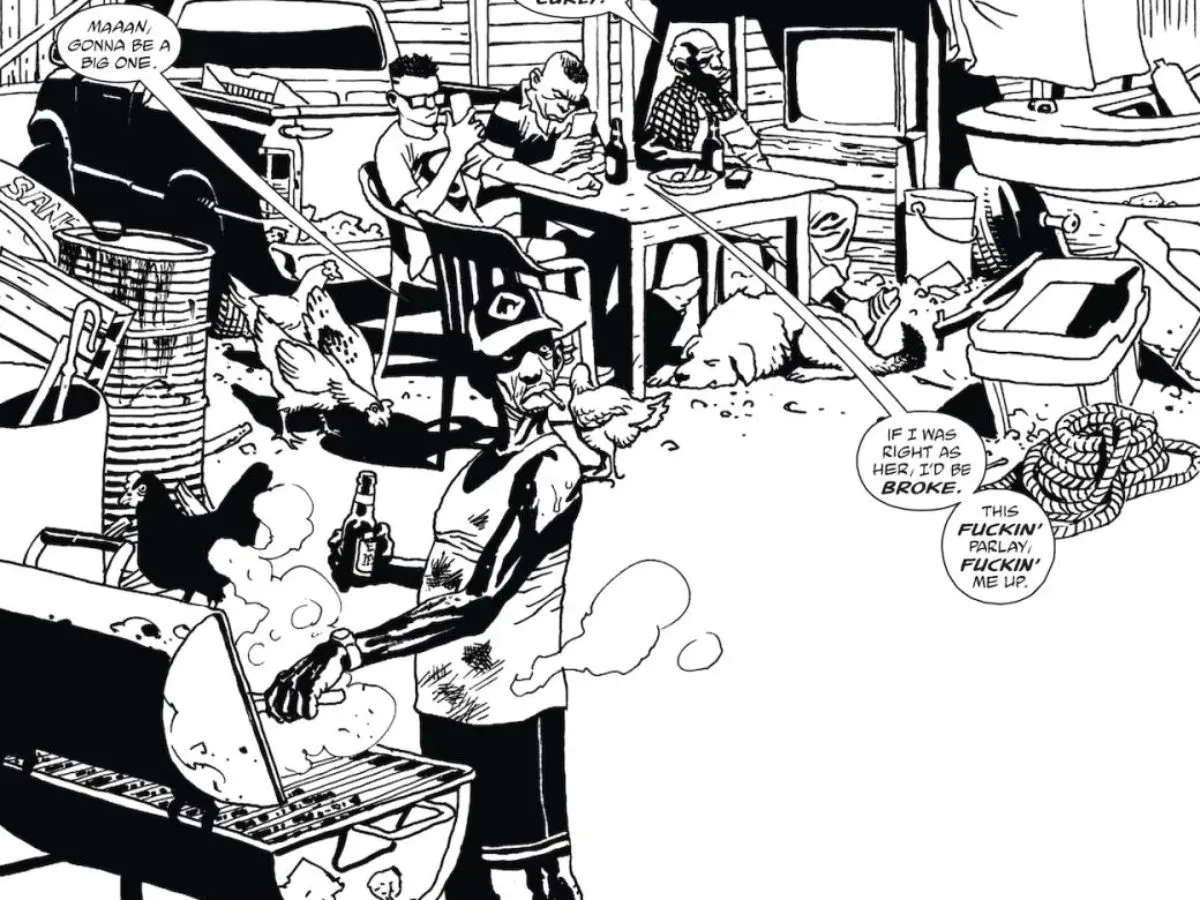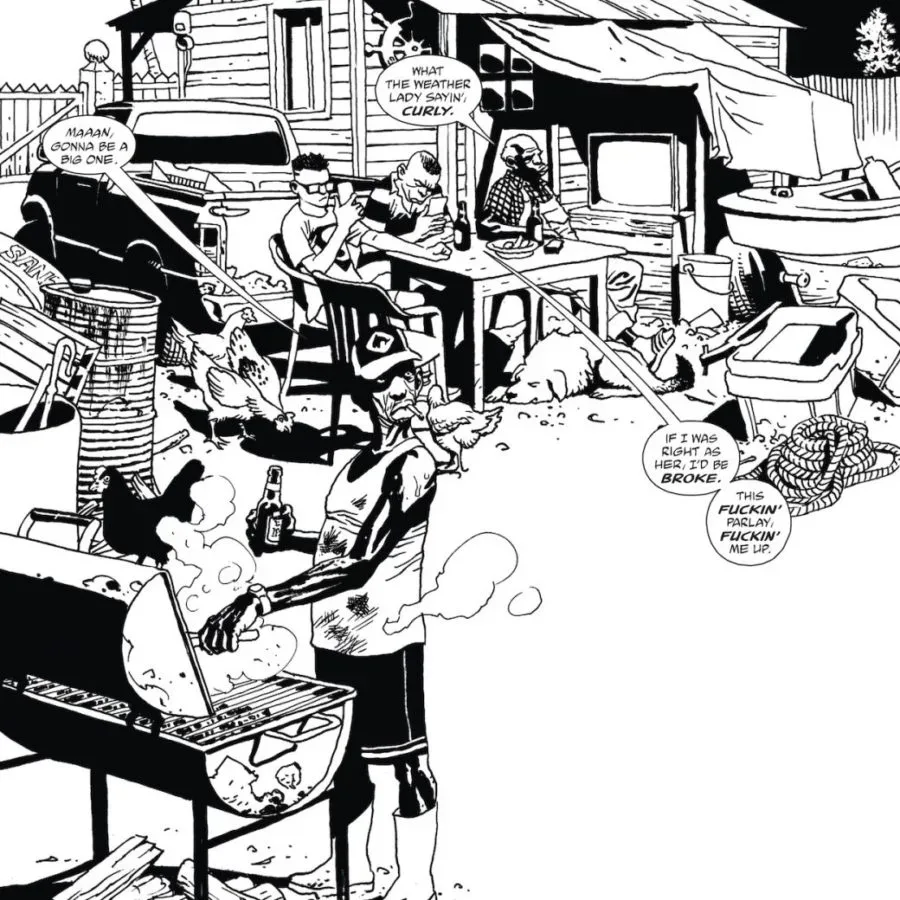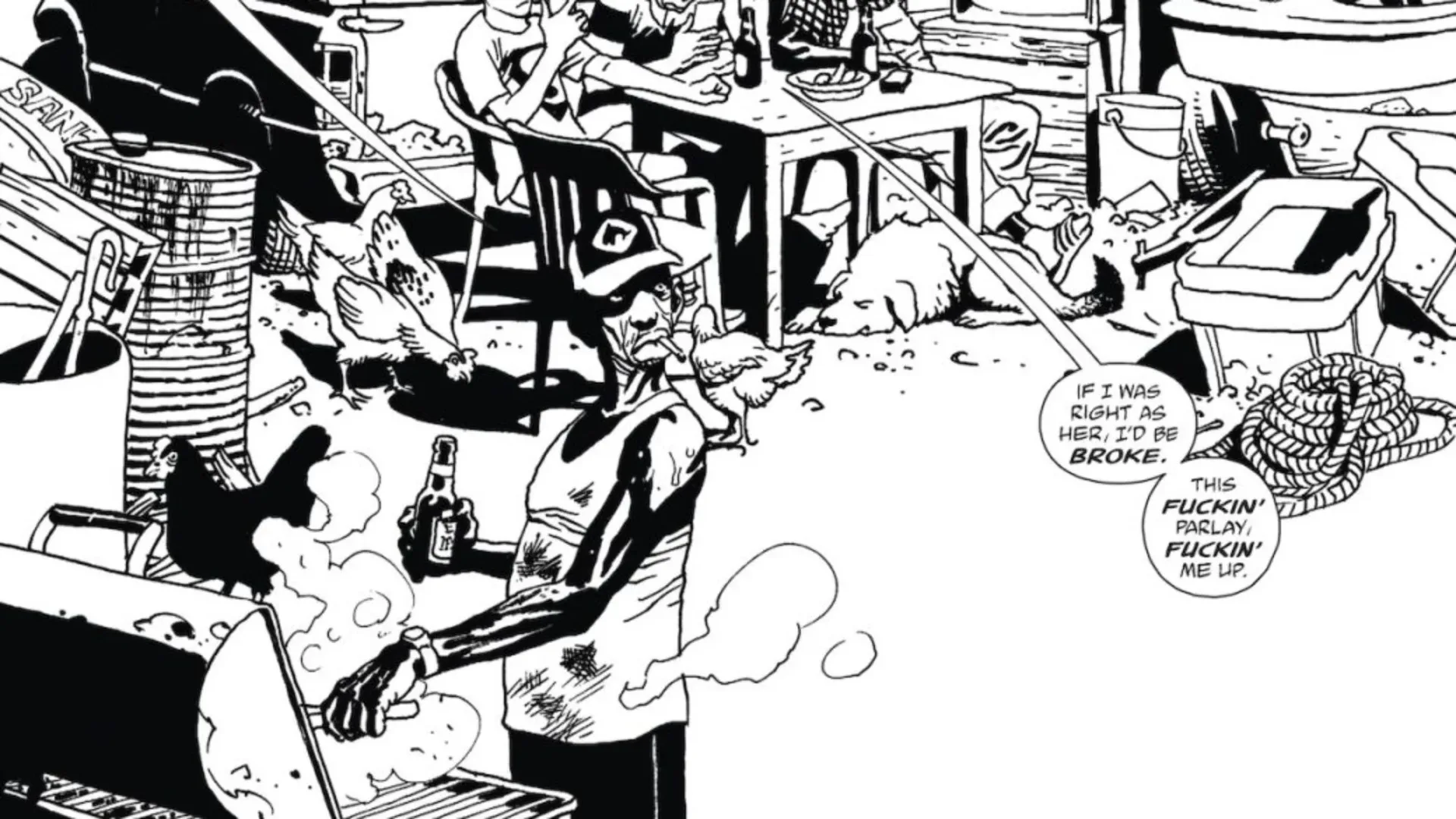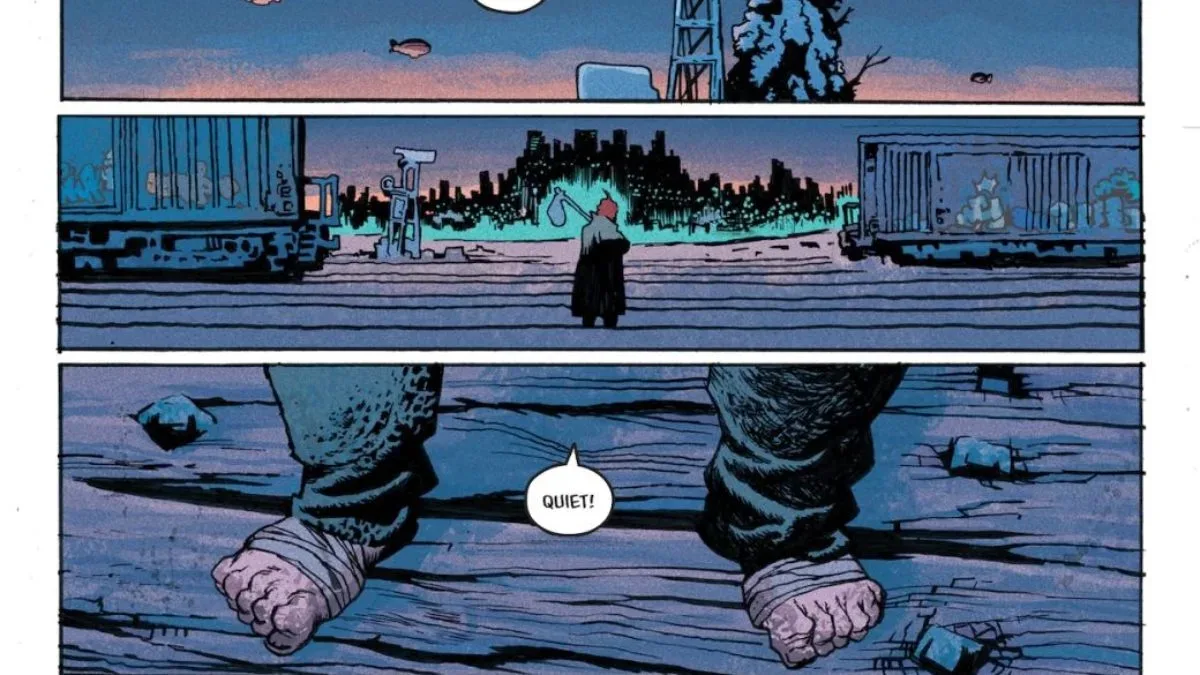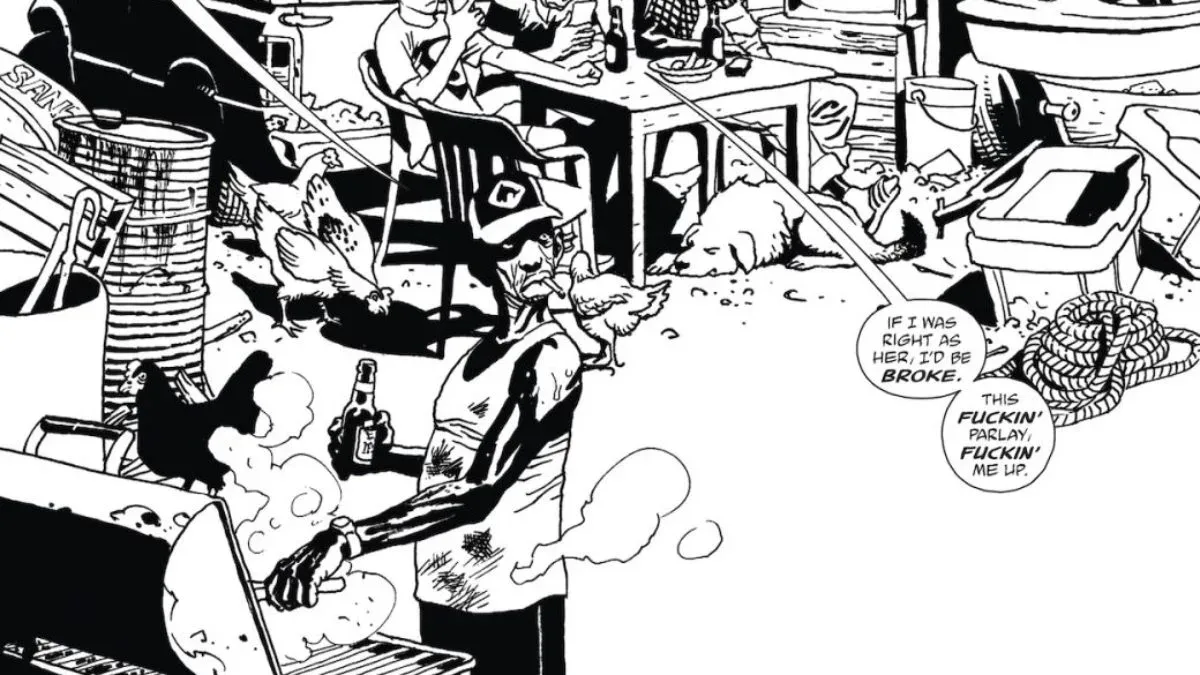
100 Bullets: The US of Anger #4 is scheduled to arrive in comic shops on October 14, 2026. The new issue places two separate domestic crises at its center: Lono’s volatile arrangement with a kidnapped police officer and a teenage murder suspect strains his position inside an alt-right militia, while Elton discovers something deeply unwelcome in his father-in-law’s garage.
Brian Azzarello is credited as writer and Eduardo Risso as interior artist. Dave Johnson is credited on the main cover, while Eric Canete is listed for an additional cover. The issue is published by DC.
Lono’s “New Family” Is Not Welcome
The core setup for the issue describes Lono’s new family as a kidnapped police officer and a teenage murder suspect. It is a deliberately unstable use of the word “family”: these are not conventional relatives, but people bound together by dangerous circumstances. That instability is immediately intensified by the group around Lono.
Lono has fallen in with an alt-right militia, and the synopsis makes clear that his companions are not being accepted by that militia. The conflict therefore does not appear to be simply an external threat approaching the characters. It is inside Lono’s current home and allegiance, putting pressure on every relationship in the arrangement.
A militia, in this context, refers to an armed civilian group organized outside the regular military. The solicitation identifies the group’s ideology as alt-right, a term commonly used for far-right political movements and networks. The issue’s premise connects that political environment with a close-quarters, character-level conflict rather than presenting it as distant background.
What remains unclear is how Lono came to this situation, what the militia wants from him, and whether the police officer and murder suspect are allies, captives, liabilities, or some shifting combination of all three. Those unanswered questions are part of the immediate hook. The setup is specific enough to establish danger without revealing which character will have control when the confrontation finally breaks open.
Elton’s Garage Discovery Adds a Second Mystery
Elsewhere, Elton makes an “unfortunate discovery” in his father-in-law’s garage. The available premise does not identify the object or explain its significance, but its framing turns the garage into a mystery scene. A mundane family storage space becomes the setting for a discovery serious enough to rival Lono’s escalating militia problem.
The question attached to Elton’s story is straightforward: what is in the box? But the narrative value of that question is not necessarily the object alone. A concealed item can also expose a past act, a secret relationship, a crime, or an obligation that changes how a character understands a family member. The synopsis only confirms that Elton finds something troubling; it does not establish what the discovery is, who placed it there, or what consequences it will create.
That restraint matters for prospective readers. The issue is being positioned around suspense, not a fully explained reveal. Anyone looking to remain completely unspoiled can take the solicitation as a warning that Elton’s family storyline is likely to pivot sharply in this installment, while readers who enjoy a mystery-driven teaser have a clear focal point going in.
Two Forms of Trouble at Home
The solicitation joins Lono and Elton through the idea of trouble at home, although their circumstances look very different. Lono’s crisis is overt and collective: he is attempting to maintain an untenable household while surrounded by an ideological group that objects to the people in it. Elton’s is quieter at first, rooted in a discovery inside a relative’s property.
That parallel gives issue #4 a dual-track structure on paper. One thread is built around immediate interpersonal and political friction; the other is built around the implications of a hidden object. Neither is explained far enough to determine how directly the stories connect, if at all. Still, both involve private spaces becoming unsafe: Lono’s apparent domestic unit is challenged from within his adopted group, and Elton’s father-in-law’s garage holds a secret rather than reassurance.
For readers following serialized comics, solicitations are advance descriptions designed to establish a broad premise without providing the full issue. They can indicate which characters and tensions matter in a given installment, but they are not a scene-by-scene account. In this case, the confirmed facts are the militia’s rejection of Lono’s companions and Elton’s troubling garage find. The reasons behind both developments remain part of the story to be revealed.
Creative and Release Details
- Title: 100 Bullets: The US of Anger #4
- Publisher: DC
- Release date: October 14, 2026
- Writer: Brian Azzarello
- Interior art: Eduardo Risso
- Main cover credit: Dave Johnson
- Additional cover credit: Eric Canete
- Listed item codes: 0826DC0251 and 0826DC0252
The listing includes two price references: an Eric Canete cover is shown at $4.99, while the issue’s suggested retail price is also listed as $3.99. Because the information distinguishes a cover-specific price from the standard SRP, readers interested in a particular edition should check with their preferred comic shop before purchase.
The Azzarello and Risso credits identify the writer and interior artist respectively. In monthly comics, the writer is responsible for the script and narrative construction, while the interior artist renders the sequential pages that carry the story from panel to panel. Cover artists create the exterior image used to represent an edition, which is why a standard cover and an alternate cover can have separate credits and, in some cases, separate pricing.
What to Watch for in Issue #4
The major question around Lono is whether he can keep his improvised household intact when the militia views its members as a problem. The mere presence of a kidnapped officer introduces obvious danger, while the teenage murder suspect adds another unresolved source of tension. The wording does not assign guilt or provide any details of the alleged murder, so readers should avoid treating the label as a complete explanation of that character.
For Elton, the key uncertainty is the garage discovery itself. The solicitation emphasizes its personal setting: the garage belongs to his father-in-law, making the discovery a possible source of conflict across family lines. The setup suggests that whatever Elton has found has immediate emotional or practical consequences, but it does not support assumptions about its contents.
Both strands make #4 sound like an issue driven by mounting pressure rather than resolution. Lono faces a confrontation that has already become difficult to contain, and Elton’s discovery opens a separate line of suspense. Readers seeking other upcoming superhero-comics coverage can also see details on Daredevil #11 and the road to Daredevil #700.
100 Bullets: The US of Anger #4 is due in shops October 14, with Lono’s uneasy place in the militia and Elton’s garage mystery serving as its two confirmed story pressures.