In a typical game of Magic: The Gathering, the graveyard is the place where spent removal, defeated creatures, cracked artifacts, and discarded ambitions wait quietly for the game to end. Commander changes that relationship dramatically. A 100-card singleton deck has fewer duplicate effects to fall back on, so recovering an important card can be as meaningful as drawing an entirely new one.
That makes the command zone an ideal home for recursion engines. A commander that repeatedly accesses the graveyard gives a deck a dependable identity rather than asking it to locate one particular spell among the other 99 cards. The five legends below approach that role from very different angles: broad permanent replay, steady creature recovery, repeatable creature casting, discard-powered reanimation, and attack-triggered returns.
None of them makes graveyard hate disappear as a concern. Exile-based effects and cards that clear graveyards remain major obstacles, and a recursive deck should still consider how it will function when its most important zone is disrupted. What these commanders offer is resilience: the ability to turn cards that have already been used, killed, milled, or discarded into future turns of value.
Five standout graveyard-recursion commanders
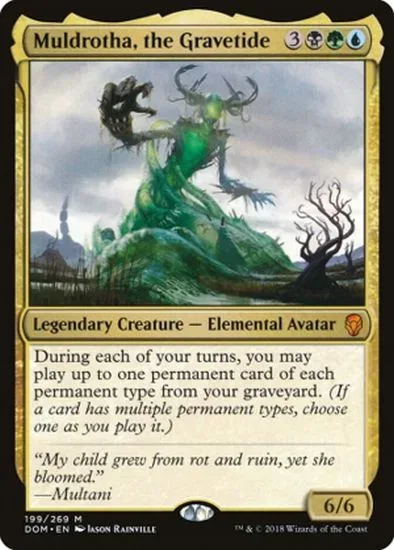
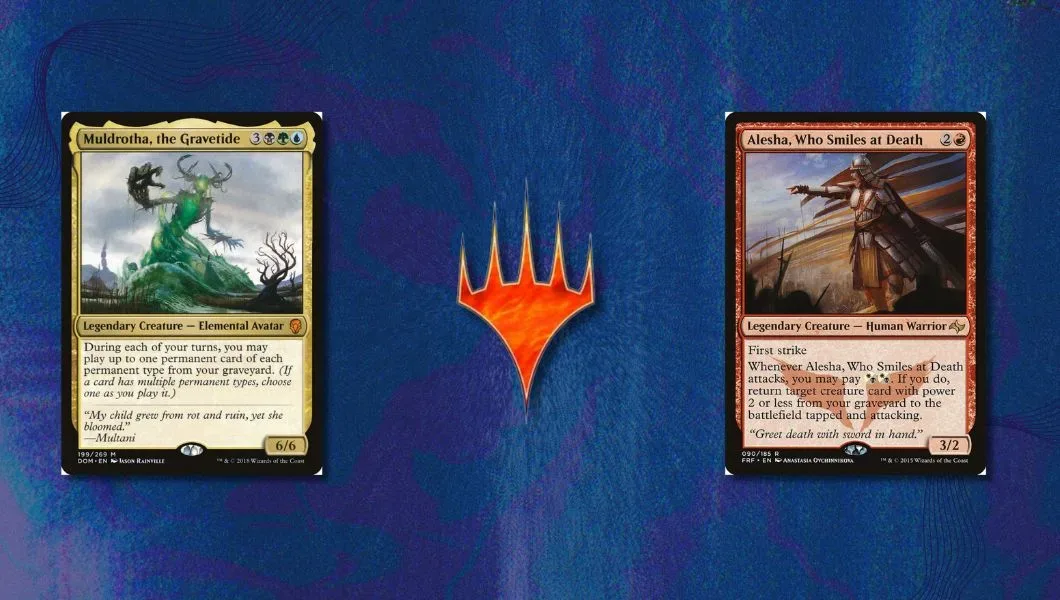
Muldrotha, the Gravetide
First printing: Dominaria Rarity: Mythic Rare
Muldrotha, the Gravetide is the widest-ranging commander on this list because its text is not confined to creatures. The six-mana 6/6 Elemental Avatar permits its controller, during each of their turns, to play a land and cast one permanent spell of each permanent type from their graveyard. In practical terms, that can mean a creature, artifact, enchantment, planeswalker, and land all become available again over the course of a turn.
That permission creates a powerful framework for Sultai decks. Self-mill effects stock the graveyard with options, while sacrifice outlets make it possible to intentionally send useful permanents there once their first job is done. A permanent that would normally deliver a single burst of value can become part of a longer plan when Muldrotha is on the battlefield and the correct card type has not yet been used for the turn.
The phrasing matters. Muldrotha does not simply put things onto the battlefield; it allows them to be played or cast. Players still need to pay applicable costs and obey normal timing rules. Its reward is flexibility rather than an automatic free reanimation chain. That distinction also gives opponents meaningful ways to respond, while leaving Muldrotha players with an unusually deep toolbox.
Jason Rainville created the original art for Muldrotha in Dominaria. The card later appeared in Commander Legends, Double Masters 2022, and Foundations, giving collectors and players multiple printings to consider. Muldrotha is particularly appealing for builders who want their graveyard plan to encompass nearly every permanent category instead of concentrating on creature loops alone.
Related coverage includes Five Magic: The Gathering Commanders That Turn the Graveyard Into a Resource.
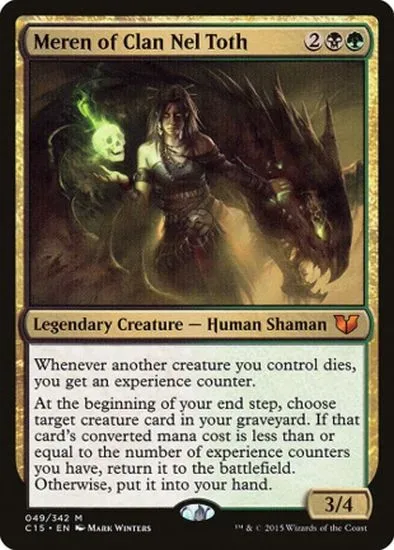
Meren of Clan Nel Toth
First printing: Commander 2015 Rarity: Mythic Rare
Meren of Clan Nel Toth turns creature deaths into a steadily improving end-step engine. Whenever another creature its controller owns dies, Meren awards an experience counter. At the beginning of that player’s end step, Meren checks a creature card in the graveyard. If that creature’s mana value is no greater than the number of experience counters, it returns directly to the battlefield. If it costs more, it returns to the player’s hand instead.
That fallback mode is an enormous part of Meren’s appeal. The commander does not need to reach a particular counter total before it begins providing value. Early in a game, a more expensive creature can still be retrieved to hand; later, as the experience total grows, the same card can come back straight into play. Small utility creatures and sacrifice fodder are therefore useful both as resources and as fuel for advancing Meren’s strongest mode.
Experience counters belong to the player, not to Meren herself. If she is removed and cast again, the accumulated counters remain. That makes the deck’s central progress harder to erase than a strategy dependent on counters sitting on a vulnerable permanent. At four mana and in black-green colors, Meren can arrive early enough for a deck to start establishing sacrifice outlets, death triggers, and inexpensive value creatures without waiting until the very late game.
Mark Winters illustrated the original Commander 2015 version. A Commander Masters printing features art by Vance Kelly, while a Secret Lair edition illustrated by Cynthia Sheppard offers a distinct collector-focused treatment. Meren is a strong fit for players who want recursion to reward ordinary creature deaths every turn rather than requiring a single huge reanimation spell.
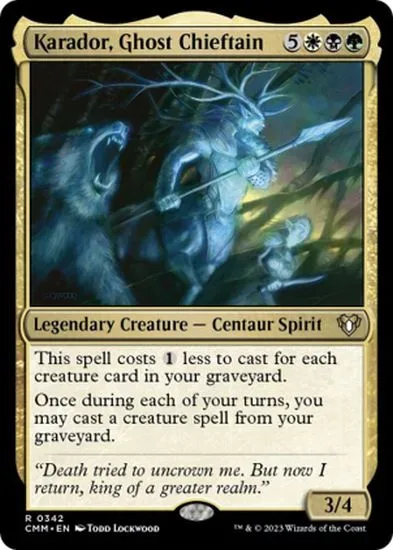
Karador, Ghost Chieftain
First printing: Commander 2011 Rarity: Mythic Rare
Karador, Ghost Chieftain looks intimidating at first glance with an eight-mana printed cost, but that number is rarely the whole story. It costs one mana less to cast for every creature card in its controller’s graveyard. A deck designed to mill, trade, sacrifice, or otherwise fill its graveyard with creatures can reduce Karador substantially, often making the commander practical well before eight mana is available. The same reduction continues to matter after removal sends Karador back to the command zone.
Once it is in play, Karador lets its controller cast one creature spell from their graveyard during each of their turns. That is narrower than Muldrotha’s access to multiple permanent types, but it is a consistently useful permission effect with an important deckbuilding advantage: Karador’s Abzan color identity adds white to black and green. White broadens the available suite of creature-based interaction and utility, while green and black supply familiar graveyard-filling and recursion tools.
Karador encourages a creature-dense construction. The graveyard is both a discount mechanism and a hand-like collection of future spells, so every creature card sent there can contribute in two ways. Because the card permits casting rather than direct battlefield return, the deck has to pay the creature’s costs, but it can benefit from cast triggers and preserve the normal texture of a creature-focused Commander game.
As one of the oldest entries here, Karador has been a fixture of graveyard Commander strategies since the first dedicated Commander release in 2011. Todd Lockwood illustrated the original printing. Subsequent appearances in Commander Legends, Double Masters 2022, and Commander Masters mean there is a healthy selection of versions for players seeking a copy.
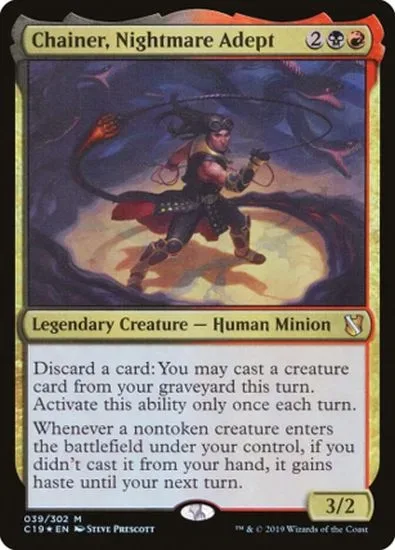
Chainer, Nightmare Adept
First printing: Commander 2019 Rarity: Mythic Rare
Chainer, Nightmare Adept is built for a more explosive Rakdos-style use of the graveyard. Once on each turn, its controller may discard a card to gain permission to cast a creature spell from their graveyard that turn. The discard is a cost, but in a deck that wants creatures in the graveyard, it can be an efficient way to exchange an unwanted card in hand for access to a better creature that has already been lost.
The second ability is what gives Chainer’s recursion a sharp combat identity. Non-token creatures entering the battlefield without having been cast from their controller’s hand gain haste until that player’s next turn. A creature returned from the graveyard can attack right away rather than waiting through a round of opponents’ turns. That pressure differentiates Chainer from commanders focused primarily on gradual attrition.
Madness has a natural connection to this design. Since Chainer asks for a discard as part of activating its first ability, cards that can be cast through madness can help ensure the discard produces additional value. Big creatures are also attractive targets because haste turns a recovered threat into an immediate factor on the battlefield. The deck must still balance setup, mana, discard material, and creatures worth reusing, but Chainer provides a clear payoff for doing so.
Steve Prescott illustrated Chainer’s debut in Commander 2019. Modern Horizons 2 later included both standard-frame and retro-frame versions at a lower rarity. Among these five commanders, Chainer is the clearest option for a player who wants graveyard access to translate into creatures attacking without delay.
Alesha, Who Smiles at Death
First printing: Fate Reforged Rarity: Rare
Alesha, Who Smiles at Death proves that a graveyard commander does not need a gigantic mana cost or an unrestricted reanimation clause to lead a formidable strategy. For three mana, Alesha is a 3/2 creature with first strike. Whenever Alesha attacks, its controller may pay two hybrid white-black mana to return a creature card with power 2 or less from their graveyard to the battlefield tapped and attacking.
The restriction is specifically about power, not mana value. That opens room for creatures whose bodies are modest but whose triggered abilities, static text, or utility are far more consequential than their combat stats suggest. Since the returned creature arrives attacking, Alesha converts an attack step into both pressure and recursion. The effect also asks players to plan around combat, which gives the deck a rhythm distinct from end-step engines such as Meren.
Alesha’s color identity is Mardu. Red comes from the mana cost, while the hybrid white-black symbols in the attack trigger supply the other two colors. That combination offers an especially broad set of options for small-power creatures, graveyard setup, sacrifice themes, and combat-oriented support. The low casting cost also means Alesha can be deployed and redeployed without requiring the same mana commitment as the larger legends on this list.
Anastasia Ovchinnikova illustrated Alesha’s original Fate Reforged appearance. It has also been reprinted in Commander 2016, Commander 2020, Time Spiral Remastered, and Dominaria United Commander. It remains a compelling choice for builders who enjoy finding disproportionately useful creatures with two power or less and sending them back into combat.
Choosing the right commander for the recursion plan
The best fit depends on what a deck wants its graveyard to contain and how it hopes to convert those cards into advantage. Muldrotha is the broad permanent-based engine. Meren rewards repeated creature deaths and gradually builds toward direct battlefield recursion. Karador favors a creature-heavy graveyard and offers repeatable casting from it. Chainer mixes discard, creatures, and haste in a more aggressive shell. Alesha turns low-power creature selection and attacking into a recurring package.
- Choose Muldrotha for a multi-permanent graveyard deck that values varied card types.
- Choose Meren for sacrifice-driven creature value and an experience-counter progression that survives commander removal.
- Choose Karador for creature density, cost reduction, and Abzan deckbuilding.
- Choose Chainer for discard synergy and immediate haste on creatures entering from outside the hand.
- Choose Alesha for attack triggers, Mardu colors, and small-power creatures with large utility.
For collectors, each commander also has a different printing history, original artist, rarity, and range of versions to investigate. That wider approach to the hobby applies across trading cards; collectors tracking other modern releases can also see how 2026 Topps Allen & Ginter Baseball pre-orders are shaping up. In Magic, though, the most important question is still the deck’s game plan: whether the graveyard is merely insurance for lost cards or the central resource every turn is designed to exploit.