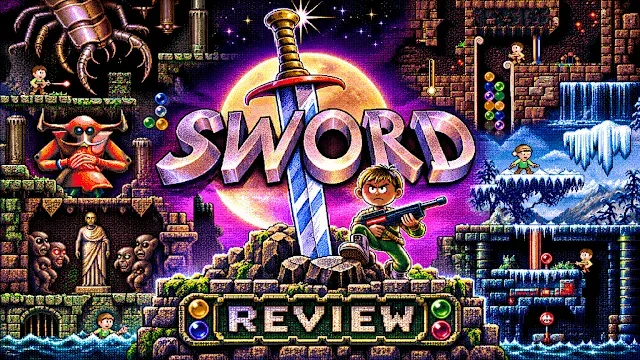
Sword is the kind of late-platform game that invites two very different reactions at once. On one hand, it is unmistakably a hard-edged action platformer from an era when a punishing timer, a weak starting weapon and long stages were accepted parts of the bargain. On the other, it contains a remarkably player-friendly idea for handling failure—one that makes its repeated attempts feel less like dead time than they initially appear.
Developed by Polish studio Serio Comic, Sword arrived in 1998 for the Amiga 500. It was the team’s second game after Gate 2 Freedom, another platformer, and possibly its final release. That context matters: this was a commercial Amiga game arriving late in the machine’s life, when the broader games business had already pivoted hard toward 3D spectacle. Yet rather than feeling like an abandoned prototype or a compromised farewell, the game is described as a polished, varied platform shooter with coherent art direction, bosses, light puzzle elements, and a steady stream of new stage-level challenges.
Its legacy is inevitably shaped by timing. Sword sold poorly and had a limited print run, leaving boxed copies relatively difficult to find. But its appeal is not just that of a scarce artifact. The more compelling case is that Serio Comic made distinctive design decisions under tight technological constraints—and one of those decisions remains worth examining now.
Death is a setback, not a full erasure
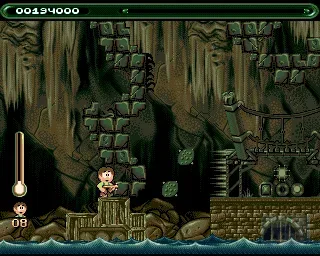
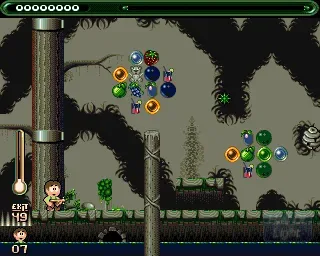
The defining mechanic is what happens after a player dies. A death sends them back to the beginning of the current level, which sounds severe. However, enemies already defeated and items already collected do not return. More unusually, the level timer remains frozen until the player reaches the point at which the prior attempt ended.
For more context, explore Nothing Phones Are Reaching US Shelves, but Carrier Shopping Still Has a Boss Fight.
That is a thoughtful response to a common platform-game frustration. A conventional restart asks the player to repeat every successful action before they can try the difficult jump, trap sequence or encounter that actually stopped them. Sword still asks for a retrace, but it strips much of the repetition of its original danger. The player retains proof of prior progress in the emptied routes and absent pickups, while the frozen clock prevents the retry from becoming an additional time-pressure penalty.
Parallax scrolling is a visual technique in which background layers move at different speeds, suggesting depth as the player travels through a 2D scene. Auto-scrolling, meanwhile, means that the game itself moves the action forward rather than letting the player set the pace. These are presentation and pacing tools. The retry system is different: it is a rules-level intervention, shaping the emotional cost of failure.
That distinction helps explain why the timer can be both irritating and interesting. A strict timer normally encourages speed and can turn deliberate exploration into a liability. In Sword, the timer’s treatment after death provides a partial counterweight. The game remains demanding, but it acknowledges that learning from an attempt should not require replaying its entire workload under the same pressure. It is an early-feeling example of a checkpoint philosophy within a level-start structure: progress is preserved even when position is not.
Related coverage includes Sword Revisited: The Late Amiga Platform Shooter That Deserved a Bigger Audience.
A platform shooter that keeps pushing back
Mercy in one system does not make Sword an easy game. Combat is constrained by a single, fairly weak gun. There are no reported weapon upgrades to transform its offensive options, and additional health boosts are likewise absent. That means enemies and obstacles can take longer to clear than players may expect, particularly in the longer stages.
This limitation has a clear practical effect on pacing. A weak weapon does not merely make combat harder; it makes every confrontation consume more time, an especially meaningful issue in a game built around a countdown. It also gives boss encounters extra weight. The game has numerous large bosses, but players should not expect the escalating arsenal or power fantasy found in many action games. Its challenge comes more from persistence, movement, route knowledge and controlled execution.
The levels reportedly differ substantially in both length and difficulty, and the game does not rely solely on shooting and jumping. Light puzzles appear along the way, though they are presented as small diversions rather than barriers that overwhelm the action flow. For players who dislike having a platformer suddenly become an opaque puzzle game, that is an important boundary: the puzzles add variety without apparently displacing the core platform-and-combat structure.
The game also contains an auto-scrolling snowboarding bonus stage. On a machine where every feature competed for memory and processing resources, that sort of side activity helps establish a sense of range. More importantly, it reinforces the claim that the levels were not simply dressed-up repetitions of one template. Variety is one of Sword’s central strengths, from its locations and challenges to its special sequences and oversized opponents.
Big ambitions on a modest Amiga 500 setup
The technical story is a major part of Sword’s identity. The game was made for an Amiga 500 configuration with 1MB of RAM and shipped on four floppy disks. Within that framework, it combines parallax scrolling, large bosses, music and sound effects running together, responsive controls and a broad range of stages.
Those details should not be flattened into a vague claim that an old game is impressive “for its time.” They describe a set of competing demands. Animation, background layers, audio, enemy behavior, player input and level data all have to coexist. A game can have attractive screens yet falter when action begins if controls lag or the display cannot maintain its intended movement. The praise here is specifically for the way Sword appears to bring those elements together while keeping its controls responsive and its action moving.
Its lead character sprite is not presented as the game’s standout achievement. That is useful perspective. Technical accomplishment does not mean every individual asset is extraordinary. Rather, Sword seems to earn its reputation through the whole production: a consistent visual identity, foreground action supported by scrolling backgrounds, substantial bosses, audio that complements the play, and levels paced to introduce fresh ideas.
Pixel art has also aged differently from much of the early 3D work that dominated the commercial conversation around the end of the 1990s. That does not make every 2D game timeless or every early 3D game obsolete. But deliberate 2D art can remain immediately legible because it is not striving for realism through a limited polygon budget. In Sword, the sustained visual cohesion appears to be more important than an individually spectacular hero sprite.
A release stranded between eras
Sword was published by Titan Computer and was its last title for classic Amiga OCS/ECS hardware. OCS/ECS refers to the earlier generations of the Amiga’s custom chipset architecture, the hardware foundation associated with the classic machines. The game is also described as a swansong spanning the ECS and AGA period, with AGA being the later Amiga graphics chipset family.
Afterward, Titan Computer moved on to PowerPC-oriented Amiga releases, including Shogo and Heretic II. Other ambitious Amiga projects, including Evil’s Doom and Alien Nations, were planned but did not ultimately release. Against that background, Sword occupies an unusually revealing place in the platform’s story: it is a finished commercial work built for the classic hardware just as its ecosystem was splintering into new technical directions and many planned projects were failing to make it across the line.
It also launched during the original PlayStation era, when 3D graphics were a dominant aspiration. That market environment likely made a polished 2D Amiga platformer a harder sell, even if the game itself had strong fundamentals. The result was poor sales and a smaller footprint than its quality might have warranted.
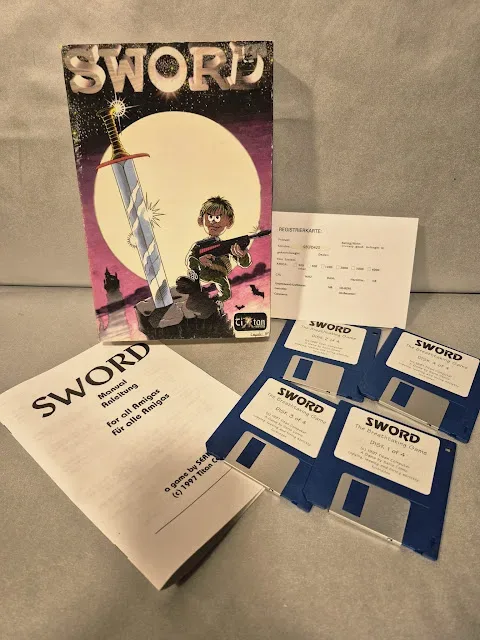
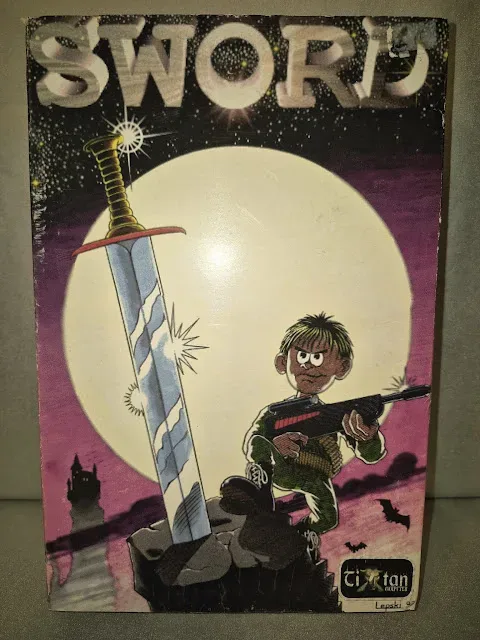
Its original packaging reflects that late-market reality. The box art is distinctive, while the manual is entirely black and white and the floppy labels are similarly economical. Such presentation is not necessarily evidence of indifference; it can also indicate a publisher limiting production costs at a moment when Amiga software had become commercially precarious. For collectors, these materials are part of the game’s physical history, but they should not eclipse the more important preservation question: how a small, technically ambitious 1998 release can remain accessible and understood beyond the scarcity of its original box.
Who Sword is likely to suit
Sword is best approached with accurate expectations. It is not an uncomplicated comfort-game recommendation. Its timer can create pressure, its gun is intentionally underpowered, and some stages may feel extended because combat takes time. Players who want abundant upgrades, forgiving combat or short levels may find those choices abrasive.
But it has a strong case for enthusiasts of late Amiga software, 2D action design and games that turn failure into knowledge rather than total loss. Its preserved-progress retry rule is particularly attractive for players willing to learn a level through successive attempts. The game asks for patience, but does not completely discard previous effort when an attempt collapses.
That is why Sword deserves attention as more than an obscure collectible. It is a substantial late-era Amiga platform shooter whose best ideas remain understandable on their own terms: challenging but not wholly punitive, technically ambitious without losing responsiveness, and willing to make the player repeat a route while respecting what they have already accomplished.