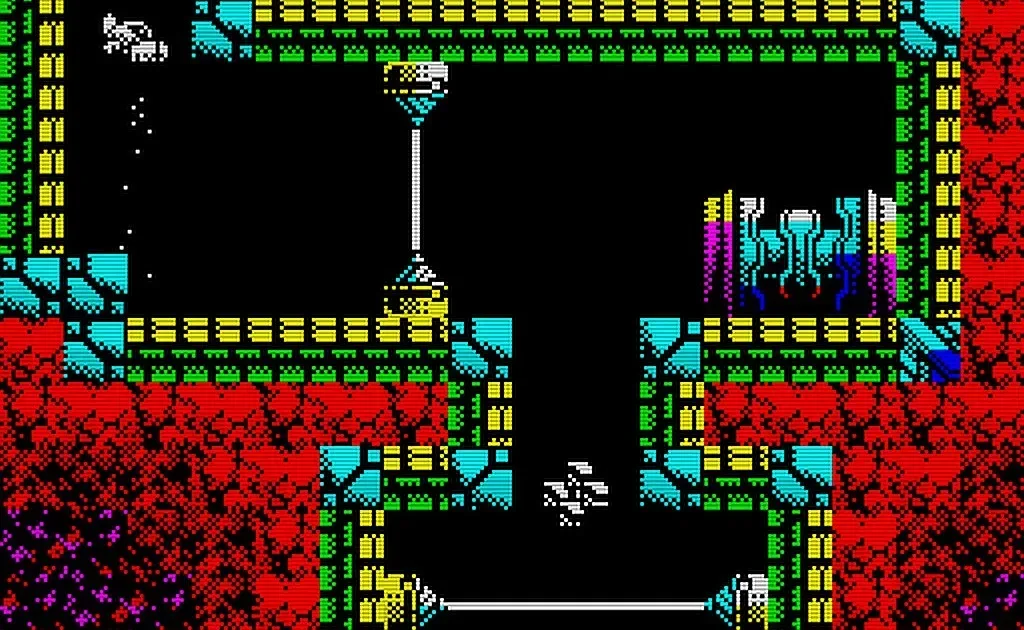
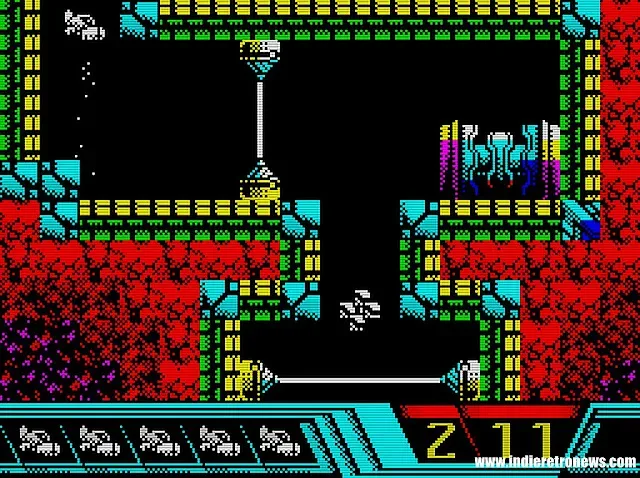
Vallation, Sokurah’s ZX Spectrum shooter built in the mould of Cybernoid, has received an expanded 128K edition that substantially changes the scale and structure of its escape mission. Rather than simply revisiting the existing game with a few technical additions, the update grows the journey to 150 screens, revises core mechanics and gives its climactic section a more exploratory design.
The premise remains delightfully hostile: a pilot must steer a small ship through a defended enemy complex and find a way off a pirate planet. The route is packed with laser barriers, enemy fire and missiles that cannot be destroyed. Survival depends on moving precisely, recognizing immediate threats and choosing a path through the complex rather than trying to eliminate every obstacle.
That pressure is central to the game’s stated Cybernoid-style identity. The comparison describes a kind of compact-screen action game where the player’s ship travels through an interconnected, heavily trapped environment. Success is not only about reflexes. It also comes from learning dangerous rooms, managing space around the craft and understanding which hazards are permanent parts of the terrain.
A larger version built around feedback
The enhanced edition is described as a response to community feedback, with Sokurah reworking considerably more than presentation. It has twice the visual tiles and three times the enemy variety of the earlier version. In practical terms, tiles are the repeated graphical building blocks used to construct a game’s environments. Increasing that pool gives the developer more pieces with which to differentiate rooms, structures and hazards across a maze of this size.
Enemy variety is equally important in a screen-by-screen action game. More enemy types can make the player assess each room anew instead of treating every encounter as a familiar firing pattern. The supplied details do not specify how the new foes behave, so it would be premature to assume particular attack types or AI routines. Still, a threefold expansion suggests a broader range of threats distributed across the levels.
Sokurah has also rewritten the mechanics. The update includes more attractive projectiles and enemies that are easier to destroy. Those two changes point in different but complementary directions. Better-looking shots are a visual revision, while easier-to-kill enemies alter the combat balance. In a game where indestructible missiles are already forcing evasive play, making ordinary opponents less punishing may create a clearer distinction between threats to destroy and threats to avoid.
It is worth separating that confirmed design change from speculation. Easier enemies do not necessarily mean the game as a whole is easy, nor does it tell us how damage, lives, weapons or progression work. What is clear is that the developer has adjusted combat accessibility while retaining the maze’s laser barriers, incoming fire and invulnerable missiles as defining pressures.
From 101 screens to 150
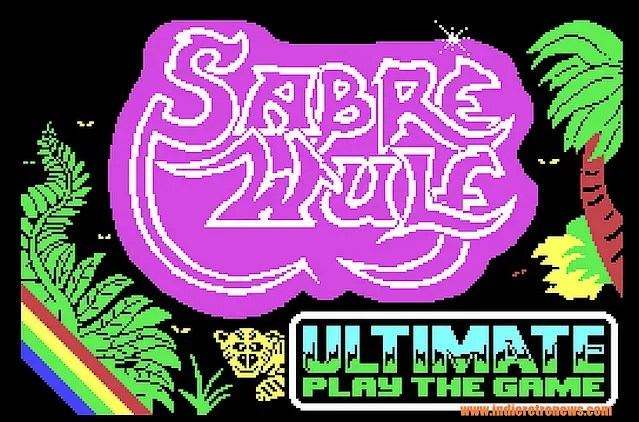
The original core structure comprises 101 screens across four levels. The new element is a fifth level containing another 49 screens, taking the complete total to 150. That is not presented as one more linear run of rooms. It is a large non-linear maze, compared to Sabre Wulf transplanted into outer space.
Related coverage includes Vallation's ZX Spectrum 128K Edition Expands Its Cybernoid-Style Escape.
“Non-linear” matters here. A linear level ordinarily directs a player through a fixed succession of screens or encounters. A non-linear layout instead allows multiple branches and asks the player to work out which routes lead to useful objectives. Vallation’s final area requires players to locate vital pickups placed along several paths before the escape teleporter can be unlocked.
That turns the final level into a search-and-navigation challenge as well as an action sequence. Players cannot simply reach a visible exit and assume the mission is over. They must explore, remember junctions and identify which discoveries are necessary for progress. With hazards still present, the cost of taking a wrong path is likely more than lost time: movement through each branch must be made under active pressure.
The Sabre Wulf comparison is useful as a description of structure, not as a promise that Vallation reproduces that game’s individual systems. The key confirmed point is the maze-like fifth level: it spreads required pickups across branching routes, then locks the final teleporter behind their collection. Players approaching the update should therefore expect the ending to demand route knowledge and deliberate exploration, not merely a final burst of shooting.
Why the 128K-specific additions matter
The release is designed for the ZX Spectrum 128K and includes dedicated 128K audio. The detail is significant because it identifies audio as part of this edition’s targeted feature set rather than an incidental carryover. No further particulars about the soundtrack or sound hardware are provided, but players can reasonably treat the dedicated audio as one of the distinctions of this version.
It also adds Kempston joystick support. Kempston is a joystick interface standard associated with Spectrum play, and support means the game can accept that controller method rather than limiting the player to another input arrangement. For a game based on quickly guiding a ship around barriers, incoming shots and missiles, controller compatibility is a practical quality-of-life addition. It gives players using that setup a supported way to handle the game’s constant directional movement and firing demands.
A high-score table rounds out the additions. High-score systems fit naturally with arcade-influenced games because they preserve a measurable target beyond merely finishing the campaign. Vallation’s broader maze and revised combat may encourage players to return for cleaner runs, though the supplied information does not define its scoring rules, ranking limits or whether scores are retained in any particular fashion.
What players should expect from the new structure
The most useful way to read the 128K version is as an expansion of both content and decision-making. The first four levels provide the 101-screen action foundation. The fifth does not merely increase that number; it adds a different demand, asking players to search several routes for the items that enable escape.
- Learn hazards before forcing progress: lasers, enemy shots and invulnerable missiles make rushed movement risky.
- Pay attention to branches in the final level: its required pickups are spread across multiple paths, so a route that looks optional may be essential.
- Distinguish permanent danger from targetable danger: some enemies have been made easier to kill, but indestructible missiles remain something to evade.
- Use a supported control setup where appropriate: the edition includes Kempston joystick support for players using that Spectrum-standard interface.
- Treat score chasing as a separate goal from escape: the new high-score table gives repeat runs an additional purpose, even after the teleporter route is understood.
None of those points amounts to a walkthrough, and the exact pickup locations or optimal routes are not detailed here. They are instead the practical implications of a sprawling final maze whose exit is gated by objects placed across its branches. The game’s design appears to reward observation and retention: recognizing a route is only useful if the pilot can repeat it while under fire.
A meaningful retro update, not a cosmetic refresh
Vallation’s enhanced 128K edition stands out because its changes are interconnected. More visual tiles and more enemy types expand the room-to-room experience. Revised mechanics and adjusted enemy durability change the moment-to-moment feel. Dedicated audio, a high-score table and Kempston compatibility add edition-specific features. Then the 49-screen, non-linear fifth level reframes the final stretch around exploration and required pickups.
That makes the total of 150 screens more informative than a simple headline number. It represents a game that begins as a demanding space-complex escape and ends with a wider maze in which the player must earn access to the exit. For ZX Spectrum players drawn to tightly constrained arcade action with a navigational edge, it is an unusually substantial enhancement of the original Vallation framework.
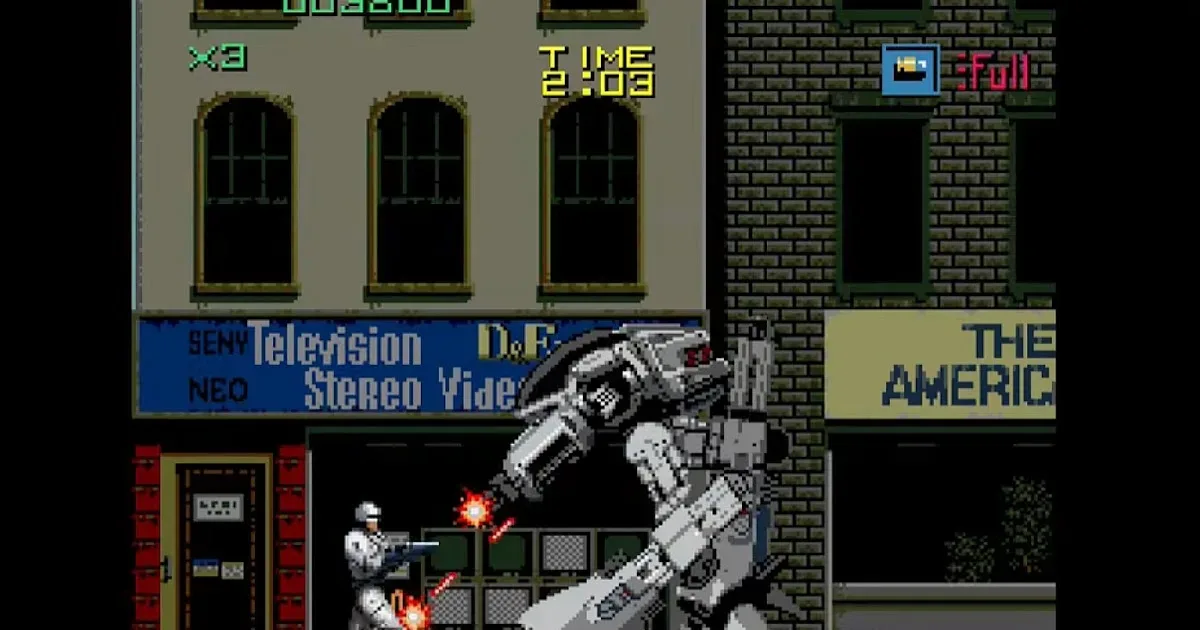
Vallation also arrives at a time when new projects and refreshed releases continue to show the range of older systems; for another recent example of a classic-platform production, see RoboCop Arcade’s planned Amiga 500 tribute. Vallation’s particular contribution is its focus on the Spectrum 128K and a maze-driven shooter format where the final escape depends on exploration as much as nerve.