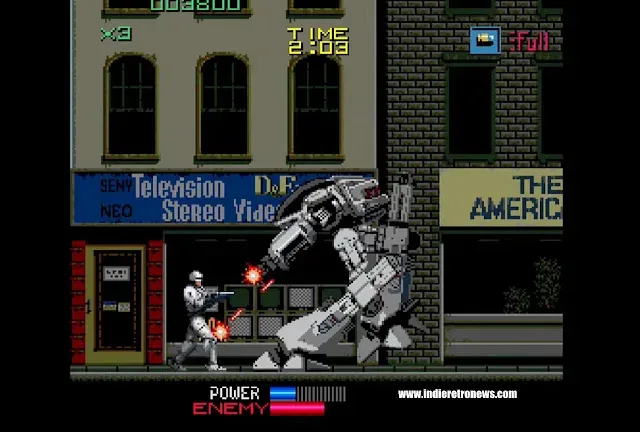
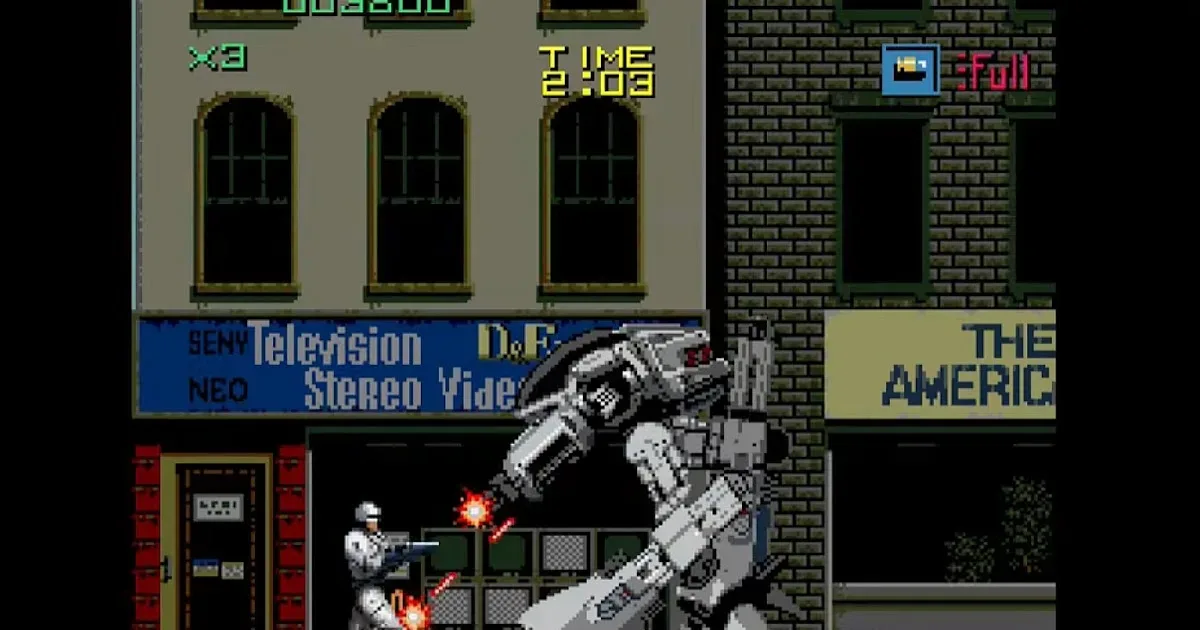
RoboCop Arcade is an ambitious work-in-progress conversion project from Ranx that sets an unusually strict target: bring the feel and visual presentation of Data East’s 1988 RoboCop coin-op to a standard, unexpanded Commodore Amiga 500. The stated plan includes the arcade game’s nine stages, its target-shooting bonus ranges, hardware scrolling, Blitter-driven sprites, digitized audio, and a single 880 KB floppy-disk build.
That last part is the real headline. Retro projects often benefit from expanded memory, faster accelerators, hard-drive storage, or modern convenience features. RoboCop Arcade is instead being built around the baseline Amiga 500 OCS configuration: a stock Motorola 68000 processor and 512 KB of RAM. It is a deliberately constrained attempt to make a much-loved arcade format work within the limits many original owners would recognize.
The project has been described as being made with AI assistance. That is a broad label rather than a technical breakdown, so it does not establish which parts of development involved AI or how it was used. What is clearer is the intended technical result: a new RoboCop arcade-style experience designed for original Amiga hardware rather than an enhanced setup.
A different kind of porting challenge
RoboCop began in arcades as a Data East action game in 1988. The new Amiga effort is framed as a response to the gap fans felt between that coin-op and the era’s Amiga version. Rather than merely borrowing the character and basic premise, Ranx’s stated ambition is to pursue a close arcade-style presentation and the original game’s raw run-and-gun pacing.
“Arcade accurate” can mean different things in practice. It may refer to visuals, the stage sequence, enemy behavior, controls, sound, scrolling, timing, or simply the broader atmosphere. In this case, the most concrete claims are the full nine-stage structure, the inclusion of target ranges, and systems intended to support arcade-like motion and sprite work. A literal one-to-one result remains an aspiration, not something that can be assessed until a finished build is available and compared on the intended hardware.
That distinction matters because arcade conversions are exercises in trade-offs. Even when two systems belong to the same broad 16-bit generation, their processors, graphics chips, memory budgets, storage media, and audio designs can demand radically different approaches. A faithful conversion is not just about drawing similar backgrounds; it is about keeping a fast action game responsive while loading, animating, scoring, scrolling, and playing effects within a much narrower set of resources.
What “stock Amiga 500 OCS” means here
The Amiga 500 is central to the project’s appeal, but the term can be misleading without the qualifiers. The target is not simply any Amiga-compatible machine. It is an unexpanded Amiga 500 OCS configuration with a Motorola 68000 CPU and 512 KB of RAM.
OCS, short for Original Chip Set, identifies the original Amiga custom-chip environment. Those chips are a major reason the Amiga became associated with vivid graphics, scrolling displays, and strong game audio. But specialist hardware does not make compromises disappear. Developers still have to decide which graphics are resident in memory, how many frames of animation can be stored, when data can be fetched from disk, and how much processor time remains after display and game-logic demands are met.
Related coverage includes RoboCop Arcade Aims to Bring Data East's Coin-Op Action to a Stock Amiga 500.
The 512 KB memory ceiling gives that planning particular weight. Memory is needed for program code, game state, screen data, character and enemy art, animation frames, sound samples, interface elements, and temporary workspace. An arcade game with multiple stages and a large supply of visual material cannot simply keep every asset ready at once. The project’s reported use of compression, staged loading, and careful memory management is therefore not decorative technical jargon; it is fundamental to fitting the game at all.
Blitter-driven sprites and hardware scrolling
Two technical promises point to the approach being pursued. The first is hardware scrolling. In plain terms, this uses the Amiga’s display capabilities to shift a playfield instead of relying solely on the main processor to redraw the entire scene pixel by pixel. For a side-scrolling action game, that can be a crucial way to preserve processor time for enemies, collisions, player input, and game rules.
The second is the use of the Blitter for sprite work. The Blitter is Amiga hardware intended to move and manipulate blocks of graphics data efficiently. A developer can use it to help assemble animated objects and update areas of the display. “Blitter-driven” does not automatically guarantee a specific frame rate or a perfect match for arcade performance, but it signals an effort to use the machine’s specialized tools rather than treating the Amiga like a generic computer.
Those choices also underline why the project should be judged as an engineering effort as well as a nostalgia piece. The stated goal is not simply to place RoboCop imagery on an Amiga screen. It is to balance recognizable visuals and an energetic arcade feel against the timing and memory realities of the base machine.
One floppy disk, with almost nothing left over
Ranx’s build is said to fit on a single 880 KB floppy disk, with only 1,536 bytes reportedly remaining free. That is a remarkably tight stated budget, especially for a game planned to contain nine action stages, bonus sections, graphics, effects, and digitized speech.
An 880 KB disk is not a vast repository by current standards, but it is also not solely a question of total capacity. Data has to be arranged so the program can load what it needs at the right time. If every stage’s background, enemies, music, speech, and animations were held in an uncompressed form, both disk space and 512 KB memory would be consumed rapidly. Compression reduces stored size, while staged loading brings in the next assets only when they are needed.
That process has a practical implication for players: loading architecture is part of the experience on original floppy-based hardware. The project’s multi-stage loading is intended to make a larger game feasible on a single disk. It is not evidence, by itself, that loading will be invisible or that every transition will mirror the coin-op. It is evidence that the developer is tackling the problem directly instead of solving it by requiring expanded hardware or multiple disks.
The near-full disk also makes revision work more demanding. In a project that tight, replacing an asset with a larger version can require a knock-on reduction somewhere else, or a better compression method, or a different loading plan. Community feedback may therefore shape not only cosmetic tweaks but potentially which changes are feasible within the build’s fixed storage and memory limits.
Audio, boot presentation, and period character
The project is also set to use digitized speech and sound effects through the Amiga’s four-channel Paula audio chip. Paula is the Amiga component associated with audio playback, and its four channels give developers a defined number of simultaneous audio lanes to work with. In a busy action game, that means effects, speech, and other audio elements have to be scheduled and prioritized rather than assumed to play without limitation.
Digitized speech is an especially fitting goal for RoboCop, whose arcade identity is tied to the impact of its audiovisual presentation. Still, its inclusion carries technical costs: sampled speech takes storage space, and samples need memory and playback-channel attention. The attempt to retain it while remaining within the project’s single-disk, 512 KB target is part of what makes the conversion notable.
Ranx also plans a traditional cracktro at boot. Historically, a cracktro was an introductory screen or sequence associated with groups that removed copy protection from software. In a new fan project, its intended role is best understood as period-inspired presentation: an overt nod to the home-computer culture surrounding Amiga games. It is not a gameplay feature, but it reinforces the project’s interest in recreating an era’s texture alongside the arcade action.
Why the base-hardware target is significant
For Amiga enthusiasts, compatibility with the unexpanded A500 is more than a checklist item. It determines who can run the intended version without extra memory or accelerator hardware, and it establishes a design benchmark that is easy to understand. If the completed game achieves its goals on that setup, it will do so through asset discipline and machine-specific programming rather than brute-force expansion.
It also makes the project part of the continuing appeal of platform-specific retro development. New releases and homebrew projects can either modernize old systems with contemporary add-ons or work inside original limitations. Neither approach is inherently better, but they serve different audiences. A stock-hardware release foregrounds the capabilities of the original machine and turns constraints into part of the creative brief.
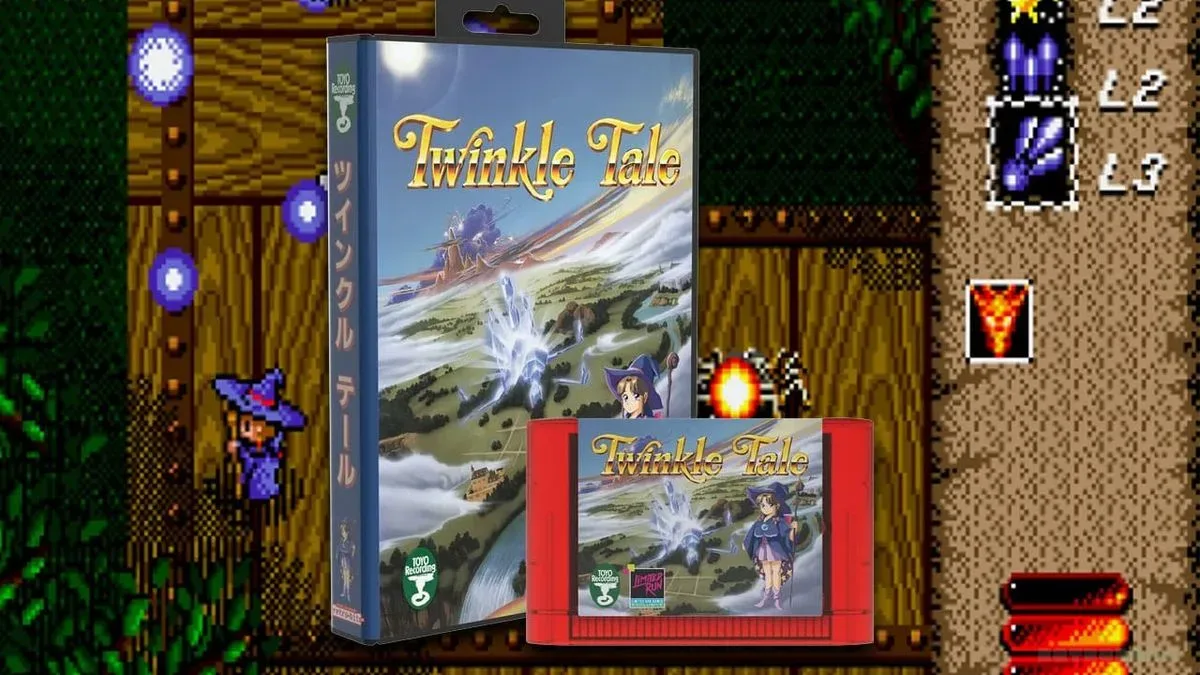
There is a useful comparison in the wider retro scene with projects that keep classic formats alive through fresh physical-style or hardware-conscious releases. For example, Twinkle Tale’s planned region-free Genesis and Mega Drive cartridge release illustrates the ongoing demand for games and releases that meet older hardware on its own terms. RoboCop Arcade’s challenge is different—conversion work rather than a cartridge revival—but the attraction is similar: treating original hardware as the destination, not merely an emulation target.
What remains to be seen
RoboCop Arcade is still evolving, and the developer is seeking feedback. That makes it premature to describe it as a finished definitive conversion. The available details establish the intended platform, hardware limits, feature goals, disk footprint, and broad technical strategy; they do not establish a release date, final performance profile, distribution plan, or the exact scope of AI-assisted work.
For now, the most interesting promise is the combination of constraints. A full nine-stage RoboCop arcade tribute, target-shooting bonuses, custom audio presentation, hardware scrolling, and Blitter-led graphics on a 512 KB Amiga 500—while fitting onto one 880 KB floppy—is a very specific and demanding proposition. Whether every arcade-era detail survives intact is an open question. But the project’s clearly defined target makes it one worth watching for anyone interested in what dedicated developers can still pull from original Amiga hardware.