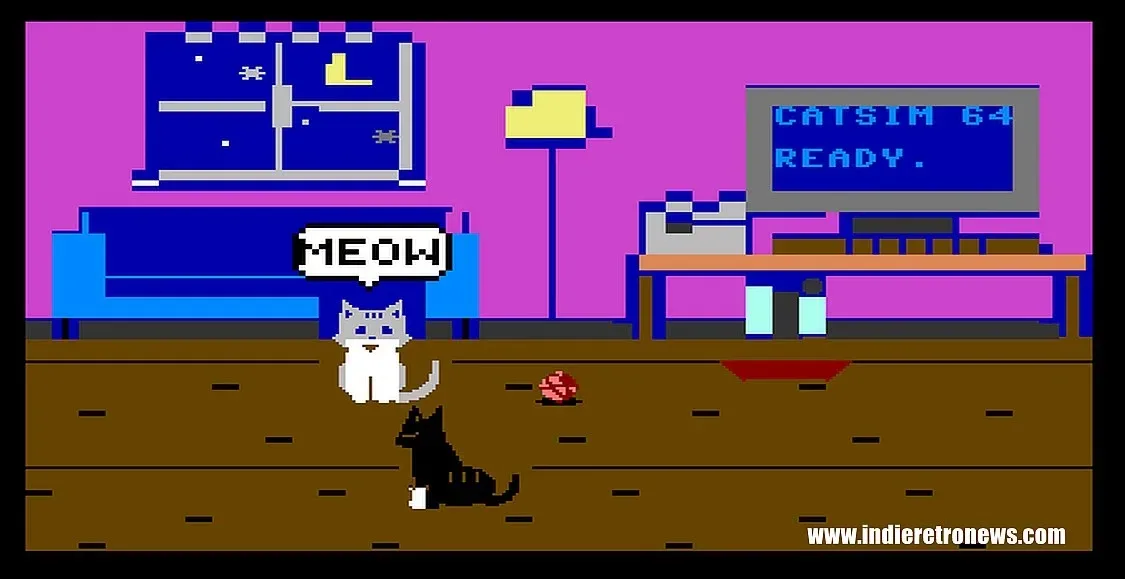
Cat Simulator 64 is a new family-friendly game for Commodore 64 hardware built around an admirably compact fantasy: being a cat in a living room. Developed by illobo, also known as netmilk, with help from Claude AI, the game puts players in control of a black cat with distinctive white socks and gives that cat a roomful of recognizable feline priorities.
There is a sofa, a food bowl, yarn, and a C64 computer to investigate. The player cat can run around the room, eat, nap and meow. None of that is framed as a grand quest, competitive challenge or fight for a high score. Instead, Cat Simulator 64 appears designed to find playfulness in a cat’s ordinary routines—and in the amount of trouble a cat can create when an object is clearly somebody else’s favorite.
That somebody else is a grey cat sharing the room. This companion follows its own behavior, spending time asleep or playing, and it does not take kindly to the player pinching its favored ball of yarn. Take the yarn and the response is immediate: an angry pixel hiss. It is a small interaction, but one that gives the room a social rule rather than making it merely a collection of props.
A room-sized game with cat-sized concerns
Cat Simulator 64 keeps its premise focused. The entire setting is a cozy living room, not a house full of interconnected spaces or a sprawling digital city. That limitation is part of the appeal. A single room lets familiar objects carry the game’s personality: the sofa becomes a likely napping spot, the bowl supports eating, yarn invites play, and the computer offers one more piece of a deliberately domestic scene.
The choice to make the playable animal a black cat in white socks also matters. It is a clear visual identity for the player character, particularly useful in a room shared with a grey cat. The contrast makes the relationship legible at a glance: this is the cat under the player’s control, and this is the roommate with independent preferences.
The activities described for the player are intentionally basic: sprinting, eating, sleeping and vocalizing. In another kind of game, that list might sound like a tutorial before the “real” mechanics begin. Here, those actions are the premise. Cat Simulator 64 turns simple behavior into the entire playground, taking an everyday pet perspective seriously enough to make it the game’s central joke and its core interaction model.
The grey cat is more than background decoration
The companion is described as an AI cat with a mind of its own. In this context, “AI” should not be read as a detailed technical disclosure about the software running the companion. The supplied details establish observable behavior: the grey cat sleeps or plays on its own terms and reacts angrily when its yarn is taken. That is enough to distinguish it from a static decorative sprite.
In game design, an AI-controlled character generally means a character whose actions are directed by the game rather than by a second player. Its behavior can be simple or complex. Cat Simulator 64’s grey cat seems to use that idea for personality rather than opposition. It is a roommate, not a conventional enemy. The hiss is therefore less a combat encounter than a boundary being enforced in the most cat-like way available to a pixel character.
Related coverage includes Cat Simulator 64 Brings Cozy Feline Mischief to Commodore 64.
That distinction gives the room a little dramatic tension. Players are encouraged to interact and say hello, but interaction does not mean every object is freely available. The yarn is a point of friction. Its presence creates a readable cause and effect: take the other cat’s favorite toy, and expect a negative reaction. For younger players or anyone drawn to gentle games, it is a simple lesson in observing what a character values without turning the situation into a harsh punishment.
What “family-friendly” means here
The family-friendly description fits the activities and consequences outlined so far. The game’s conflict is an annoyed hiss after an act of feline theft, not violence or a punishing fail state. Eating, napping, meowing and exploring a living room are accessible actions with immediately understandable meanings. The setting also avoids the need for extensive lore or complicated objectives before players can engage with its central idea.
That does not automatically define every aspect of the game or its controls; those details have not been outlined. But the available picture is clear: Cat Simulator 64 is built around approachable, low-stakes behavior, with a mischievous edge supplied by the yarn incident.
A C64 inside a C64 game
One especially neat detail is the C64 computer located within the game’s living room. Cat Simulator 64 is itself a Commodore 64 title, so its virtual feline can investigate a representation of the same sort of machine on which the game runs. It is a small piece of self-reference that suits the premise. The game is not just set in a generic lounge; it acknowledges its platform inside the fiction of its own room.
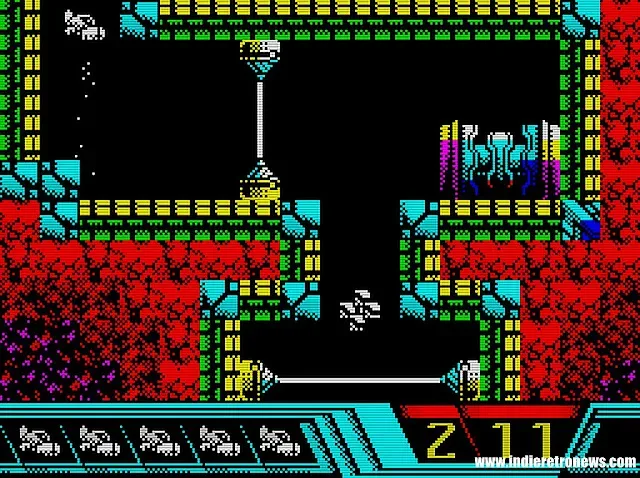
That platform focus places the release among contemporary projects continuing to find new uses for classic machines. Another recent retro development, for example, centers on a ZX Spectrum 128K project with a substantially different, maze-oriented approach: Vallation’s ZX Spectrum 128K upgrade. Cat Simulator 64 heads in the opposite tonal direction. Its hook is not a huge screen count or a high-pressure escape, but the close observation of a tiny domestic space.
The contrast is a useful reminder that retro development is not one genre or aesthetic. A classic platform can host action games, puzzle games, technical showcases, arcade tributes and, in this case, a deliberately cozy pet simulation. The distinctive idea is not simply that the game runs on a Commodore 64. It is that its scale and setting are tailored to a single charming gag: let a player be a cat, and give that cat just enough room, furniture and temptation to behave like one.
Why the yarn matters
The ball of yarn is Cat Simulator 64’s most important object because it does several jobs at once. It signals a familiar cat toy, provides an item for the player to investigate, and establishes the grey cat’s personality through its reaction. A single prop becomes an informal rule system: the room is inviting, but it is shared.
That arrangement makes the hiss memorable. A living room full of interactable objects is pleasant; a living room where one object comes with social consequences feels more alive. The grey cat’s reaction also gives players a reason to experiment. They can observe the companion sleeping or playing, greet it, and then discover that the yarn is not neutral territory.
Importantly, the consequence is specific. The grey cat is not said to react negatively to every interaction or simply roam without purpose. Its temper is tied to its favorite ball of yarn. That specificity is what makes the companion feel less like an obstacle and more like a resident with a preference.
Claude AI’s stated role, and what remains unknown
Illobo’s development of Cat Simulator 64 is described as having help from Claude AI. That establishes the use of an AI tool during the project, but it does not establish which assets, code, writing, design decisions or other elements it assisted with. It would be inaccurate to infer more than that from the available information.
There are two separate uses of “AI” around this game. Claude AI refers to the development assistance credited for the project. The grey cat’s AI refers to the companion’s in-game autonomy. One concerns how the game was made; the other concerns how a character behaves once the game is running. Keeping those meanings apart avoids turning a brief development credit into a claim about the game’s technical systems.
For now, the clearest picture of Cat Simulator 64 is also the most appealingly straightforward one: a black, white-socked cat; a warm living room; everyday feline actions; and a grey roommate whose yarn should probably be left alone. For players interested in new work for the Commodore 64, it is a small-scale concept with a defined personality, built around the comedy of treating a cat’s afternoon as a complete game world.