The Super Nintendo was never designed as a machine that would casually join a home Wi-Fi network, shuffle save data between hardware and emulators, or ask a language model to improvise a villager’s next line. That is exactly the alternate-history lane explored by SNET, a homemade Super Network Adapter created by Danny Boland.
SNET connects through the SNES controller port rather than the expansion connection on the underside of the console. The project frames that choice and its wider ambitions as “16-bit futurism”: an accessory meant to feel like the sort of network peripheral people might have imagined for the original hardware, only realized with modern components and wireless networking.
Its reported feature set includes a Wi-Fi connection to a local network or a hotspot, flash-cart-oriented ROM patching and loading, the ability to link saves between cartridges and servers, and an experimental route for AI-generated in-game dialogue. It is not an official Nintendo product or a new online service for the SNES library. It is a maker project that puts a modern communications layer beside an old console’s controller interface.
What the SNET hardware is doing
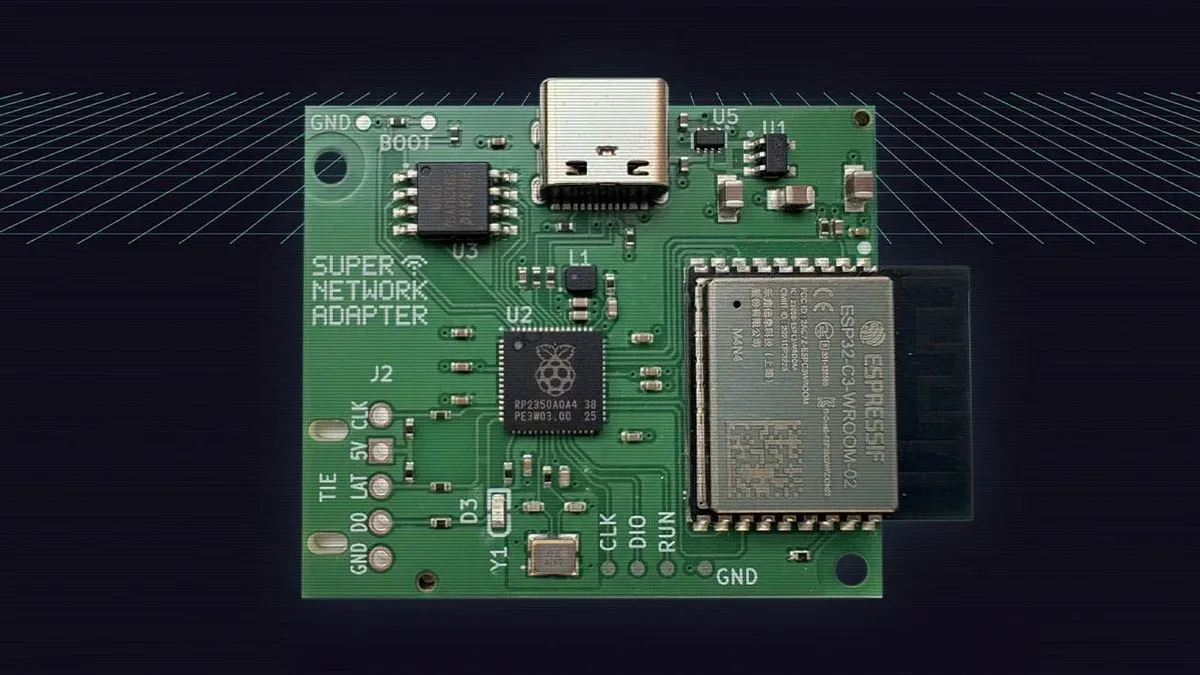
The adapter combines an RP2350 and an ESP32-C3. In broad terms, the RP2350 handles communication with the SNES controller port, while the ESP32-C3 provides Wi-Fi capability. The reported controller-port link operates at roughly 30 kB/s.
That figure is worth putting in perspective without overstating it. kB/s means kilobytes per second: a measure of data transfer rather than a promise of modern broadband-style performance. A connection in that range is better understood as a compact utility channel for information such as save data, commands, patches, or text exchanges. SNET’s described use cases fit that profile. The project is not presented as a way to turn the SNES into a contemporary online multiplayer machine or to make it behave like a current console.
The controller-port approach is also central to the project’s character. Rather than treating the SNES as a box to be rebuilt around a modern networking expansion, SNET works through an interface already familiar to anyone who has connected a pad to the system. That makes the adapter an intriguing example of retro hardware experimentation: it accepts the limits of the original machine while giving it a path to devices and services far outside the assumptions of its era.
A very different kind of SNES networking idea
Nintendo did explore connected Super Famicom hardware decades ago with the Satellaview satellite modem, which launched in Japan in 1995. That historical example is useful context, but SNET is pursuing a distinctly different model. Satellaview was tied to satellite broadcasting and its own period-specific ecosystem. SNET instead uses contemporary Wi-Fi and is intended for a local network or hotspot.
In other words, the adapter does not try to recreate an old network service. It imagines what an SNES peripheral could do if it had access to present-day wireless infrastructure. That distinction matters because the most interesting parts of SNET are not simply about connecting an old console to “the internet.” They concern what information can travel between retro hardware, storage, flash cartridges, emulators, and external software once that connection exists.
That same mix of preservation-minded enthusiasm and contemporary experimentation has a natural place in the wider SNES scene. Projects surrounding the platform can range from original cartridges and hardware repair to reissues, including the Terranigma re-release campaign. SNET sits at the more technical end of that spectrum: its focus is on extending what original hardware can exchange with modern systems.
Save synchronization is the most practical idea
Among the capabilities described for SNET, save synchronization may be the clearest everyday benefit for people who use both original hardware and emulation. A save file is the small set of data that records a player’s progress: completed objectives, inventory, location, statistics, settings, and other game-specific state. On a cartridge-based system, that progress is normally closely tied to the cartridge and its save memory.
SNET proposes a bridge between that traditional cartridge-based setup and a server, with the stated aim of making saves available across devices. For someone moving between a real SNES setup and an emulator, the appeal is straightforward: progress need not be treated as permanently isolated on one side of that divide.
The important word is potential. Different games save information in different ways, and the supplied details do not establish a universal compatibility list, a particular sync method, or how conflicts between multiple versions of a save would be handled. Those implementation questions are significant. A good save-sync workflow needs to know which copy is current and avoid overwriting progress unintentionally. Still, the basic concept is compelling precisely because save movement is usually less glamorous than networking, yet more useful than a novelty once a player has built up serious progress in a long game.
Flash carts, ROM patches and the homebrew angle
SNET is also described as supporting ROM patching and loading through a flash cart. A flash cart is a cartridge-like device that can load game data from storage, allowing compatible software to run on original console hardware. In retro-development and modification communities, these devices are commonly part of the workflow for testing homebrew projects, fan modifications, and patches on the real machine.
A ROM patch is not necessarily a full game file. It is typically a set of changes applied to compatible game data. That can be useful for technical fixes, translations, alterations, or original modifications. The practical value of SNET in this area is its proposed ability to move patching and loading tasks into a network-connected workflow rather than treating every change as a purely manual storage-transfer job.
There is an important boundary here. The existence of hardware that can patch or load software does not settle the legal status of any particular game image, modification, or distribution method. SNET’s technical possibilities should not be confused with a blanket permission to obtain or share copyrighted games. For enthusiasts working with their own materials, authorized software, or original homebrew, however, a wireless link could make iteration and testing more convenient.
That convenience is especially relevant to the project’s old-hardware-new-tools premise. The SNES remains the device displaying and running the game experience, while the networked adapter can act as the pathway for getting data into that experience. It is a division of labor that keeps the original console at the center rather than replacing it.
AI-generated dialogue is SNET’s boldest—and most divisive—experiment
The most attention-grabbing SNET feature is the ability to generate dialogue for non-player characters through an AI language model while a game is being played. Boland has demonstrated that concept with The Legend of Zelda: A Link to the Past.
A language model is software that generates text from prompts and surrounding context. Applied to game dialogue, it could produce new lines rather than drawing only from the fixed script originally stored in the game. In theory, that creates room for dynamic exchanges and unusual modding experiments. A character might respond with text that was not in the cartridge’s original dialogue data at all.
It also changes something fundamental about a classic game. Scripted dialogue is usually deliberate: writers, designers, localizers, and technical limits shape every line a player encounters. Generated text introduces variability. That may delight players interested in experimental ROM hacks and manipulated playthroughs, but it can also clash with the authored tone, pacing, and wording that make a classic game recognizable.
There are practical questions as well. Generated dialogue can be inconsistent, contextually weak, or simply unlike the original writing. The available information identifies the feature as a demonstration, not as a claim that it seamlessly improves a finished SNES game. That is the right way to view it for now: a provocative proof of what a connected accessory can attempt, rather than an automatic upgrade to the source material.
A modding tool, not a replacement for the original SNES experience
SNET’s appeal will likely depend on what a player wants from original hardware. Someone looking for a completely untouched console-and-cartridge experience may see little reason to place Wi-Fi, server-linked saves, or generative text in the signal path. The adapter’s value is strongest for tinkerers: people interested in flash carts, emulation continuity, ROM-hack experimentation, or simply the engineering puzzle of bringing a network connection to a 16-bit system.
That does not make the project less interesting to traditionalists. On the contrary, it highlights how much creative space remains around a decades-old platform. SNET uses modern chips and wireless networking, but its stated goal is to behave like a peripheral for the original SNES hardware. The result is less about declaring that the SNES needs to become a current console and more about asking what an imagined future accessory for it might have looked like.
For now, the most grounded takeaway is simple: SNET demonstrates a controller-port-based wireless link for the SNES, with an approximately 30 kB/s data channel and a set of ambitious uses built around saves, flash-cart workflows, and live text generation. The save and development-oriented ideas have clear practical logic; the AI dialogue demonstration is more experimental. Together, they make the Super Network Adapter a striking example of how retro hardware projects can preserve a machine’s physical identity while taking its software workflows somewhere the original designers could not have anticipated.