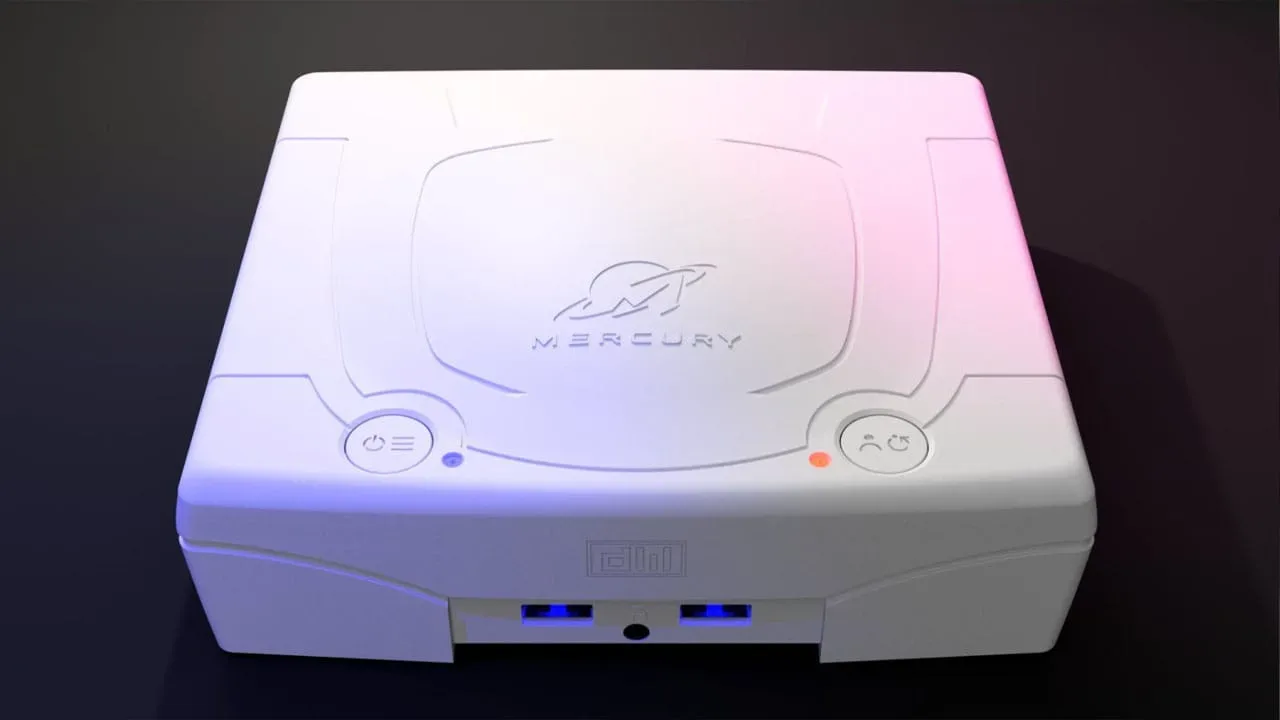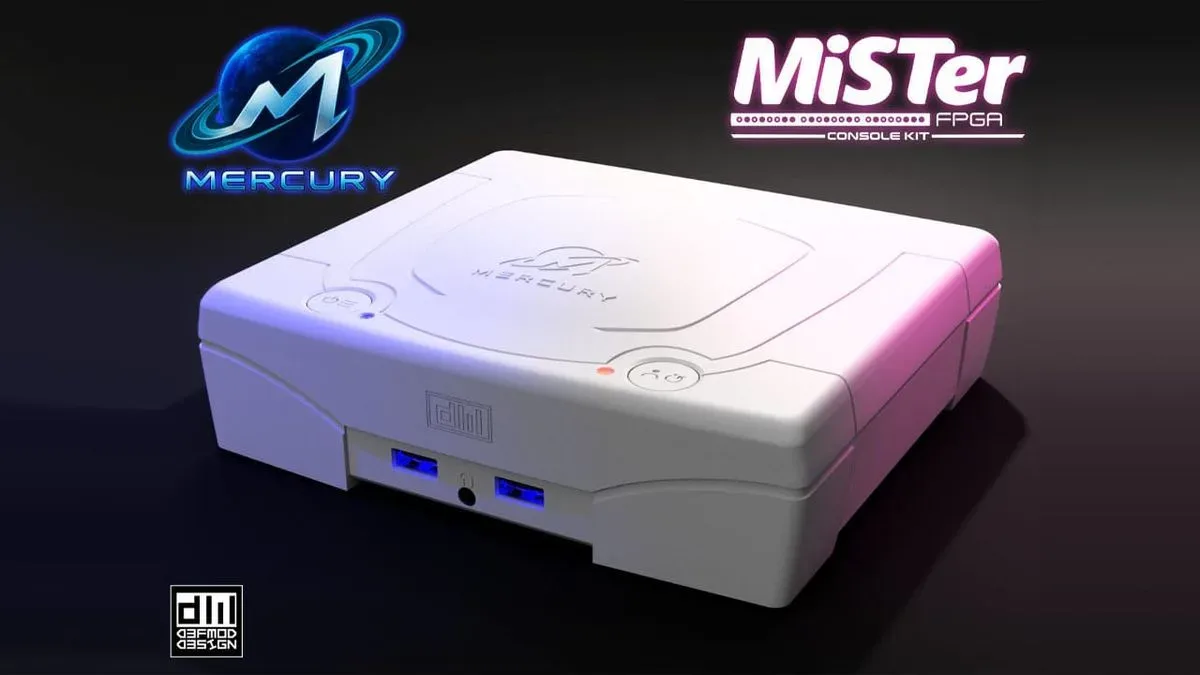
MiSTer builders who want their multi-system FPGA setup to look a little more at home beside Sega hardware have a new option: the Mercury, a Saturn-inspired complete kit from Df3mod. Preorders begin at €229, before a substantial menu of configuration choices that can change both the function and final cost of a build.
The name is an especially deliberate piece of Sega history. Mercury was the original code name for the Sega Saturn, and the kit’s external design follows that association rather than presenting MiSTer as a bare circuit board, a generic mini-PC, or a conventional modern console.
That distinction matters because Mercury is not itself a Sega Saturn, nor is it an all-in-one plug-and-play machine. It is a housing and accessory ecosystem for a MiSTer-based project. Most importantly, the DE-10 Nano is not included. Anyone considering the starting price needs to treat that board as a separate requirement, rather than assuming €229 represents a complete route to a running MiSTer.
What MiSTer FPGA is—and what this kit changes
MiSTer is an FPGA-based retro-gaming platform built around the DE-10 Nano. FPGA stands for field-programmable gate array: a configurable chip that can be set up to reproduce the logic of particular hardware designs. In the MiSTer context, users can switch between different hardware “cores” to access more than one classic machine from a single base platform.
Mercury does not alter that fundamental purpose. Its contribution is physical integration: it is designed to turn the collection of boards, ports, adapters and cooling considerations around a MiSTer build into something with a more console-like identity—and specifically one that nods to the Saturn.
That makes the kit potentially appealing on two fronts. There is the visual appeal of a Saturn-styled unit, and there is the practical appeal of selecting the ports and accessories wanted at the time of purchase rather than treating every MiSTer addition as an unrelated external extra.
The wider retro scene is increasingly full of projects that make older game hardware easier to revisit in new forms. For example, the MediEvil Recomp beta takes a different, software-focused route to revisiting a PlayStation-era game. Mercury instead centres on configurable hardware and a particular console-era aesthetic.
Mercury’s video connections and Saturn cable angle
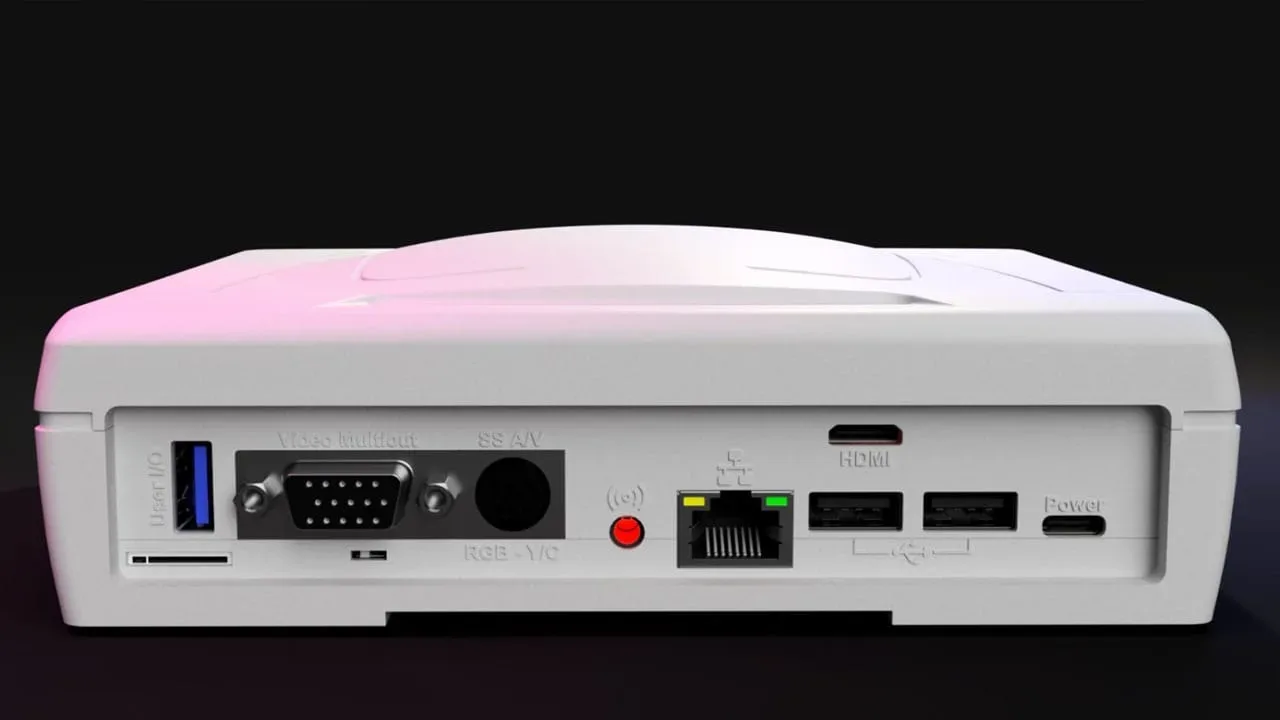
Df3mod lists several video-related features built into Mercury: a VGA connection, a Sega Saturn-style MiniDIN, and a 24-bit DAC. A DAC, or digital-to-analog converter, translates a digital signal into an analog one for compatible displays and equipment.
Related coverage includes Mercury Kit Gives MiSTer FPGA a Sega Saturn-Inspired Form.
The kit also has a passive internal luma trap, a circuit feature intended to allow the use of S-Video Saturn cables. Luma refers to the brightness portion of a video signal. S-Video separates brightness and colour information more than composite video does, and Mercury’s internal design is intended to support that Saturn-cable use case.
There is an important limitation for buyers planning around older televisions: Mercury does not support composite video. Composite is the single-cable analog format familiar from many classic consoles. That omission does not make the kit universally unsuitable, but it does mean display planning should happen before an order is placed.
For people whose setup calls for other analog formats, the configuration list includes a Component YPbPr Adapter for €18 and an RGB to Composite/S-Video converter for €35. YPbPr is component video, where brightness and colour-difference signals are carried separately. RGB likewise carries red, green and blue signal information separately; the converter option is relevant for those who need to route that kind of output toward composite or S-Video equipment.
Practical reading: the included connection choices and the paid converter are not interchangeable details. A buyer with only a composite input available should not read “Saturn-inspired” as a guarantee of direct composite support. Conversely, anyone intending to use S-Video Saturn cables should pay close attention to the MiniDIN and luma-trap provisions rather than adding a converter simply because it appears in the option list.
Configuration options can raise the total quickly
The base price is only the beginning. Df3mod offers optional cooling, remotes, wireless connectivity, storage connectivity, platform compatibility and controller-port accessories. The available add-ons are:
- Massive Heatsink: €10
- Basic Remote Control: €9
- MX3 Air Mouse Remote Control: €19
- Wi-Fi + Bluetooth Adapter: €15
- SATA SSD to USB Adapter: €12
- MiSTer Pi Compatibility Adapter: €5
- User I/O Port to DB9 Adapter: €10
These choices illustrate why the headline price should be viewed as a starting point, not a universal finished-build total. A heatsink concerns passive cooling; a Wi-Fi and Bluetooth adapter concerns wireless networking and peripherals; and a SATA SSD-to-USB adapter concerns connecting SATA storage through USB. Whether any of those is necessary depends on the individual build plan, not on the Saturn-styled case alone.
The remote choices also point to a living-room-friendly ambition. A basic remote and an air-mouse remote are offered separately, but neither is standard at the entry price. Anyone who expects to control a menu-driven setup from a sofa should account for that rather than discovering afterward that the desired control method is an extra.
SDRAM and SNAC: options aimed at different needs
Mercury can be ordered with no SDRAM module, a 128MB SDRAM module for €55, or dual SDRAM modules for €75. SDRAM is working memory used by the system while it is operating. The presence of “none” as an option means buyers should not assume memory expansion is included by default.
There are also several SNAC options. SNAC is a MiSTer accessory approach that connects compatible original-style controller inputs directly to the system’s I/O. Mercury’s choices are:
- SNAC Adapters Full Set: €99.99
- IRONSNAC-N: €49
- IRONSNAC-S: €46
- SNAC Adapter DB15/NG/Arcade 2P: €18
- USB3 male-to-male extension cable for USB3 SNACs, 0.4m: €9
The naming makes clear that these are specialised selections rather than a single mandatory accessory. The DB15/NG/Arcade 2P option, for instance, identifies arcade-oriented and DB15/Neo Geo-style connectivity in its label. The full set is the most expensive SNAC choice at almost €100, while the individual items let a buyer choose a narrower route.
Analysis: the sensible approach is to begin with the controllers and display already in use, then select only the interfaces those devices require. Selecting every option because it appears on the order page can make a carefully styled MiSTer considerably more expensive without necessarily making it more useful for a particular setup.
What to verify before committing
Df3mod repeatedly advises customers to read the listing information in full before ordering. That warning deserves to be taken literally because preorders cannot be cancelled once made.
A short pre-order checklist follows:
- Confirm the DE-10 Nano plan. Mercury does not include it.
- Check the display inputs. The kit has VGA, a Saturn-style MiniDIN and a 24-bit DAC, but no native composite-video support.
- Decide whether S-Video Saturn cables are part of the setup. The internal luma trap is specifically relevant to that use.
- Choose memory deliberately. The order configuration can include no SDRAM, a 128MB module, or dual modules.
- Match controller access to real needs. SNAC is offered in several forms, including a full set and more specific adapters.
- Build the actual total before checkout. Cooling, wireless support, storage connectivity, remotes, adapters and video conversion all add to the €229 starting figure.
Mercury’s appeal is not merely that it resembles a Saturn. It packages the inherently modular nature of a MiSTer build into a more coherent, console-inspired project while leaving the buyer in charge of the important decisions. That flexibility is a strength for people who know exactly which display, controller and storage route they need. It is also the reason a careful read of every configuration line is essential before a non-cancellable preorder becomes a purchase.